
Last Updated on March 15, 2026
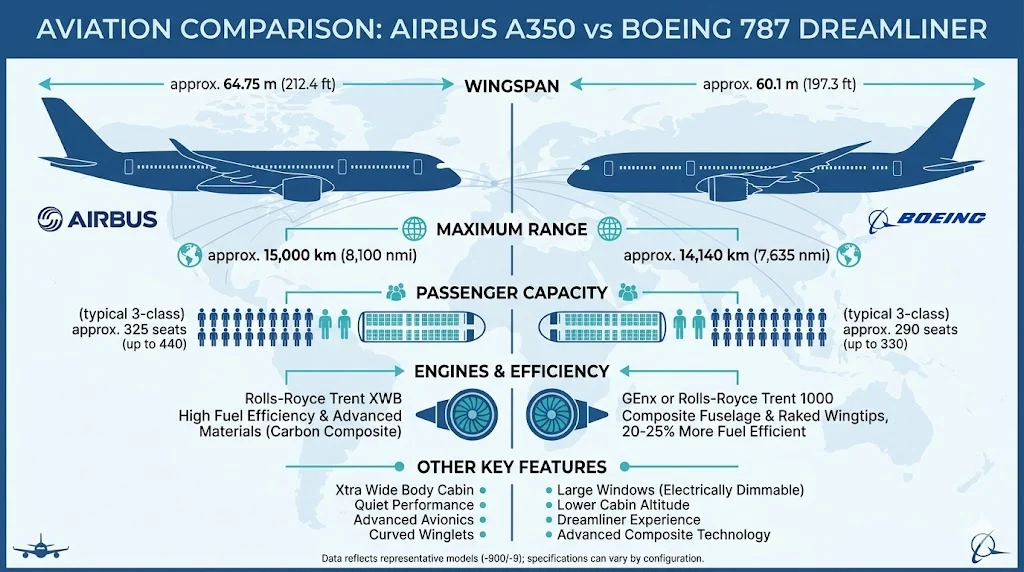
The A350 vs 787 comparison focuses on two of the most advanced long-haul passenger aircraft in modern aviation. The Airbus A350 is typically larger and designed for ultra-long routes, while the Boeing 787 Dreamliner emphasizes fuel efficiency and flexibility for medium to long-haul flights. Both aircraft use advanced composite materials, modern aerodynamics, and improved cabin comfort.
You’re 35,000 feet over the Pacific, somewhere between Tokyo and Los Angeles, and you have no idea which aircraft is keeping you airborne. Here’s why that’s worth knowing.
Most passengers board a plane, find their seat, and never think twice about what they’re flying in. But the aircraft underneath you its engineering, its cabin design, its pressure systems directly affects how you feel when you land fourteen hours later. Rested or exhausted. Headache or none. That difference often comes down to two planes.
The Airbus A350 and the Boeing 787 Dreamliner.
Two of the most advanced commercial aircraft ever built. Both designed to fly farther, burn less fuel, and treat passengers better than anything that came before them. Both so technologically sophisticated that airlines spent billions choosing between them.
And yet they represent two completely different philosophies about what a long-haul aircraft should be.
Airbus built the A350 to dominate. Bigger, more powerful, engineered for the world’s longest routes with maximum capacity. Boeing built the 787 to liberate giving airlines the flexibility to open new routes that were never economically possible before.
Same sky. Completely different ambitions.
Whether you’re an aviation enthusiast who wants the full technical picture, a frequent flyer who wants to know which aircraft to actively seek out, or simply someone who just looked up their next flight and saw an unfamiliar aircraft code this guide gives you everything.
Performance, cabin comfort, safety, passenger experience, and the honest verdict on which aircraft wins and when.
Quick Answer: A350 vs 787
| Feature | Airbus A350 | Boeing 787 Dreamliner |
|---|---|---|
| Manufacturer | Airbus | Boeing |
| First Flight | 2013 | 2009 |
| Typical Capacity | 300–410 passengers | 242–336 passengers |
| Range | Up to 16,100 km | Up to 14,140 km |
| Cabin Width | Wider | Slightly narrower |
| Main Use | Ultra long haul | Medium and long haul |
| Efficiency | Very efficient on high capacity routes | Highly efficient on flexible routes |
Simple summary
- A350 = Larger aircraft for major long distance routes
- 787 = Flexible aircraft for many long routes with fewer passengers
Both are among the most advanced passenger aircraft in the world.
Understanding the Airbus A350
The Airbus A350 is a modern widebody aircraft designed to compete with large Boeing long haul jets.
It was introduced to replace older aircraft like the A340 and compete directly with the Boeing 787 and Boeing 777.
Key characteristics
- Composite fuselage and wings
- Very quiet engines
- Advanced cockpit technology
- Long flight range
- Wide passenger cabin
A350 variants
| Model | Typical Capacity | Range |
|---|---|---|
| A350-900 | 300–350 passengers | ~15,000 km |
| A350-1000 | 350–410 passengers | ~16,100 km |
The A350-1000 is the largest version and competes with the Boeing 777 family.
Understanding the Boeing 787 Dreamliner
The Boeing 787 Dreamliner is another advanced widebody jet designed to reduce fuel consumption and improve passenger comfort.
It became famous for introducing many new technologies in commercial aviation.
Key characteristics
- Carbon composite fuselage
- Large electrochromic windows
- Lower cabin altitude
- Improved humidity
- Fuel efficient engines
787 variants
| Model | Typical Capacity | Range |
|---|---|---|
| 787-8 | 242 passengers | ~13,530 km |
| 787-9 | 290 passengers | ~14,140 km |
| 787-10 | 318–336 passengers | ~11,910 km |
The 787-9 is the most common model used by airlines.
Key Design Differences Between A350 and 787
Although both aircraft share modern design ideas, they differ in size, structure, and purpose.
Size comparison
| Feature | A350 | 787 |
|---|---|---|
| Length | 66–73 m | 57–68 m |
| Wingspan | 64.75 m | 60 m |
| Maximum Passengers | 410 | 336 |
The A350 is generally larger.
This allows airlines to carry more passengers on busy international routes.
Materials and Technology
Both aircraft use composite materials, which are lighter than aluminum.
Composite structure
| Aircraft | Composite Usage |
|---|---|
| A350 | ~53% composite |
| 787 | ~50% composite |
Composite materials help:
- Reduce fuel consumption
- Lower maintenance costs
- Improve durability
Passenger Comfort: A350 vs 787 Cabin
Passengers often compare these two aircraft when booking long flights.
Cabin width
| Aircraft | Cabin Width |
|---|---|
| A350 | 5.61 m |
| 787 | 5.49 m |
This means the A350 is slightly wider.
Airlines can install:
- wider seats
- larger aisles
- more comfortable layouts
Window size
The 787 Dreamliner has larger windows.
These windows also have electronic dimming instead of traditional shades.
Range and Performance
Range is important for airlines operating long flights.
Range comparison
| Aircraft | Maximum Range |
|---|---|
| A350-900 | ~15,000 km |
| A350-1000 | ~16,100 km |
| 787-9 | ~14,140 km |
This means:
- A350 is better for ultra long routes
- 787 is ideal for long but smaller demand routes
Fuel Efficiency
Fuel is one of the largest costs for airlines.
Both aircraft were designed to reduce fuel consumption.
Efficiency factors
- composite structure
- new engine technology
- aerodynamic wings
- lighter systems
Many airlines report 20–25% fuel savings compared to older aircraft like the Boeing 767 or Airbus A330.
Engines Used in A350 vs 787
Airbus A350 engines
The A350 uses Rolls Royce Trent XWB engines.
These engines are:
- very quiet
- extremely fuel efficient
- designed specifically for the A350
Boeing 787 engines
The 787 offers two engine choices.
| Engine | Manufacturer |
|---|---|
| Trent 1000 | Rolls Royce |
| GEnx | General Electric |
Airlines choose based on maintenance agreements and fuel performance.
Advantages of the Airbus A350
Large passenger capacity
Ideal for busy international routes.
Very long range
Can fly extremely long flights like:
- Singapore to New York
- Doha to Los Angeles
Quiet cabin
The aircraft has excellent noise reduction.
Comfortable cabin
Slightly wider cabin allows better seat layouts.
Disadvantages of the Airbus A350
Higher purchase price
Large aircraft cost more.
Not ideal for smaller routes
Airlines must fill many seats to make the flight profitable.
Advantages of the Boeing 787
Highly flexible aircraft
Airlines can use it on many route types.
Lower operating cost
Good for routes with moderate passenger demand.
Large windows
Passengers enjoy better outside views.
Advanced passenger comfort
Lower cabin altitude reduces fatigue.
Disadvantages of the Boeing 787
Smaller passenger capacity
Not ideal for extremely busy routes.
Slightly narrower cabin
Seats may feel tighter depending on airline configuration.
Real World Airline Examples
Many airlines operate both aircraft.
Airlines using Airbus A350
Examples include:
- Qatar Airways
- Singapore Airlines
- Cathay Pacific
- Lufthansa
- Delta Air Lines
These airlines often use the A350 on long high demand routes.
Airlines using Boeing 787
Examples include:
- United Airlines
- ANA
- British Airways
- Air Canada
- Ethiopian Airlines
These airlines use the 787 for efficient long distance routes with moderate passenger demand.
Typical Routes for A350 and 787
A350 routes
Common ultra long flights include:
- Singapore to New York
- Doha to Sydney
- Dubai to Los Angeles
787 routes
Typical routes include:
- London to Boston
- Tokyo to Bangkok
- Toronto to Dublin
These flights benefit from the efficiency of the 787 Dreamliner.
Global Usage and Popularity
Both aircraft are extremely successful in the airline industry.
Total orders
| Aircraft | Orders |
|---|---|
| Boeing 787 | 1700+ |
| Airbus A350 | 1000+ |
The 787 has more orders because it entered the market earlier and offers more size options.
However, the A350 dominates ultra long haul travel.
Common Mistakes When Comparing A350 vs 787
Many people misunderstand these aircraft.
Mistake: They are the same size
Correction
The A350 is generally larger.
Mistake: One aircraft is always better
Correction
Airlines choose based on route demand and economics.
Mistake: The 787 is older technology
Correction
Both aircraft are extremely modern.
Mistake: Passenger comfort is identical
Correction
Cabin layout depends on the airline configuration.
Related Aircraft Comparisons
People often compare the A350 and 787 with other aircraft.
A350 vs Boeing 777
The 777 is larger and carries more passengers.
787 vs Airbus A330neo
The A330neo is cheaper but slightly less advanced.
A350 vs A380
The A380 is much larger and designed for very busy routes.
Simple Exercises
Test your understanding of A350 vs 787.
Exercise 1
Which aircraft usually carries more passengers?
A. Boeing 787
B. Airbus A350
Answer: Airbus A350
Exercise 2
Which aircraft is known for its large electronic windows?
A. A350
B. 787
Answer: Boeing 787 Dreamliner
Exercise 3
Which aircraft is more commonly used on ultra long routes?
A. A350
B. 787
Answer: Airbus A350
FAQs
What is the main difference between A350 and 787?
The main difference in A350 vs 787 is size and mission. The A350 is larger and designed for ultra long haul flights, while the 787 focuses on efficient long distance travel with fewer passengers.
Is the A350 bigger than the 787?
Yes. The Airbus A350 is generally larger in passenger capacity, wingspan, and cabin width compared with the Boeing 787 Dreamliner.
Which aircraft is more comfortable, A350 or 787?
Both aircraft are comfortable, but the A350 offers a slightly wider cabin while the 787 features larger windows and advanced cabin humidity systems.
Which aircraft has better range, A350 or 787?
The Airbus A350 has a longer range. The A350-1000 can fly about 16,100 km, while the 787-9 reaches about 14,140 km.
Which aircraft is more fuel efficient?
Both aircraft are extremely efficient. The Boeing 787 is optimized for smaller long haul routes, while the Airbus A350 is efficient for high capacity routes.
Why do airlines choose the Boeing 787 Dreamliner?
Airlines choose the 787 Dreamliner because it offers flexibility, lower operating costs, and excellent fuel efficiency for medium and long haul routes.
Why do airlines choose the Airbus A350?
Airlines select the Airbus A350 when they need higher passenger capacity and very long range for intercontinental travel.
Is the A350 newer than the 787?
Yes. The Boeing 787 first flew in 2009, while the Airbus A350 entered service later in 2015.
Which aircraft is quieter for passengers?
Both are very quiet, but many passengers report that the A350 cabin is slightly quieter due to advanced sound insulation.
Do pilots find A350 or 787 easier to fly?
Both aircraft use advanced fly by wire systems and modern avionics. Pilots generally find both aircraft highly automated and efficient.
Conclusion
The comparison of A350 vs 787 highlights two of the most advanced passenger aircraft ever built.
The Airbus A350 is larger, offers greater range, and works best for ultra long international routes with high passenger demand. Airlines use it when they need maximum capacity and long distance capability.
The Boeing 787 Dreamliner, on the other hand, focuses on flexibility. It allows airlines to open new long distance routes that may not have enough passengers for a larger aircraft. Its efficiency and lower operating costs make it extremely popular worldwide.
For passengers, both aircraft offer excellent comfort. Improved air pressure, better humidity, quieter cabins, and larger windows make long flights more pleasant than older airplanes.
In the end, there is no single winner in the A350 vs 787 debate. Each aircraft is designed for a different mission. Airlines choose the aircraft that best matches their routes, passenger demand, and operating costs.