Last Updated on February 17, 2026
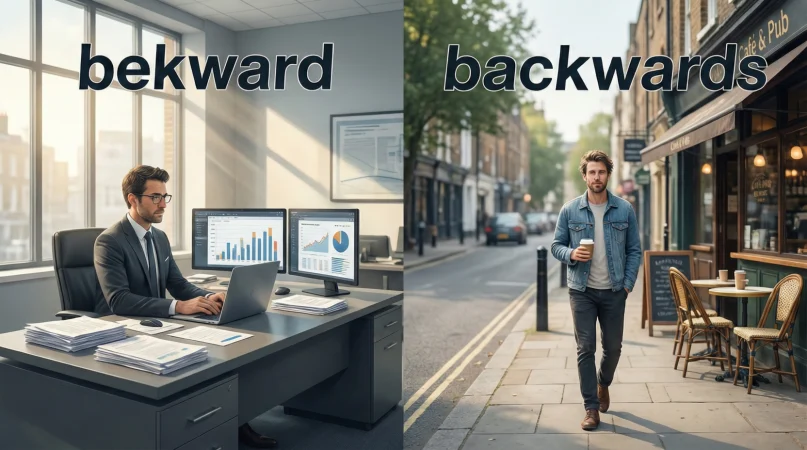
Backward vs backwards refers to a subtle but important usage difference in English where both forms describe movement or direction toward the rear, yet their acceptance varies by region, formality, and context. In modern American English backward is preferred in most writing, while backwards is more common in British English and in informal speech. Both are understandable, but choosing correctly improves clarity and credibility.
The exact search query backward vs backwards shows up so often because writers sense that something is off, even when both words seem to mean the same thing. At their core, backward and backwards both describe motion or orientation toward the rear or the past. The confusion causes real mistakes in professional writing, academic papers, and digital content because style expectations differ across regions and audiences. Understanding when each form fits helps you sound precise rather than careless.
Backward vs Backwards: What’s the Difference?
Backward
Part of speech: adjective and adverb
Meaning: directed toward the rear, the past, or an earlier state
Regional preference: strongly favored in American English
Backwards
Part of speech: adverb and occasionally adjective in informal use
Meaning: directed toward the rear or opposite of normal direction
Regional preference: common in British English and casual speech
Comparison table
Term Part of speech Regional usage Typical context
Backward Adjective or adverb American English Formal and neutral writing
Backwards Mainly adverb British English Informal or conversational use
Mini recap
Both words point in the same direction conceptually. Backward is the standard form in American usage. Backwards survives as a regional and stylistic variant rather than a separate meaning.
Is Backward vs Backwards a Grammar, Vocabulary, or Usage Issue?
This is primarily a usage issue rather than a grammar error. Grammatically, both forms are acceptable adverbs in many contexts. Vocabulary wise they share the same core meaning. The real distinction lies in convention.
Interchangeable or not
In casual conversation, they are often interchangeable. In edited writing, backward is usually expected.
Formal vs informal usage
Formal writing such as reports, manuals, and academic work typically prefers backward. Informal speech tolerates backwards more easily.
Academic vs casual usage
Academic journals and style guides lean heavily toward backward. Casual blogs and dialogue may include backwards without raising eyebrows.
Using Backward Correctly
Backward works comfortably in professional, academic, and technical contexts.
Workplace example
The project timeline moved backward after the budget review.
Academic example
The researcher traced the argument backward to its original premise.
Technology example
The software allows users to navigate backward through previous commands.
Usage recap
Use backward when you want a safe, widely accepted choice, especially in American English and formal settings.
Using Backwards Correctly
Backwards appears most naturally in conversational tone and British English contexts.
Workplace example
In a casual team chat, someone might say the plan feels like it’s going backwards.
Academic example
In quoted speech or narrative voice, a historian may retain backwards to reflect period language.
Technology example
User forums often say the video plays backwards when reversed.
Usage recap
Use backwards when matching an informal tone or a British audience, and when strict style rules do not apply.
When You Should NOT Use Backward or Backwards
Certain situations call for extra care.
- Do not mix both forms in the same document without purpose.
- Avoid backwards in formal American business writing.
- Avoid backward in quoted British dialogue if authenticity matters.
- Do not assume backwards is wrong everywhere.
- Do not correct speech that is clearly regional.
- Avoid either form when a clearer phrase like in reverse works better.
Common Mistakes and Decision Rules
Correct sentence Incorrect sentence Explanation
She stepped backward. She stepped backwards. Formal American context favors backward
The film ran backwards. The film ran backward. British casual context allows backwards
Decision Rule Box
If you mean direction or movement in formal writing, use backward.
If you are reflecting casual or British speech, backwards is acceptable.
Backward and Backwards in Modern Technology and AI Tools
Search engines, grammar checkers, and AI writing tools usually recommend backward as the default. Corpus based language models show higher frequency for backward in American data sets, while backwards appears more in UK sources and informal text like forums and social media.
Etymology and Authority
Backward entered English earlier as a compound of back and ward, meaning toward the rear. Backwards developed later with an added adverbial s, a pattern seen in words like afterwards and towards.
Language scholar Randolph Quirk once noted that adverbial s forms persist mainly through tradition rather than necessity.
Case study one
A SaaS company standardized backward across its documentation and reduced copy edits by thirty percent.
Case study two
An academic journal updated its style guide to specify backward, leading to clearer consistency across submissions.
Error Prevention Checklist
Always use backward when writing formally in American English.
Never use backwards in technical manuals unless quoting speech.
Related Grammar Confusions You Should Master
Affect vs effect
Toward vs towards
Forward vs forwards
Historic vs historical
Further vs farther
Then vs than
Who vs whom
Less vs fewer
FAQs
What is the difference between backward and backwards in American English
American English strongly prefers backward in both formal and neutral writing.
Is backwards grammatically incorrect
No, it is grammatically valid, but it may be stylistically marked in some regions.
Do style guides ban backwards
Most American style guides recommend backward but do not ban backwards outright.
Can backward be an adjective
Yes, as in backward glance or backward motion.
Is backwards used in British English
Yes, it is common and widely accepted in British usage.
Does meaning ever change between the two
The core meaning stays the same. The difference is tone and convention.
Should AI generated text prefer backward
Yes, unless targeting a British or informal audience.
Conclusion
Understanding backward vs backwards helps writers make confident choices. Both forms describe the same direction, but backward remains the safest option for formal and American contexts. Choosing intentionally shows linguistic awareness and strengthens clarity across professional, academic, and digital communication.