
Last Updated on April 3, 2026
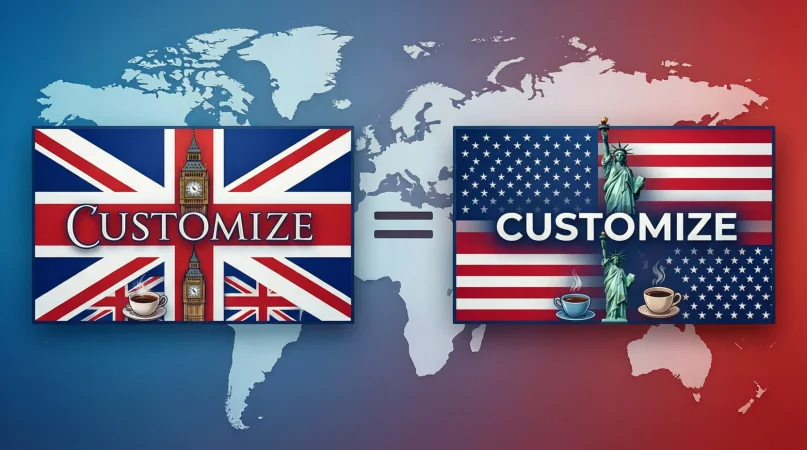
Both “customise” and “customize” are correct spellings of the same verb meaning to modify something according to personal preferences or requirements. “Customize” is standard in American English, while “customise” is the preferred British English spelling. The choice depends entirely on your target audience and regional writing conventions.
Have you ever paused mid-sentence, wondering whether to write “customize” with a Z or “customise” with an S? You’re not alone. This spelling variation creates confusion for content creators, business professionals, and students worldwide, particularly when writing for international audiences or submitting work that crosses regional boundaries.
The distinction between customise and customize isn’t about correctness in an absolute sense. Both spellings represent the identical action of tailoring, modifying, or adapting something to meet specific needs or preferences. However, choosing the wrong variant for your audience can undermine your credibility, trigger automatic spell-check flags, and signal unfamiliarity with regional writing standards. Understanding when to use each form matters significantly in professional communication, academic writing, and global business contexts.
This comprehensive guide clarifies the grammar rules, regional preferences, and practical applications of both spellings. Whether you’re drafting marketing materials, writing academic papers, or developing software documentation, you’ll learn exactly which spelling serves your purpose and how to maintain consistency throughout your work.
Customise vs Customize: What’s the Difference?
At their core, customise and customize are identical in meaning, function, and pronunciation. Both function as transitive verbs that describe the action of modifying something to suit individual specifications, tastes, or requirements.
Part of Speech: Verb (transitive)
Pronunciation: /ˈkʌstəmaɪz/ (identical for both spellings)
Core Meaning: To make or change something according to specific preferences or needs
| Aspect | Customize (American) | Customise (British) |
|---|---|---|
| Primary Region | United States, Canada (often) | United Kingdom, Australia, New Zealand, South Africa, India |
| Dictionary Standard | Merriam-Webster, American Heritage Dictionary | Oxford English Dictionary, Cambridge Dictionary |
| Corporate Usage | Microsoft, Google (US), Adobe | BBC, The Guardian, British Government documents |
| Academic Writing | APA Style, Chicago Manual (US editions) | Oxford Style Manual, MLA (UK contexts) |
| Software Localization | Default in US English settings | Default in UK English settings |
| Interchangeability | Not interchangeable within same document | Not interchangeable within same document |
Quick Recap: The Z versus S distinction follows the broader pattern of American versus British English spelling variations, similar to realize/realise, organize/organise, and analyze/analyse. Neither spelling is inherently more correct, formal, or modern. Your choice should align with your audience’s location, your publication’s style guide, and the regional English variant you’re committed to throughout your document.
Is Customise vs Customize a Grammar, Vocabulary, or Usage Issue?
This isn’t a grammar error waiting to happen. The customise versus customize distinction represents a spelling convention rooted in historical language evolution and regional standardization rather than grammatical correctness.
Complete Interchangeability Within Regional Contexts
Within their respective regional contexts, customise and customize function identically. Both conjugate the same way (customizing/customising, customized/customised, customizes/customises), accept the same objects, and appear in the same sentence structures. You won’t find situations where one spelling changes the grammatical validity of a sentence.
Formal vs Informal Usage
Neither spelling carries different levels of formality. Both appear equally in academic journals, business contracts, casual blog posts, and everyday conversation. A British academic paper using “customise” holds the same formal register as an American research article using “customize.”
Academic vs Casual Contexts
Academic institutions typically require consistency with their preferred English variant. American universities generally expect “customize” in student papers following APA or Chicago style guides. British universities and those following Oxford referencing systems expect “customise.” The academic rigor lies in maintaining consistency rather than choosing one over the other.
The critical rule: Never mix spellings within a single document, website, or publication. Inconsistency signals carelessness and damages professional credibility far more than choosing either spelling consistently throughout your work.
When to Use Customize American English
Customize dominates in American English contexts across virtually all writing formats and professional settings. This spelling appears in American dictionaries as the primary entry, with “customise” often absent or noted as a variant.
Workplace Communication Example
“Our development team will customize the dashboard interface to match your company’s workflow requirements. We can customize everything from data visualization preferences to automated reporting schedules, ensuring the platform integrates seamlessly with your existing processes.”
In American corporate environments, this spelling appears in software documentation, customer service communications, product descriptions, and internal memos. Companies like Apple, Amazon, and Tesla consistently use “customize” across all their American market materials.
Academic Writing Example
“Researchers must customize their experimental protocols to account for population specific variables. The methodology section should explicitly describe how investigators customize standard procedures to maintain scientific rigor while addressing unique participant characteristics.”
American academic journals across disciplines—from psychology to engineering—require “customize” when following APA, Chicago, or AMA style guidelines. Dissertation committees at US universities expect this spelling throughout thesis documents.
Technology and Software Example
“Users can customize notification settings through the preferences menu. The application allows you to customize theme colors, font sizes, keyboard shortcuts, and privacy controls to create a personalized experience that matches your working style.”
American software companies, tech startups, and digital platforms universally adopt “customize” in user interfaces, help documentation, and feature descriptions. This consistency extends to mobile apps, web services, and enterprise software solutions.
Usage Recap: Employ “customize” when writing for American audiences, following American style guides, creating content for US-based companies, or developing products primarily serving North American markets. Maintain this spelling throughout all related materials, from initial documentation through customer support resources.
When to Use Customise British English
Customise serves as the standard spelling throughout Commonwealth English regions, including the United Kingdom, Australia, New Zealand, Ireland, South Africa, and India. This variant appears as the primary entry in British dictionaries, with “customize” sometimes listed as an American alternative.
Workplace Communication Example
“Our consultancy will help you customise employee training programmes to address sector specific compliance requirements. We customise each module based on your organisation’s regulatory environment, ensuring staff receive relevant, actionable guidance that meets current standards.”
British corporations, government agencies, and professional services firms consistently use “customise” in official communications. The BBC, British Airways, and HSBC maintain this spelling across all their corporate materials and public-facing content.
Academic Writing Example
“PhD candidates must customise their research frameworks to reflect theoretical perspectives dominant within their specific disciplines. Supervisors expect students to customise literature review structures according to departmental conventions while maintaining methodological coherence throughout their investigations.”
British universities, academic journals based in the UK, and international publications following Oxford or Cambridge style conventions require “customise.” This extends to conference papers, grant applications, and scholarly book manuscripts targeting Commonwealth markets.
Technology Example
“The software enables administrators to customise access permissions across multiple user groups. IT managers can customise security protocols, data retention policies, and audit logging features to align with GDPR requirements and organisational governance frameworks.”
British technology companies and European software providers serving UK markets adopt “customise” in product interfaces and technical documentation. This consistency appears in everything from mobile banking apps to enterprise resource planning systems.
Usage Recap: Choose “customise” when addressing British, Australian, or other Commonwealth audiences, adhering to Oxford or Cambridge style guidelines, writing for UK-based organisations, or developing content for markets where British English predominates. Consistency across all related documentation remains essential for maintaining professional standards.
When You Should NOT Use Customize or Customise
Understanding incorrect usage prevents common mistakes that compromise your writing quality and professional presentation.
1. Don’t Mix Spellings in the Same Document
Never alternate between “customize” and “customise” within a single article, report, website, or document collection. This inconsistency immediately signals poor editorial control and damages credibility with readers familiar with either English variant.
2. Avoid Using the Wrong Regional Variant for Your Audience
Don’t use “customize” when writing for The Guardian’s editorial submission or “customise” when preparing documentation for a Silicon Valley startup. Misalignment with your audience’s expected conventions undermines your authority.
3. Don’t Assume “Customize” Is More Modern or Technical
Neither spelling represents newer terminology or technical sophistication. Both emerged simultaneously in their respective regions and carry identical meanings across all contexts, including cutting-edge technology fields.
4. Never Use These Spellings When You Mean Different Words
Don’t confuse “customize/customise” (to modify) with “custom” (a tradition), “customer” (a buyer), or “customs” (border regulations). These represent entirely different words despite shared etymological roots.
5. Avoid Inconsistency Across Related Materials
If your website uses “customize,” your email newsletters, social media content, and downloadable resources must maintain that spelling. Mixed variants across platforms create confusion and appear unprofessional.
6. Don’t Rely on Automatic Spell-Checkers Alone
Spell-check tools default to whatever English variant your software settings specify. A document might pass spell-check using American English settings while containing the wrong variant for your British audience.
7. Resist Changing Established Brand Terminology
If your company has consistently used one spelling across years of marketing materials, don’t suddenly switch without rebranding efforts. Established brand language creates recognition that inconsistency destroys.
8. Never Use Alternate Spellings Within Quoted Material
When quoting sources that use the opposite spelling, maintain their original text exactly as written. Editorial consistency applies to your own writing, not to accurately reproduced quotations from external sources.
Common Mistakes and Decision Rules
Understanding frequent errors helps you avoid them in your own writing while recognizing them during editing processes.
| Correct Usage | Incorrect Usage | Explanation |
|---|---|---|
| “We customize solutions for American clients.” | “We customise solutions for American clients.” | Use American spelling for American audience contexts. |
| “The programme allows users to customise settings.” | “The programme allows users to customize settings.” | British “programme” requires British “customise” for consistency. |
| “Customers can customize their orders online.” | “Customers can customise their orders online.” (in US context) | Maintain regional spelling throughout US-based e-commerce platforms. |
| “Researchers must customise their methodology.” | “Researchers must customize their methodology.” (in UK journal) | British academic publications require British spelling conventions. |
| “The app lets you customize notification preferences.” | “The app lets you customise notification preferences.” (in American app) | Software targeting American users should use American spelling in interfaces. |
Decision Rule Framework
If you’re writing for an American audience or following American style guides: Always use “customize” throughout all related content, from initial drafts through final publication.
If you’re addressing British, Australian, or Commonwealth readers or adhering to Oxford standards: Consistently employ “customise” across every document, interface, and communication channel.
If you’re uncertain about your primary audience: Research your readers’ geographical distribution, check competitor content in your niche, and select the variant that serves the majority of your audience. Then maintain that choice absolutely consistently.
If you’re writing for international audiences: Choose one variant based on your primary market or company location, acknowledge in style guides that you’ve selected a standard, and train all contributors to maintain that consistency.
Customise and Customize in Modern Technology and AI Tools
Contemporary software and artificial intelligence systems handle both spellings with increasing sophistication, though awareness of their treatment remains important for content creators.
Modern word processors like Microsoft Word and Google Docs automatically adjust spelling preferences based on your selected language settings. When set to “English (United States),” these tools flag “customise” as incorrect. Switch to “English (United Kingdom),” and “customize” receives the red underline treatment.
AI writing assistants and grammar checkers like Grammarly, ProWritingAid, and Hemingway Editor similarly adjust recommendations based on your English variant selection. However, these tools sometimes miss subtle inconsistencies when mixed variants appear within longer documents, making manual proofreading essential.
Search engines treat both spellings as equivalent for most queries, recognizing them as regional variants of identical terms. Google Search results for “customize templates” and “customise templates” show largely overlapping content, with slight geographical prioritization based on the searcher’s location.
Content management systems and website platforms often include localization features that automatically adjust spelling based on visitor location. E-commerce sites serving global markets increasingly implement these features to display “customize” to American visitors while showing “customise” to British users accessing identical product pages.
The Etymology and Historical Development
Understanding the historical origins of customize and customise illuminates why this variation exists and how both spellings achieved legitimacy within their respective regions.
The verb “customize” emerged in American English around the early 20th century, derived from “custom” (meaning made to order) combined with the suffix “ize.” American English traditionally favors Greek-derived suffixes spelled with Z, following patterns established by lexicographer Noah Webster in his 1828 dictionary reforms aimed at differentiating American from British spelling conventions.
British English maintained the “ise” suffix for similar Greek-derived words, though this represents an older French-influenced spelling pattern rather than direct Greek origin. The Oxford English Dictionary records “customise” as the standard British variant while acknowledging “customize” as the American alternative.
As noted in the Oxford Guide to English Usage, “The choice between ize and ise spellings reflects historical spelling reforms rather than etymological correctness. Both patterns have legitimate linguistic foundations, with American English preferring Greek patterns and British English maintaining French-influenced conventions.”
Throughout the 20th century, both spellings spread through their respective regions via educational systems, publishing standards, and increasingly global media exposure. Today, each variant holds equal legitimacy within its regional context, with neither representing a corrupted or inferior form of the language.
Real-World Case Studies
Examining how major organizations handle this spelling variation provides practical guidance for your own decision-making processes.
Case Study 1: Global Software Company Microsoft maintains separate documentation for its international products, using “customize” in materials for American markets and “customise” in content for Commonwealth regions. Their localization team reports that consistent regional spelling increases customer satisfaction scores and reduces support inquiries related to unclear documentation. This systematic approach extends across user interfaces, help files, and marketing materials.
Case Study 2: International Publishing House Cambridge University Press requires authors to select either American or British English at contract signing, then maintains that choice throughout editing, production, and marketing. Their editorial director notes that consistency within each title matters far more than which variant authors choose, with mixed spellings creating the only truly problematic scenarios that require costly revision.
Error Prevention Checklist
Use this practical checklist to maintain spelling consistency and avoid common mistakes:
Always use “customize” when:
- Writing for American publications or websites
- Following APA, Chicago, or other American style guides
- Creating content for US-based companies
- Developing software primarily serving North American markets
- Addressing audiences in American educational institutions
Always use “customise” when:
- Writing for British, Australian, or Commonwealth publications
- Following Oxford, Cambridge, or other British style guides
- Creating content for UK-based organisations
- Developing software for European or Commonwealth markets
- Addressing audiences in British or Commonwealth educational institutions
Never:
- Mix both spellings within a single document or website
- Change spelling conventions mid-project without clear communication
- Assume one spelling is more correct, modern, or professional than the other
- Rely solely on spell-check without verifying your language settings match your audience
- Use the wrong variant when directly quoting sources that use the opposite spelling
Related Grammar Confusions You Should Master
Expanding your understanding of similar British versus American spelling variations strengthens your overall writing consistency and professional presentation:
- Realise vs Realize – identical pattern to customise/customize
- Organise vs Organize – common in business and management writing
- Analyse vs Analyze – frequently appears in academic and technical contexts
- Recognise vs Recognize – widespread in professional communications
- Specialise vs Specialize – common in career and expertise descriptions
- Summarise vs Summarize – essential for academic and business writing
- Apologise vs Apologize – important for customer service communications
- Prioritise vs Prioritize – frequently used in project management contexts
- Authorise vs Authorize – critical for legal and compliance documentation
- Optimise vs Optimize – prevalent in technology and marketing fields
Mastering these variations enables you to maintain consistent regional spelling across all your professional and academic writing, regardless of which English variant your audience expects.
FAQs
Is it customise or customize in Australia?
Australian English follows British spelling conventions, making “customise” the standard spelling throughout Australia. Australian government documents, educational institutions, media outlets, and businesses consistently use “customise” rather than “customize.” This aligns with broader Australian preferences for British English variants across most spelling differences.
Can I use customize in UK English writing?
While British readers will understand “customize,” using American spelling in UK English contexts appears inconsistent and unprofessional. British publications, academic institutions, and businesses expect “customise” in formal writing. Using “customize” in UK contexts signals unfamiliarity with regional conventions and may reduce your credibility with British audiences.
Which spelling should I use for international audiences?
Choose based on your primary audience or company location, then maintain that choice consistently. If your readers span multiple regions, select the variant matching your largest audience segment or your organization’s home base. Many international companies document their chosen English variant in style guides to ensure all contributors maintain consistency across global communications.
Do search engines treat customise and customize differently?
Search engines recognize both as regional variants of the same term and typically return similar results regardless of which spelling users search. However, search algorithms may slightly prioritize content matching the searcher’s geographical location, meaning British users might see more results containing “customise” higher in rankings.
Does Microsoft Word accept both customise and customize?
Microsoft Word accepts whichever spelling matches your selected language settings. When set to “English (United States),” Word recognizes “customize” as correct and flags “customise” as misspelled. Switch to “English (United Kingdom),” and the opposite occurs. Always verify your language settings match your intended audience before finalizing documents.
Is customize more common in technical writing?
Neither spelling dominates technical writing globally. American technical documentation uses “customize,” while British and Commonwealth technical materials use “customise.” The prevalence of American technology companies in software documentation has made “customize” more visible internationally, but this reflects market presence rather than technical correctness.
Should I change my website spelling based on visitor location?
Many global e-commerce and content platforms implement localization that automatically adjusts spelling based on visitor location. This provides optimal user experience for international audiences. However, smaller businesses often choose one variant and maintain it consistently across all markets rather than investing in dynamic localization systems.
What happens if I mix both spellings on my website?
Mixing spellings damages your professional credibility and confuses visitors about your attention to detail. It signals poor editorial control and may reduce trust in your expertise or product quality. Search engines may also interpret inconsistent spelling as duplicate content in some scenarios, potentially affecting rankings.
Are there other words following the same pattern?
Yes, numerous verbs follow identical British versus American spelling patterns, including realise/realize, organise/organize, analyse/analyze, specialise/specialize, and dozens more. Understanding this systematic pattern helps you maintain consistency across all related vocabulary rather than memorizing each word individually.
Which spelling should I teach English language learners?
Teach based on your students’ likely usage context. Students planning to study or work in America should learn American spelling conventions including “customize.” Those heading to Commonwealth countries should master British variants including “customise.” For general learners, teaching awareness of both variants while emphasizing consistency within individual documents provides the most practical preparation.
Conclusion
The customise versus customize distinction reflects regional spelling conventions rather than grammatical correctness or semantic differences. Both spellings represent identical meanings, grammatical functions, and professional legitimacy within their respective regions. Your choice should align with your target audience’s location and the English variant your style guide specifies.
Success lies not in choosing one spelling over the other, but in maintaining absolute consistency throughout your work. Whether you customize solutions for American clients or customise services for British customers, unwavering adherence to your selected variant demonstrates professional attention to detail and respect for your audience’s expectations.
Understanding these regional preferences empowers you to communicate effectively across international boundaries while maintaining the credibility that comes from matching your readers’ linguistic conventions. Apply these principles to customize or customise your writing approach, ensuring every document reflects the professional standards your audience expects.