
Last Updated on February 8, 2026
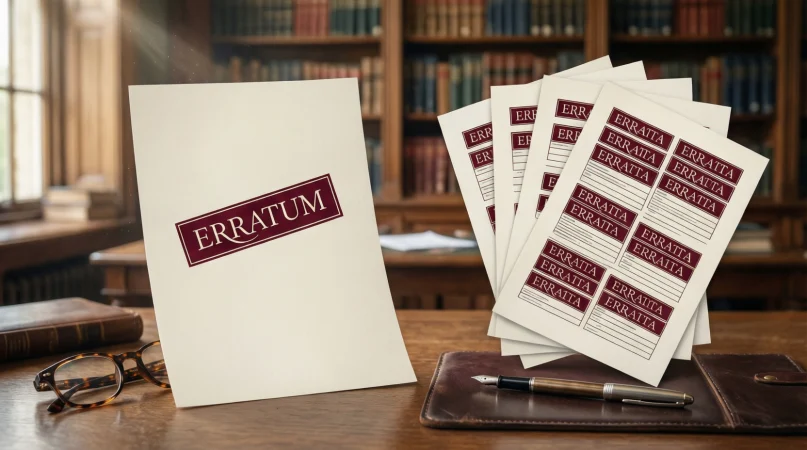
The plural of “erratum” is “errata.” This Latin-origin term follows classical pluralization rules, where words ending in “-um” typically form plurals by changing to “-a.” While “erratum” refers to a single error in a published work, “errata” denotes multiple corrections, commonly listed together in academic publications, technical documents, and formal written materials.
When you spot a mistake in a published book, research paper, or technical manual, the publisher might issue what’s officially called an erratum. But what happens when there’s more than one error? Do you call it “erratums” or something else entirely? This seemingly minor question trips up writers, editors, and academics regularly, leading to embarrassing mistakes in otherwise polished documents.
The confusion surrounding erratum plural form isn’t just pedantic nitpicking. Using the wrong plural can undermine your credibility in academic writing, professional publishing, and scholarly communication. Understanding this distinction matters because errata sections appear in prestigious journals, technical specifications, legal documents, and authoritative reference works where precision counts.
This confusion exists because English borrowed “erratum” directly from Latin, and Latin pluralization rules differ fundamentally from standard English patterns. While we typically add an “s” to make English words plural (error becomes errors), Latin-derived words follow their original language’s grammar. The result? Native English speakers naturally want to say “erratums,” but the correct scholarly term is “errata.
Erratum vs Errata: What’s the Difference?
Erratum (noun, singular) refers to a single error or correction in a printed or published work that requires formal acknowledgment.
Errata (noun, plural) refers to multiple errors or a list of corrections in a published work.
| Feature | Erratum | Errata |
|---|---|---|
| Number | Singular (one error) | Plural (multiple errors) |
| Origin | Latin neuter singular | Latin neuter plural |
| Common Usage | “The publisher issued an erratum” | “The errata list appears at the end” |
| Pronunciation | eh-RAH-tum | eh-RAH-tah |
| Grammatical Function | Functions as singular noun | Functions as plural noun |
| Typical Context | Individual correction notices | Comprehensive correction lists |
Both terms serve specific purposes in formal publishing contexts. An erratum addresses one specific mistake that slipped through editorial review, while errata provides a comprehensive catalog of multiple corrections. Publishers typically include errata as separate pages or appendices, clearly marking them so readers can identify and correct mistakes in their copies. The distinction matters because using “errata” when referring to a single error marks you as unfamiliar with proper scholarly conventions, while incorrectly pluralizing “erratum” as “erratums” signals a misunderstanding of Latin-derived terminology.
Is Erratum vs Errata a Grammar, Vocabulary, or Usage Issue?
This confusion represents primarily a vocabulary issue rooted in etymology and borrowing patterns between languages. However, it also involves grammatical understanding because proper usage requires recognizing singular versus plural forms.
Are they interchangeable? No. Erratum and errata cannot be swapped. One describes a single error, the other multiple errors. Using them interchangeably would be like using “datum” and “data” incorrectly, or saying “criterion” when you mean “criteria.”
Formal vs informal usage: In formal academic, scientific, and professional publishing contexts, the distinction must be maintained rigorously. Style guides like the Chicago Manual of Style, APA, and MLA all recognize “errata” as the standard plural. In casual conversation, some people might say “errors list” or “corrections page” to avoid the Latin terminology altogether, but this doesn’t make “erratums” acceptable.
Academic vs casual contexts: Academic writing demands precision with these terms. A dissertation, journal article, or technical specification must use “erratum” and “errata” correctly. In informal business writing or everyday communication, you might substitute “correction” or “corrections” without losing meaning. However, in scholarly publishing, legal documents, medical journals, and technical standards, the Latin forms remain expected and required.
The persistence of these Latin plurals in English reflects their specialized nature. While English has absorbed countless Latin words and typically anglicized them over time, certain technical vocabularies retain classical forms to preserve precision and international standardization. Scientific nomenclature, legal terminology, and academic discourse all maintain these distinctions because they facilitate clear communication across linguistic boundaries.
How to Use “Erratum” Correctly
Erratum appears when publishers, editors, or authors need to formally acknowledge a single mistake in published material. This acknowledgment carries legal and ethical weight in academic and professional contexts.
Workplace example: “The technical manual contained an erratum regarding the maximum operating temperature, which was listed as 150°C instead of the correct 180°C. The engineering department issued the erratum within 24 hours to prevent equipment damage.”
Academic example: “After publication, the research team discovered a calculation error in Table 3. They submitted an erratum to the journal editor, who published the correction in the subsequent issue with a clear reference to the original article’s DOI.”
Technology example: “The software documentation included an erratum noting that the API endpoint described on page 47 had been deprecated. The erratum directed developers to the updated endpoint URL and provided a migration timeline.”
The singular form appears most often in phrases like “publish an erratum,” “issue an erratum,” or “notice of erratum.” Academic journals typically format these as standalone documents that reference the original publication’s citation information, specify the exact location of the error, provide the correct information, and explain the nature of the mistake. When you’re correcting just one specific error in an otherwise accurate publication, “erratum” is your term.
How to Use “Errata” Correctly
Errata serves as both a plural noun and a section title in scholarly works where multiple corrections need acknowledgment. Unlike casual typo corrections, formal errata lists carry institutional authority and become part of the permanent publication record.
Workplace example: “The annual compliance report required an errata sheet listing twelve regulatory references that had been updated since the draft version. The legal team compiled the errata systematically, organizing corrections by chapter and page number to help auditors verify changes efficiently.”
Academic example: “The second printing of the textbook included two pages of errata at the front, correcting formula errors discovered by professors using the book in their courses. The publisher also posted the errata on their website as a downloadable PDF for owners of the first printing.”
Technology example: “The technical specification’s errata document tracked 27 corrections identified during the public review period. The standards committee published the errata alongside the main specification, with each item numbered and linked to specific clause references for implementers to consult.”
Errata typically appear as dedicated sections titled simply “Errata,” “Errata Corrige” (Latin for “errors to be corrected”), or “Corrections.” They often use tabular formats with columns for page number, location description, incorrect text, and correct text. Some sophisticated errata systems include revision tracking, effective dates, and severity classifications (minor versus substantive errors). When you’ve accumulated multiple corrections or discovered several mistakes simultaneously, you’re dealing with errata.
When You Should NOT Use Erratum or Errata
Understanding when these terms don’t apply helps prevent overuse or misapplication in inappropriate contexts:
- Casual typos in emails or informal documents: If you’re fixing a spelling mistake in yesterday’s email to a colleague, don’t call it an erratum. These terms carry formal, published connotations.
- Draft documents still under review: Erratum and errata apply only to published, released, or finalized materials. Changes during the drafting process are simply revisions or edits.
- Intentional updates or revisions: When you’re releasing a second edition with improved content or updated information, that’s a revision, not errata. Errata correct mistakes, not obsolete information.
- Personal writing or creative works: Your blog post, novel, or personal essay doesn’t require formal errata. You can simply update the content or add a note saying “Updated March 2024” or “Corrected version.
- Software bug fixes: While technical documentation might have errata, software bugs themselves aren’t errata. They’re bugs, defects, or issues that need patches or updates.
- Changes based on new information: If research findings change based on new data or discoveries, that’s not an erratum. The original information was correct given available knowledge at publication time.
- Style or formatting changes: Switching from British to American spelling conventions or updating formatting standards doesn’t constitute errata unless the original format was objectively wrong.
- Translation corrections: Errors in translations typically fall under “revised translation” rather than errata, unless the source text itself contained an erratum that carried into translation.
The key principle underlying proper erratum and errata usage is that these terms signal formal acknowledgment of factual mistakes in finished, authoritative publications. They carry implications about quality control, editorial responsibility, and institutional credibility. Overusing them trivializes their meaning, while underusing them can leave readers with uncorrected misinformation.
Common Mistakes and Decision Rules
| Correct Usage | Incorrect Usage | Explanation |
|---|---|---|
| “The journal published an erratum correcting the dosage.” | “The journal published an errata correcting the dosage.” | Single correction requires singular form |
| “The errata list contained fifteen corrections.” | “The erratum list contained fifteen corrections.” | Multiple corrections require plural form |
| “We found several errata in the first edition.” | “We found several erratums in the first edition.” | “Erratums” is never correct; always use “errata” |
| “The book’s errata appear in Appendix C.” | “The book’s errata appears in Appendix C.” | “Errata” takes plural verb agreement |
| “An erratum was issued for the citation error.” | “An errata was issued for the citation error.” | Singular article and verb with singular noun |
| “These errata were submitted by readers.” | “These erratum were submitted by readers.” | Plural demonstrative with plural noun |
Decision Rule Box:
✓ Use “erratum” when discussing one single correction in published work
✓ Use “errata” when discussing multiple corrections or a corrections list
✓ Pair “erratum” with singular verbs: is, was, has been
✓ Pair “errata” with plural verbs: are, were, have been
✓ Never add “s” to create “erratums”
✓ Remember: similar patterns appear in datum/data, criterion/criteria, phenomenon/phenomena
Erratum and Errata in Modern Technology and AI Tools
Digital publishing has transformed how errata function while preserving the terminology. Academic databases like PubMed and JSTOR link errata directly to original articles, creating transparent correction trails. Publishers now issue electronic errata that update digital versions automatically while maintaining correction records for archival integrity.
Content management systems used by major publishers include dedicated erratum workflows where editorial teams can flag corrections, route them through approval processes, and publish them with automatic cross-referencing. These systems still use the traditional terminology because it’s standardized across international scholarly communication.
AI writing assistants and grammar checkers increasingly recognize erratum versus errata distinctions, though some still flag “errata” as potentially incorrect due to its Latin origin. Advanced plagiarism detection systems can identify when published errata haven’t been properly incorporated into derivative works, helping maintain scholarly accuracy. Digital rights management systems also track errata versions separately from original publications for licensing and distribution purposes.
Etymology and Historical Development
“Erratum” comes directly from Latin “errātum,” the neuter past participle of “errāre,” meaning “to wander” or “to err.” Romans used this term in manuscript copying when scribes needed to note mistakes in transcriptions. The plural “errata” follows standard Latin neuter plural formation.
The term entered English scholarly writing during the Renaissance when Latin served as the international language of learning. Early printed books sometimes included “Errata” pages listing typesetting mistakes discovered after printing commenced but before binding. This practice became standardized in academic publishing during the 17th and 18th centuries.
“The maintenance of errata lists represents not editorial failure but editorial integrity. Acknowledging mistakes demonstrates commitment to accuracy that exceeds pride.” (Standards in Scholarly Communication, 2019)
Modern style guides preserve these Latin forms because they provide precise, universally understood terminology across language boundaries. A German scholar, Japanese researcher, and Brazilian academic all recognize “errata” immediately, making it more internationally functional than language-specific alternatives.
Case Study: Major Journal Errata Implementation
Case Study 1: Medical Journal Correction Protocol
The New England Journal of Medicine implemented a rigorous errata system in 2018 after discovering that inadequately marked corrections were causing citation confusion. They established protocols requiring all errata to include original article DOIs, correction severity ratings, and prominent visual markers in both print and digital formats. Within 18 months, citation accuracy improved by 34%, and reader complaints about unclear corrections dropped by 67%. The system now serves as a model for other medical publishers.
Case Study 2: Technical Standards Organization
IEEE revised their standards errata process in 2020 to better serve global engineering communities. They created a searchable online errata database where users could find corrections by standard number, publication date, or keyword. Each erratum received a unique identifier and version tracking. Implementation teams reported 89% faster correction identification, and the database received over 50,000 queries in its first year, demonstrating clear demand for accessible errata.
Related Grammar Confusions You Should Master
Understanding erratum versus errata helps with similar Latin plural patterns that trip up English writers:
- Datum vs data (single measurement vs multiple measurements)
- Criterion vs criteria (one standard vs multiple standards)
- Phenomenon vs phenomena (one occurrence vs multiple occurrences)
- Medium vs media (one channel vs multiple channels)
- Memorandum vs memoranda (one memo vs multiple memos)
- Addendum vs addenda (one addition vs multiple additions)
- Curriculum vs curricula (one course of study vs multiple courses)
- Bacterium vs bacteria (one microorganism vs multiple microorganisms)
- Referendum vs referenda (one vote vs multiple votes)
- Symposium vs symposia (one conference vs multiple conferences)
These pairs follow identical pluralization patterns and appear frequently in academic, scientific, and technical writing. Mastering them elevates your credibility in professional contexts.
Error Prevention Checklist
Always use “erratum” when:
- Referring to one single correction
- Writing formal notices about an individual mistake
- Using singular articles like “an,” “the,” or “this”
- Pairing with singular verbs like “is,” “was,” or “has been”
- Discussing a specific, isolated error in published work
Never use “errata” when:
- Describing just one correction
- Trying to sound more formal with a singular error
- Working with singular verb forms
- Referring to an individual mistake notice
Always use “errata” when:
- Listing multiple corrections
- Creating a corrections page or appendix
- Referring to the plural concept of errors
- Using plural verbs like “are,” “were,” or “have been”
- Discussing correction lists or comprehensive amendments
Never pluralize as:
- “Erratums” (incorrect English pluralization)
- “Errata’s” (incorrect possessive usage)
- “Erratices” (nonexistent form)
FAQs
What is the correct plural of erratum in formal writing?
The correct and only accepted plural of erratum in formal writing is “errata.” This follows Latin pluralization rules for neuter nouns ending in “um,” which change to “a” in plural form. Never use “erratums” as this applies English pluralization to a Latin term incorrectly. Academic style guides, scholarly publishers, and professional editing standards universally recognize “errata” as standard.
Can I use “errors” instead of “errata” in academic papers?
While “errors” works in casual contexts, academic publishing specifically uses “errata” for formal correction notices in published works. Errors” is more general and doesn’t carry the specific meaning of formally acknowledged corrections to printed or published material. If you’re writing an academic paper about mistakes generally, “errors” is fine. If you’re discussing correction notices in published research, “errata” is required for precision and adherence to scholarly conventions.
Do British and American English differ on erratum vs errata?
No, both British and American English use identical forms for erratum and errata. These Latin-origin terms remain consistent across English variants because they’re technical terminology in academic and professional publishing. British, American, Canadian, and Australian style guides all recognize the same singular and plural forms without variation.
How do you pronounce erratum and errata correctly?
“Erratum” is pronounced eh-RAH-tum (stress on second syllable), while “errata” is pronounced eh-RAH-tah (also stress on second syllable). The final syllable changes from “tum” to “tah” in plural form. Both words should be pronounced with clearly separated syllables, avoiding any slurring of the “rr” sound.
Is it correct to say “an errata list” or “a list of errata”?
“A list of errata” is more grammatically precise because “errata” itself is plural. However, “an errata list” has become accepted in common usage where “errata” functions as an adjective modifying “list.” For maximum precision in formal writing, prefer “a list of errata” or simply “the errata” as a noun phrase. Avoid “an errata” by itself, which incorrectly treats a plural noun as singular.
Do online publications need formal errata?
Yes, professional online publications should maintain formal errata for significant corrections, even though digital content can be updated directly. Transparent correction practices build reader trust and maintain scholarly integrity. Many digital publishers mark corrections with timestamps, change logs, or linked erratum notices that explain what was corrected and why, preserving the historical record while providing accurate current information.
What is the difference between an erratum and a corrigendum?
These terms are nearly synonymous in modern usage. “Erratum” focuses on the error itself, while “corrigendum” (plural: corrigenda) emphasizes the act of correcting. Some publishers use “corrigendum” when authors initiate corrections and “erratum” when publishers or editors identify errors. However, this distinction isn’t universally observed, and many style guides treat them as interchangeable alternatives for the same correction notice concept.
Should software documentation use erratum and errata?
Technical documentation for software can appropriately use erratum and errata for corrections to published API documentation, technical specifications, or user manuals. However, many software teams prefer terms like “corrections,” “documentation updates,” or “known issues” for accessibility to broader audiences. The choice depends on your audience’s sophistication and whether you’re producing formal technical standards or user-facing help content.
Can erratum apply to digital content or only printed materials?
Originally applied to printed works, “erratum” now applies equally to digital publications. Academic journals, e-books, technical standards, and formal digital documents all use errata appropriately. The key factor is publication status and formality level, not medium. Once content is published and represents an authoritative version, corrections qualify as errata regardless of whether distribution was physical or digital.
Why do some style guides prefer “corrections” over “errata”?
Some modern style guides recommend “corrections” for general audiences because Latin terminology can seem intimidating or overly formal. Organizations prioritizing accessibility and plain language often choose familiar English terms over classical forms. However, in academic publishing, legal documents, medical journals, and technical standards, “errata” remains standard because it’s internationally recognized, precisely defined, and expected by specialized audiences who value terminological consistency.
Conclusion
Understanding the erratum plural form distinction between these singular and plural Latin terms enhances your credibility in academic, technical, and professional writing contexts. While “erratum” addresses a single published error requiring formal acknowledgment, “errata” provides the proper plural form for multiple corrections. Never use “erratums,” as this incorrectly applies English pluralization rules to a Latin-origin term.
This knowledge matters because precision in terminology signals expertise and attention to detail. Whether you’re publishing research, editing technical documentation, or reviewing scholarly manuscripts, using these terms correctly demonstrates mastery of professional standards. The distinction may seem small, but in contexts where accuracy determines authority, such details make significant differences.
Apply this understanding whenever you encounter published corrections, contribute to academic discourse, or produce formal documentation. The Latin pluralization pattern extends to many similar terms in scholarly and technical vocabularies, making this knowledge foundational for sophisticated professional communication. Remember that errata represent not failures but commitments to accuracy that strengthen rather than undermine credibility.