Last Updated on March 27, 2026
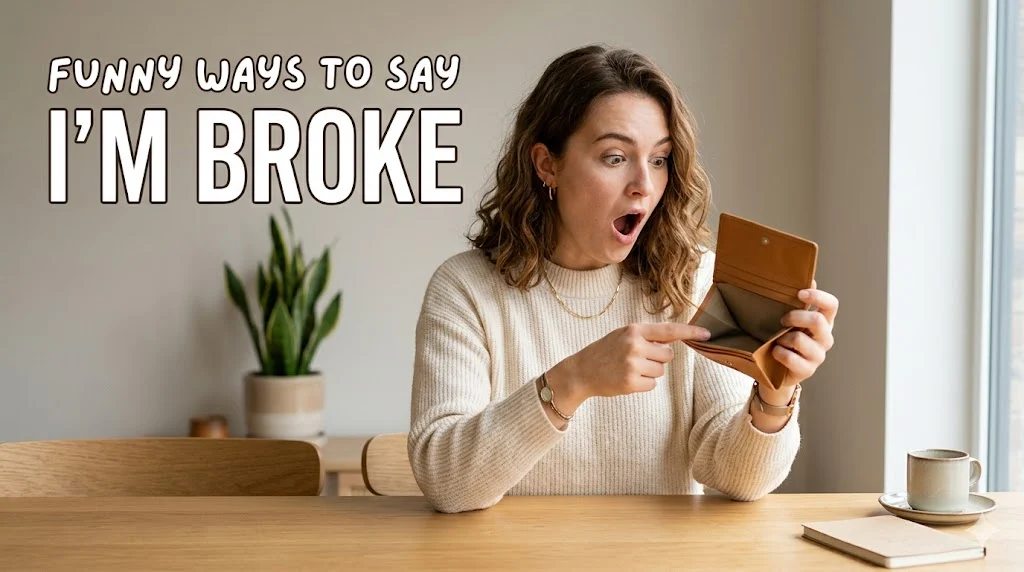
If you want funny ways to say you’re broke, try: “I’m on a tight budget,” “My wallet is empty,” “I’m financially challenged,” “I’m running low on cash,” “I’m broke as a joke.”
These alternatives to funny ways to say I’m broke help you sound more natural, expressive, and context-appropriate.
The phrase funny ways to say I’m broke refers to humorous or lighthearted expressions people use when they have little or no money. It’s common in casual conversations, especially among friends.
People use these phrases to soften the seriousness of financial struggles and keep the tone playful. Instead of sounding negative, humor helps maintain a relaxed and relatable vibe.
Learning other ways to say funny ways to say I’m broke improves fluency, helps you adapt your tone, and allows you to express yourself naturally in different contexts even when you want to express excitement in English or keep things light.
“Humor makes even difficult situations sound lighter and more relatable.”
Quick Categories Section
Formal alternatives to “funny ways to say I’m broke”
- I am currently low on funds
- I am experiencing financial constraints
- My budget is limited
- I cannot afford it at the moment
Pro Tip: Use these in polite or serious discussions where humor may not be appropriate.
Casual alternatives
- I’m out of cash
- I’m broke as a joke
- My wallet is crying
- I’m running on empty
Pro Tip: Perfect for friends, chats, and informal expressions in English.
Professional alternatives
- I’m working within a tight budget
- That’s outside my current budget
- I need to manage my expenses
- I’m prioritizing my finances
Pro Tip: These are excellent professional reaction phrases in workplace conversations.
Informal expressions
- I’m flat broke
- I’ve got zero balance vibes
- My bank account is on vacation
- I’m living on instant noodles
“The right phrase depends on your audience, not just your situation.”
Common Mistakes Section
- Using slang in formal settings
Example: ❌ “I’m broke as a joke” in a business meeting - Overusing the same phrase
Example: ❌ Repeating “I’m broke” in every conversation - Sounding too negative
Example: ❌ “I have no money and life is terrible” - Incorrect tone with strangers
Example: ❌ “My wallet is dead” to a client - Mixing humor with serious contexts
Example: ❌ Joking during financial discussions
What Does “funny ways to say I’m broke” Mean?
It refers to humorous expressions used to say you have little or no money.
Grammar Note:
“I’m broke” uses the adjective broke to describe a financial state.
Example Sentence:
“I’d join you, but I’m broke this week.”
When to Use “funny ways to say I’m broke”
- Casual conversations
- Social media captions
- Friendly chats
- Light humor situations
Spoken vs Written: Mostly spoken or informal writing
Formal vs Informal: Primarily informal
Is It Professional or Polite to Say “funny ways to say I’m broke”?
- Polite? ✔️ Yes
- Professional? ❌ No (in most cases)
Business Example:
“I’m currently working within budget limitations.”
Pros and Cons of Using “funny ways to say I’m broke”
Pros
- Simple and natural
- Friendly tone
- Common usage
- Easy to understand
Cons
- Too informal for work
- Overused
- Limited emotional range
- Not suitable for formal writing
“Professional English is about clarity, not comedy.”
Other Ways to Say “funny ways to say I’m broke” With Examples
These alternatives will help you sound more fluent, confident, and natural in different situations.
Use them according to tone, context, and audience to express your situation clearly.
1. Phrase: I’m broke as a joke
Meaning: Completely out of money
Explanation: A humorous exaggeration
Example Sentence: “Can’t go out tonight—I’m broke as a joke.”
Best Use: casual humor
Worst Use: workplace
Tone: playful, light
Context Variability: casual / spoken
2. Phrase: My wallet is empty
Meaning: No money left
Explanation: Simple and visual
Example Sentence: “I’d help, but my wallet is empty.”
Best Use: everyday talk
Worst Use: formal email
Tone: neutral, clear
Context Variability: casual / spoken
3. Phrase: I’m financially challenged
Meaning: Lacking money
Explanation: Polite humorous phrasing
Example Sentence: “I’m financially challenged this month.”
Best Use: polite humor
Worst Use: serious finance
Tone: soft, light
Context Variability: casual / semi-formal
4. Phrase: I’m on a tight budget
Meaning: Limited spending ability
Explanation: More practical than funny
Example Sentence: “I’m on a tight budget right now.”
Best Use: professional
Worst Use: jokes
Tone: neutral, responsible
Context Variability: professional / casual
5. Phrase: I’m running low on cash
Meaning: Almost out of money
Explanation: Indicates temporary shortage
Example Sentence: “I’m running low on cash this week.”
Best Use: general use
Worst Use: humor-heavy
Tone: neutral
Context Variability: all contexts
6. Phrase: My bank account is crying
Meaning: No money left
Explanation: Personification for humor
Example Sentence: “After shopping, my bank account is crying.”
Best Use: social media
Worst Use: business
Tone: humorous, expressive
Context Variability: casual
7. Phrase: I’m flat broke
Meaning: Completely out of money
Explanation: Strong emphasis
Example Sentence: “I’m flat broke till payday.”
Best Use: informal talk
Worst Use: formal setting
Tone: direct, informal
Context Variability: casual
8. Phrase: I’ve got no cash to spare
Meaning: No extra money
Explanation: Slightly polite
Example Sentence: “I’ve got no cash to spare right now.”
Best Use: polite refusal
Worst Use: humor
Tone: neutral
Context Variability: semi-formal
9. Phrase: I’m down to my last dollar
Meaning: Almost no money left
Explanation: Dramatic expression
Example Sentence: “I’m down to my last dollar.”
Best Use: storytelling
Worst Use: professional
Tone: dramatic
Context Variability: casual
10. Phrase: I’m cash-strapped
Meaning: Short on money
Explanation: Semi-formal term
Example Sentence: “I’m a bit cash-strapped this month.”
Best Use: work talk
Worst Use: jokes
Tone: professional
Context Variability: professional / casual
1. Phrase: I’m out of funds
Meaning: No money available
Explanation: A more formal way to say you have no funds left
Example Sentence: “I’d join, but I’m out of funds this week.”
Best Use: semi-formal
Worst Use: humor
Tone: neutral, polite
Context Variability: professional / casual
12. Phrase: My budget is tight
Meaning: Limited spending ability
Explanation: Suggests careful financial control
Example Sentence: “My budget is tight this month.”
Best Use: workplace
Worst Use: jokes
Tone: responsible, neutral
Context Variability: professional / casual
13. Phrase: I’m low on money
Meaning: Not much cash left
Explanation: Simple and direct expression
Example Sentence: “I’m low on money right now.”
Best Use: general use
Worst Use: formal writing
Tone: neutral
Context Variability: casual / spoken
14. Phrase: I’m scraping by
Meaning: Just managing financially
Explanation: Implies difficulty but survival
Example Sentence: “I’m scraping by until payday.”
Best Use: storytelling
Worst Use: business
Tone: serious, real
Context Variability: casual
15. Phrase: I’m penny-pinching
Meaning: Being very careful with spending
Explanation: Focuses on saving money
Example Sentence: “I’m penny-pinching these days.”
Best Use: informal
Worst Use: formal meeting
Tone: light, practical
Context Variability: casual
16. Phrase: I’m broke right now
Meaning: Currently have no money
Explanation: Straightforward statement
Example Sentence: “I’m broke right now, maybe later.”
Best Use: direct talk
Worst Use: professional
Tone: simple, honest
Context Variability: casual
17. Phrase: I’m financially drained
Meaning: Completely out of money
Explanation: Emphasizes exhaustion of funds
Example Sentence: “After bills, I’m financially drained.”
Best Use: serious tone
Worst Use: humor
Tone: strong, serious
Context Variability: semi-formal
18. Phrase: No money, no honey
Meaning: No money available (playful)
Explanation: Rhyming humorous phrase
Example Sentence: “No money, no honey this weekend.”
Best Use: jokes
Worst Use: workplace
Tone: playful, funny
Context Variability: casual
19. Phrase: I’m out of pocket
Meaning: No money available
Explanation: Can also mean paying personally (context matters)
Example Sentence: “I’m out of pocket this month.”
Best Use: careful use
Worst Use: unclear context
Tone: neutral
Context Variability: casual / professional
20. Phrase: I’m counting coins
Meaning: Very little money left
Explanation: Suggests extreme budgeting
Example Sentence: “I’m literally counting coins.”
Best Use: humor
Worst Use: formal
Tone: light, visual
Context Variability: casual
21. Phrase: My savings are gone
Meaning: No savings left
Explanation: Indicates financial depletion
Example Sentence: “My savings are gone after that expense.”
Best Use: serious talk
Worst Use: jokes
Tone: serious
Context Variability: all contexts
22. Phrase: I’m in saving mode
Meaning: Avoiding spending
Explanation: Focus on financial discipline
Example Sentence: “I’m in saving mode this month.”
Best Use: practical talk
Worst Use: humor
Tone: responsible
Context Variability: casual / professional
23. Phrase: I’m short on cash
Meaning: Not enough money
Explanation: Very common neutral phrase
Example Sentence: “I’m short on cash right now.”
Best Use: universal
Worst Use: none
Tone: neutral
Context Variability: all contexts
24. Phrase: I’m cutting expenses
Meaning: Reducing spending
Explanation: Focuses on financial control
Example Sentence: “I’m cutting expenses this month.”
Best Use: professional
Worst Use: jokes
Tone: practical
Context Variability: professional / casual
25. Phrase: I’m living cheap
Meaning: Spending very little
Explanation: Informal lifestyle expression
Example Sentence: “I’m living cheap these days.”
Best Use: casual
Worst Use: formal
Tone: relaxed
Context Variability: casual
26. Phrase: I’m on survival mode
Meaning: Only covering essentials
Explanation: Emphasizes minimal spending
Example Sentence: “This month, I’m on survival mode.”
Best Use: dramatic
Worst Use: business
Tone: expressive
Context Variability: casual
27. Phrase: I’m stretched thin
Meaning: Limited resources
Explanation: Can refer to money or energy
Example Sentence: “I’m financially stretched thin.”
Best Use: semi-formal
Worst Use: jokes
Tone: serious
Context Variability: professional / casual
28. Phrase: Funds are limited
Meaning: Not much money available
Explanation: Formal and indirect
Example Sentence: “Funds are limited at the moment.”
Best Use: business
Worst Use: humor
Tone: formal
Context Variability: professional
29. Phrase: I’m not spending right now
Meaning: Avoiding expenses
Explanation: Soft way to decline
Example Sentence: “I’m not spending right now.”
Best Use: polite refusal
Worst Use: jokes
Tone: polite
Context Variability: all contexts
30. Phrase: I’m keeping it low-budget
Meaning: Spending minimally
Explanation: Casual and flexible expression
Example Sentence: “I’m keeping it low-budget this week.”
Best Use: casual
Worst Use: formal writing
Tone: relaxed
Context Variability: casual
“Expanding your vocabulary helps you sound more natural and confident.”
Mini Quiz / Self-Check
1. Which phrase is best for a workplace?
A. I’m broke as a joke
B. I’m cash-strapped ✔️
C. My wallet is crying
2. Which is most humorous?
A. I’m financially constrained
B. My bank account is crying ✔️
C. I’m budgeting
3. Which is neutral and widely usable?
A. I’m running low on cash ✔️
B. I’m flat broke
C. No money, no honey
Comparison Table: Top Alternatives
| Phrase | Tone | Best Use |
|---|---|---|
| I’m on a tight budget | Neutral | Professional |
| I’m cash-strapped | Formal | Work |
| I’m broke as a joke | Funny | Friends |
| My wallet is empty | Simple | Everyday |
| I’m running low on cash | Neutral | General |
| My bank account is crying | Humorous | Social |
| I’m flat broke | Direct | Casual |
| I’ve got no cash to spare | Polite | Semi-formal |
| I’m down to my last dollar | Dramatic | Storytelling |
| I’m financially challenged | Light | Polite humor |
FAQs
1. What are the best funny ways to say I’m broke?
“Broke as a joke” and “my bank account is crying” are popular and engaging.
2. Are funny expressions appropriate in professional settings?
No, use professional alternatives like “I’m on a tight budget.”
3. How can I sound polite when saying I’m broke?
Use phrases like “I can’t afford it right now.”
4. Why learn alternatives to funny ways to say I’m broke?
They improve fluency and help match tone to context.
5. What is the safest phrase to use everywhere?
“I’m running low on cash” works in most situations.
See Also
- Other Ways to Say “I Need Your Help”
- Professional English Guide: Polite Refusals
Conclusion
Learning other ways to say funny ways to say I’m broke helps you communicate more effectively across different situations. From casual humor to professional clarity, the right phrase makes a strong impression.
Practice these alternatives daily and pay attention to tone. Over time, you’ll naturally choose the right expression and sound more confident in English.
CTA: Which phrase do you use the most? Try a new one today and upgrade your English fluency.