Last Updated on April 7, 2026
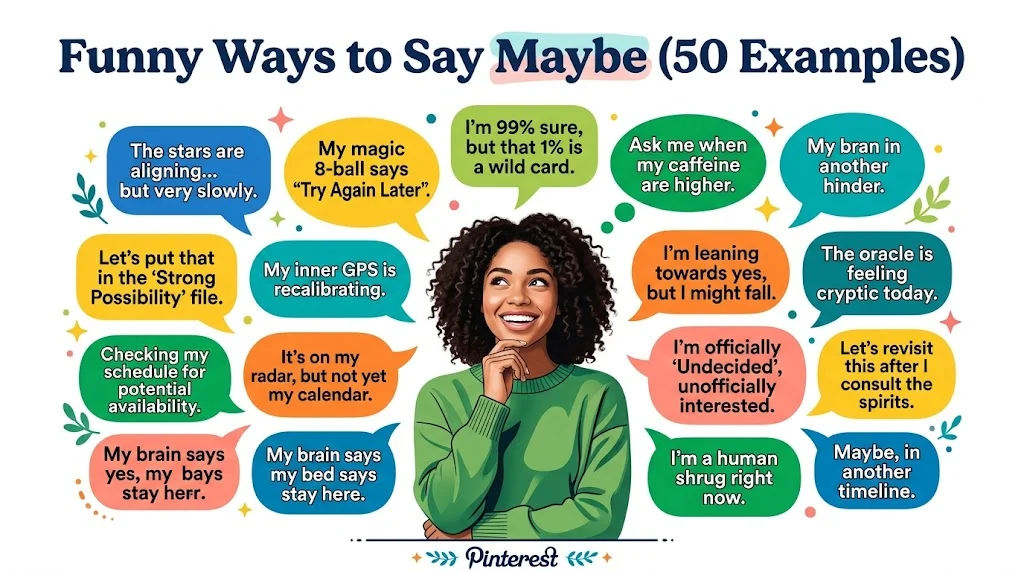
If you want funny ways to say maybe, try: “I’ll think about it,” “Ask me again later,” “Possibly, in another universe,” “It’s a strong maybe,” and “I’m 50/50 on that.”
These phrases add humor, personality, and flexibility while keeping your response light and engaging.
The phrase “maybe” is one of the most common ways to express uncertainty in English. It’s simple, neutral, and widely used in both spoken and written communication.
However, using the same word repeatedly can sound dull or vague. Learning alternatives to funny ways to say maybe helps you sound more expressive, natural, and even entertaining.
Whether you want to express excitement in English, sound witty, or adapt your tone for different situations, expanding your vocabulary makes your communication more effective and memorable.
“The right phrase can turn uncertainty into personality.”
Quick Categories Section
Formal alternatives to “funny ways to say maybe”
- It is possible
- I will consider it
- That remains uncertain
- Potentially
Pro Tip: Use formal phrases in emails or presentations to sound polished and professional.
Casual alternatives
- I guess so
- Could be
- We’ll see
- Maybe, maybe not
Pro Tip: Casual phrases work best in relaxed conversations with friends or colleagues.
Professional alternatives
- I’ll evaluate that
- Let me get back to you
- It’s under consideration
- That’s a possibility
Pro Tip: In business settings, replace humor with clarity and confidence.
Informal expressions
- Eh, maybe
- Not sure yet
- Ask me later
- It’s a toss-up
Pro Tip: Informal expressions are perfect for conversations but avoid them in formal writing.
“Fluency isn’t about big words—it’s about choosing the right tone.”
Common Mistakes Section
- Overusing “maybe”
Example: Maybe I’ll go, maybe I’ll call, maybe I’ll try. - Using it in formal writing
Example: Maybe we can approve the proposal. - Sounding too vague
Example: Maybe. (no context given) - Using humor in serious situations
Example: Maybe in another universe (in a job interview) - Incorrect placement in sentences
Example: I will maybe attend. (awkward structure)
What Does “Funny Ways to Say Maybe” Mean?
It refers to humorous or creative expressions used to show uncertainty instead of simply saying “maybe.”
Grammar Note: These phrases often replace adverbs like maybe or perhaps.
Example Sentence:
“I might join you… if my couch lets me go.”
When to Use “Funny Ways to Say Maybe”
- Casual conversations
- Social media captions
- Friendly chats
- Light-hearted situations
Spoken vs Written: Mostly spoken or informal writing
Formal vs Informal: Strongly informal
Is It Professional or Polite to Say “Funny Ways to Say Maybe”?
Polite? ✔️ Yes
Professional? ❌ No (in most cases)
Business Example:
“I will review the proposal and respond shortly.” (Better than a funny reply)
Pros and Cons of Using “Funny Ways to Say Maybe”
Pros
- Simple and natural
- Friendly tone
- Common usage
- Easy to understand
Cons
- Too informal for work
- Overused
- Limited emotional range
- Not suitable for formal writing
“Humor builds connection—but context builds credibility.”
Other Ways to Say “Funny Ways to Say Maybe” With Examples
These alternatives will help you sound more fluent, confident, and natural in different situations.
Use them according to tone, context, and audience.
1. Phrase: I’ll think about it
Meaning: You are undecided
Explanation: Suggests consideration
Example Sentence: I’ll think about it and let you know
Best Use: polite delay
Worst Use: urgent reply
Tone: neutral, polite
Context Variability: casual / professional
2. Phrase: Ask me again later
Meaning: Not ready to decide
Explanation: Delays decision humorously
Example Sentence: Ask me again later, I’m still deciding
Best Use: playful delay
Worst Use: formal meeting
Tone: light, casual
Context Variability: spoken
3. Phrase: It’s a strong maybe
Meaning: Likely but unsure
Explanation: Shows leaning toward yes
Example Sentence: It’s a strong maybe for tonight
Best Use: friendly plans
Worst Use: formal email
Tone: casual, confident
Context Variability: casual
4. Phrase: Possibly, in another universe
Meaning: Very unlikely
Explanation: Adds humor
Example Sentence: I’ll wake up early? Possibly, in another universe
Best Use: jokes
Worst Use: serious talk
Tone: humorous, sarcastic
Context Variability: spoken
5. Phrase: I’m 50/50
Meaning: Completely undecided
Explanation: Equal chance
Example Sentence: I’m 50/50 about going
Best Use: casual talk
Worst Use: formal writing
Tone: neutral, casual
Context Variability: casual
6. Phrase: We’ll see
Meaning: Future decision
Explanation: Non-committal
Example Sentence: We’ll see how things go
Best Use: flexible plans
Worst Use: firm commitments
Tone: relaxed
Context Variability: all
7. Phrase: Could be
Meaning: Possible
Explanation: Slight uncertainty
Example Sentence: Could be a good idea
Best Use: quick reply
Worst Use: detailed discussion
Tone: casual
Context Variability: spoken
8. Phrase: Depends
Meaning: Conditional
Explanation: Needs more info
Example Sentence: Depends on the timing
Best Use: clarification
Worst Use: vague reply
Tone: neutral
Context Variability: all
9. Phrase: I guess so
Meaning: Slight agreement
Explanation: Mild uncertainty
Example Sentence: I guess so, why not
Best Use: casual agreement
Worst Use: strong decision
Tone: soft
Context Variability: casual
10. Phrase: Let me get back to you
Meaning: Delayed answer
Explanation: Professional alternative
Example Sentence: Let me get back to you tomorrow
Best Use: business
Worst Use: casual joke
Tone: professional
Context Variability: professional
11. Phrase: Maybe, maybe not
Meaning: Uncertain outcome
Explanation: Shows equal possibility of yes or no
Example Sentence: Maybe, maybe not—we’ll find out soon
Best Use: casual talk
Worst Use: formal writing
Tone: playful, balanced
Context Variability: spoken
12. Phrase: Time will tell
Meaning: Future will decide
Explanation: Indicates uncertainty over time
Example Sentence: Time will tell if it works
Best Use: reflective
Worst Use: urgent decisions
Tone: thoughtful, neutral
Context Variability: all
13. Phrase: I’ll see how I feel
Meaning: Mood-based decision
Explanation: Depends on personal feelings later
Example Sentence: I’ll see how I feel tonight
Best Use: casual plans
Worst Use: commitments
Tone: relaxed, casual
Context Variability: spoken
14. Phrase: Not sure yet
Meaning: Still undecided
Explanation: Direct expression of uncertainty
Example Sentence: Not sure yet, I’ll let you know
Best Use: simple reply
Worst Use: formal email
Tone: neutral, casual
Context Variability: casual
15. Phrase: It’s up in the air
Meaning: Not decided yet
Explanation: Outcome is unclear
Example Sentence: The plan is still up in the air
Best Use: discussions
Worst Use: firm commitments
Tone: neutral
Context Variability: all
16. Phrase: I might
Meaning: Possible action
Explanation: Shows slight possibility
Example Sentence: I might join you later
Best Use: casual reply
Worst Use: official response
Tone: light, informal
Context Variability: spoken
17. Phrase: There’s a chance
Meaning: Some possibility
Explanation: Indicates probability
Example Sentence: There’s a chance I’ll come
Best Use: neutral
Worst Use: precise planning
Tone: neutral
Context Variability: all
18. Phrase: I’ll consider it
Meaning: Thinking about it
Explanation: Shows willingness to evaluate
Example Sentence: I’ll consider your suggestion
Best Use: professional
Worst Use: jokes
Tone: formal, polite
Context Variability: professional
19. Phrase: Possibly
Meaning: Maybe
Explanation: Formal synonym of maybe
Example Sentence: Possibly, we can proceed
Best Use: formal writing
Worst Use: casual humor
Tone: formal
Context Variability: formal
20. Phrase: I’m on the fence
Meaning: Unable to decide
Explanation: Stuck between choices
Example Sentence: I’m on the fence about this
Best Use: opinions
Worst Use: urgent matters
Tone: casual
Context Variability: casual
21. Phrase: I’ll play it by ear
Meaning: Decide later
Explanation: No fixed plan yet
Example Sentence: I’ll play it by ear this weekend
Best Use: flexible plans
Worst Use: business
Tone: relaxed, informal
Context Variability: spoken
22. Phrase: It’s a toss-up
Meaning: Equal chance
Explanation: Either option is possible
Example Sentence: It’s a toss-up between both options
Best Use: choices
Worst Use: formal reports
Tone: casual
Context Variability: casual
23. Phrase: Could go either way
Meaning: Uncertain outcome
Explanation: Both results are possible
Example Sentence: It could go either way
Best Use: discussion
Worst Use: commitment
Tone: neutral
Context Variability: all
24. Phrase: I’ll decide later
Meaning: Postponed decision
Explanation: Choosing at a later time
Example Sentence: I’ll decide later today
Best Use: neutral
Worst Use: urgent
Tone: neutral
Context Variability: all
25. Phrase: Let’s wait and see
Meaning: Observe first
Explanation: Delay decision
Example Sentence: Let’s wait and see what happens
Best Use: planning
Worst Use: deadlines
Tone: calm, neutral
Context Variability: all
26. Phrase: I’m thinking about it
Meaning: Considering
Explanation: Decision not final
Example Sentence: I’m thinking about your idea
Best Use: polite
Worst Use: urgent reply
Tone: neutral
Context Variability: all
27. Phrase: I’m undecided
Meaning: No decision yet
Explanation: Clear uncertainty
Example Sentence: I’m still undecided
Best Use: formal
Worst Use: humor
Tone: neutral
Context Variability: all
28. Phrase: It’s still open
Meaning: Not finalized
Explanation: Decision is pending
Example Sentence: The offer is still open
Best Use: work
Worst Use: jokes
Tone: neutral, professional
Context Variability: professional
29. Phrase: I’m not committing yet
Meaning: Avoiding decision
Explanation: Holding back from agreeing
Example Sentence: I’m not committing yet
Best Use: clarity
Worst Use: casual humor
Tone: firm
Context Variability: all
30. Phrase: I’ll keep it in mind
Meaning: Considering for later
Explanation: Polite non-commitment
Example Sentence: I’ll keep it in mind for future plans
Best Use: polite
Worst Use: direct answer
Tone: polite, soft
Context Variability: professional
“Small changes in wording can make your English sound natural and confident.”
Mini Quiz / Self-Check
1. Which phrase is best for a business email?
A. Maybe
B. Let me get back to you ✔️
C. Ask me later
2. Which is the funniest option?
A. Possibly
B. In another universe ✔️
C. I will consider it
3. Which is most formal?
A. Could be
B. Potentially ✔️
C. We’ll see
Comparison Table: Top Alternatives
| Phrase | Tone | Best Use |
|---|---|---|
| Let me get back to you | Professional | Work emails |
| I’ll think about it | Neutral | General use |
| We’ll see | Casual | Conversations |
| Possibly | Formal | Writing |
| I’m 50/50 | Casual | Friends |
| Depends | Neutral | Clarifying |
| I guess so | Soft | Informal |
| Time will tell | Reflective | General |
| On the fence | Casual | Opinions |
| Under consideration | Professional | Business |
FAQs
1. What are the best funny ways to say maybe?
Playful phrases like “Ask me later” or “In another universe” work best.
2. Are funny alternatives to maybe professional?
No, most are informal and not suitable for business communication.
3. How can I sound more fluent using alternatives?
Use tone-appropriate phrases depending on context and audience.
4. What is the most polite alternative?
“I’ll consider it” or “Let me get back to you.”
5. Can I use these in writing?
Yes, but only in informal or creative writing.
Conclusion
Learning funny ways to say maybe helps you communicate with more personality, flexibility, and confidence. It allows you to adapt your tone depending on the situation, whether casual or professional.
Practice these phrases daily to improve fluency. The key is not just vocabulary but choosing the right expression for the right moment.
CTA: Which phrase will you start using today? Try it in your next conversation.