Last Updated on March 27, 2026
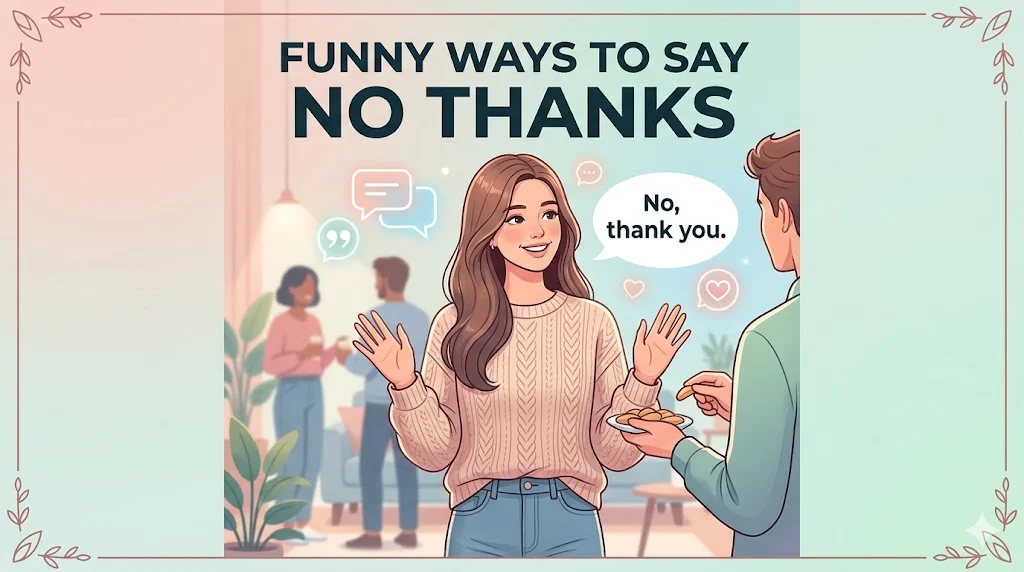
Looking for funny ways to say no thanks without sounding rude? Try these: I’ll pass, but I appreciate it, Tempting, but not today, Hard pass, I’m good, thanks, Maybe another time. These alternatives keep your tone light, polite, and engaging.
The phrase “no thanks” is a simple and polite way to decline something. However, using the same expression repeatedly can sound flat or predictable in conversation.
That’s why learning alternatives to funny ways to say no thanks helps you sound more natural and expressive. Whether you want to soften your refusal or add humor, variety improves your communication.
Expanding your vocabulary also helps you express excitement in English while still maintaining politeness, especially in social and professional settings.
“The way you say no matters just as much as the words you choose.”
Quick Categories Section
Formal Alternatives to “funny ways to say no thanks”
- I must respectfully decline
- I appreciate the offer, but I’ll pass
- Thank you, but I’m unable to accept
- I’ll have to decline at this time
Pro Tip: Use formal phrases in emails, meetings, or when speaking with senior professionals.
Casual Alternatives
- I’m good, thanks
- I’ll pass
- Not today
- Maybe next time
Pro Tip: Casual phrases work best with friends or relaxed conversations.
Professional Alternatives
- I’ll have to pass on this
- I appreciate the opportunity, but I’ll decline
- That won’t be possible for me
- I’ll need to say no for now
Pro Tip: Keep your tone polite and neutral in workplace communication.
Informal Expressions
- Hard pass
- I’m gonna sit this one out
- That’s a no from me
- I’ll skip it
Pro Tip: Informal expressions are great for humor but avoid them in formal writing.
“A polite refusal keeps doors open while protecting your boundaries.”
Common Mistakes
- Being too blunt
Example: No. → Sounds rude without context - Over-explaining
Example: No thanks, I can’t because I have 10 things… → Too long - Using slang in formal settings
Example: Hard pass, boss → Unprofessional - Sounding uncertain
Example: I guess no? → Lacks confidence - Forgetting politeness markers
Example: I don’t want it → Missing “thank you”
What Does “funny ways to say no thanks” Mean?
It refers to creative or humorous alternatives used to politely refuse something while keeping the tone light and engaging.
Grammar Note: Usually used as a standalone response or short sentence.
Example:
Do you want more coffee?
No thanks, I’m good.
When to Use “funny ways to say no thanks”
- Declining offers politely
- Avoiding awkward situations
- Keeping conversations light
- Social or casual interactions
Spoken vs Written: More common in spoken English
Formal vs Informal: Generally informal
Is It Professional or Polite to Say “funny ways to say no thanks”?
Polite? ✔️ Yes
Professional? ❌ No (in most cases)
Business Example:
Thank you for the proposal, but I’ll have to decline at this time.
Pros and Cons of Using “funny ways to say no thanks”
Pros
- Simple and natural
- Friendly tone
- Common usage
- Easy to understand
Cons
- Too informal for work
- Overused
- Limited emotional range
- Not suitable for formal writing
“Fluency is not about knowing more words—it’s about choosing the right ones.”
Other Ways to Say “funny ways to say no thanks” With Examples
These alternatives to funny ways to say no thanks will help you sound more fluent, confident, and natural in different situations.
Use them based on tone, audience, and context.
1. Phrase: I’ll pass
Meaning: Politely refusing
Explanation: Simple and neutral
Example Sentence: I’ll pass on dessert, thanks
Best Use: casual polite
Worst Use: formal email
Tone: neutral, polite
Context Variability: casual / spoken
2. Phrase: Hard pass
Meaning: Strong refusal
Explanation: Emphasizes no
Example Sentence: That’s a hard pass for me
Best Use: friends humor
Worst Use: workplace
Tone: firm, playful
Context Variability: casual
3. Phrase: Maybe next time
Meaning: Declining for now
Explanation: Keeps door open
Example Sentence: Maybe next time, I’m busy today
Best Use: friendly polite
Worst Use: final decisions
Tone: soft, friendly
Context Variability: casual / spoken
4. Phrase: I’m good, thanks
Meaning: No need
Explanation: Casual refusal
Example Sentence: I’m good, thanks—I already ate
Best Use: everyday
Worst Use: formal writing
Tone: relaxed, polite
Context Variability: casual
5. Phrase: Tempting, but no
Meaning: Acknowledges appeal
Explanation: Adds humor
Example Sentence: Tempting, but no—I’ll behave
Best Use: light humor
Worst Use: serious context
Tone: playful
Context Variability: casual
6. Phrase: I’ll skip this one
Meaning: Choosing not to join
Explanation: Soft decline
Example Sentence: I’ll skip this one today
Best Use: group plans
Worst Use: formal
Tone: calm, neutral
Context Variability: casual
7. Phrase: Not today
Meaning: Declining now
Explanation: Short and clear
Example Sentence: Not today, maybe later
Best Use: quick replies
Worst Use: emails
Tone: casual
Context Variability: spoken
8. Phrase: I’ll sit this out
Meaning: Not participating
Explanation: Used in group situations
Example Sentence: I’ll sit this one out
Best Use: activities
Worst Use: formal
Tone: neutral
Context Variability: casual
9. Phrase: I’ll have to pass on that
Meaning: Polite refusal
Explanation: Slightly more formal
Example Sentence: I’ll have to pass on that offer
Best Use: semi-formal
Worst Use: slang context
Tone: polite
Context Variability: professional
10. Phrase: Thanks, but I’m not interested
Meaning: Clear refusal
Explanation: Direct but polite
Example Sentence: Thanks, but I’m not interested
Best Use: firm polite
Worst Use: sensitive cases
Tone: direct
Context Variability: professional
11. Phrase: I’ll decline this time
Meaning: Refusing politely for now
Explanation: Keeps the tone respectful and temporary
Example Sentence: I’ll decline this time, but thank you for asking
Best Use: polite situations
Worst Use: casual chats
Tone: formal, polite
Context Variability: professional / spoken
12. Phrase: I’m going to pass
Meaning: Choosing not to accept
Explanation: Neutral and commonly used
Example Sentence: I’m going to pass on that offer
Best Use: everyday use
Worst Use: formal emails
Tone: neutral, calm
Context Variability: casual / spoken
13. Phrase: Not for me
Meaning: Not suitable or preferred
Explanation: Short and slightly informal
Example Sentence: Thanks, but that’s not for me
Best Use: casual talk
Worst Use: professional settings
Tone: casual, direct
Context Variability: informal
14. Phrase: I’ll skip it
Meaning: Choosing not to participate
Explanation: Light and simple refusal
Example Sentence: I’ll skip it this time
Best Use: group settings
Worst Use: formal writing
Tone: relaxed, neutral
Context Variability: casual
15. Phrase: I’m all set
Meaning: No need for anything more
Explanation: Implies satisfaction already
Example Sentence: I’m all set, thanks
Best Use: polite casual
Worst Use: formal contexts
Tone: friendly, relaxed
Context Variability: casual / spoken
16. Phrase: I’ll take a rain check
Meaning: Declining now but maybe later
Explanation: Keeps future possibility open
Example Sentence: I’ll take a rain check for now
Best Use: social plans
Worst Use: final decisions
Tone: friendly, polite
Context Variability: casual
17. Phrase: I’m okay for now
Meaning: No need at the moment
Explanation: Soft and indirect refusal
Example Sentence: I’m okay for now, thank you
Best Use: polite responses
Worst Use: strong refusals
Tone: gentle, polite
Context Variability: casual / spoken
18. Phrase: I’ll leave it
Meaning: Choosing not to take or do something
Explanation: Common in British English
Example Sentence: I’ll leave it, thanks
Best Use: casual conversation
Worst Use: formal writing
Tone: neutral
Context Variability: informal
19. Phrase: I’ll say no this time
Meaning: Temporary refusal
Explanation: Clear but still polite
Example Sentence: I’ll say no this time, maybe later
Best Use: friendly tone
Worst Use: formal use
Tone: neutral, soft
Context Variability: casual
20. Phrase: I appreciate it, but no
Meaning: Polite but firm refusal
Explanation: Acknowledges the offer first
Example Sentence: I appreciate it, but no thank you
Best Use: respectful decline
Worst Use: very formal emails
Tone: polite, firm
Context Variability: semi-professional
“Adding appreciation before refusal makes your English sound more respectful.”
21. Phrase: I’ll bow out
Meaning: Choosing to withdraw
Explanation: Slightly formal and graceful
Example Sentence: I’ll bow out of this one
Best Use: group or events
Worst Use: casual slang settings
Tone: polite, graceful
Context Variability: semi-formal
22. Phrase: Count me out
Meaning: Clearly not participating
Explanation: Firm and direct
Example Sentence: Count me out for tonight
Best Use: casual group talk
Worst Use: professional emails
Tone: direct, firm
Context Variability: casual
23. Phrase: I’m sitting this one out
Meaning: Not joining an activity
Explanation: Common in group situations
Example Sentence: I’m sitting this one out today
Best Use: activities
Worst Use: business communication
Tone: neutral
Context Variability: casual
24. Phrase: I’ll keep it simple—no thanks
Meaning: Clear and polite refusal
Explanation: Balanced tone
Example Sentence: I’ll keep it simple—no thanks
Best Use: polite clarity
Worst Use: very formal writing
Tone: calm, polite
Context Variability: semi-casual
25. Phrase: I’m not up for it
Meaning: Not interested or not in the mood
Explanation: Expresses personal feeling
Example Sentence: I’m not up for it today
Best Use: casual honesty
Worst Use: professional settings
Tone: informal, honest
Context Variability: casual
26. Phrase: I’ll opt out
Meaning: Choosing not to participate
Explanation: Slightly formal phrasing
Example Sentence: I’ll opt out of this meeting
Best Use: professional contexts
Worst Use: playful settings
Tone: formal, neutral
Context Variability: professional
27. Phrase: I’ll pass this round
Meaning: Declining temporarily
Explanation: Often used in games or group activities
Example Sentence: I’ll pass this round
Best Use: group activities
Worst Use: formal writing
Tone: casual
Context Variability: spoken
28. Phrase: I’m going to say no
Meaning: Direct refusal
Explanation: Clear and straightforward
Example Sentence: I’m going to say no for now
Best Use: clarity
Worst Use: sensitive situations
Tone: direct
Context Variability: casual / semi-formal
29. Phrase: I’ll pass politely
Meaning: Respectful refusal
Explanation: Emphasizes politeness
Example Sentence: I’ll pass politely on that
Best Use: respectful tone
Worst Use: casual slang
Tone: polite
Context Variability: semi-formal
30. Phrase: I’ll respectfully decline
Meaning: Formal refusal
Explanation: Very professional and appropriate for business
Example Sentence: I’ll respectfully decline your offer
Best Use: business communication
Worst Use: casual chats
Tone: formal, professional
Context Variability: professional
“Polite refusals show confidence, not weakness.”
Mini Quiz / Self-Check
1. Which is best for a business email?
A. Hard pass
B. I’ll respectfully decline ✔️
C. Not today
2. Which sounds most casual?
A. I’ll pass ✔️
B. I must decline
C. I appreciate the offer
3. Which keeps future options open?
A. No
B. Maybe next time ✔️
C. Hard pass
Comparison Table: Top Alternatives
| Phrase | Tone | Best Use |
|---|---|---|
| I’ll pass | Neutral | Everyday |
| Hard pass | Playful | Friends |
| Maybe next time | Friendly | Social |
| I’m good, thanks | Relaxed | Casual |
| I’ll decline | Formal | Work |
| I’ll skip this one | Neutral | Group plans |
| Not today | Casual | Quick reply |
| I’ll sit this out | Calm | Activities |
| Thanks, but no | Direct | Clear refusal |
| I appreciate it, but I’ll pass | Polite | Professional |
FAQs
1. What are the best funny ways to say no thanks?
Light phrases like Hard pass or Tempting, but no are popular and sound playful.
2. Are funny refusals polite?
Yes, if used with the right tone and audience.
3. Can I use these in professional emails?
Only the more formal alternatives like I’ll respectfully decline.
4. Why learn alternatives to funny ways to say no thanks?
They improve fluency and help you adapt to different social contexts.
5. What is the safest professional phrase?
I appreciate the offer, but I’ll have to decline.
Conclusion
Learning funny ways to say no thanks and their alternatives gives you more control over tone, politeness, and clarity. It helps you communicate confidently in both casual and professional settings.
Practice using different expressions daily. Over time, you’ll naturally choose the right phrase based on context, making your English sound more fluent and intentional.
CTA: Try using 3 new alternatives today in real conversations to build confidence and fluency.