
Last Updated on February 26, 2026
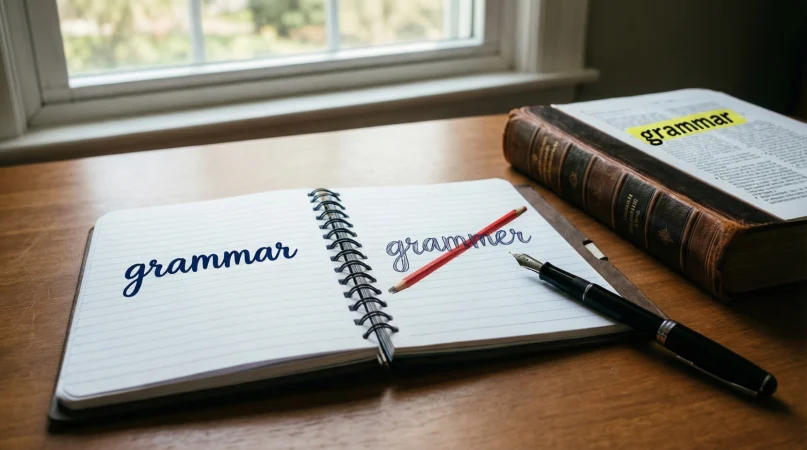
Confused about grammar or grammer? The correct spelling is grammar, which refers to the system of rules that structure a language, including syntax and word forms. Grammer is a common misspelling with no meaning in standard English, and using it can make writing appear careless or unprofessional.
If you have ever typed grammar or grammer into a search bar, you are not alone. Grammar is a real word that names the rule system governing how a language works. Grammer, on the other hand, is simply a spelling error. This confusion leads to real mistakes in essays, emails, job applications, and even published content, where a single letter can affect credibility, grades, and professional trust.
Understanding the difference is not just about spelling. It is about clarity, authority, and using language with confidence.
Grammar or Grammer: What Is the Difference?
At its core, this is a spelling and meaning distinction.
Grammar is a noun. It refers to the structured system of rules that control how words combine into sentences. These rules include sentence structure, verb forms, agreement, and punctuation patterns.
Grammer is not a standard English word. It has no accepted meaning in modern dictionaries. When it appears, it is almost always an accidental misspelling of grammar.
Comparison Table
| Term | Part of Speech | Meaning | Correct in Standard English | Example Sentence |
|---|---|---|---|---|
| Grammar | Noun | The system of language rules covering sentence structure and word forms | Yes | Good grammar helps readers understand your message clearly. |
| Grammer | None | No meaning. Misspelling of grammar | No | Incorrect spelling can weaken your credibility. |
Mini Recap
Grammar is a real word with a clear linguistic meaning.
Grammer is a spelling mistake, not a variant or informal form.
They are not interchangeable in any context.
Using the wrong form can affect how others judge your writing.
Is Grammar or Grammer a Grammar, Vocabulary, or Usage Issue?
Interestingly, the grammar or grammer confusion is not actually a grammar rule problem. It is primarily a spelling and vocabulary issue.
These two forms are not interchangeable. Grammar is correct in formal writing, academic work, professional communication, and casual conversation. Grammer is incorrect everywhere in standard English, regardless of tone or setting.
In academic environments, spelling accuracy signals care and competence. In workplace communication, errors in common words can influence how colleagues or clients perceive attention to detail. Even in casual digital spaces, repeated misspellings may reduce clarity or credibility.
So this is not about formal versus informal style. It is about correct versus incorrect spelling.
Understanding Grammar in Real World Contexts
Because grammar is the only correct term, it is important to see how it functions across different settings.
Workplace Example
A manager reviewing a report might comment, “The data is strong, but the grammar needs improvement.” Here, grammar refers to sentence clarity, correct verb forms, and proper punctuation. Clear grammar supports professionalism and prevents misunderstandings.
Academic Example
In a university essay, a professor may write, “Your argument is interesting, but frequent grammar errors make it harder to follow.” In this case, grammar includes sentence structure, agreement, and word order. Strong grammar often contributes directly to higher grades.
Technology Example
Modern writing tools often include grammar checking features. When a software program highlights a sentence and suggests a correction, it is analyzing grammar patterns such as verb tense consistency or subject verb agreement.
Usage Recap for Grammar
Grammar refers to language rules.
It is used in education, business, and technology.
The word carries authority and precision.
It should always be spelled g r a m m a r.
Why Grammer Is Incorrect in Every Context
Since grammer has no accepted meaning, its only role in writing is as an error.
Workplace Example
If someone writes, “Please check the grammer in this document,” the message is still understandable, but the misspelling may make the writer appear less careful. In competitive fields, small details can influence impressions.
Academic Example
A student who writes about “English grammer rules” in an exam or paper may lose marks simply for incorrect spelling, even if the concept is understood. Accuracy matters in formal assessment.
Technology Example
Search engines and writing tools often auto correct grammer to grammar. This reflects the fact that grammer is not recognized as a valid word in standard dictionaries or language databases.
Usage Recap for Grammer
Grammer is a misspelling.
It has no formal definition.
It should be corrected to grammar in all serious writing.
Relying on spell check can help, but awareness is better.
When You Should NOT Use Grammar or Grammer
Even though grammar is the correct word, there are situations where people misuse it conceptually. Here are common problem scenarios.
- Using grammar to mean vocabulary. Vocabulary refers to word choice, not sentence structure rules.
- Saying grammar when you mean spelling. Spelling concerns letter order in words, not rule systems.
- Blaming grammar for unclear ideas. Sometimes the issue is logic or organization, not grammar.
- Using grammar as an insult rather than feedback. Constructive advice is more helpful than vague criticism.
- Confusing grammar with accent or pronunciation. Spoken features are part of phonology, not grammar alone.
- Treating grammar rules as fixed across all dialects. Different dialects can have valid grammatical systems.
- Assuming grammar only matters in writing. Spoken language also follows grammatical patterns.
In contrast, you should never use grammer in any of these situations because it remains an error regardless of intent.
Common Mistakes and Decision Rules
Here is a quick reference to spot and fix errors.
| Correct Sentence | Incorrect Sentence | Explanation |
|---|---|---|
| Her grammar has improved a lot this year. | Her grammer has improved a lot this year. | Grammar is the correct spelling of the noun. |
| This course teaches English grammar. | This course teaches English grammer. | Grammer is not a recognized word. |
| Good grammar makes writing easier to read. | Good grammer makes writing easier to read. | The double m and ar ending form the standard spelling. |
Decision Rule Box
If you mean the system of language rules, use grammar.
If you are about to type grammer, stop and correct the spelling.
There is no context where grammer is the standard form.
Grammar or Grammer in Modern Technology and AI Tools
Digital writing assistants, search engines, and language learning apps all recognize grammar as a core concept. They analyze grammar patterns to suggest clearer sentence structures and correct errors.
When users type grammer into search engines, algorithms typically interpret it as grammar and show corrected results. This automatic correction highlights how deeply established the correct spelling is in language technology systems.
Word History and Expert Insight
The word grammar comes from the Greek word grammatike, meaning the art of letters. It entered English through Latin and Old French, gradually narrowing in meaning to refer specifically to language structure rules.
As linguist David Crystal has noted, grammar is not about policing language but about describing how it works in real life. This perspective reminds us that grammar is a system we all use naturally, even when we are not aware of the rules.
Case Studies: The Real Impact of Spelling Grammar Correctly
Case Study One: Academic Performance
A secondary school introduced focused lessons on common language confusions, including grammar versus grammer. Over one term, teachers reported a noticeable drop in basic spelling errors in essays. Students who previously lost marks for simple mistakes improved their writing scores by an average of ten percent.
Case Study Two: Professional Communication
A small marketing firm conducted an internal review of client emails. They found that early messages sent by new staff sometimes included spelling mistakes in key terms like grammar. After a short training session and proofreading checklist, client satisfaction ratings improved, and fewer clarification emails were needed. Clear, correct language helped build trust.
Author Note
Written by a language specialist with more than a decade of experience in linguistics, education, and professional content strategy.
Error Prevention Checklist
Always use grammar when referring to language rules, sentence structure, or correctness.
Always double check spelling in academic and professional documents.
Never use grammer in formal writing.
Never assume spell check will catch every mistake.
Review headings, titles, and important labels for correct spelling.
Grammar or Grammer and Related Confusions You Should Master
Writers who mix up grammar and grammer often struggle with other similar pairs. Building awareness of these can sharpen overall accuracy.
Affect versus effect
Their versus there versus they are
Your versus you are
Its versus it is
Then versus than
Lose versus loose
Advice versus advise
Compliment versus complement
Principle versus principal
Mastering these distinctions strengthens both written clarity and reader trust.
FAQs
Is grammer ever a correct spelling in English?
No. Grammer is considered a misspelling in standard English. The only correct form for the language rule system is grammar.
Why do so many people type grammer instead of grammar?
The error often happens because of pronunciation patterns and typing habits. People may not notice the ar ending or may rely too heavily on sound rather than memorized spelling.
Does using grammer instead of grammar really matter?
Yes, especially in formal contexts. Misspelling a common academic word can affect grades, job applications, and professional credibility.
How can I remember the correct spelling of grammar?
Focus on the ending ar. You can associate grammar with similar words like calendar or familiar that also end in ar.
Do search engines understand grammer as grammar?
Most modern search engines automatically interpret grammer as grammar and show corrected results, but that does not make the spelling correct in your own writing.
Is grammar the same as punctuation?
Not exactly. Punctuation is part of writing mechanics, while grammar covers broader structural rules like sentence formation and agreement.
Can grammar rules change over time?
Yes. Grammar evolves as language changes. However, the spelling of the word grammar itself has remained stable in modern English.
Why is grammar important in professional writing?
Strong grammar improves clarity, reduces misunderstandings, and signals attention to detail. This builds trust with readers, clients, and colleagues.
Conclusion
The grammar or grammer confusion may seem small, but it reflects a larger issue of accuracy and authority in language use. Grammar is the correct term for the rule system that shapes how we speak and write. Grammer is simply an error. Choosing the right spelling shows care, strengthens credibility, and helps your message land exactly as you intend.