
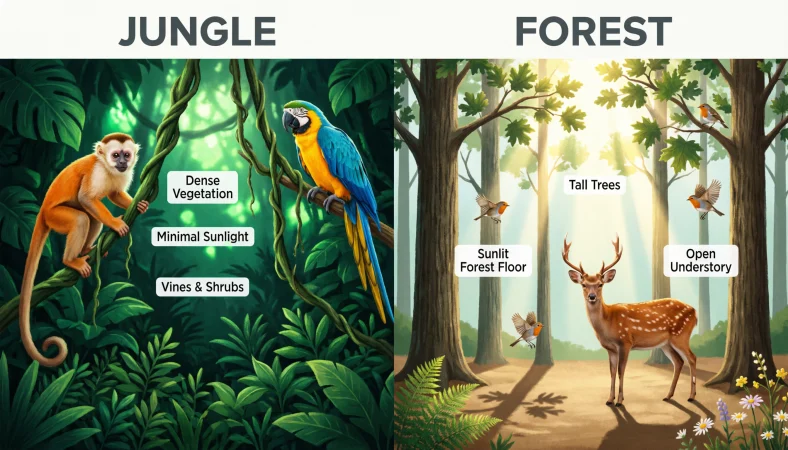
A jungle is a dense, tangled area of vegetation with thick undergrowth that is difficult to walk through. A forest is a large area dominated by trees, often with a clearer structure and less dense ground vegetation. In simple terms, all jungles are forests, but not all forests are jungles.
Many people use the words jungle and forest as if they mean the same thing. Movies, books, and documentaries often mix them. But in nature and science, the two terms describe different types of ecosystems.
Understanding the difference between jungle vs forest helps us learn more about the planet. It also helps students, travelers, researchers, and nature lovers describe environments correctly.
A forest is a large area filled with trees. Forests can exist in many climates such as cold, warm, dry, or wet regions.
A jungle, on the other hand, is very dense and thick vegetation. Jungles usually grow in warm tropical areas. The plants grow so closely together that sunlight struggles to reach the ground.
This confusion happens because many jungles grow inside tropical forests. When people see dense plants, vines, and animals, they call it a jungle.
In this article, we will explore the complete comparison of jungle vs forest, including definitions, features, advantages, examples, common mistakes, and exercises to help you understand the topic clearly.
Quick Answer / Overview
The difference between jungle vs forest mainly depends on vegetation density and structure.
| Feature | Jungle | Forest |
|---|---|---|
| Vegetation | Very dense | Moderate to dense |
| Sunlight | Very little reaches the ground | More sunlight reaches ground |
| Movement | Hard to walk through | Usually easier to move |
| Climate | Mostly tropical | Found in many climates |
| Biodiversity | Extremely high | High but varies |
Simple Rule
Think of it this way:
Forest = Trees
Jungle = Thick plants and undergrowth inside some forests
Definition and Explanation
What Is a Forest?
A forest is a large land area covered mainly by trees. Forests are one of the most important ecosystems on Earth.
They support wildlife, regulate climate, and produce oxygen.
Key Characteristics of Forests
• Large area with trees
• Multiple plant layers
• Home to animals, insects, fungi, and microorganisms
• Present in many climates
Types of Forests
There are several types of forests:
| Forest Type | Climate | Example |
|---|---|---|
| Tropical Forest | Warm and wet | Amazon Rainforest |
| Temperate Forest | Moderate climate | North American forests |
| Boreal Forest | Cold climate | Siberian taiga |
Forests often have structured layers.
Forest Layers
- Canopy – top layer of trees
- Understory – smaller trees and shrubs
- Forest floor – soil, fungi, insects
Sunlight can reach the lower layers in many forests.
What Is a Jungle?
A jungle is a dense area of vegetation with thick plants, vines, and shrubs growing closely together.
The word “jungle” originally comes from the Hindi word jangal, meaning wild or uncultivated land.
Key Characteristics of Jungles
• Extremely thick vegetation
• Dense shrubs and vines
• Limited sunlight on the ground
• Very difficult to walk through
• Mostly found in tropical climates
Jungles often grow where sunlight reaches the forest floor, encouraging fast plant growth.
This creates a tangled mass of vegetation.
Typical Jungle Plants
Examples include:
• Vines
• Bamboo
• Shrubs
• Tall grasses
• Small trees
This makes jungles feel crowded and chaotic compared to forests.
Jungle vs Forest Comparison
Here is a deeper comparison of jungle vs forest.
| Aspect | Jungle | Forest |
|---|---|---|
| Structure | Dense and tangled | Organized layers |
| Accessibility | Difficult to navigate | Often accessible |
| Plant density | Extremely high | Moderate to high |
| Sunlight | Minimal ground sunlight | Partial sunlight |
| Location | Tropical regions | Worldwide |
| Tree dominance | Less dominant | Trees dominate |
Important Insight
A jungle is often a part of a tropical forest where vegetation becomes extremely dense.
Advantages and Disadvantages
Advantages of Forests
Forests provide many environmental benefits.
Environmental Benefits
• Produce oxygen
• Absorb carbon dioxide
• Regulate climate
• Prevent soil erosion
• Maintain water cycles
Biodiversity Support
Forests support:
• Mammals
• Birds
• Reptiles
• Insects
• Plants
They act as natural biodiversity hubs.
Disadvantages of Forests
Although forests are beneficial, they also have challenges.
• Difficult terrain for human settlement
• Risk of wildfires
• Deforestation pressure
• Wildlife conflicts
Advantages of Jungles
Jungles support some of the richest ecosystems on Earth.
Biodiversity
Many rare species live in jungles.
Examples include:
• Jaguars
• Parrots
• Monkeys
• Poison dart frogs
Natural Protection
Dense vegetation provides protection for wildlife.
Disadvantages of Jungles
Jungles also present difficulties.
• Hard for humans to navigate
• High humidity and disease risk
• Dangerous animals and insects
• Limited sunlight at ground level
Real World Examples
Understanding jungle vs forest becomes easier when looking at real places.
Famous Forests
Amazon Rainforest
The Amazon is the largest tropical forest in the world.
It spans multiple countries in South America.
It contains:
• Dense trees
• Rivers
• Diverse wildlife
Some parts of the Amazon contain jungle like vegetation.
Black Forest in Germany
This is a temperate forest known for:
• Tall pine trees
• Scenic landscapes
• Hiking trails
It is clearly a forest, not a jungle, because vegetation is not tangled.
Famous Jungles
Congo Basin Jungle
Central Africa has dense jungle vegetation.
Plants grow so thick that walking becomes difficult.
Southeast Asian Jungles
Countries such as:
• Malaysia
• Indonesia
• Thailand
have dense tropical jungles with thick vegetation.
Regional and Global Usage
Different parts of the world use the words jungle vs forest differently.
Scientific Usage
Scientists prefer the term forest when describing ecosystems.
“Jungle” is used less often in scientific classification.
Popular Culture
Movies and books often use jungle to describe exotic tropical forests.
Examples include adventure stories.
Geographic Usage
| Region | Common Term |
|---|---|
| Europe | Forest |
| North America | Forest |
| South America | Rainforest or jungle |
| Southeast Asia | Jungle |
Common Mistakes
People frequently misunderstand jungle vs forest.
Here are common mistakes.
Mistake 1: Thinking They Are Identical
Correction:
A jungle is a type of dense vegetation, often within forests.
Mistake 2: Calling Every Tropical Forest a Jungle
Correction:
Not all tropical forests have dense undergrowth.
Mistake 3: Assuming Jungles Only Contain Trees
Correction:
Jungles contain vines, shrubs, grasses, and small plants more than large trees.
Mistake 4: Believing Jungles Exist Everywhere
Correction:
Jungles mainly grow in tropical climates with high rainfall.
Related Concepts and Comparisons
Understanding jungle vs forest also involves related ecosystems.
Rainforest
A rainforest is a forest with heavy rainfall.
Many rainforests contain jungle areas.
Woodland
Woodlands have fewer trees and more open space.
They are less dense than forests.
Savanna
Savannas contain grasslands with scattered trees.
They are very different from jungles.
Comparison Table
| Ecosystem | Density | Climate |
|---|---|---|
| Jungle | Extremely dense | Tropical |
| Forest | Moderate to dense | Various |
| Woodland | Light tree cover | Temperate |
| Savanna | Mostly grass | Tropical dry |
Exercises with Answers
These exercises help reinforce the concept of jungle vs forest.
Exercise 1
Identify whether the description refers to a jungle or forest.
- Thick vines and shrubs block movement.
- Large area dominated by tall trees.
- Very dense tropical vegetation.
- Temperate ecosystem with pine trees.
Answers
- Jungle
- Forest
- Jungle
- Forest
Exercise 2
Fill in the blanks.
- A jungle is usually found in ______ climates.
- A forest is mainly dominated by ______.
- Jungles have thick ______ vegetation.
Answers
- Tropical
- Trees
- Dense
Exercise 3
True or False
- All jungles are forests.
- All forests are jungles.
- Jungles are easy to walk through.
Answers
- True
- False
- False
FAQs
What is the main difference between jungle vs forest?
The main difference is vegetation density. A forest is a tree dominated ecosystem, while a jungle has extremely dense undergrowth and tangled plants.
Is a jungle a type of forest?
Yes. In many cases, a jungle forms within tropical forests where sunlight allows dense vegetation to grow.
Why are jungles harder to walk through than forests?
Jungles contain thick vines, shrubs, and tangled plants that block movement, unlike forests where the ground is often clearer.
Are all tropical forests jungles?
No. Some tropical forests have tall trees with little undergrowth, so they are forests but not jungles.
Where are jungles commonly found?
Jungles usually grow in tropical regions such as Southeast Asia, Central Africa, and South America.
Do jungles have more animals than forests?
Jungles often have extremely high biodiversity, but many forests also support diverse wildlife depending on climate.
Why do people confuse jungle vs forest?
Movies, books, and casual language often use the terms interchangeably, even though they have different ecological meanings.
Can a forest become a jungle?
Yes. If sunlight reaches the ground and plants grow rapidly, dense vegetation can form jungle like conditions.
Is the Amazon a jungle or forest?
The Amazon is primarily a tropical rainforest, but some regions have jungle like dense vegetation.
Which ecosystem is more important for the environment?
Both jungles and forests are vital. They help regulate climate, protect biodiversity, and support global ecosystems.
Conclusion
Understanding jungle vs forest helps us describe nature more accurately. While the two terms are often used interchangeably, they represent different ecological conditions.
A forest is a large area dominated by trees. Forests exist across many climates including tropical, temperate, and boreal regions. They support wildlife, regulate climate, and play a major role in the Earth’s ecosystem.
A jungle, however, refers to extremely dense vegetation with thick undergrowth, vines, and shrubs. Jungles usually grow in tropical areas where sunlight and rainfall allow plants to grow rapidly.
In simple terms, jungles are dense sections that can exist within forests, especially tropical ones.
When studying geography, ecology, or environmental science, it is best to use the terms correctly. Recognizing the difference also helps improve communication in education, research, travel, and conservation discussions.
By learning how jungles and forests function, we can better understand the importance of protecting these ecosystems for the future of the planet.