
Last Updated on March 14, 2026
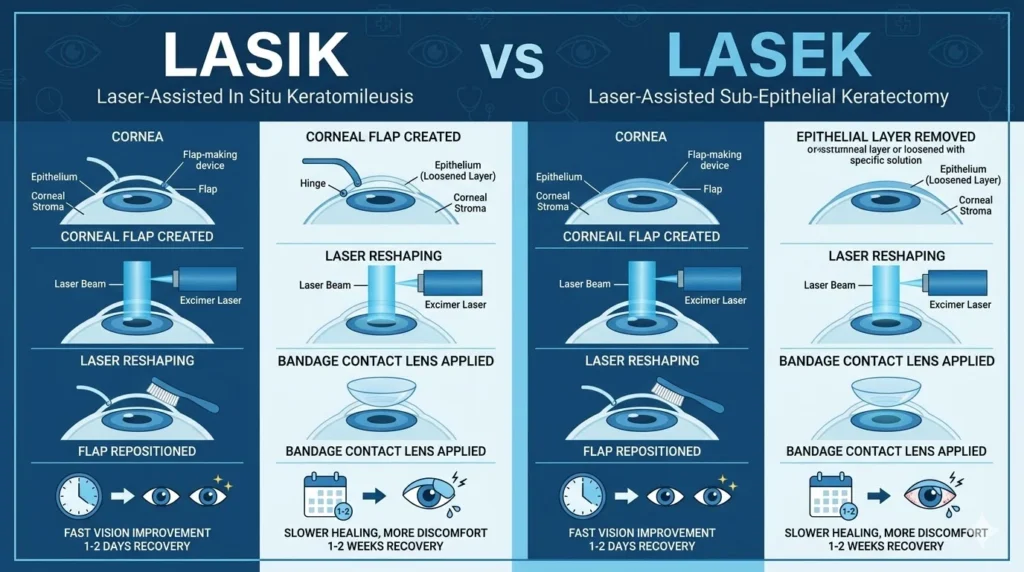
LASEK vs LASIK are two laser eye surgery procedures used to correct vision problems such as myopia, hyperopia, and astigmatism. LASIK reshapes the cornea by creating a flap, while LASEK works on the surface layer of the cornea without creating a flap. The main difference lies in recovery time, suitability for thin corneas, and surgical technique.
You’re one laser procedure away from never touching your glasses again. But pick the wrong one and recovery could take weeks longer than it needed to.
Most people spend more time choosing a new phone than researching laser eye surgery. They hear “LASIK” from a friend, book a consultation, and assume there’s only one option on the table. Then the surgeon mentions LASEK and suddenly the questions start piling up.
Are they the same thing? Which one is safer? Why is one faster? Which one is right for my eyes?
Here’s what the glossy clinic brochures don’t tell you upfront: LASIK and LASEK are not interchangeable. Same laser technology, same goal, completely different approach and that difference determines your recovery time, your eligibility, and your long-term results.
For most patients, one of these procedures is clearly the better fit. But without understanding how they actually work, you’re essentially letting someone else make a permanent decision about your vision.
This guide changes that.
We break down exactly how each procedure works, who the ideal candidate is, what recovery really looks like, and which option gives you the best outcome for your specific situation.
No medical jargon. No sales pitch. Just the clear, honest information you need before you sit in that surgery chair.
Quick Answer Overview
| Feature | LASIK | LASEK |
|---|---|---|
| Surgical method | Corneal flap created | Surface layer treated without flap |
| Recovery time | Very fast | Slower recovery |
| Pain after surgery | Minimal | Mild discomfort for a few days |
| Best for | Normal cornea thickness | Thin corneas |
| Risk of flap complications | Yes | No |
| Return to work | 1 to 2 days | 4 to 7 days |
Simple summary
- LASIK is faster and more comfortable.
- LASEK is safer for people with thin corneas or high risk of eye injury.
Both procedures can produce excellent vision results.
What Is LASIK?
LASIK stands for Laser Assisted In Situ Keratomileusis. It is one of the most popular vision correction surgeries in the world.
In LASIK surgery, a surgeon creates a thin flap in the cornea. The cornea is the clear front part of the eye. After lifting the flap, a laser reshapes the cornea to correct the way light enters the eye.
The flap is then placed back in position. It heals naturally without stitches.
Vision problems LASIK can correct
- Nearsightedness (myopia)
- Farsightedness (hyperopia)
- Astigmatism
How LASIK works step by step
- Eye drops numb the eye.
- A thin flap is created in the cornea.
- The surgeon lifts the flap.
- A laser reshapes the cornea.
- The flap is repositioned.
The whole procedure usually takes 10 to 15 minutes per eye.
Recovery after LASIK
Many people notice clearer vision within 24 hours. Most return to normal activities in 1 to 2 days.
What Is LASEK?
LASEK stands for Laser Assisted Subepithelial Keratectomy. It is another type of laser vision correction.
Unlike LASIK, LASEK does not create a corneal flap. Instead, the surgeon gently moves the thin outer layer of the cornea called the epithelium.
After the laser reshapes the cornea, the epithelial layer is repositioned.
Vision problems LASEK can correct
LASEK treats the same problems as LASIK:
- Myopia
- Hyperopia
- Astigmatism
How LASEK works step by step
- Eye drops numb the eye.
- Alcohol solution loosens the epithelial layer.
- The surgeon moves the surface layer aside.
- A laser reshapes the cornea.
- The epithelial layer is replaced.
- A protective contact lens is placed.
Recovery after LASEK
Healing takes longer because the surface layer must regrow.
Typical recovery timeline
- Initial discomfort: 2 to 4 days
- Vision improvement: 1 to 2 weeks
- Full recovery: several weeks
Understanding the Key Difference Between LASEK vs LASIK
The biggest difference between LASEK vs LASIK is how the surgeon accesses the cornea.
| Aspect | LASIK | LASEK |
|---|---|---|
| Access method | Corneal flap | Surface layer moved |
| Tissue removed | Inside cornea | Surface reshaped |
| Healing process | Flap heals quickly | Surface regrows |
| Eye structure impact | Slightly deeper | More surface level |
Simple analogy
Think of the cornea like a book cover.
- LASIK opens the cover and edits the page inside.
- LASEK edits the cover itself without opening the book.
Both methods fix the text, but they use different approaches.
Advantages of LASIK
LASIK is extremely popular because of its comfort and fast recovery.
Key benefits
Fast recovery
Most people see well within one day.
Minimal pain
Patients usually feel only mild irritation.
Quick procedure
Surgery takes less than 15 minutes.
High success rate
Over 95% of patients achieve good vision results.
Immediate vision improvement
Many patients notice clear vision the same day.
Disadvantages of LASIK
Despite its benefits, LASIK is not perfect.
Potential drawbacks
Flap complications
The corneal flap can shift or wrinkle in rare cases.
Not suitable for thin corneas
People with thin corneas may not qualify.
Dry eye symptoms
Temporary dry eye can occur after surgery.
Risk for contact sports
Athletes in boxing or martial arts may risk flap injury.
Advantages of LASEK
LASEK offers several benefits for specific patients.
Key benefits
No corneal flap
This removes the risk of flap complications.
Better for thin corneas
Patients with thinner corneas can safely undergo LASEK.
Lower risk for trauma
Athletes or military personnel often prefer LASEK.
Preserves more corneal tissue
This makes it suitable for certain eye conditions.
Disadvantages of LASEK
LASEK also has some disadvantages.
Possible drawbacks
Longer recovery
Vision may take weeks to fully stabilize.
More discomfort
Patients may feel burning or irritation during healing.
Delayed vision improvement
Clear vision takes longer compared to LASIK.
Temporary blurred vision
This can last several days.
Real World Examples
Understanding LASEK vs LASIK becomes easier with real situations.
Example 1: Office worker
Ali works on a computer all day. His corneas are normal thickness.
Best option: LASIK
Reason: Faster recovery and quick return to work.
Example 2: Professional athlete
Sara plays martial arts and experiences frequent physical contact.
Best option: LASEK
Reason: No flap that could be damaged during sports.
Example 3: Thin cornea patient
Ahmed has thin corneas during eye exam.
Best option: LASEK
Reason: LASIK may remove too much tissue.
Example 4: Busy parent
Maria wants minimal downtime after surgery.
Best option: LASIK
Reason: Recovery is much faster.
Regional and Global Usage
Both procedures are widely used worldwide.
LASIK popularity
LASIK is the most common laser eye surgery globally.
It is widely performed in:
- United States
- United Kingdom
- Europe
- Middle East
- Asia
Millions of procedures are performed every year.
LASEK popularity
LASEK is less common but still important.
It is often recommended in cases where LASIK is not suitable.
Many clinics in:
- Japan
- South Korea
- Germany
- United States
offer LASEK for patients with thin corneas.
Comparison Table: LASEK vs LASIK
| Feature | LASEK | LASIK |
|---|---|---|
| Corneal flap | No | Yes |
| Recovery speed | Slower | Fast |
| Pain level | Mild to moderate | Minimal |
| Suitable for thin cornea | Yes | Sometimes no |
| Sports safety | Higher | Lower |
| Vision stabilization | Weeks | Days |
Common Mistakes People Make
When choosing between LASEK vs LASIK, patients often misunderstand some facts.
Mistake 1: Thinking LASIK is always better
Correction
Both surgeries are effective. The best option depends on your eye condition.
Mistake 2: Ignoring cornea thickness
Correction
Eye doctors measure cornea thickness before recommending surgery.
Mistake 3: Expecting instant perfect vision
Correction
Vision improves gradually after surgery.
Mistake 4: Choosing surgery based on price only
Correction
Safety and suitability are more important than cost.
Exercises With Answers
These exercises help you understand the difference between LASEK vs LASIK.
Exercise 1
Which procedure involves creating a corneal flap?
A. LASEK
B. LASIK
Answer: B. LASIK
Exercise 2
Which surgery is better for thin corneas?
A. LASEK
B. LASIK
Answer: A. LASEK
Exercise 3
Which surgery usually has faster recovery?
A. LASIK
B. LASEK
Answer: A. LASIK
Exercise 4
Which procedure may cause more discomfort during healing?
A. LASIK
B. LASEK
Answer: B. LASEK
Related Concepts and Comparisons
Understanding related procedures can help clarify LASEK vs LASIK.
PRK (Photorefractive Keratectomy)
PRK is another laser eye surgery.
Differences from LASIK
- No flap created
- Longer healing time
- Similar results
PRK is actually similar to LASEK.
SMILE Surgery
SMILE is a newer laser vision correction method.
Features
- Small incision
- No flap
- Less dry eye risk
It is becoming popular as an alternative to LASIK.
FAQs
Is LASEK better than LASIK?
Neither is universally better. The choice between LASEK vs LASIK depends on cornea thickness, lifestyle, and eye health.
Which surgery heals faster, LASEK or LASIK?
LASIK heals much faster. Most patients see clearly within one day, while LASEK recovery may take weeks.
Is LASEK more painful than LASIK?
Yes. LASEK may cause mild discomfort for several days because the surface layer of the cornea must heal.
Can LASEK correct the same vision problems as LASIK?
Yes. Both LASEK vs LASIK treat myopia, hyperopia, and astigmatism effectively.
Is LASIK safe long term?
LASIK has been performed for decades and is considered safe when done by qualified surgeons.
Who should avoid LASIK?
People with thin corneas, severe dry eye, or certain eye diseases may be better candidates for LASEK or PRK.
How long does LASEK recovery take?
Initial recovery takes about one week, but full vision stabilization may take several weeks.
Is LASEK cheaper than LASIK?
Costs vary by clinic and country. In many cases, prices are similar.
Can vision return after LASIK or LASEK?
Sometimes small vision changes occur with age, but most patients enjoy long lasting results.
Do both eyes get surgery on the same day?
Yes. Most clinics perform LASEK vs LASIK on both eyes during the same session.
Conclusion
Choosing between LASEK vs LASIK is an important decision for anyone considering laser eye surgery. Both procedures are designed to correct vision problems such as nearsightedness, farsightedness, and astigmatism. They use advanced laser technology to reshape the cornea and improve how light focuses on the retina.
The main difference lies in how the surgeon accesses the cornea. LASIK creates a thin flap, which allows for faster recovery and minimal discomfort. LASEK works on the surface layer of the cornea, making it a safer option for people with thin corneas or those involved in contact sports.
Neither procedure is universally better. The best choice depends on individual eye structure, lifestyle, and medical evaluation by an experienced ophthalmologist.
If you are considering laser vision correction, the most important step is a comprehensive eye examination. A qualified eye surgeon can determine whether LASIK or LASEK is safer and more effective for your eyes.
With the right procedure, many patients achieve clear vision and long term freedom from glasses or contact lenses.