Last Updated on March 13, 2026
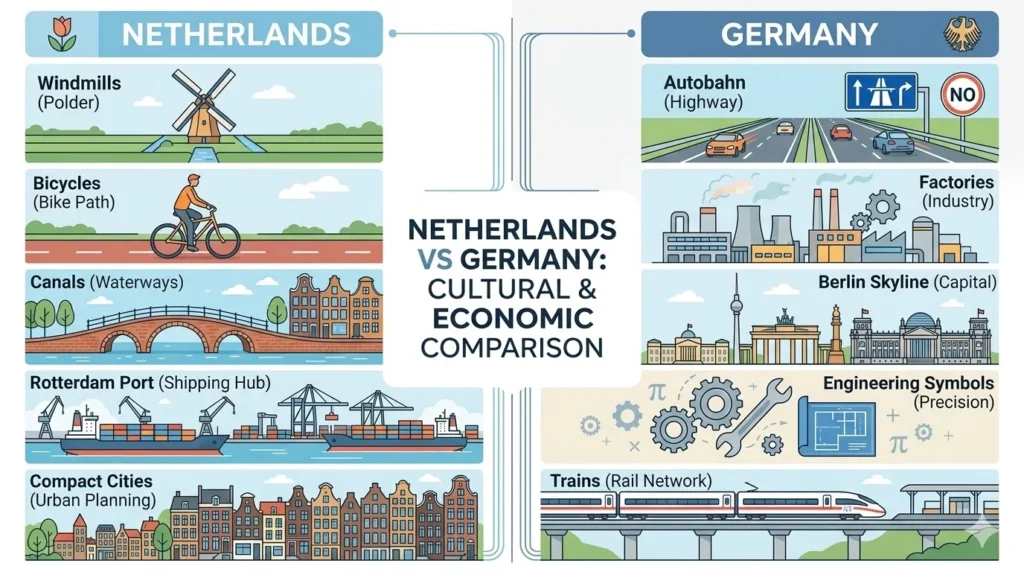
Netherlands vs Germany difference comes down to size, economy, and culture. Germany is Europe’s largest economy with 84 million people, while the Netherlands is smaller but leads in trade, logistics, and innovation. For travelers, students, and businesses, Germany offers scale and industry, while the Netherlands offers efficiency and global connectivity.
Same continent. Same wealth. Same reputation for efficiency. So why do Germany and the Netherlands feel like completely different worlds the moment you arrive?
On paper, they look almost identical. Two of Europe’s most developed nations, sitting side by side, both known for strong economies, high living standards, and global influence. Easy to assume one is just a smaller version of the other.
That assumption has cost students the wrong university choice. Pushed businesses into the wrong market. Sent travelers to the wrong city for the experience they actually wanted.
Here’s the reality: Germany is Europe’s powerhouse massive, industrial, politically dominant, with a cultural weight that shapes the entire continent. The Netherlands is Europe’s quiet overachiever compact, globally connected, surprisingly liberal, and punching so far above its size it consistently stuns economists and expats alike.
Same neighborhood. Completely different DNA.
Whether you’re choosing where to study, where to launch a business, where to relocate, or simply where to spend two weeks this comparison will save you from making a choice based on the wrong information.
No surface-level geography lesson here. This is a real breakdown of two countries that look similar from the outside and operate nothing alike from the inside.
Quick Answer Overview
Here is the short answer to Netherlands vs Germany.
| Factor | Netherlands | Germany |
|---|---|---|
| Size | Small country | Large country |
| Population | About 18 million | About 84 million |
| Economy | Trade and logistics hub | Largest economy in Europe |
| Capital | Amsterdam | Berlin |
| Government | Constitutional monarchy | Federal republic |
| Language | Dutch | German |
| Global Influence | Trade and innovation | Industry and politics |
Key takeaway
- Germany dominates in size, industry, and political influence.
- The Netherlands leads in logistics, global trade, and infrastructure efficiency.
Both countries rank high in quality of life.
Geography and Location
Understanding geography helps explain the differences in Netherlands vs Germany.
Netherlands Geography
The Netherlands is small and flat.
Key characteristics:
- Large parts below sea level
- Famous for canals and water control
- Dense population
- Strong coastal influence
Important features:
- North Sea coastline
- Large rivers like Rhine and Meuse
- Highly managed land called polders
Water management is central to Dutch engineering.
Germany Geography
Germany is much larger and more diverse.
It includes:
- Forests
- Mountains
- Rivers
- Plains
Major regions include:
- Bavarian Alps
- Black Forest
- Rhine Valley
- Northern plains
Germany’s size allows many industries and regional cultures to develop.
Comparison
| Geographic Feature | Netherlands | Germany |
|---|---|---|
| Land size | Very small | Large |
| Terrain | Flat | Mixed |
| Mountains | None | Many |
| Rivers | Major trade routes | Major economic routes |
| Population density | Very high | Moderate |
Population and Demographics
Population differences are a major part of Netherlands vs Germany.
Netherlands Population
Approximate population:
18 million people.
Characteristics:
- Highly urbanized
- Multicultural cities
- Strong international workforce
Major cities:
- Amsterdam
- Rotterdam
- The Hague
- Utrecht
The population density is one of the highest in Europe.
Germany Population
Germany has around 84 million people.
It is the most populous country in the European Union.
Major cities include:
- Berlin
- Hamburg
- Munich
- Frankfurt
- Cologne
Germany also has many mid sized industrial cities.
Population Comparison
| Category | Netherlands | Germany |
|---|---|---|
| Population | ~18 million | ~84 million |
| Largest city | Amsterdam | Berlin |
| Density | Very high | Moderate |
| Urbanization | High | High |
Germany simply has more people and more cities.
Economy Comparison
One of the most important parts of Netherlands vs Germany is the economy.
Both countries are extremely strong economically.
Netherlands Economy
The Dutch economy is export focused.
Key sectors:
- Trade
- Logistics
- Agriculture technology
- Finance
- Innovation
- Ports and shipping
The Port of Rotterdam is one of the largest ports in the world.
Key strengths:
- International trade
- Efficient transport networks
- Business friendly policies
- High productivity
Despite its small size, the Netherlands is one of the world’s top exporters.
Germany Economy
Germany has the largest economy in Europe.
Major industries include:
- Automotive manufacturing
- Engineering
- Machinery
- Chemicals
- Technology
- Industrial exports
Famous companies include:
- Volkswagen
- BMW
- Siemens
- Bosch
- SAP
Germany is known for precision manufacturing.
Economic Comparison
| Economic Factor | Netherlands | Germany |
|---|---|---|
| Economy size | Smaller | Much larger |
| Key strength | Trade and logistics | Manufacturing |
| Exports | Agricultural and tech | Industrial goods |
| Business environment | Very international | Strong industrial base |
| Innovation | High | High |
Both countries are global economic leaders.
Education Systems
Students often research Netherlands vs Germany when choosing where to study.
Education in the Netherlands
The Netherlands is famous for English taught programs.
Key advantages:
- Many degrees taught in English
- International student friendly
- Innovative teaching style
- Shorter degree durations
Typical structure:
- Bachelor’s: 3 years
- Master’s: 1–2 years
Universities emphasize:
- Research
- Discussion
- Critical thinking
Education in Germany
Germany is known for low tuition fees.
Advantages include:
- Public universities often free
- Strong engineering programs
- Large research institutions
- Many technical universities
Challenges:
- Some programs require German language
- Administrative processes can be complex
Education Comparison
| Feature | Netherlands | Germany |
|---|---|---|
| Tuition | Moderate | Often free |
| English programs | Very common | Increasing |
| Research | Strong | Very strong |
| Global reputation | High | Very high |
Germany is excellent for engineering.
The Netherlands is excellent for international study.
Culture and Lifestyle
Culture is another key difference in Netherlands vs Germany.
Dutch Culture
The Netherlands is known for:
- Direct communication
- Tolerance
- Liberal social values
- Cycling culture
- Work life balance
Daily life includes:
- Bicycles everywhere
- Compact cities
- International communities
Dutch people are often fluent in English.
German Culture
Germany is known for:
- Structure
- Efficiency
- Precision
- Regional traditions
- Strong work culture
Lifestyle varies by region.
Examples:
- Bavaria is traditional
- Berlin is modern and creative
- Hamburg is maritime and business focused
Cultural Comparison
| Cultural Factor | Netherlands | Germany |
|---|---|---|
| Communication | Direct | Structured |
| Language use | English widely spoken | German dominant |
| Lifestyle | Relaxed | Organized |
| Work culture | Balanced | Highly disciplined |
Transportation and Infrastructure
Transportation strongly affects Netherlands vs Germany.
Netherlands Transportation
The Netherlands has one of the best transport networks.
Key features:
- Extensive cycling lanes
- Efficient trains
- Compact cities
- Short travel distances
Cycling is a national habit.
Many people commute by bike.
Germany Transportation
Germany has world famous infrastructure.
Major features:
- Autobahn highways
- High speed trains
- Large airports
- Extensive rail network
The Autobahn is famous for sections without speed limits.
Transport Comparison
| Transport Feature | Netherlands | Germany |
|---|---|---|
| Cycling | Excellent | Good |
| Highways | Smaller network | Large network |
| Rail | Efficient | Extensive |
| Travel distances | Short | Long |
Advantages and Disadvantages
Understanding the pros and cons helps evaluate Netherlands vs Germany.
Advantages of the Netherlands
- Highly international
- Strong trade economy
- Excellent infrastructure
- English widely spoken
- Strong innovation sector
Disadvantages of the Netherlands
- Small housing market
- High living costs
- Limited land
- High population density
Advantages of Germany
- Large economy
- Many job opportunities
- Strong industry
- Affordable education
- Large research sector
Disadvantages of Germany
- Bureaucracy
- German language requirement
- Slower administrative processes
Real World Examples
Here are examples of Netherlands vs Germany in practice.
Example 1: Business Expansion
A logistics company chooses the Netherlands.
Reason:
- Access to the Port of Rotterdam
- Quick access to European markets
Example 2: Manufacturing Investment
A car manufacturer chooses Germany.
Reason:
- Skilled workforce
- Industrial supply chains
- Engineering expertise
Example 3: Student Choice
A student wants English education.
Choice:
Netherlands.
Another student wants low tuition engineering.
Choice:
Germany.
Regional and Global Influence
Both countries influence Europe differently.
Netherlands Global Role
The Netherlands plays a huge role in:
- Global trade
- Shipping
- Agricultural technology
- Finance
Dutch companies operate worldwide.
Germany Global Role
Germany leads Europe in:
- Industrial exports
- Economic policy
- European Union leadership
- Manufacturing technology
Germany’s economy shapes the entire EU.
Common Mistakes When Comparing Netherlands vs Germany
Many people misunderstand these countries.
Mistake 1: Thinking Netherlands is small and unimportant
Reality:
It is one of the world’s largest exporters.
Mistake 2: Assuming Germany is only manufacturing
Germany also leads in:
- research
- engineering innovation
- renewable energy
Mistake 3: Believing both cultures are identical
Despite being neighbors, cultural styles differ significantly.
Mistake 4: Assuming English works everywhere in Germany
Many workplaces still require German.
Comparison Table: Netherlands vs Germany
| Category | Netherlands | Germany |
|---|---|---|
| Land Area | Small | Large |
| Population | 18M | 84M |
| Economy Type | Trade focused | Industrial |
| Language | Dutch | German |
| Capital | Amsterdam | Berlin |
| Transport | Cycling friendly | Autobahn highways |
| Global Role | Trade hub | Industrial powerhouse |
Exercises to Test Your Understanding
Exercise 1
Which country has the largest economy in Europe?
A. Netherlands
B. Germany
Answer: Germany
Exercise 2
Which country is known for the Port of Rotterdam?
A. Netherlands
B. Germany
Answer: Netherlands
Exercise 3
Which country offers more tuition free public universities?
A. Netherlands
B. Germany
Answer: Germany
Exercise 4
Which country is famous for cycling infrastructure?
A. Netherlands
B. Germany
Answer: Netherlands
Related Comparisons
To better understand Netherlands vs Germany, consider these comparisons.
Netherlands vs Belgium
- Netherlands focuses on trade and ports
- Belgium focuses on EU politics and logistics
Germany vs France
- Germany leads in manufacturing
- France leads in aerospace and luxury industries
Netherlands vs Denmark
Both are small but highly developed nations.
FAQs
Which country is better, Netherlands or Germany?
It depends on the goal. Germany offers a larger economy and more industrial jobs, while the Netherlands provides international business opportunities and English friendly environments.
Is the Netherlands richer than Germany?
Germany has the larger economy overall. However, the Netherlands often ranks very high in GDP per capita and productivity.
Which country is better for international students: Netherlands vs Germany?
The Netherlands offers more English taught programs, while Germany offers very low tuition fees. Both are excellent options.
Is living in the Netherlands more expensive than Germany?
Generally yes. Housing and living costs in major Dutch cities can be higher than in many German cities.
Which country has better job opportunities?
Germany offers more total jobs due to its larger economy. The Netherlands offers strong opportunities in finance, logistics, and international business.
Do people speak English in Germany like in the Netherlands?
English is widely spoken in the Netherlands. In Germany it depends on the region and workplace.
Which country has better infrastructure?
Both have excellent infrastructure. The Netherlands leads in cycling and urban transport, while Germany leads in highways and rail networks.
Which country has better universities?
Germany has many globally ranked research universities. The Netherlands also has top ranked institutions known for international programs.
Is Germany safer than the Netherlands?
Both countries are considered very safe with low crime rates compared to global averages.
Which country has a stronger economy: Netherlands vs Germany?
Germany has the largest economy in Europe, but the Netherlands is one of the most efficient and trade focused economies globally.
Conclusion
The comparison Netherlands vs Germany shows two powerful European countries with different strengths. Germany stands out because of its size, population, and industrial power. It is the largest economy in Europe and a global leader in engineering, manufacturing, and exports.
The Netherlands proves that a smaller country can still be extremely influential. Its strategic location, world class ports, strong logistics system, and innovative economy make it one of the most important trade hubs in the world.
For students, the choice may depend on language and tuition costs. Germany often offers free or low cost education, especially in engineering fields. The Netherlands provides more English taught programs and a very international environment.
For businesses, Germany offers scale and manufacturing expertise, while the Netherlands offers access to global trade networks and efficient logistics.
Ultimately, both countries rank among the best places in Europe for living, studying, and doing business. The best choice depends on personal goals, career paths, and lifestyle preferences.