
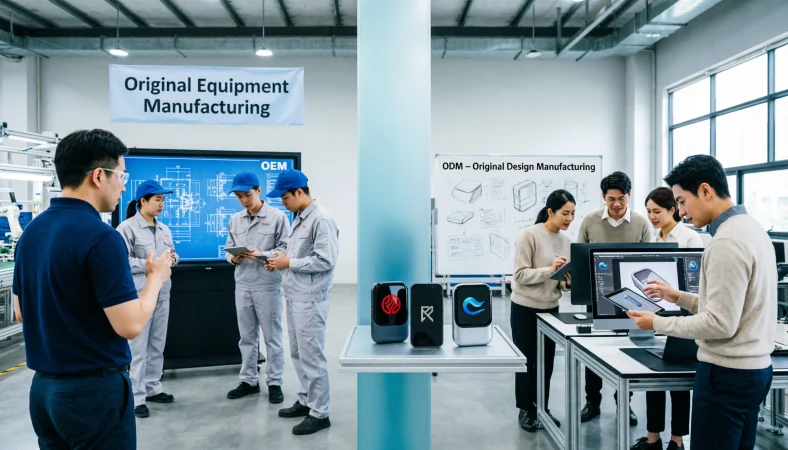
OEM vs ODM refers to two manufacturing models used in global production. An OEM, or Original Equipment Manufacturer, produces goods based on a buyer’s design and specifications. An ODM, or Original Design Manufacturer, creates and designs products that other companies can brand and sell as their own.
The search query OEM vs ODM appears simple, yet it creates frequent confusion in manufacturing, ecommerce, and product development. Both terms describe production partnerships, but they refer to very different roles.
An OEM, or Original Equipment Manufacturer, builds products using the design and specifications provided by another company. An ODM, or Original Design Manufacturer, designs and manufactures a product that other companies can rebrand.
Misunderstanding these terms leads to costly mistakes. Businesses sometimes expect design ownership from an OEM or customization flexibility from an ODM. When those expectations fail, product launches stall, budgets inflate, and intellectual property disputes can occur.
Understanding the real difference between these two manufacturing models helps companies choose the right production strategy and avoid expensive operational errors.
OEM vs ODM: What’s the Difference?
Both OEM and ODM refer to third party manufacturing partnerships, yet the ownership of design and product development is what separates them.
| Factor | OEM | ODM |
|---|---|---|
| Full Term | Original Equipment Manufacturer | Original Design Manufacturer |
| Role | Manufactures products from a client design | Designs and manufactures products |
| Design Ownership | Client owns the design | Manufacturer owns the design |
| Customization | High level customization | Limited customization |
| Development Responsibility | Client develops the product | Manufacturer develops the product |
| Typical Use | Technology hardware, automotive parts | Consumer electronics, generic devices |
| Intellectual Property | Belongs to the client | Usually belongs to the manufacturer |
Mini recap
In simple terms, the client controls the product in an OEM model. The manufacturer simply produces it. In an ODM model, the manufacturer creates the product and offers it to brands that want to sell it under their own name. The difference comes down to who owns the design.
Is OEM vs ODM a Grammar, Vocabulary, or Usage Issue?
The phrase OEM vs ODM is not a grammar issue. It is a vocabulary and industry terminology issue used in manufacturing, supply chain management, and product development.
These terms are not interchangeable because they describe different roles in production.
Formal vs informal use
OEM and ODM are widely used in formal business communication such as:
Manufacturing contracts
Technology procurement
Supply chain documentation
Investor presentations
In informal conversation, people sometimes use OEM to mean any third party manufacturer. This is technically incorrect and can lead to misunderstanding.
Academic vs casual usage
In academic research, supply chain studies use precise definitions:
OEM refers to production based on external design ownership.
ODM refers to manufacturers that both design and produce products.
In casual ecommerce discussions, however, the distinction is often blurred. Many online sellers call any factory an OEM partner even when the factory is actually acting as an ODM.
Clarity matters when negotiating production agreements.
Understanding OEM Manufacturing
An Original Equipment Manufacturer produces goods using the exact design provided by another company.
The client controls the product architecture, engineering specifications, and intellectual property.
Workplace example
A laptop brand designs a new motherboard layout and internal cooling system. The company then hires a factory to build the components according to those specifications. The factory acts as an OEM because it manufactures but does not design the product.
Academic example
Supply chain research frequently cites OEM partnerships in the automotive sector. Vehicle companies design engines and components internally while specialized manufacturers produce the parts at scale.
Technology example
Many smartphone companies design processors, hardware architecture, and user interface systems internally. They then contract manufacturing facilities to produce the hardware exactly as specified.
Usage recap
Use OEM when:
The buyer owns the design
The factory follows strict specifications
The client controls intellectual property
OEM manufacturing gives companies full product control but requires larger design and research investments.
Understanding ODM Manufacturing
An Original Design Manufacturer designs and produces a product that other companies can brand as their own.
The manufacturer owns the original product design and engineering.
Workplace example
A consumer electronics factory designs a wireless keyboard and produces it in large quantities. Multiple ecommerce brands buy the same product and place their own logo on it.
Academic example
Studies in global manufacturing often identify ODM models in consumer electronics where factories create standardized devices that many brands distribute.
Technology example
Smart home devices such as security cameras often come from ODM companies that design the hardware and sell it to multiple brands.
Usage recap
Use ODM when:
You want a ready made product
Design development is handled by the manufacturer
Customization needs are minimal
ODM manufacturing allows companies to launch products quickly with lower development costs.
OEM vs ODM in Business Strategy
Choosing between OEM and ODM is not just a manufacturing decision. It directly affects branding, product differentiation, and intellectual property ownership.
OEM strategy advantages
Companies gain full control over product design and innovation. This allows strong brand differentiation and long term competitive advantage.
However, development costs and engineering responsibilities are significantly higher.
ODM strategy advantages
Businesses can launch products faster because the design work is already complete. This reduces development risk and lowers entry barriers.
The trade off is limited product uniqueness since multiple brands may sell similar products.
When You Should NOT Use OEM or ODM
Misusing these terms can lead to confusion in contracts and negotiations.
Avoid using OEM or ODM in the following situations:
- When referring to a retail brand that only sells products
- When describing a distributor or wholesaler
- When the manufacturer only assembles components
- When the product design is shared equally between partners
- When referring to white label packaging only
- When describing software development partnerships
- When the factory only supplies raw materials
- When discussing simple product reselling
In these cases, terms like supplier, assembler, or contract manufacturer may be more accurate.
Common Mistakes and Decision Rules
| Correct Sentence | Incorrect Sentence | Explanation |
|---|---|---|
| Our company hired an OEM to manufacture our phone design | Our OEM designed the phone for us | OEM manufactures but does not design |
| The factory acts as an ODM for multiple brands | The ODM only follows our design instructions | ODM creates the original design |
| We maintain intellectual property through OEM production | The ODM gives us full design ownership | ODM designs are usually owned by the manufacturer |
Decision Rule Box
If you mean the manufacturing action based on your design, use OEM
If you mean the manufacturer that creates and sells the design, use ODM
OEM vs ODM in Modern Technology and AI Tools
Modern technology sectors rely heavily on both manufacturing models.
Artificial intelligence hardware, smart home devices, and consumer electronics often combine these strategies.
For example, AI device startups frequently launch using ODM hardware platforms first. Once the product gains market traction, companies move to OEM manufacturing to develop unique proprietary designs.
This hybrid strategy balances speed and innovation.
The Origins of OEM and ODM
The term Original Equipment Manufacturer appeared in industrial production during the twentieth century. It described companies that produced parts used in another company’s final product.
Original Design Manufacturer emerged later as Asian manufacturing industries expanded. Factories began offering not only production but also product design services to international brands.
Both terms now play central roles in global supply chains.
Expert Insight
Manufacturing strategist Dr. Alan Peters, a global supply chain consultant, explains:
“Companies that misunderstand the difference between OEM and ODM often lose control of their product roadmap. The decision determines who owns innovation.”
This insight highlights why the distinction is critical for long term product strategy.
Case Study 1: Startup Electronics Brand
A startup launched a portable Bluetooth speaker.
Initially the company partnered with an ODM factory that already produced a speaker model. The startup customized branding and packaging.
Result:
Product launched in four months
Development costs reduced by sixty percent
Early market validation achieved quickly
After gaining traction, the company shifted to an OEM partner to develop a proprietary design.
Sales doubled within one year due to product differentiation.
Case Study 2: Smart Home Device Company
A smart home startup attempted to work with an OEM factory despite having no internal design team.
The project stalled for nine months because the manufacturer expected the startup to provide technical specifications.
The company later switched to an ODM manufacturer that offered a ready designed device platform.
Outcome:
Product launch accelerated
Engineering costs dramatically reduced
Brand entered market within six months
Error Prevention Checklist
Use this checklist to avoid confusion.
Always use OEM when
- Your company created the product design
- You control engineering specifications
- Intellectual property belongs to your brand
- The manufacturer only produces the item
Never use ODM when
- Your company owns the product blueprint
- The factory only performs assembly
- You expect full design customization
- The product architecture comes from your engineering team
Related Manufacturing Confusions You Should Master
Understanding OEM vs ODM often leads to other terminology questions.
Important related topics include:
Contract manufacturing
Private label production
White label products
Product development ownership
Supply chain outsourcing
Industrial design licensing
Component suppliers
Manufacturing partnerships
Technology hardware production
Mastering these terms improves negotiation clarity and supply chain decision making.
FAQs
What is the difference between OEM and ODM manufacturing?
OEM manufacturing produces products designed by the client company. ODM manufacturing involves factories that design products themselves and sell them to brands for rebranding.
Which is better OEM or ODM?
Neither model is universally better. OEM offers full design control and stronger brand differentiation. ODM provides faster market entry and lower development costs.
Why do many startups begin with ODM manufacturing?
Startups often lack engineering resources and development budgets. ODM manufacturers offer ready designed products that can be branded quickly, reducing risk during early market testing.
Can a company switch from ODM to OEM later?
Yes. Many companies launch using ODM products and later transition to OEM manufacturing once they develop proprietary designs and internal engineering capabilities.
Do ODM manufacturers allow customization?
Most ODM factories allow limited customization such as branding, packaging, and minor design adjustments. However, the core product architecture usually remains unchanged.
Does OEM manufacturing protect intellectual property?
Yes. Since the buyer provides the design, intellectual property typically belongs to the buyer, provided that contracts clearly define ownership.
Are smartphones produced using OEM or ODM?
Both models are used. Major brands often design their own hardware and use OEM factories for production, while smaller brands rely on ODM designs to launch devices quickly.
Why do many ecommerce sellers use ODM products?
ODM products reduce development complexity. Sellers can focus on marketing and branding rather than engineering and product design.
Is private label the same as ODM?
Private label products are often sourced from ODM manufacturers, but the terms are not identical. Private label refers to branding strategy while ODM refers to the design and manufacturing role.
Conclusion
Understanding OEM vs ODM is essential for businesses entering manufacturing or launching physical products. OEM manufacturing gives companies full ownership of design, innovation, and intellectual property. ODM manufacturing offers ready made product designs that allow faster market entry and lower development costs.
The right choice depends on resources, timeline, and long term strategy. Companies seeking differentiation and proprietary technology usually prefer OEM partnerships. Businesses focused on speed and lower risk often begin with ODM products.
Knowing the difference helps entrepreneurs avoid costly mistakes, negotiate better manufacturing agreements, and build stronger product strategies.