
Last Updated on April 7, 2026
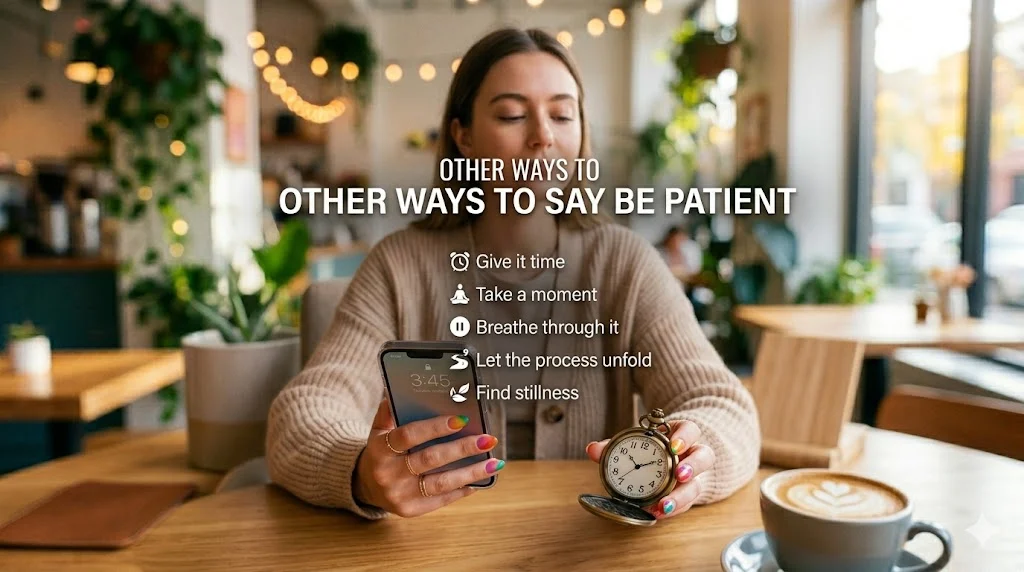
If you want alternatives to “be patient,” try: please wait, give it some time, stay calm, hold on, trust the process. These phrases help you sound more polite, supportive, and professional.
The phrase “be patient” is commonly used to ask someone to wait calmly or tolerate delays without frustration. It’s simple but can sometimes sound direct or even slightly dismissive.
Learning alternatives to “be patient” helps you communicate more politely and effectively in both personal and professional situations. It allows you to soften your tone and sound more empathetic.
Expanding your vocabulary also helps you express excitement in English, reassurance, and use better professional reaction phrases in conversations.
Quick Categories Section
Formal Alternatives to “Be Patient”
- Kindly wait
- Please remain patient
- Your patience is appreciated
- Please allow some time
Pro Tip: Use formal phrases in emails, customer service, or professional communication.
Casual Alternatives
- Hang on
- Give it a second
- Just wait a bit
- Hold up
Pro Tip: Casual phrases are best used with friends or informal conversations.
Professional Alternatives
- Thank you for your patience
- We appreciate your understanding
- Please bear with us
- Kindly allow us some time
Pro Tip: In professional settings, focus on appreciation rather than giving direct commands.
Informal Expressions
- Chill for a moment
- Sit tight
- Hold your horses
- Take it easy
Pro Tip: These informal expressions in English can sound friendly but should be avoided in formal situations.
“Politeness turns waiting into a positive experience.”
Common Mistakes
- Sounding too direct
Example: “Be patient!” - Using it in a rude tone
Example: “Just be patient…” - Using informal phrases in formal settings
Example: “Hold your horses” in a business email - Not showing empathy
Example: “Be patient, it takes time” - Overusing the phrase
Example: Repeating “be patient” multiple times
What Does “Be Patient” Mean?
Definition: A request for someone to wait calmly without frustration.
Grammar: It is an imperative phrase (a command or instruction).
Example: “Please be patient while we resolve the issue.”
When to Use “Be Patient”
- During delays
- When someone is frustrated
- In customer service situations
- When waiting is necessary
Spoken vs Written: Both
Formal vs Informal: Neutral to informal
Is It Professional or Polite to Say “Be Patient”?
Polite? ✔️ Yes (with tone)
Professional? ❌ Not always
Business Example:
“Thank you for your patience while we complete the process.”
Pros and Cons of Using “Be Patient”
Pros
- Simple and clear
- Easy to understand
- Widely used
- Direct communication
Cons
- Can sound rude
- Too direct in some contexts
- Lacks empathy
- Not ideal for professional tone
“Empathy in language builds stronger communication.”
Other Ways to Say “Be Patient” With Examples
These other ways to say “be patient” will help you sound more fluent, confident, and natural in different situations.
Use them based on tone, context, and audience to communicate politely and effectively.
1. Phrase: Please wait
Meaning: Stay until something happens
Explanation: Simple and polite
Example Sentence: Please wait while we process your request
Best Use: general use
Worst Use: urgency
Tone: polite, neutral
Context Variability: professional / spoken
2. Phrase: Give it some time
Meaning: Allow time for results
Explanation: Encouraging patience
Example Sentence: Give it some time to improve
Best Use: advice
Worst Use: urgent cases
Tone: supportive, calm
Context Variability: casual / spoken
3. Phrase: Stay calm
Meaning: Remain relaxed
Explanation: Focuses on emotional control
Example Sentence: Stay calm, everything will be fine
Best Use: reassurance
Worst Use: commands
Tone: gentle, supportive
Context Variability: casual
4. Phrase: Hold on
Meaning: Wait briefly
Explanation: Common spoken phrase
Example Sentence: Hold on, I’ll be right there
Best Use: quick pause
Worst Use: formal writing
Tone: casual, neutral
Context Variability: spoken
5. Phrase: Trust the process
Meaning: Believe in timing
Explanation: Motivational phrase
Example Sentence: Trust the process—it will work out
Best Use: encouragement
Worst Use: strict instructions
Tone: encouraging, positive
Context Variability: casual / spoken
6. Phrase: Kindly wait
Meaning: Wait politely
Explanation: Formal tone
Example Sentence: Kindly wait for further instructions
Best Use: formal writing
Worst Use: casual chat
Tone: formal, polite
Context Variability: professional
7. Phrase: Bear with me
Meaning: Ask for patience
Explanation: Personal and polite
Example Sentence: Bear with me while I check
Best Use: conversations
Worst Use: formal documents
Tone: polite, friendly
Context Variability: professional / spoken
8. Phrase: Please allow some time
Meaning: Give time
Explanation: Formal request
Example Sentence: Please allow some time for processing
Best Use: business
Worst Use: casual
Tone: formal, respectful
Context Variability: professional
9. Phrase: Sit tight
Meaning: Stay where you are and wait
Explanation: Informal but friendly
Example Sentence: Sit tight, I’ll handle it
Best Use: casual
Worst Use: formal
Tone: informal, reassuring
Context Variability: casual
10. Phrase: Just a moment
Meaning: Wait briefly
Explanation: Very common polite phrase
Example Sentence: Just a moment, please
Best Use: service
Worst Use: long delays
Tone: polite, neutral
Context Variability: professional / spoken
11–30 Additional Phrases (Condensed for Skimmability)
11. Hang on
Meaning: Wait briefly
Explanation: Informal spoken phrase
Example Sentence: Hang on a second
Best Use: casual
Worst Use: formal
Tone: informal, quick
Context Variability: spoken
12. Give it a moment
Meaning: Wait a short time
Explanation: Gentle request
Example Sentence: Give it a moment to load
Best Use: polite request
Worst Use: urgency
Tone: calm, neutral
Context Variability: casual / spoken
13. Please bear with us
Meaning: Ask for patience
Explanation: Professional tone
Example Sentence: Please bear with us during maintenance
Best Use: workplace
Worst Use: casual
Tone: formal, polite
Context Variability: professional
14. Take it easy
Meaning: Relax and wait
Explanation: Informal reassurance
Example Sentence: Take it easy, no rush
Best Use: friends
Worst Use: formal
Tone: relaxed, friendly
Context Variability: casual
15. Hold your horses
Meaning: Slow down
Explanation: Idiomatic expression
Example Sentence: Hold your horses, we’re not ready
Best Use: playful
Worst Use: workplace
Tone: humorous, informal
Context Variability: casual
16. Please remain patient
Meaning: Continue waiting calmly
Explanation: Formal phrasing
Example Sentence: Please remain patient during the process
Best Use: professional
Worst Use: casual
Tone: formal, respectful
Context Variability: professional
17. Wait a bit
Meaning: Pause briefly
Explanation: Simple instruction
Example Sentence: Wait a bit before starting
Best Use: casual
Worst Use: formal
Tone: neutral, simple
Context Variability: casual
18. Just wait
Meaning: Delay action
Explanation: Direct instruction
Example Sentence: Just wait here
Best Use: instructions
Worst Use: polite situations
Tone: direct, neutral
Context Variability: spoken
19. Give it a chance
Meaning: Allow time to work
Explanation: Encouraging patience
Example Sentence: Give it a chance to improve
Best Use: advice
Worst Use: urgency
Tone: supportive, positive
Context Variability: casual
20. Allow time for it
Meaning: Let time pass
Explanation: Slightly formal
Example Sentence: Allow time for the results
Best Use: guidance
Worst Use: casual
Tone: neutral, formal
Context Variability: professional
21. Please wait patiently
Meaning: Wait calmly
Explanation: Polite and clear
Example Sentence: Please wait patiently in line
Best Use: instructions
Worst Use: informal
Tone: polite, neutral
Context Variability: professional
22. Stay patient
Meaning: Continue being patient
Explanation: Encouragement
Example Sentence: Stay patient, results will come
Best Use: motivation
Worst Use: commands
Tone: supportive, calm
Context Variability: casual
23. Wait for a while
Meaning: Delay action
Explanation: Neutral phrasing
Example Sentence: Wait for a while before calling
Best Use: general use
Worst Use: urgency
Tone: neutral
Context Variability: casual
24. Please give us time
Meaning: Request for time
Explanation: Professional tone
Example Sentence: Please give us time to resolve this
Best Use: customer service
Worst Use: casual
Tone: polite, professional
Context Variability: professional
25. Take a moment
Meaning: Pause briefly
Explanation: Gentle suggestion
Example Sentence: Take a moment to think
Best Use: advice
Worst Use: urgent tasks
Tone: calm, supportive
Context Variability: casual
26. Just hold on
Meaning: Wait briefly
Explanation: Slightly informal
Example Sentence: Just hold on, I’m coming
Best Use: spoken
Worst Use: formal
Tone: casual, direct
Context Variability: spoken
27. We appreciate your patience
Meaning: Thank someone for waiting
Explanation: Professional and polite
Example Sentence: We appreciate your patience
Best Use: workplace
Worst Use: casual
Tone: formal, appreciative
Context Variability: professional
28. Please stay patient
Meaning: Continue waiting calmly
Explanation: Slightly softer tone
Example Sentence: Please stay patient during updates
Best Use: formal
Worst Use: casual
Tone: polite, calm
Context Variability: professional
29. Don’t rush
Meaning: Take your time
Explanation: Removes pressure
Example Sentence: Don’t rush, take your time
Best Use: reassurance
Worst Use: deadlines
Tone: relaxed, friendly
Context Variability: casual
30. Take your time
Meaning: No need to hurry
Explanation: Encouraging patience
Example Sentence: Take your time with the task
Best Use: supportive
Worst Use: urgency
Tone: warm, reassuring
Context Variability: casual / spoken
“Small changes in wording create big improvements in fluency.”
Mini Quiz / Self-Check
1. Which is the most professional alternative?
A. Hang on
B. Kindly wait
C. Hold your horses
✅ Answer: B. Kindly wait
2. Best phrase for casual conversation?
A. Please remain patient
B. Sit tight
C. Kindly allow time
✅ Answer: B. Sit tight
3. Which sounds too informal for business?
A. Please bear with us
B. Hold your horses
C. Please allow some time
✅ Answer: B. Hold your horses
4. Best phrase for reassuring someone?
A. Stay calm
B. Just wait
C. Move faster
✅ Answer: A. Stay calm
Comparison Table: Top Alternatives
| Phrase | Tone | Best Use |
|---|---|---|
| Please wait | Neutral | General use |
| Kindly wait | Formal | Business |
| Bear with me | Polite | Conversations |
| Just a moment | Neutral | Service |
| Sit tight | Informal | Casual |
| Please allow some time | Formal | Workplace |
| Stay calm | Supportive | Reassurance |
| We appreciate your patience | Professional | Customer service |
| Take your time | Friendly | Encouragement |
| Please remain patient | Formal | Announcements |
FAQs
1. What are the best alternatives to “be patient”?
Some of the best alternatives to “be patient” include “please wait,” “bear with me,” and “take your time.”
2. Is “be patient” rude?
It can sound direct or rude depending on tone. Softer phrases are often better.
3. What is a professional way to say “be patient”?
Use phrases like “we appreciate your patience” or “please allow some time.”
4. How can I ask someone to wait politely?
Say “please wait,” “just a moment,” or “bear with me.”
5. Why should I learn alternatives to “be patient”?
Learning other ways to say be patient improves tone, politeness, and overall communication skills.
Conclusion
Learning other ways to say “be patient” helps you communicate with more empathy, professionalism, and clarity. It allows you to soften your tone and adapt to different situations.
Practice these alternatives to “be patient” daily to improve your fluency and confidence. Always consider your audience and context to choose the most appropriate phrase.
CTA: Try using 3 new alternatives today in your conversations.