Last Updated on April 10, 2026
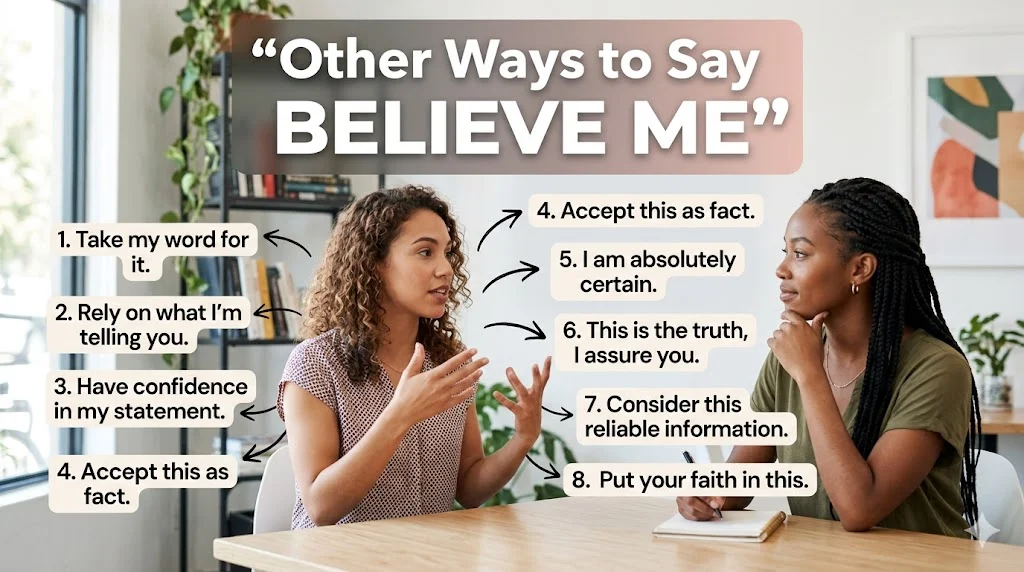
If you want alternatives to “believe me,” try: trust me, I assure you, you can count on it, take my word for it, rest assured. These phrases help you sound more confident, persuasive and natural in conversations.
The phrase “believe me” is often used to emphasize that something is true or trustworthy. Speakers use it when they want others to accept their statement with confidence.
However, repeating the same phrase can make your speech sound repetitive. Learning alternatives to “believe me” allows you to express certainty in more natural and varied ways.
Expanding your vocabulary also helps you express excitement in English, build credibility, and use stronger professional reaction phrases in conversations.
Quick Categories Section
Formal Alternatives to “Believe Me”
- I assure you
- Rest assured
- You have my assurance
- I can confirm
Pro Tip: These phrases are useful in professional communication where credibility and clarity matter.
Casual Alternatives
- Trust me
- Take my word for it
- Honestly
- I promise
Pro Tip: Casual expressions work best with friends or in relaxed conversations.
Professional Alternatives
- I can assure you
- You can rely on this
- I can confidently say
- Let me assure you
Pro Tip: In professional settings, avoid overly emotional language and focus on confident wording.
Informal Expressions
- No joke
- Seriously
- I’m telling you
- You’ve got to trust me
Pro Tip: These informal expressions in English add personality but should be avoided in formal writing.
“Confidence in language makes your message more persuasive.”
Common Mistakes
- Overusing the phrase
Example: Saying “believe me” repeatedly in conversation. - Using it in formal writing unnecessarily
Example: “Believe me, this report is accurate.” - Sounding defensive
Example: “Believe me, I didn’t do anything wrong.” - Using informal phrases in business settings
Example: “Trust me, this plan will work.” - Adding it without evidence
Example: “Believe me, it’s the best option.”
What Does “Believe Me” Mean?
Definition:
“Believe me” is used to emphasize that what someone is saying is true or trustworthy.
Grammar:
It functions as an emphatic expression used to strengthen a statement.
Example Sentence:
“Believe me, this restaurant is amazing.”
When to Use “Believe Me”
- When emphasizing honesty
- When persuading someone
- During storytelling
- When sharing personal experience
Spoken vs Written: Mostly spoken
Formal vs Informal: Mostly informal
Is It Professional or Polite to Say “Believe Me”?
Polite? ✔️ Yes
Professional? ❌ Usually not
Business Example:
“I assure you that the project will be completed on time.”
Pros and Cons of Using “Believe Me”
Pros
- Easy to use
- Emphasizes sincerity
- Common in conversation
- Adds emotional emphasis
Cons
- Can sound defensive
- Often overused
- Too informal for business writing
- May weaken credibility if overused
“Persuasive language relies on confidence, not repetition.”
Other Ways to Say “Believe Me” With Examples
These other ways to say “believe me” help you sound more fluent, persuasive, and confident in English.
Use them depending on tone, audience, and context.
1. Phrase: Trust me
Meaning: Accept what I say as true.
Explanation: Very common casual alternative.
Example Sentence: Trust me, this movie is worth watching.
Best Use: friendly advice
Worst Use: formal emails
Tone: casual, confident
Context Variability: casual / spoken
2. Phrase: I assure you
Meaning: I guarantee something is true.
Explanation: Formal and professional expression.
Example Sentence: I assure you that the information is accurate.
Best Use: workplace
Worst Use: casual jokes
Tone: formal, confident
Context Variability: professional
3. Phrase: Take my word for it
Meaning: Accept my statement without proof.
Explanation: Friendly persuasive phrase.
Example Sentence: Take my word for it you will love this place.
Best Use: recommendations
Worst Use: legal discussions
Tone: friendly, confident
Context Variability: casual
4. Phrase: I promise
Meaning: I strongly guarantee something.
Explanation: Expresses sincerity and commitment.
Example Sentence: I promise you’ll enjoy the trip.
Best Use: reassurance
Worst Use: formal reports
Tone: sincere, warm
Context Variability: casual / spoken
5. Phrase: Rest assured
Meaning: Feel confident that something is certain.
Explanation: Common professional reassurance phrase.
Example Sentence: Rest assured, we are working on the issue.
Best Use: business communication
Worst Use: casual chat
Tone: formal, reassuring
Context Variability: professional
6. Phrase: Honestly
Meaning: Emphasizes truthfulness.
Explanation: Often used before sharing an opinion.
Example Sentence: Honestly, it’s the best decision.
Best Use: casual talk
Worst Use: formal writing
Tone: casual, sincere
Context Variability: casual
7. Phrase: I can guarantee it
Meaning: Strong promise of truth.
Explanation: Shows confidence in a statement.
Example Sentence: I can guarantee it will work.
Best Use: persuasive situations
Worst Use: uncertain claims
Tone: confident, direct
Context Variability: professional / spoken
8. Phrase: Seriously
Meaning: Emphasizes that something is true.
Explanation: Informal emphasis in speech.
Example Sentence: Seriously, you should try it.
Best Use: friends
Worst Use: workplace meetings
Tone: informal, expressive
Context Variability: casual
9. Phrase: I’m telling you
Meaning: Strong emphasis that something is true.
Explanation: Conversational emphasis phrase.
Example Sentence: I’m telling you, this plan will work.
Best Use: storytelling
Worst Use: formal writing
Tone: informal, persuasive
Context Variability: casual
10. Phrase: You can count on it
Meaning: Something is certain or reliable.
Explanation: Encourages trust and confidence.
Example Sentence: You can count on it we’ll succeed.
Best Use: reassurance
Worst Use: uncertain promises
Tone: confident, supportive
Context Variability: professional / spoken
11. Phrase: Mark my words
Meaning: Something will definitely happen in the future.
Explanation: Often used to strongly emphasize a prediction or warning.
Example Sentence: Mark my words, this team will win the championship.
Best Use: predictions
Worst Use: formal reports
Tone: confident, dramatic
Context Variability: casual / spoken
12. Phrase: I swear
Meaning: I promise that what I’m saying is true.
Explanation: Strong informal way to emphasize honesty.
Example Sentence: I swear, I didn’t touch your phone.
Best Use: personal conversations
Worst Use: professional settings
Tone: emotional, informal
Context Variability: casual / spoken
13. Phrase: You have my word
Meaning: A firm promise or assurance.
Explanation: Indicates strong commitment and reliability.
Example Sentence: You have my word that I will help you.
Best Use: reassurance
Worst Use: casual jokes
Tone: sincere, confident
Context Variability: professional / spoken
14. Phrase: No doubt about it
Meaning: Something is certainly true.
Explanation: Used to show complete confidence in a statement.
Example Sentence: No doubt about it, this strategy will work.
Best Use: confident opinions
Worst Use: uncertain discussions
Tone: confident, direct
Context Variability: casual / spoken
15. Phrase: I can confidently say
Meaning: You are certain about a statement.
Explanation: Often used in professional or formal contexts.
Example Sentence: I can confidently say that the results are accurate.
Best Use: workplace communication
Worst Use: casual jokes
Tone: professional, confident
Context Variability: professional
16. Phrase: I’m serious
Meaning: Emphasizes that you are not joking.
Explanation: Often used when someone doubts your statement.
Example Sentence: I’m serious you should try this restaurant.
Best Use: conversations
Worst Use: formal writing
Tone: informal, emphatic
Context Variability: casual / spoken
17. Phrase: I mean it
Meaning: Shows sincerity and seriousness.
Explanation: Emphasizes that your words are genuine.
Example Sentence: I mean it when I say you did a great job.
Best Use: encouragement
Worst Use: business reports
Tone: sincere, emotional
Context Variability: casual / spoken
18. Phrase: You can trust this
Meaning: The information is reliable.
Explanation: Encourages confidence in what you’re saying.
Example Sentence: You can trust this it’s accurate data.
Best Use: reassurance
Worst Use: sarcasm
Tone: confident, supportive
Context Variability: professional / spoken
19. Phrase: Without a doubt
Meaning: Absolutely certain.
Explanation: Strong expression of confidence.
Example Sentence: Without a doubt, this is the best option.
Best Use: strong statements
Worst Use: uncertain topics
Tone: confident, decisive
Context Variability: casual / professional
20. Phrase: I stand by this
Meaning: You fully support what you said.
Explanation: Shows strong belief or commitment to a statement.
Example Sentence: I stand by this decision completely.
Best Use: professional statements
Worst Use: casual jokes
Tone: firm, confident
Context Variability: professional
21. Phrase: It’s the truth
Meaning: The statement is completely honest.
Explanation: Used to emphasize honesty.
Example Sentence: It’s the truth you handled it well.
Best Use: reassurance
Worst Use: formal writing
Tone: sincere, conversational
Context Variability: casual / spoken
22. Phrase: I’m being honest
Meaning: Emphasizes sincerity.
Explanation: Used to reassure someone that your statement is genuine.
Example Sentence: I’m being honest the idea is excellent.
Best Use: reassurance
Worst Use: formal reports
Tone: sincere, friendly
Context Variability: casual / spoken
23. Phrase: I can confirm
Meaning: The information is verified as true.
Explanation: Commonly used in professional or official contexts.
Example Sentence: I can confirm that the meeting is scheduled.
Best Use: workplace communication
Worst Use: casual jokes
Tone: professional, factual
Context Variability: professional
24. Phrase: I truly believe this
Meaning: Expresses strong personal conviction.
Explanation: Emphasizes genuine belief in a statement.
Example Sentence: I truly believe this idea will succeed.
Best Use: motivational statements
Worst Use: factual reports
Tone: sincere, reflective
Context Variability: casual / professional
25. Phrase: I wouldn’t lie
Meaning: Emphasizes honesty.
Explanation: Used to reassure someone of sincerity.
Example Sentence: I wouldn’t lie this place is amazing.
Best Use: friendly conversations
Worst Use: professional settings
Tone: informal, sincere
Context Variability: casual / spoken
26. Phrase: That’s a fact
Meaning: Something is undeniably true.
Explanation: Used to emphasize certainty strongly.
Example Sentence: Hard work leads to success that’s a fact.
Best Use: confident statements
Worst Use: uncertain discussions
Tone: direct, assertive
Context Variability: casual / spoken
27. Phrase: I’m certain
Meaning: Completely sure about something.
Explanation: A clear and confident expression of belief.
Example Sentence: I’m certain this plan will succeed.
Best Use: professional or academic contexts
Worst Use: casual jokes
Tone: confident, calm
Context Variability: professional / spoken
28. Phrase: I know for sure
Meaning: Something is definitely true.
Explanation: Indicates strong certainty based on knowledge or experience.
Example Sentence: I know for sure this method works.
Best Use: sharing experience
Worst Use: formal documents
Tone: confident, conversational
Context Variability: casual / spoken
29. Phrase: I guarantee it
Meaning: Strong promise that something is true.
Explanation: Emphasizes high confidence or assurance.
Example Sentence: I guarantee it you’ll enjoy the event.
Best Use: persuasive situations
Worst Use: uncertain claims
Tone: confident, persuasive
Context Variability: casual / professional
30. Phrase: You can rely on it
Meaning: Something is dependable or certain.
Explanation: Encourages trust in a statement or promise.
Example Sentence: You can rely on it the results will improve.
Best Use: reassurance
Worst Use: casual jokes
Tone: professional, supportive
Context Variability: professional / spoken
“Small changes in wording create big improvements in fluency.”
Mini Quiz / Self-Check
1. Which phrase is the most professional alternative?
A. Seriously
B. I assure you
C. I’m telling you
✅ Answer: B. I assure you
2. Which phrase is best for casual conversation?
A. Trust me
B. Rest assured
C. I can confirm
✅ Answer: A. Trust me
3. Which phrase sounds too informal for business communication?
A. I can confirm
B. Seriously
C. Rest assured
✅ Answer: B. Seriously
4. Which phrase shows a strong personal guarantee?
A. I promise
B. I can confirm
C. I suggest
✅ Answer: A. I promise
“The right phrase can make your message more believable and confident.”
Comparison Table: Top Alternatives
| Phrase | Tone | Best Use |
|---|---|---|
| Trust me | Casual | Friendly advice |
| I assure you | Formal | Workplace |
| Rest assured | Professional | Business reassurance |
| Take my word for it | Casual | Recommendations |
| I promise | Warm | Reassurance |
| I can confirm | Professional | Facts |
| You can count on it | Supportive | Encouragement |
| Without a doubt | Confident | Strong statements |
| I guarantee it | Persuasive | Promises |
| Mark my words | Dramatic | Storytelling |
FAQs
1. What are the best alternatives to “believe me”?
Some common alternatives include “trust me,” “I assure you,” and “take my word for it.”
2. Is “believe me” professional?
It is polite but often too informal for professional communication.
3. What is a formal way to say “believe me”?
You can say “I assure you,” “rest assured,” or “I can confirm.”
4. How do you sound more persuasive in English?
Use confident phrases such as “without a doubt” or “I can guarantee it.”
5. Why learn other ways to say believe me?
Learning other ways to say believe me improves fluency, tone control, and persuasion in English.
Conclusion
Learning other ways to say “believe me” allows you to express certainty, confidence, and persuasion more effectively. Different situations require different tones from casual conversations to professional communication.
Practice these alternatives to “believe me” in daily conversations. Over time, your English will sound more fluent, confident, and natural.