
Last Updated on April 4, 2026
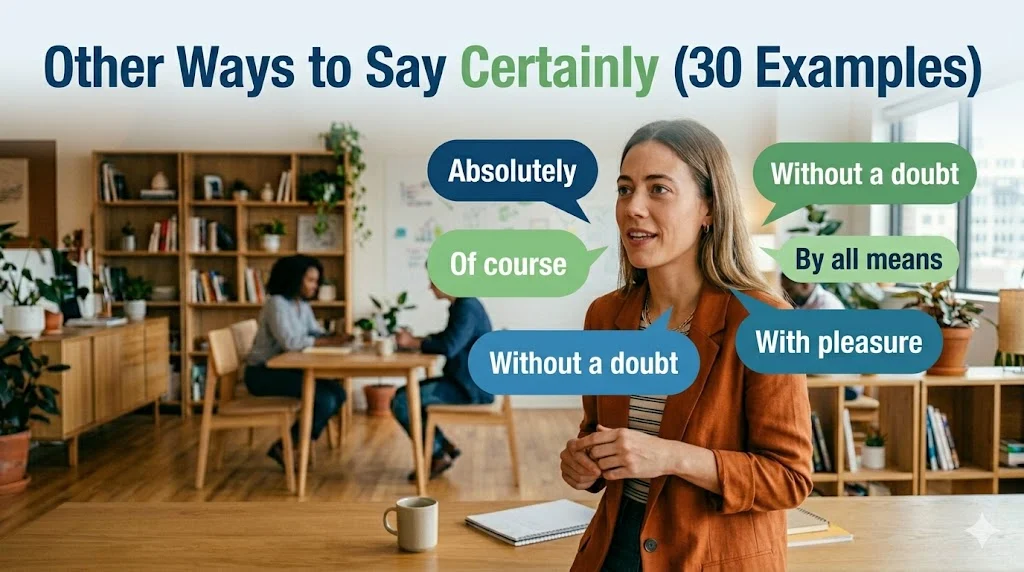
If you want alternatives to “certainly” try: Of course, Absolutely, Definitely, Without a doubt, Sure thing.
These options help you sound more confident, polite, and natural in both professional and casual English.
The word “certainly” is used to express agreement, confirmation, or strong assurance. It’s polite, clear, and commonly used in both spoken and written English.
However, repeating the same word can make your speech sound repetitive. Learning alternatives to “other ways to say certainly” helps you vary your tone and communicate more effectively.
If you want to express excitement in English or sound more fluent, expanding your vocabulary with these expressions is essential.
“Confidence in English comes from choosing the right words at the right time.”
Quick Categories Section
Formal Alternatives to “Other Ways to Say Certainly”
- Indeed
- Without a doubt
- Most certainly
- By all means
Pro Tip: Use these in formal writing, presentations, or polite conversations.
Casual Alternatives
- Sure
- Of course
- Yep
- No problem
Pro Tip: Best for relaxed conversations with friends or peers.
Professional Alternatives
- Absolutely
- Definitely
- Certainly, I can assist
- I’d be happy to
Pro Tip: These are perfect for emails, meetings, and workplace communication.
Informal Expressions
- You bet
- For sure
- No worries
- 100%
Pro Tip: Use these only in informal settings to keep tone appropriate.
“Professional English is not about complexity—it’s about clarity and tone.”
Common Mistakes Section
- Overusing “certainly” in every response
Example: Certainly, certainly, I agree ❌ - Using informal alternatives in formal emails
Example: Yep, I will do it ❌ - Sounding too robotic
Example: Certainly. Certainly. Certainly. ❌ - Using overly strong phrases in minor situations
Example: Without a doubt (for small requests) ❌ - Incorrect tone in professional communication
Example: You bet, boss ❌
What Does “Certainly” Mean?
“Certainly” means definitely, without doubt, or with full agreement.
Grammar Note:
It is an adverb used to confirm or emphasize certainty.
Example:
I will certainly attend the meeting.
When to Use “Certainly”
- Agreeing politely
- Confirming requests
- Responding in customer service
- Formal conversations
Spoken vs Written:
Common in both
Formal vs Informal:
More formal than casual
Is It Professional or Polite to Say “Certainly”?
Polite? ✔️ Yes
Professional? ✔️ Yes
Business Example:
Certainly, I will send you the report by tomorrow.
Pros and Cons of Using “Certainly”
Pros
- Polite and respectful
- Clear and confident
- Widely understood
- Suitable for professional use
Cons
- Can sound stiff if overused
- Less natural in casual speech
- Lacks emotional variation
- May feel formal in friendly chats
“Fluent speakers adapt their words to match the situation.”
Other Ways to Say “Certainly” With Examples
These alternatives will help you sound more fluent, confident, and natural in different situations.
Use them according to tone, context, and audience to express excitement in English.
1. Phrase: Of course
Meaning: Yes, naturally
Explanation: Very common and polite
Example Sentence: Of course, I can help you with that
Best Use: general use
Worst Use: none
Tone: friendly, polite
Context Variability: casual / professional
2. Phrase: Absolutely
Meaning: Strong agreement
Explanation: Adds emphasis and confidence
Example Sentence: Absolutely, I agree with your idea
Best Use: work, agreement
Worst Use: minor replies
Tone: confident, strong
Context Variability: all contexts
3. Phrase: Definitely
Meaning: Without doubt
Explanation: Clear and assertive
Example Sentence: I will definitely join the meeting
Best Use: commitments
Worst Use: uncertain cases
Tone: firm, confident
Context Variability: all contexts
4. Phrase: Sure
Meaning: Yes
Explanation: Simple and casual
Example Sentence: Sure, I’ll do it
Best Use: casual
Worst Use: formal email
Tone: relaxed
Context Variability: casual
5. Phrase: Without a doubt
Meaning: Completely certain
Explanation: Strong emphasis
Example Sentence: Without a doubt, this is the best option
Best Use: strong opinions
Worst Use: small talk
Tone: strong, formal
Context Variability: semi-formal
6. Phrase: By all means
Meaning: Yes, go ahead
Explanation: Polite permission
Example Sentence: By all means, take your time
Best Use: formal
Worst Use: casual jokes
Tone: polite, formal
Context Variability: professional
7. Phrase: I’d be happy to
Meaning: Willing to help
Explanation: Polite and friendly
Example Sentence: I’d be happy to assist you
Best Use: work
Worst Use: refusals
Tone: warm, professional
Context Variability: professional
8. Phrase: No problem
Meaning: It’s okay
Explanation: Casual reassurance
Example Sentence: No problem, I’ll handle it
Best Use: casual
Worst Use: formal
Tone: relaxed
Context Variability: informal
9. Phrase: For sure
Meaning: Definitely
Explanation: Informal confirmation
Example Sentence: I’ll be there for sure
Best Use: friends
Worst Use: workplace
Tone: casual
Context Variability: informal
10. Phrase: Indeed
Meaning: Yes, truly
Explanation: Formal agreement
Example Sentence: Indeed, that is correct
Best Use: formal
Worst Use: casual chat
Tone: formal
Context Variability: professional
11–30 (Full Structured Continuation)
11. Phrase: You bet
Meaning: Certainly
Explanation: Friendly informal agreement
Example Sentence: You bet, I’ll help you
Best Use: friends
Worst Use: office
Tone: playful, casual
Context Variability: informal
12. Phrase: 100%
Meaning: Completely certain
Explanation: Modern informal emphasis
Example Sentence: I agree 100% with you
Best Use: social
Worst Use: formal
Tone: strong, casual
Context Variability: informal
13. Phrase: No worries
Meaning: It’s fine
Explanation: Reassuring response
Example Sentence: No worries, I’ve got it
Best Use: casual
Worst Use: formal
Tone: relaxed
Context Variability: informal
14. Phrase: Affirmative
Meaning: Yes
Explanation: Formal or technical tone
Example Sentence: Affirmative, task completed
Best Use: formal
Worst Use: casual
Tone: formal, direct
Context Variability: professional
15. Phrase: Gladly
Meaning: Happily agree
Explanation: Expresses willingness
Example Sentence: I will gladly assist you
Best Use: polite
Worst Use: negative context
Tone: warm
Context Variability: semi-formal
16. Phrase: With pleasure
Meaning: Happy to do it
Explanation: Polite and refined
Example Sentence: With pleasure, I’ll join
Best Use: formal
Worst Use: casual
Tone: polite
Context Variability: professional
17. Phrase: Naturally
Meaning: As expected
Explanation: Suggests obvious agreement
Example Sentence: Naturally, I agree
Best Use: formal
Worst Use: jokes
Tone: confident
Context Variability: semi-formal
18. Phrase: That’s right
Meaning: Correct
Explanation: Confirms accuracy
Example Sentence: That’s right, you’re correct
Best Use: discussion
Worst Use: formal writing
Tone: neutral
Context Variability: casual
19. Phrase: Sounds good
Meaning: Agree
Explanation: Common casual approval
Example Sentence: Sounds good to me
Best Use: casual
Worst Use: formal
Tone: friendly
Context Variability: informal
20. Phrase: Consider it done
Meaning: It will be completed
Explanation: Confident assurance
Example Sentence: Consider it done by tomorrow
Best Use: work
Worst Use: uncertain tasks
Tone: confident
Context Variability: professional
21. Phrase: No doubt
Meaning: Definitely
Explanation: Strong agreement
Example Sentence: No doubt, that’s correct
Best Use: casual
Worst Use: formal
Tone: confident
Context Variability: casual
22. Phrase: Absolutely yes
Meaning: Strong agreement
Explanation: Emphasized confirmation
Example Sentence: Absolutely yes, I support this
Best Use: emphasis
Worst Use: formal writing
Tone: strong
Context Variability: semi-formal
23. Phrase: I agree completely
Meaning: Full agreement
Explanation: Clear and direct
Example Sentence: I agree completely with your plan
Best Use: professional
Worst Use: casual jokes
Tone: formal
Context Variability: professional
24. Phrase: Sure thing
Meaning: Yes
Explanation: Friendly agreement
Example Sentence: Sure thing, I’ll do it
Best Use: casual
Worst Use: formal
Tone: relaxed
Context Variability: informal
25. Phrase: That works
Meaning: Acceptable
Explanation: Agreement in plans
Example Sentence: That works for me
Best Use: scheduling
Worst Use: formal
Tone: neutral
Context Variability: casual
26. Phrase: I’m on it
Meaning: I will do it
Explanation: Immediate action
Example Sentence: I’m on it right now
Best Use: work
Worst Use: formal writing
Tone: proactive
Context Variability: semi-professional
27. Phrase: Count on it
Meaning: You can rely on me
Explanation: Strong assurance
Example Sentence: Count on it, I’ll deliver
Best Use: trust
Worst Use: uncertain tasks
Tone: confident
Context Variability: casual / professional
28. Phrase: No hesitation
Meaning: Without doubt
Explanation: Immediate agreement
Example Sentence: I accept with no hesitation
Best Use: formal
Worst Use: casual
Tone: strong
Context Variability: formal
29. Phrase: Undoubtedly
Meaning: Without doubt
Explanation: Very formal
Example Sentence: Undoubtedly, this is correct
Best Use: formal writing
Worst Use: casual
Tone: formal
Context Variability: professional
30. Phrase: Positively
Meaning: Definitely
Explanation: Emphasized certainty
Example Sentence: I will positively confirm this
Best Use: formal
Worst Use: casual
Tone: strong
Context Variability: semi-formal
“Strong English comes from using the right word—not just the familiar one.”
Mini Quiz / Self-Check
1. Best professional alternative?
A. Yep
B. Absolutely ✔️
C. You bet
2. Most informal option?
A. Indeed
B. 100% ✔️
C. Undoubtedly
3. Safe for all contexts?
A. Sure
B. Definitely ✔️
C. No worries
Comparison Table: Top Alternatives
| Phrase | Tone | Best Use |
|---|---|---|
| Absolutely | Strong | Work |
| Of course | Polite | All contexts |
| Definitely | Confident | General |
| Indeed | Formal | Writing |
| Sure | Casual | Friends |
| I’d be happy to | Professional | Service |
| By all means | Formal | Permission |
| No problem | Relaxed | Informal |
| Consider it done | Confident | Work |
| Count on it | Strong | Trust |
FAQs
1. What are the best alternatives to “certainly”?
Top options include Absolutely, Of course, Definitely, and Indeed.
2. Is “certainly” formal or informal?
It is more formal and commonly used in professional communication.
3. Can I use “sure” instead of “certainly”?
Yes, but only in casual contexts.
4. What is the most professional alternative?
“I’d be happy to” or “Absolutely” are great choices.
5. Why learn other ways to say “certainly”?
It improves fluency, tone control, and helps you express excitement in English.
Conclusion
Learning other ways to say certainly helps you sound more fluent, confident, and adaptable in different situations. It allows you to match your tone with the context whether formal, casual or professional.
Practice these phrases daily and focus on tone awareness. The right choice of words can make your communication clear, natural, and impactful.