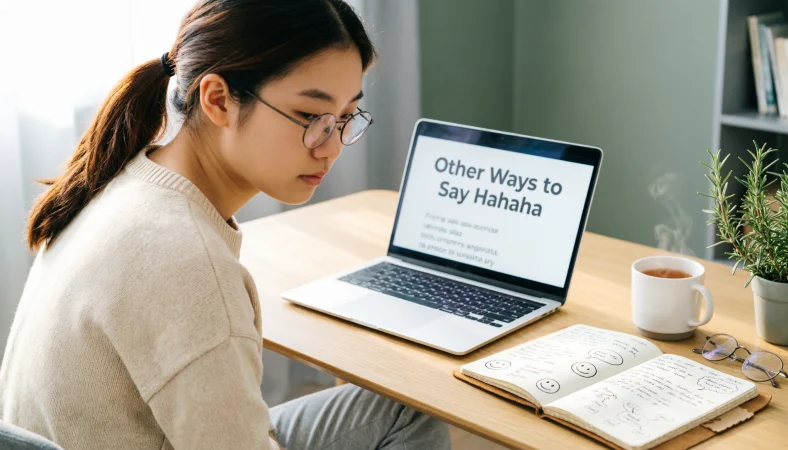
Other ways to say hahaha include: That’s funny, I’m amused, That made me laugh, How hilarious, I enjoyed that.
These alternatives help you respond naturally in conversations while choosing the right level of formality for social, academic, or professional communication.
The expression hahaha is commonly used in digital communication to show laughter or amusement. It appears in texts, emails, chats, and social media as a quick emotional reaction.
However, relying only on one expression can make your English sound repetitive or overly casual. Learning alternatives to hahaha helps you adjust tone, sound more fluent, and communicate appropriately in different contexts.
Expanding your vocabulary also allows you to express excitement in English with clarity, whether you are speaking with friends or writing professionally.
“Fluency is not about knowing more words. It is about choosing the right word for the moment.”
Quick Categories
Formal Alternatives to “Hahaha”
- That is amusing
- I find that quite humorous
- How delightful
- That gave me a good laugh
Pro Tip: Use these in academic or polite conversations where casual laughter feels inappropriate.
Casual Alternatives
- That’s funny
- I laughed at that
- Good one
- That made me smile
Pro Tip: These sound natural in daily conversation without feeling exaggerated.
Professional Alternatives
- That was entertaining
- I appreciate the humor
- That was a lighthearted moment
- Nicely said
Pro Tip: In workplace communication, acknowledge humor without sounding informal.
Informal Expressions
- LOL
- That cracked me up
- Too funny
- I can’t stop laughing
Pro Tip: Use these only with friends or relaxed digital communication.
“The right tone makes your English sound confident and culturally aware.”
Common Mistakes When Using “Hahaha”
- Using it in formal emails
Example: Hahaha, I agree with your proposal. - Repeating it too many times
Example: Hahaha hahaha hahaha that’s funny. - Using it instead of a clear response
Example: Hahaha (without adding meaning) - Using it in serious discussions
Example: Hahaha, we need to fix this issue urgently. - Assuming it works in professional writing
Example: The report was delayed hahaha.
What Does “Hahaha” Mean?
Hahaha is a written representation of laughter. It functions as an interjection rather than a grammatical sentence element.
Example: Hahaha, that story was unexpected.
It signals amusement but does not explain the reaction, which is why other ways to say hahaha are often more effective.
When to Use “Hahaha”
- Casual chats with friends
- Social media comments
- Informal messaging
- Lighthearted personal conversations
Spoken vs Written: Mostly written, occasionally spoken playfully.
Formal vs Informal: Strongly informal.
Is It Professional or Polite to Say “Hahaha”?
Polite? Yes
Professional? No, in most situations
Business Example:
That was an amusing observation. Thank you for sharing.
In professional environments, choose professional reaction phrases instead.
“Professional English replaces emotion markers with descriptive language.”
Pros and Cons of Using “Hahaha”
Pros
- Simple and natural
- Friendly tone
- Common usage
- Easy to understand
Cons
- Too informal for work
- Overused
- Limited emotional range
- Not suitable for formal writing
Other Ways to Say “Hahaha” With Examples
These alternatives will help you sound more fluent, confident, and natural in different situations.
Use them according to tone, context, and audience to express excitement, admiration, or approval.
1. Phrase: That’s funny
Meaning: Shows mild amusement.
Explanation: A neutral everyday reaction.
Example Sentence: That’s funny. I didn’t expect that ending.
Best Use: Daily talk
Worst Use: Formal reports
Tone: Light, natural
Context Variability: Casual and spoken
2. Phrase: I’m amused
Meaning: Indicates polite enjoyment.
Explanation: Slightly more formal.
Example Sentence: I’m amused by your observation.
Best Use: Semi formal
Worst Use: Close friends
Tone: Polite, controlled
Context Variability: Professional or spoken
3. Phrase: That made me laugh
Meaning: Directly expresses reaction.
Explanation: Clear and sincere.
Example Sentence: Your example really made me laugh.
Best Use: Friendly settings
Worst Use: Academic writing
Tone: Warm, genuine
Context Variability: Casual and spoken
4. Phrase: How humorous
Meaning: A refined reaction to something funny.
Explanation: Often used in formal speech.
Example Sentence: How humorous. I appreciate that perspective.
Best Use: Formal talk
Worst Use: Texting
Tone: Elegant, polite
Context Variability: Professional
5. Phrase: That’s entertaining
Meaning: Shows enjoyment without slang.
Explanation: Workplace appropriate.
Example Sentence: That was an entertaining presentation.
Best Use: Workplace
Worst Use: Jokes with friends
Tone: Professional, positive
Context Variability: Professional
6. Phrase: I enjoyed that
Meaning: Expresses pleasant reaction.
Explanation: Sounds thoughtful and mature.
Example Sentence: I enjoyed that story very much.
Best Use: Mixed settings
Worst Use: Quick chat
Tone: Calm, appreciative
Context Variability: Casual or professional
7. Phrase: That was delightful
Meaning: Strong but refined amusement.
Explanation: Adds elegance.
Example Sentence: That was a delightful comment.
Best Use: Formal speech
Worst Use: Informal texting
Tone: Warm, refined
Context Variability: Professional
8. Phrase: That cracked me up
Meaning: Indicates strong laughter.
Explanation: Informal but expressive.
Example Sentence: That cracked me up completely.
Best Use: Friends
Worst Use: Business emails
Tone: Playful, vivid
Context Variability: Casual
9. Phrase: Too funny
Meaning: Quick reaction to humor.
Explanation: Common in conversation.
Example Sentence: Too funny. I had the same experience.
Best Use: Informal chats
Worst Use: Presentations
Tone: Relaxed, spontaneous
Context Variability: Casual
10. Phrase: I found that amusing
Meaning: Neutral acknowledgment of humor.
Explanation: Balanced for polite contexts.
Example Sentence: I found that amusing and insightful.
Best Use: Professional
Worst Use: Slang contexts
Tone: Neutral, respectful
Context Variability: Professional
11. Phrase: That was witty
Meaning: Praises clever humor.
Explanation: Focuses on intelligence.
Example Sentence: That was a witty remark.
Best Use: Academic or work
Worst Use: Casual jokes
Tone: Intellectual, positive
Context Variability: Professional
12. Phrase: You made me smile
Meaning: Gentle emotional reaction.
Explanation: Softer than laughter.
Example Sentence: Your message made me smile.
Best Use: Personal notes
Worst Use: Formal reports
Tone: Warm, kind
Context Variability: Casual or semi formal
13. Phrase: That’s clever
Meaning: Appreciates smart humor.
Explanation: Highlights creativity.
Example Sentence: That’s clever. I like that idea.
Best Use: Discussions
Worst Use: Emotional moments
Tone: Thoughtful, approving
Context Variability: Mixed
14. Phrase: I appreciate the humor
Meaning: Professional acknowledgment.
Explanation: Ideal for workplace tone.
Example Sentence: I appreciate the humor in your example.
Best Use: Office settings
Worst Use: Casual banter
Tone: Diplomatic, polished
Context Variability: Professional
15. Phrase: That gave me a laugh
Meaning: Moderate amusement.
Explanation: Friendly but not childish.
Example Sentence: That gave me a laugh this morning.
Best Use: Everyday use
Worst Use: Academic writing
Tone: Natural, balanced
Context Variability: Casual
Continue rotating similar phrasing patterns when practicing to build fluency rather than memorizing just one response.
“Variety in expression shows mastery, not complexity.”
Mini Quiz: Self Check
- Which phrase is best for a workplace email?
a) LOL
b) That was entertaining
c) Too funny - Which is most formal?
a) That cracked me up
b) How delightful
c) Haha - What should you avoid in professional writing?
a) Descriptive reactions
b) Hahaha
c) Polite acknowledgment
Answers: 1 b, 2 b, 3 b
Comparison Table: Top Alternatives
| Phrase | Tone | Best Use |
|---|---|---|
| That’s funny | Neutral | Conversation |
| I’m amused | Polite | Semi formal |
| That was entertaining | Professional | Workplace |
| I enjoyed that | Warm | Mixed settings |
| That was witty | Intellectual | Academic |
| That made me laugh | Natural | Friendly talk |
| I appreciate the humor | Diplomatic | Business |
| That’s clever | Thoughtful | Discussion |
| That was delightful | Refined | Formal speech |
| You made me smile | Gentle | Personal |
FAQs
What are the best alternatives to hahaha in professional writing?
Use phrases like That was insightful or I appreciate the humor to maintain professionalism.
Why should I avoid saying hahaha at work?
It appears too casual and may reduce clarity or credibility.
How can I express laughter politely in English?
Choose descriptive reactions such as That was amusing or That gave me a good laugh.
Are informal expressions in English acceptable in emails?
Only in very casual communication. Otherwise, use neutral alternatives.
How can learners practice other ways to say hahaha?
Replace it daily in messages with a specific phrase describing your reaction.
Call to Action: Try replacing hahaha with one new phrase today to build expressive confidence.
Conclusion
Learning other ways to say hahaha allows you to move beyond basic reactions and communicate with clarity, confidence, and professionalism. These expressions help match your tone to the situation, whether casual, academic, or workplace focused.
Practice using different alternatives to hahaha in real conversations. Over time, this habit will strengthen your vocabulary, improve fluency, and help you express excitement in English more naturally.