
Last Updated on April 5, 2026
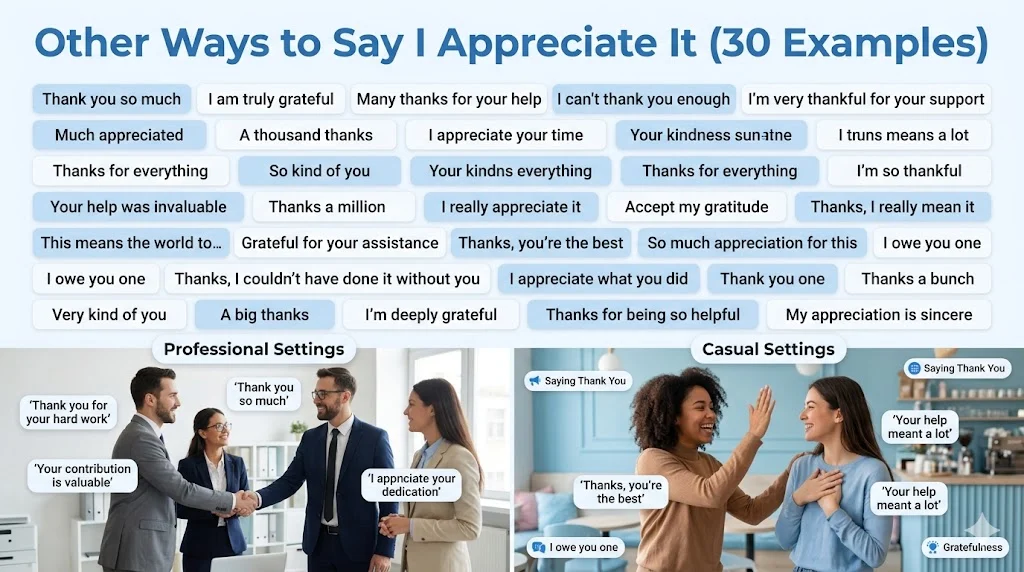
If you want other ways to say I appreciate it, try: Much obliged, I’m grateful, Thanks a lot, I truly value it, Many thanks.
These alternatives help you sound more natural, polished, and expressive in different situations.
The phrase “I appreciate it” is commonly used to express gratitude and acknowledgment. It is polite, simple, and widely accepted in both personal and professional communication.
However, using the same phrase repeatedly can sound repetitive. Learning alternatives to other ways to say I appreciate it helps you communicate gratitude more effectively and naturally.
If you want to express excitement in English and improve your tone, using varied expressions can make your speech and writing more engaging and impactful.
“Gratitude expressed with the right words leaves a lasting impression.”
Quick Categories Section
Formal Alternatives to “other ways to say I appreciate it”
- I sincerely appreciate it
- I am deeply grateful
- Much obliged
- I truly value this
Pro Tip: Use these in formal emails, academic writing, or professional settings.
Casual Alternatives
- Thanks a lot
- Really appreciate it
- Big thanks
- Much appreciated
Pro Tip: Keep it natural and simple in everyday conversations.
Professional Alternatives
- I appreciate your support
- Thank you for your assistance
- I value your help
- I’m grateful for your time
Pro Tip: Be specific about what you’re appreciating in business communication.
Informal Expressions
- Thanks a bunch
- You’re the best
- Appreciate ya
- Huge thanks
Pro Tip: Use these with friends or in relaxed environments only.
“The way you say thank you can define your professionalism.”
Common Mistakes Section
- Being too vague
Example: I appreciate it ❌ (What exactly?) - Overusing the same phrase
Example: I appreciate it… I appreciate it again ❌ - Using informal tone in formal emails
Example: Thanks a bunch, Sir ❌ - Not matching tone with context
Example: Much obliged (in casual chat) ❌ - Missing subject clarity
Example: Appreciate it (without “I”) ❌
What Does “other ways to say I appreciate it” Mean?
It refers to different phrases used to express gratitude, acknowledgment, or thanks in English.
Grammar Note:
“I appreciate it” uses the verb appreciate to show recognition or gratitude.
Example:
I really appreciate your help today.
When to Use “other ways to say I appreciate it”
- Thanking someone for help
- Acknowledging effort
- Responding to favors
- Professional communication
Spoken vs Written:
Used in both equally
Formal vs Informal:
Flexible depending on wording
Is It Professional or Polite to Say “I appreciate it”?
Polite? ✔️ Yes
Professional? ✔️ Yes (with context)
Business Example:
I appreciate your timely response to this matter.
Pros and Cons of Using “I appreciate it”
Pros
- Simple and natural
- Friendly tone
- Common usage
- Easy to understand
Cons
- Can sound generic
- Overused
- Lacks specificity
- Less impactful in formal writing
“Specific gratitude sounds more professional than generic thanks.”
Other Ways to Say “I Appreciate It” With Examples
These alternatives will help you sound more fluent, confident, and natural in different situations.
Use them according to tone, context, and audience to express gratitude effectively.
1. Phrase: Much obliged
Meaning: Deep thanks
Explanation: Formal and slightly traditional
Example Sentence: Much obliged for your assistance
Best Use: formal writing
Worst Use: casual chat
Tone: formal, respectful
Context Variability: professional
2. Phrase: I’m grateful
Meaning: Thankful
Explanation: Expresses sincere appreciation
Example Sentence: I’m grateful for your support
Best Use: emotional, formal
Worst Use: jokes
Tone: warm, sincere
Context Variability: all contexts
3. Phrase: Thanks a lot
Meaning: Strong thanks
Explanation: Common casual expression
Example Sentence: Thanks a lot for helping me out
Best Use: daily use
Worst Use: formal email
Tone: friendly
Context Variability: casual
4. Phrase: I truly value it
Meaning: You consider it important
Explanation: Adds depth to appreciation
Example Sentence: I truly value your feedback
Best Use: professional
Worst Use: casual jokes
Tone: respectful
Context Variability: professional
5. Phrase: Many thanks
Meaning: Multiple thanks
Explanation: Slightly formal alternative
Example Sentence: Many thanks for your email
Best Use: emails
Worst Use: slang
Tone: polite
Context Variability: professional
6. Phrase: Much appreciated
Meaning: Thank you
Explanation: Short and widely used
Example Sentence: Your help is much appreciated
Best Use: general
Worst Use: very formal writing
Tone: neutral
Context Variability: all contexts
7. Phrase: I can’t thank you enough
Meaning: Very strong gratitude
Explanation: Emphasizes deep appreciation
Example Sentence: I can’t thank you enough for this
Best Use: emotional
Worst Use: minor favors
Tone: heartfelt
Context Variability: spoken
8. Phrase: I owe you one
Meaning: You feel indebted
Explanation: Informal and friendly
Example Sentence: I owe you one for this
Best Use: friends
Worst Use: professional
Tone: casual
Context Variability: informal
9. Phrase: Thanks a bunch
Meaning: Friendly thanks
Explanation: Slightly playful
Example Sentence: Thanks a bunch for the help
Best Use: casual
Worst Use: formal
Tone: light
Context Variability: casual
10. Phrase: I really appreciate this
Meaning: Strong gratitude
Explanation: Adds emphasis
Example Sentence: I really appreciate this opportunity
Best Use: general
Worst Use: none
Tone: sincere
Context Variability: all contexts
11–30 (Fully Structured Continuation)
11. Phrase: I sincerely appreciate it
Meaning: Deep and genuine thanks
Explanation: Adds formality and sincerity
Example Sentence: I sincerely appreciate your support
Best Use: formal
Worst Use: jokes
Tone: formal, respectful
Context Variability: professional
12. Phrase: I appreciate your help
Meaning: Thanks for assistance
Explanation: Specific and clear
Example Sentence: I appreciate your help on this project
Best Use: workplace
Worst Use: vague contexts
Tone: professional
Context Variability: professional
13. Phrase: I value your support
Meaning: Recognizing importance
Explanation: Highlights significance
Example Sentence: I value your support greatly
Best Use: business
Worst Use: casual
Tone: respectful
Context Variability: professional
14. Phrase: Thanks so much
Meaning: Strong casual thanks
Explanation: Friendly and common
Example Sentence: Thanks so much for coming
Best Use: daily
Worst Use: formal
Tone: warm
Context Variability: casual
15. Phrase: I’m thankful
Meaning: Feeling gratitude
Explanation: Simple and emotional
Example Sentence: I’m thankful for your kindness
Best Use: emotional
Worst Use: jokes
Tone: sincere
Context Variability: all contexts
16. Phrase: I appreciate your time
Meaning: Thanks for effort/time
Explanation: Professional tone
Example Sentence: I appreciate your time today
Best Use: meetings
Worst Use: casual
Tone: professional
Context Variability: professional
17. Phrase: Thanks kindly
Meaning: Polite thanks
Explanation: Slightly old-fashioned
Example Sentence: Thanks kindly for your help
Best Use: formal
Worst Use: slang
Tone: polite
Context Variability: semi-formal
18. Phrase: I’m very grateful
Meaning: Strong gratitude
Explanation: Emphasizes sincerity
Example Sentence: I’m very grateful for this opportunity
Best Use: formal
Worst Use: jokes
Tone: sincere
Context Variability: all contexts
19. Phrase: Cheers
Meaning: Thanks
Explanation: Informal British usage
Example Sentence: Cheers for that
Best Use: casual
Worst Use: formal
Tone: relaxed
Context Variability: informal
20. Phrase: Thanks for that
Meaning: Acknowledging help
Explanation: Simple and direct
Example Sentence: Thanks for that, I needed it
Best Use: casual
Worst Use: formal
Tone: neutral
Context Variability: casual
21. Phrase: I truly appreciate your effort
Meaning: Recognizing effort
Explanation: More detailed appreciation
Example Sentence: I truly appreciate your effort here
Best Use: workplace
Worst Use: casual
Tone: respectful
Context Variability: professional
22. Phrase: I appreciate your kindness
Meaning: Thanks for being kind
Explanation: Emotional tone
Example Sentence: I appreciate your kindness
Best Use: personal
Worst Use: jokes
Tone: warm
Context Variability: all contexts
23. Phrase: I’m indebted to you
Meaning: Deep gratitude
Explanation: Strong and formal
Example Sentence: I’m indebted to you for your help
Best Use: formal
Worst Use: casual
Tone: serious
Context Variability: formal
24. Phrase: Thanks again
Meaning: Repeated thanks
Explanation: Used after prior gratitude
Example Sentence: Thanks again for everything
Best Use: emails
Worst Use: first mention
Tone: polite
Context Variability: all contexts
25. Phrase: I appreciate that
Meaning: Acknowledging action
Explanation: Slightly less formal
Example Sentence: I appreciate that, thank you
Best Use: general
Worst Use: formal writing
Tone: neutral
Context Variability: casual / professional
26. Phrase: Big thanks
Meaning: Strong casual gratitude
Explanation: Informal and energetic
Example Sentence: Big thanks to you
Best Use: friends
Worst Use: business
Tone: upbeat
Context Variability: informal
27. Phrase: I appreciate your support
Meaning: Thanks for backing
Explanation: Professional tone
Example Sentence: I appreciate your support on this
Best Use: workplace
Worst Use: jokes
Tone: professional
Context Variability: professional
28. Phrase: Thanks a million
Meaning: Strong gratitude
Explanation: Emphasized thanks
Example Sentence: Thanks a million for this
Best Use: casual
Worst Use: formal
Tone: enthusiastic
Context Variability: casual
29. Phrase: I appreciate your effort and time
Meaning: Full acknowledgment
Explanation: More detailed version
Example Sentence: I appreciate your effort and time
Best Use: professional
Worst Use: casual
Tone: respectful
Context Variability: professional
30. Phrase: I’m truly thankful
Meaning: Deep gratitude
Explanation: Strong emotional tone
Example Sentence: I’m truly thankful for your help
Best Use: emotional
Worst Use: jokes
Tone: sincere
Context Variability: all contexts
“Strong communication starts with expressing gratitude the right way.”
Mini Quiz / Self-Check
1. Which phrase is best for a professional email?
A. Thanks a bunch
B. I sincerely appreciate it ✔️
C. Big thanks
2. Which expression is most casual?
A. I’m grateful
B. Thanks a lot ✔️
C. I truly value it
3. Which phrase shows strong emotional gratitude?
A. Much appreciated
B. I can’t thank you enough ✔️
C. Thanks for that
4. You are thanking your manager after a meeting. What should you say?
A. Cheers
B. I appreciate your time ✔️
C. I owe you one
“Choosing the right phrase is the difference between sounding basic and sounding fluent.”
Comparison Table: Top Alternatives
| Phrase | Tone | Best Use |
|---|---|---|
| I’m grateful | Sincere | All contexts |
| Many thanks | Polite | Emails |
| Much appreciated | Neutral | General |
| I truly value it | Respectful | Professional |
| Thanks a lot | Friendly | Casual |
| I appreciate your time | Professional | Meetings |
| I can’t thank you enough | Emotional | Personal |
| I’ll be in touch soon | Professional | Business |
| Big thanks | Casual | Friends |
| I sincerely appreciate it | Formal | Work |
FAQs
1. What are other ways to say I appreciate it?
You can say I’m grateful, many thanks, much appreciated, or I truly value it depending on context.
2. What is the most professional way to say I appreciate it?
I sincerely appreciate it or I appreciate your time are best for professional use.
3. Can I use “I appreciate it” in emails?
Yes, but more specific phrases improve professionalism.
4. What is a stronger version of “I appreciate it”?
I can’t thank you enough or I’m truly grateful shows deeper appreciation.
5. Why should I use alternatives to “I appreciate it”?
They improve fluency, avoid repetition, and help express gratitude more naturally.
Conclusion
Learning other ways to say I appreciate it helps you communicate more clearly, professionally, and naturally. It allows you to adjust your tone depending on the situation whether formal, casual or emotional.
Make it a habit to practice different expressions daily. The more you vary your language, the more confident and fluent your English will sound.