Last Updated on April 2, 2026
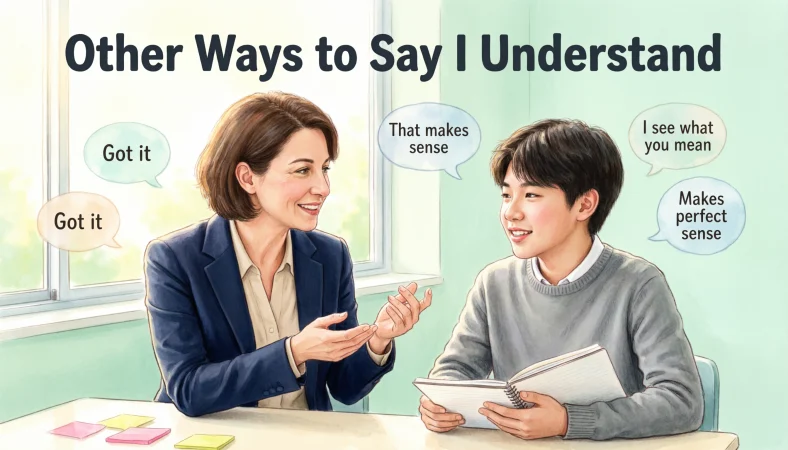
If you want alternatives to other ways to say I understand, try: I get it, I see your point, I follow you, that makes sense, I hear you. These phrases help you sound more natural, professional, or expressive depending on the situation.
The phrase “I understand” is one of the most common ways to show comprehension in English. It signals that you’ve received and processed information clearly.
People use it in conversations, emails, meetings, and daily interactions. However, repeating the same phrase can make your English sound basic or repetitive.
Learning alternatives to other ways to say I understand helps improve fluency, tone, and clarity. It also allows you to express excitement in English, agreement, or empathy more precisely.
“Using varied expressions makes your English sound more natural and confident.”
Quick Categories Section
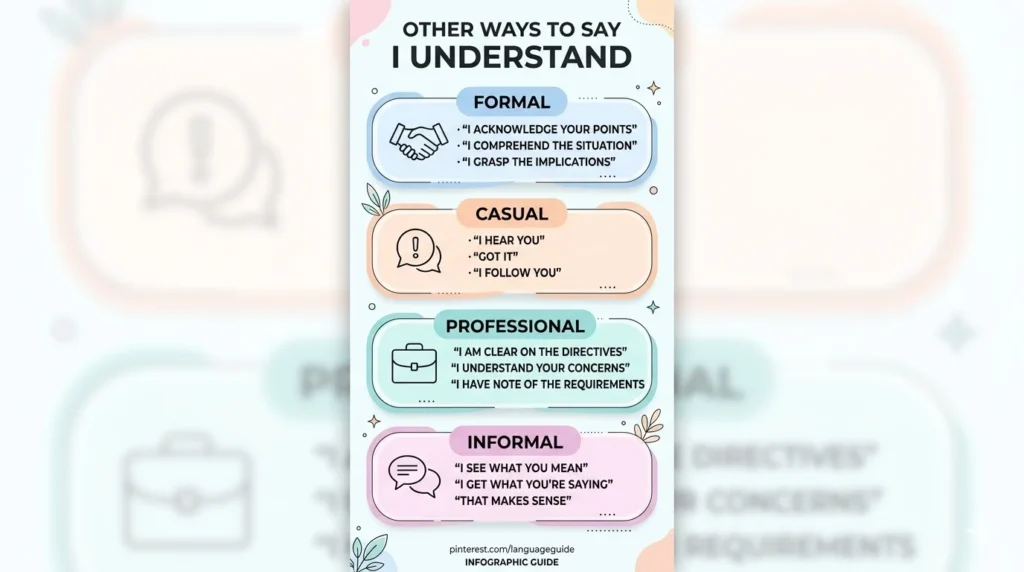
Formal Alternatives to “I Understand”
- I comprehend
- I acknowledge your point
- I appreciate your explanation
- I fully understand the situation
Pro Tip: Use formal phrases in emails, reports, and academic writing.
Casual Alternatives
- I get it
- Got it
- I see
- Makes sense
Pro Tip: Keep casual phrases for conversations with friends or peers.
Professional Alternatives
- I understand your concern
- That’s clear to me
- I follow your reasoning
- I appreciate the clarification
Pro Tip: Combine clarity with politeness in workplace communication.
Informal Expressions
- I’m with you
- I hear you
- Totally get it
- Ah, okay
Pro Tip: Informal expressions work best in relaxed, spoken contexts.
“The right tone can turn a simple response into a powerful communication tool.”
Common Mistakes Section
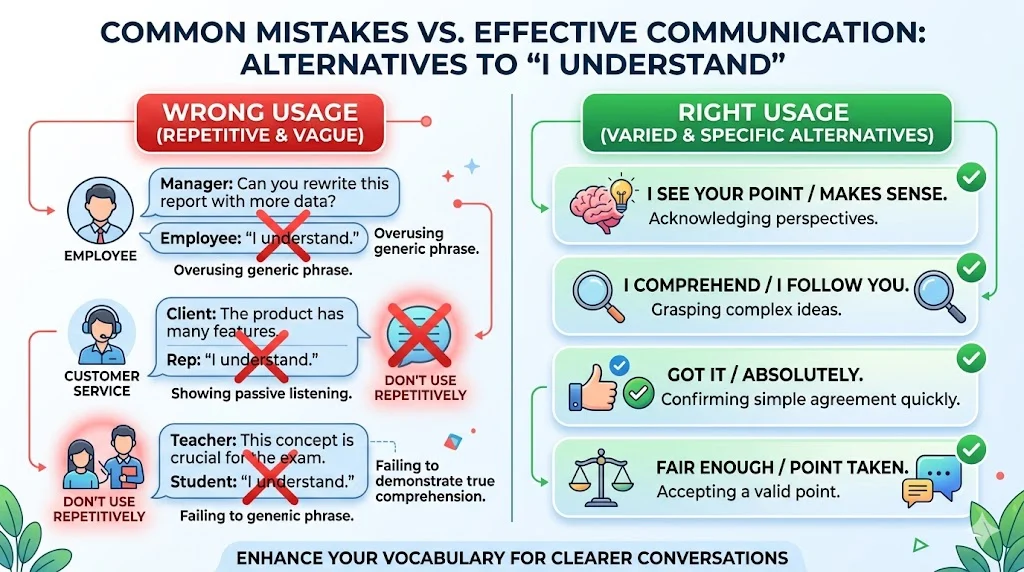
- Overusing “I understand”
Example: I understand, I understand, I understand… - Using it without actually understanding
Example: I understand (but asking the same question again) - Using it in formal writing repeatedly
Example: I understand your email (sounds basic) - Sounding dismissive
Example: I understand, but… (can feel abrupt) - Wrong tone in emotional situations
Example: I understand (when empathy is needed instead)
What Does “I Understand” Mean?
“I understand” means you have grasped the meaning, idea, or feeling someone is communicating.
Grammar Note:
It is a simple present tense statement used for acknowledgment.
Example:
I understand what you’re saying.
When to Use “I Understand”
- During conversations to show comprehension
- In meetings to confirm clarity
- In emails to acknowledge information
- Spoken and written contexts
- Neutral tone (works in both formal and informal settings)
Is It Professional or Polite to Say “I Understand”?
“I understand” is polite but not always professional in tone.
Business Example:
I understand your concern and will address it promptly.
Polite? ✔️ Yes
Professional? ❌ No (in most cases)
Pros and Cons of Using “I Understand”
Pros
- Simple and natural
- Friendly tone
- Common usage
- Easy to understand
Cons
- Too informal for work
- Overused
- Limited emotional range
- Not suitable for formal writing
“Professional English relies on precision, not repetition.”
Other Ways to Say “I Understand” With Examples
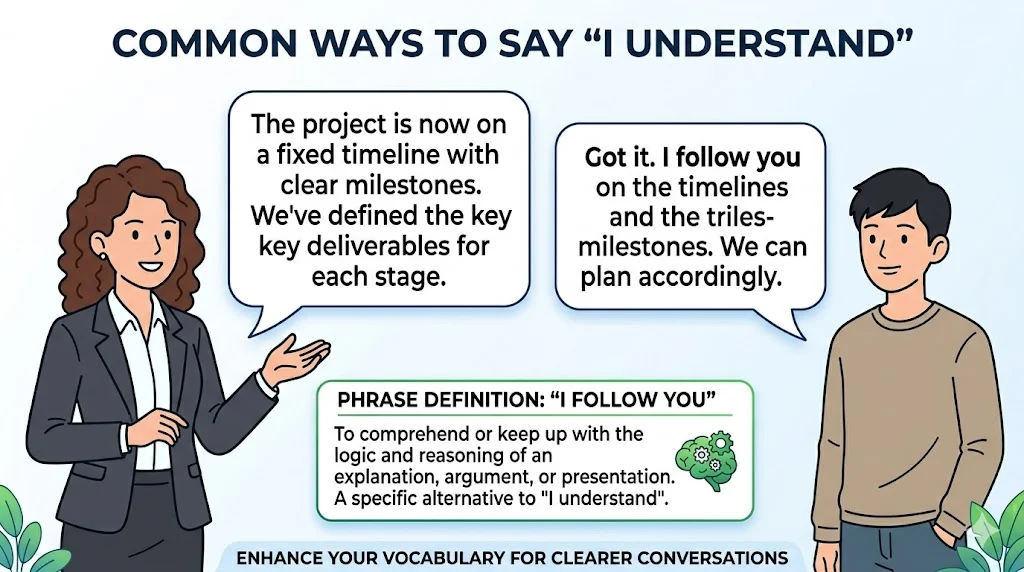
These alternatives will help you sound more fluent, confident, and natural in different situations.
Use them according to tone, context, and audience to express excitement, admiration, or approval.
1. Phrase: I get it
Meaning: You understand something clearly.
Explanation: Casual and commonly used in speech.
Example Sentence: I get it now, thanks for explaining.
Best Use: casual talk
Worst Use: formal writing
Tone: relaxed, friendly
Context Variability: casual, spoken
2. Phrase: I see your point
Meaning: You understand someone’s perspective.
Explanation: Shows thoughtful agreement.
Example Sentence: I see your point about the deadline.
Best Use: discussion
Worst Use: quick reply
Tone: thoughtful, neutral
Context Variability: professional, spoken
3. Phrase: That makes sense
Meaning: Something is logical or clear.
Explanation: Confirms clarity and agreement.
Example Sentence: That makes sense given the situation.
Best Use: explanation
Worst Use: disagreement
Tone: neutral, clear
Context Variability: casual, professional
4. Phrase: I follow you
Meaning: You understand the explanation.
Explanation: Often used during ongoing explanations.
Example Sentence: Yes, I follow you so far.
Best Use: meetings
Worst Use: emotional talk
Tone: attentive, neutral
Context Variability: spoken, professional
5. Phrase: I hear you
Meaning: You acknowledge feelings or concerns.
Explanation: Shows empathy more than logic.
Example Sentence: I hear you it’s been a tough week.
Best Use: empathy
Worst Use: technical talk
Tone: empathetic, supportive
Context Variability: informal, spoken
6. Phrase: Got it
Meaning: You understand quickly.
Explanation: Short and direct.
Example Sentence: Got it, I’ll do that.
Best Use: quick reply
Worst Use: formal email
Tone: brief, casual
Context Variability: casual, spoken
7. Phrase: I comprehend
Meaning: You fully understand.
Explanation: Formal and precise.
Example Sentence: I comprehend the issue clearly.
Best Use: academic
Worst Use: casual chat
Tone: formal, serious
Context Variability: formal, written
8. Phrase: I acknowledge that
Meaning: You recognize a point.
Explanation: Often used professionally.
Example Sentence: I acknowledge that concern.
Best Use: workplace
Worst Use: casual talk
Tone: formal, respectful
Context Variability: professional
9. Phrase: I’m with you
Meaning: You understand and agree.
Explanation: Informal and friendly.
Example Sentence: I’m with you on this idea.
Best Use: teamwork
Worst Use: formal writing
Tone: supportive, casual
Context Variability: spoken
10. Phrase: That’s clear
Meaning: Something is easy to understand.
Explanation: Direct acknowledgment.
Example Sentence: That’s clear now.
Best Use: instructions
Worst Use: emotional context
Tone: neutral, direct
Context Variability: professional
11. Phrase: I understand completely
Meaning: You fully grasp the situation.
Explanation: Adds emphasis to your understanding.
Example Sentence: I understand completely what you’re going through.
Best Use: empathy
Worst Use: quick reply
Tone: sincere, supportive
Context Variability: spoken, professional
12. Phrase: I see what you mean
Meaning: You understand someone’s intention.
Explanation: Shows agreement and clarity.
Example Sentence: I see what you mean about the design.
Best Use: discussion
Worst Use: disagreement
Tone: thoughtful, friendly
Context Variability: casual, professional
13. Phrase: That’s understandable
Meaning: Something is reasonable or expected.
Explanation: Often used to show empathy.
Example Sentence: That’s understandable given the circumstances.
Best Use: empathy
Worst Use: technical talk
Tone: polite, empathetic
Context Variability: professional, spoken
14. Phrase: I get your point
Meaning: You understand someone’s argument.
Explanation: Slightly more direct than “I see your point.”
Example Sentence: I get your point about the budget.
Best Use: discussion
Worst Use: formal writing
Tone: casual, direct
Context Variability: spoken
15. Phrase: I grasp that
Meaning: You understand something clearly.
Explanation: Slightly formal alternative.
Example Sentence: I grasp that this is important.
Best Use: formal talk
Worst Use: casual chat
Tone: formal, clear
Context Variability: professional
16. Phrase: Understood
Meaning: You acknowledge and understand.
Explanation: Very concise and often used in work settings.
Example Sentence: Understood, I’ll proceed accordingly.
Best Use: workplace
Worst Use: emotional context
Tone: direct, professional
Context Variability: professional, written
17. Phrase: I’m aware
Meaning: You already know or understand something.
Explanation: Indicates prior knowledge.
Example Sentence: I’m aware of the issue.
Best Use: workplace
Worst Use: empathy
Tone: neutral, firm
Context Variability: professional
18. Phrase: I take your point
Meaning: You accept someone’s argument.
Explanation: Common in British English.
Example Sentence: I take your point about the risks.
Best Use: discussion
Worst Use: casual talk
Tone: polite, formal
Context Variability: professional
19. Phrase: That’s noted
Meaning: You acknowledge information.
Explanation: Often used in formal communication.
Example Sentence: That’s noted for future reference.
Best Use: business
Worst Use: friendly chat
Tone: formal, neutral
Context Variability: written, professional
20. Phrase: I appreciate that
Meaning: You understand and value the point.
Explanation: Adds politeness and respect.
Example Sentence: I appreciate that this took time.
Best Use: workplace
Worst Use: quick reply
Tone: polite, warm
Context Variability: professional
“Small changes in wording can greatly improve your professional communication.”
21. Phrase: I recognize that
Meaning: You accept something as true.
Explanation: Formal acknowledgment.
Example Sentence: I recognize that this is challenging.
Best Use: formal
Worst Use: casual talk
Tone: formal, respectful
Context Variability: professional
22. Phrase: I can see that
Meaning: You understand visually or logically.
Explanation: Flexible and widely used.
Example Sentence: I can see that this approach works.
Best Use: explanation
Worst Use: emotional talk
Tone: neutral, clear
Context Variability: casual, professional
23. Phrase: Fair enough
Meaning: You accept a point as reasonable.
Explanation: Informal and conversational.
Example Sentence: Fair enough, that makes sense.
Best Use: casual
Worst Use: formal writing
Tone: relaxed, agreeable
Context Variability: spoken
24. Phrase: Right, I see
Meaning: You’ve just understood something.
Explanation: Often used in real-time conversations.
Example Sentence: Right, I see what you mean now.
Best Use: conversation
Worst Use: formal email
Tone: casual, responsive
Context Variability: spoken
25. Phrase: I follow your logic
Meaning: You understand reasoning.
Explanation: Useful in analytical discussions.
Example Sentence: I follow your logic on this matter.
Best Use: meetings
Worst Use: casual chat
Tone: professional, analytical
Context Variability: professional
26. Phrase: Message received
Meaning: You understand clearly.
Explanation: Slightly informal, sometimes humorous.
Example Sentence: Message received, I’ll fix it.
Best Use: casual work
Worst Use: formal writing
Tone: informal, light
Context Variability: spoken
27. Phrase: I take that on board
Meaning: You accept and will consider something.
Explanation: Common in business English.
Example Sentence: I take that on board and will adjust.
Best Use: workplace
Worst Use: casual talk
Tone: professional, cooperative
Context Variability: professional
28. Phrase: That adds up
Meaning: Something makes logical sense.
Explanation: Often used in reasoning contexts.
Example Sentence: That adds up based on the data.
Best Use: analysis
Worst Use: emotional context
Tone: logical, neutral
Context Variability: casual, professional
29. Phrase: I’m following
Meaning: You are keeping up with the explanation.
Explanation: Used during ongoing discussions.
Example Sentence: Yes, I’m following so far.
Best Use: meetings
Worst Use: final response
Tone: attentive, neutral
Context Variability: spoken
30. Phrase: Crystal clear
Meaning: Something is completely understood.
Explanation: Emphasizes total clarity.
Example Sentence: Your instructions are crystal clear.
Best Use: emphasis
Worst Use: serious formal writing
Tone: expressive, confident
Context Variability: casual, spoken
“Mastering alternatives to ‘I understand’ is key to sounding fluent, natural, and professional in English.”
Mini Quiz / Self-Check
1. Which is most professional?
A. Got it
B. I comprehend
C. I get it
Answer: B
2. Which shows empathy?
A. I hear you
B. That’s clear
C. I follow you
Answer: A
3. Best for casual conversation?
A. I acknowledge that
B. I get it
C. I comprehend
Answer: B
Comparison Table: Top Alternatives
| Phrase | Tone | Best Use |
|---|---|---|
| I get it | Casual | Conversations |
| I see your point | Thoughtful | Discussions |
| That makes sense | Neutral | Explanations |
| I follow you | Attentive | Meetings |
| I hear you | Empathetic | Emotions |
| Got it | Brief | Quick replies |
| I comprehend | Formal | Academic |
| I acknowledge | Professional | Workplace |
| I’m with you | Friendly | Teamwork |
| That’s clear | Direct | Instructions |
FAQs
1. What are professional ways to say “I understand”?
Use phrases like I acknowledge your point or I appreciate the clarification.
2. What are casual alternatives to “I understand”?
Try I get it, got it, or makes sense.
3. Is “I understand” too basic?
Yes, it can feel repetitive; using other ways to say I understand improves fluency.
4. How do I express empathy instead of understanding?
Use I hear you or I understand how you feel.
5. Why learn alternatives to “I understand”?
They help you sound more natural, professional, and expressive.
Conclusion
Learning other ways to say I understand improves your communication skills by adding variety and precision. It helps you adapt your tone for casual, professional, and emotional situations.
Practice these phrases daily to build confidence. Always choose expressions based on context and audience for more natural and effective English.
CTA: Which phrase do you use most often? Try replacing it today with a new one.