Last Updated on April 2, 2026
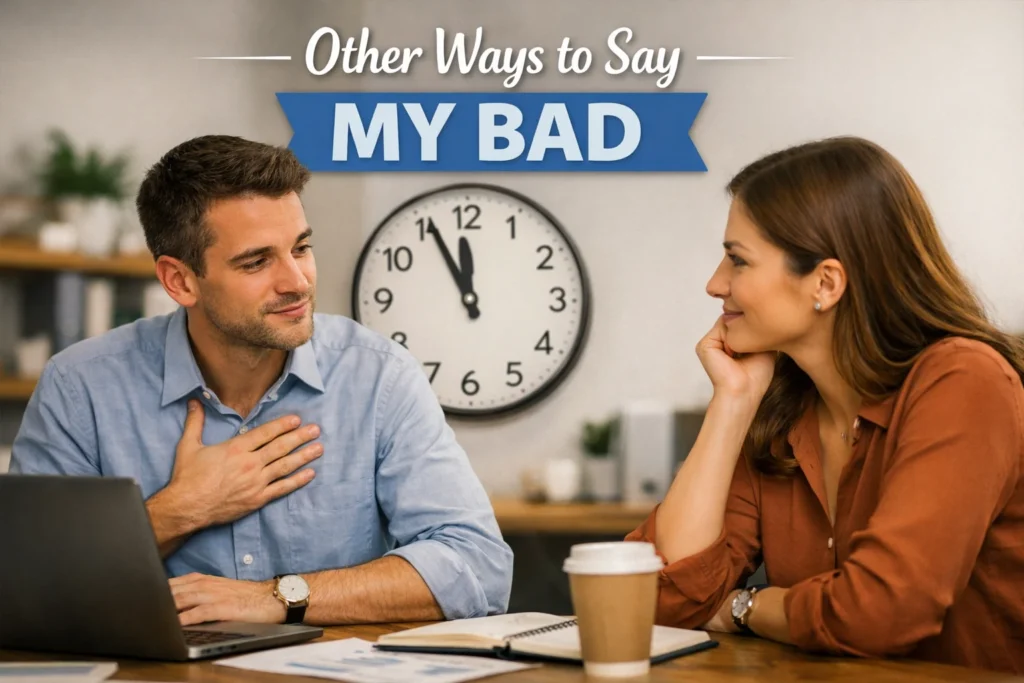
If you want alternatives to “my bad,” try: my mistake, I apologize, that’s on me, I take responsibility, please forgive me. These options help you sound more polite, professional, or sincere depending on the situation.
The phrase “my bad” is commonly used to admit a mistake or take responsibility for something. It’s informal, quick, and widely understood in everyday conversation.
However, relying only on one phrase can limit your communication. Learning alternatives to “my bad” helps you express accountability with the right tone in different situations.
Expanding your vocabulary also helps you express excitement in English, show sincerity, and communicate more professionally and confidently.
Quick Categories Section
Formal Alternatives to “My Bad”
- I sincerely apologize
- I take full responsibility
- Please accept my apologies
- That was an oversight on my part
Pro Tip: Use formal phrases in emails, reports, or when addressing clients or supervisors.
Casual Alternatives
- My mistake
- Oops, that’s on me
- Sorry about that
- I messed up
Pro Tip: Casual phrases are perfect for conversations with friends or colleagues you know well.
Professional Alternatives
- I apologize for the error
- That was my responsibility
- I’ll correct that immediately
- Thank you for your patience
Pro Tip: In the workplace, focus on solutions—not just the mistake.
Informal Expressions
- My fault
- That’s on me
- I goofed
- I slipped up
Pro Tip: Informal expressions in English should be used carefully to avoid sounding careless.
“Owning your mistakes the right way builds trust and professionalism.”
Common Mistakes
- Using “my bad” in formal emails
Example: “My bad for the delay.” - Sounding too casual in serious situations
Example: “Oops, my bad!” (in a client meeting) - Not taking full responsibility
Example: “My bad, but it wasn’t clear.” - Overusing the phrase
Example: Saying “my bad” repeatedly instead of varying language - Not offering a solution
Example: “My bad.” (without fixing the issue)
What Does “My Bad” Mean?
Definition: It means “I made a mistake” or “I am responsible for the error.”
Grammar: It’s an informal idiomatic expression.
Example: “My bad—I sent the wrong file.”
When to Use “My Bad”
- In casual conversations
- With friends or coworkers (informally)
- For small or minor mistakes
- In relaxed environments
Spoken vs Written: Mostly spoken
Formal vs Informal: Informal
Is It Professional or Polite to Say “My Bad”?
Polite? ✔️ Yes (in casual tone)
Professional? ❌ No (in most cases)
Business Example:
“I apologize for the oversight. I will correct it immediately.”
Pros and Cons of Using “My Bad”
Pros
- Simple and natural
- Friendly tone
- Common usage
- Easy to understand
Cons
- Too informal for work
- Can sound careless
- Overused
- Not suitable for formal writing
“Professional communication is about taking responsibility with the right tone.”
Other Ways to Say “My Bad” With Examples
These other ways to say “my bad” will help you sound more fluent, confident, and natural in different situations.
Use them according to tone, context, and audience to express accountability effectively.
1. Phrase: My mistake
Meaning: I made an error
Explanation: Simple and widely accepted
Example Sentence: My mistake I misunderstood the instructions
Best Use: general use
Worst Use: very formal
Tone: neutral, polite
Context Variability: casual / professional
2. Phrase: I apologize
Meaning: I am sorry
Explanation: More formal and respectful
Example Sentence: I apologize for the confusion
Best Use: professional
Worst Use: jokes
Tone: formal, sincere
Context Variability: professional
3. Phrase: That’s on me
Meaning: I take responsibility
Explanation: Casual accountability
Example Sentence: That’s on me—I forgot the deadline
Best Use: casual talk
Worst Use: formal email
Tone: informal, honest
Context Variability: casual
4. Phrase: I take responsibility
Meaning: Accepting blame
Explanation: Strong and professional
Example Sentence: I take responsibility for the error
Best Use: workplace
Worst Use: casual chat
Tone: formal, serious
Context Variability: professional
5. Phrase: Please forgive me
Meaning: Asking for understanding
Explanation: Emotional and sincere
Example Sentence: Please forgive me for the mistake
Best Use: serious situations
Worst Use: minor errors
Tone: sincere, emotional
Context Variability: personal / formal
6. Phrase: My fault
Meaning: I caused the issue
Explanation: Direct and informal
Example Sentence: My fault—I didn’t double-check
Best Use: casual
Worst Use: formal
Tone: blunt, honest
Context Variability: informal
7. Phrase: I messed up
Meaning: I made a mistake
Explanation: Informal and expressive
Example Sentence: I messed up the schedule
Best Use: friends
Worst Use: business
Tone: casual, emotional
Context Variability: informal
8. Phrase: That was my oversight
Meaning: I missed something
Explanation: Professional tone
Example Sentence: That was my oversight, I’ll fix it
Best Use: workplace
Worst Use: casual talk
Tone: formal, calm
Context Variability: professional
9. Phrase: I slipped up
Meaning: Small mistake
Explanation: Suggests minor error
Example Sentence: I slipped up on that detail
Best Use: minor issues
Worst Use: serious error
Tone: light, casual
Context Variability: casual
10. Phrase: I was wrong
Meaning: Admitting incorrect action
Explanation: Clear and honest
Example Sentence: I was wrong about that
Best Use: discussions
Worst Use: sarcastic tone
Tone: honest, direct
Context Variability: professional / spoken
“Admitting mistakes clearly makes your English more powerful.”
11. Phrase: I sincerely apologize
Meaning: Formal apology
Explanation: Shows deep regret
Example Sentence: I sincerely apologize for the inconvenience
Best Use: formal email
Worst Use: casual chat
Tone: formal, sincere
Context Variability: professional
12. Phrase: That was my error
Meaning: I made a mistake
Explanation: Professional wording
Example Sentence: That was my error in the report
Best Use: workplace
Worst Use: informal talk
Tone: formal, neutral
Context Variability: professional
13. Phrase: I regret that
Meaning: Expressing regret
Explanation: Slightly formal apology
Example Sentence: I regret that this happened
Best Use: serious tone
Worst Use: jokes
Tone: formal, reflective
Context Variability: professional
14. Phrase: I didn’t mean to
Meaning: Unintentional mistake
Explanation: Explains intent
Example Sentence: I didn’t mean to cause confusion
Best Use: clarification
Worst Use: excuses
Tone: gentle, sincere
Context Variability: casual / professional
15. Phrase: I take full responsibility
Meaning: Full accountability
Explanation: Strong professional tone
Example Sentence: I take full responsibility for this issue
Best Use: workplace
Worst Use: minor error
Tone: formal, serious
Context Variability: professional
16. Phrase: That was careless of me
Meaning: Acknowledging carelessness
Explanation: Honest admission
Example Sentence: That was careless of me
Best Use: reflection
Worst Use: jokes
Tone: honest, serious
Context Variability: professional
17. Phrase: I overlooked that
Meaning: Missed detail
Explanation: Common in work context
Example Sentence: I overlooked that step
Best Use: workplace
Worst Use: casual chat
Tone: neutral, professional
Context Variability: professional
18. Phrase: I’ll fix it
Meaning: Offering solution
Explanation: Focuses on correction
Example Sentence: I’ll fix it right away
Best Use: action response
Worst Use: blame shifting
Tone: proactive, confident
Context Variability: professional / spoken
19. Phrase: Sorry about that
Meaning: Casual apology
Explanation: Light and common
Example Sentence: Sorry about that I forgot
Best Use: daily talk
Worst Use: formal
Tone: casual, friendly
Context Variability: casual
20. Phrase: I didn’t catch that
Meaning: Missed something
Explanation: Softens mistake
Example Sentence: I didn’t catch that earlier
Best Use: meetings
Worst Use: excuses
Tone: neutral, polite
Context Variability: professional
21. Phrase: That’s my responsibility
Meaning: Accepting blame
Explanation: Clear ownership
Example Sentence: That’s my responsibility, I’ll handle it
Best Use: workplace
Worst Use: casual
Tone: professional, direct
Context Variability: professional
22. Phrase: I made an error
Meaning: Formal admission
Explanation: Clear and neutral
Example Sentence: I made an error in calculation
Best Use: reports
Worst Use: casual talk
Tone: formal, neutral
Context Variability: professional
23. Phrase: I’ll correct that
Meaning: Fixing mistake
Explanation: Action-focused
Example Sentence: I’ll correct that immediately
Best Use: workplace
Worst Use: casual
Tone: proactive, professional
Context Variability: professional
24. Phrase: That was unintentional
Meaning: Not done on purpose
Explanation: Explains intent
Example Sentence: That was unintentional, I apologize
Best Use: clarification
Worst Use: excuses
Tone: calm, polite
Context Variability: professional
25. Phrase: I apologize for that
Meaning: Direct apology
Explanation: Polite and flexible
Example Sentence: I apologize for that mistake
Best Use: general
Worst Use: sarcasm
Tone: polite, neutral
Context Variability: professional / spoken
26. Phrase: My apologies
Meaning: Formal apology
Explanation: Short and respectful
Example Sentence: My apologies for the delay
Best Use: email
Worst Use: jokes
Tone: formal, polite
Context Variability: professional
27. Phrase: I didn’t realize
Meaning: Lack of awareness
Explanation: Softens mistake
Example Sentence: I didn’t realize the deadline changed
Best Use: explanation
Worst Use: excuses
Tone: neutral, reflective
Context Variability: casual / professional
28. Phrase: That’s my oversight
Meaning: Missed detail
Explanation: Professional tone
Example Sentence: That’s my oversight—I’ll update it
Best Use: workplace
Worst Use: casual
Tone: formal, calm
Context Variability: professional
29. Phrase: I accept the mistake
Meaning: Acknowledging error
Explanation: Direct responsibility
Example Sentence: I accept the mistake and will improve
Best Use: formal
Worst Use: casual
Tone: serious, formal
Context Variability: professional
30. Phrase: Please accept my apologies
Meaning: Formal apology
Explanation: Very respectful
Example Sentence: Please accept my apologies for the inconvenience
Best Use: formal writing
Worst Use: casual
Tone: formal, respectful
Context Variability: professional
“Small changes in wording create big improvements in fluency.”
Mini Quiz / Self-Check
1. Which option is the most professional?
A. My bad
B. I sincerely apologize
C. I messed up
Answer: B. I sincerely apologize
2. Which is the best casual phrase?
A. My fault
B. Please accept my apologies
C. I take responsibility
Answer: A. My fault
3. Which phrase is inappropriate in a business setting?
A. I apologize
B. My bad
C. That was my error
Answer: B. My bad
4. Which is best for taking responsibility at work?
A. That’s on me
B. I take full responsibility
C. Oops
Answer: B. I take full responsibility
Comparison Table: Top Alternatives
| Phrase | Tone | Best Use |
|---|---|---|
| I apologize | Formal | Workplace |
| My mistake | Neutral | General |
| I take responsibility | Professional | Business |
| That’s on me | Casual | Conversations |
| My fault | Informal | Friends |
| I sincerely apologize | Formal | Emails |
| That was my oversight | Professional | Reports |
| I’ll fix it | Proactive | Work |
| Sorry about that | Casual | Daily use |
| Please accept my apologies | Formal | Official writing |
FAQs
1. What are better alternatives to “my bad”?
Use “my mistake,” “I apologize,” or “that was my oversight.”
2. Is “my bad” rude?
Not rude, but it can sound too casual in formal situations.
3. What is a professional way to say “my bad”?
“I apologize” or “I take responsibility.”
4. How do I apologize politely in English?
Use phrases like “please accept my apologies.”
5. Why learn alternatives to “my bad”?
They improve tone, clarity, and professionalism.
Conclusion
Learning other ways to say “my bad” helps you communicate more clearly and professionally. The right phrase allows you to show responsibility without sounding careless.
Practice these alternatives to “my bad” daily to improve fluency and confidence. Always match your tone to the situation for the best results.
CTA: Practice replacing “my bad” with 3 new phrases today.