Last Updated on April 5, 2026
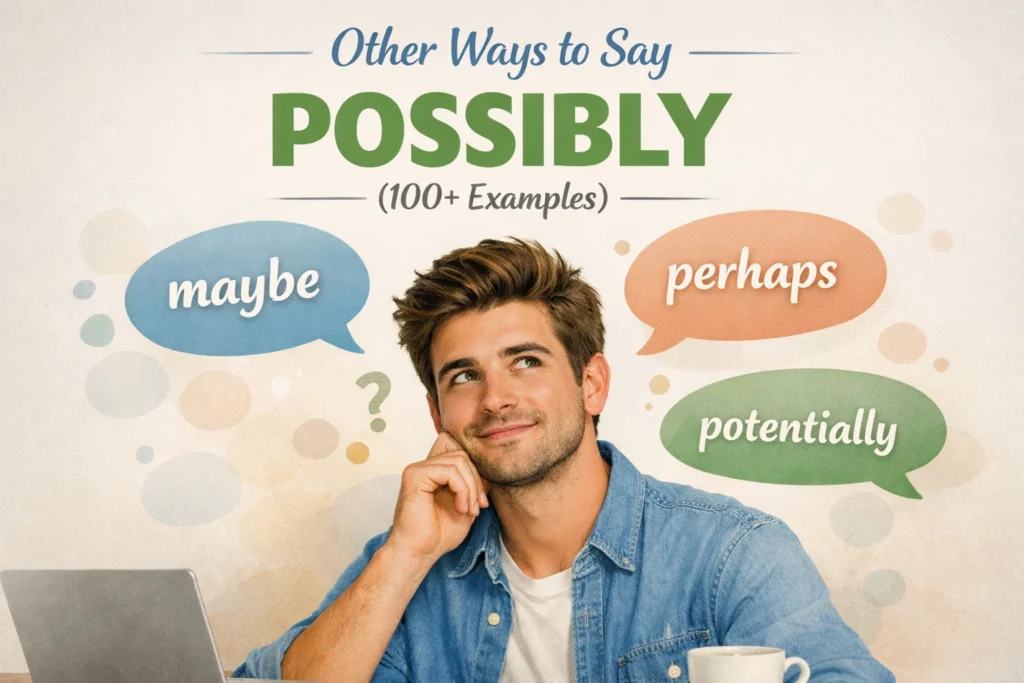
If you’re looking for other ways to say possibly, try: perhaps, maybe, potentially, conceivably, it’s possible. These alternatives help you sound more natural, precise, and confident in both casual and professional English.
The word “possibly” is commonly used to express uncertainty or a chance that something may happen. It’s useful, but overusing it can make your English sound repetitive or vague.
Learning alternatives to other ways to say possibly helps you communicate with more clarity and variety. It also improves your ability to adjust tone in different situations.
If you want to express uncertainty in English more effectively, mastering these variations is essential for both spoken and written communication.
“The right word can turn uncertainty into clarity.”
Quick Categories Section
Formal Alternatives to “other ways to say possibly”
- It is conceivable that
- It may be the case
- There is a likelihood
- It is plausible
Pro Tip: Use these in academic writing, reports, or formal discussions.
Casual Alternatives
- Maybe
- Could be
- Might be
- There’s a chance
Pro Tip: Keep it simple and natural in everyday conversations.
Professional Alternatives
- Potentially
- It is possible that
- There is a possibility
- Likely (context-dependent)
Pro Tip: Choose precise words to avoid sounding uncertain in business settings.
Informal Expressions
- Who knows
- You never know
- Could happen
- It’s up in the air
Pro Tip: Use these to sound relaxed and conversational.
“Professional English values clarity over uncertainty.”
Common Mistakes Section
- Overusing “possibly” in every sentence
Example: It could possibly maybe happen ❌ - Using it in formal writing without variation
Example: This is possibly correct ❌ - Combining with similar words unnecessarily
Example: Possibly might occur ❌ - Using vague wording in professional settings
Example: We will possibly deliver tomorrow ❌ - Incorrect placement in a sentence
Example: Possibly we can maybe go ❌
What Does “other ways to say possibly” Mean?
It refers to alternative words or phrases that express uncertainty, chance, or probability, similar to “possibly.”
Grammar Note:
“Possibly” is an adverb used to modify verbs or entire clauses.
Example:
It could possibly rain later.
When to Use “other ways to say possibly”
- Expressing uncertainty
- Suggesting options
- Making polite assumptions
- Softening statements
Spoken vs Written:
Used in both, but varies in tone
Formal vs Informal:
Flexible depending on alternative used
Is It Professional or Polite to Say “possibly”?
Polite? ✔️ Yes
Professional? ✔️ Yes (when used carefully)
Business Example:
We may potentially complete the project by Friday. ✔️
Pros and Cons of Using “possibly”
Pros
- Simple and clear
- Widely understood
- Useful in many contexts
- Softens statements
Cons
- Can sound vague
- Overused
- Lacks precision
- Weak in strong arguments
“Fluent speakers choose precise words, not just common ones.”
Other Ways to Say “possibly” With Examples
These alternatives will help you sound more fluent, confident, and natural in different situations.
Use them based on tone, context, and audience to express uncertainty in English.
1. Phrase: Perhaps
Meaning: Maybe or possibly
Explanation: Slightly more formal than “maybe”
Example Sentence: Perhaps we should try another approach
Best Use: writing, discussion
Worst Use: none
Tone: neutral, thoughtful
Context Variability: casual / professional
2. Phrase: Maybe
Meaning: Something might happen
Explanation: Common and simple
Example Sentence: Maybe I’ll join you later
Best Use: casual talk
Worst Use: formal reports
Tone: casual, neutral
Context Variability: casual
3. Phrase: Potentially
Meaning: Has the capacity to happen
Explanation: More professional and precise
Example Sentence: This could potentially increase sales
Best Use: business
Worst Use: informal jokes
Tone: formal, analytical
Context Variability: professional
4. Phrase: Conceivably
Meaning: It is possible to imagine
Explanation: Formal and advanced
Example Sentence: This could conceivably lead to growth
Best Use: academic
Worst Use: casual talk
Tone: formal, intellectual
Context Variability: formal
5. Phrase: It’s possible
Meaning: Something may happen
Explanation: Direct and clear
Example Sentence: It’s possible we’ll finish early
Best Use: general
Worst Use: none
Tone: neutral
Context Variability: all contexts
6. Phrase: There’s a chance
Meaning: Some probability exists
Explanation: Slightly informal
Example Sentence: There’s a chance it will rain
Best Use: casual
Worst Use: formal writing
Tone: friendly
Context Variability: casual
7. Phrase: Might
Meaning: Indicates possibility
Explanation: Modal verb for uncertainty
Example Sentence: I might go later
Best Use: spoken English
Worst Use: none
Tone: neutral
Context Variability: all contexts
8. Phrase: Could be
Meaning: Possibly true
Explanation: Flexible and common
Example Sentence: That could be the answer
Best Use: general
Worst Use: formal writing
Tone: casual
Context Variability: casual
9. Phrase: It may be the case
Meaning: Something might be true
Explanation: Formal expression
Example Sentence: It may be the case that we are late
Best Use: reports
Worst Use: casual talk
Tone: formal
Context Variability: professional
10. Phrase: Plausibly
Meaning: Reasonably possible
Explanation: Suggests logical possibility
Example Sentence: This could plausibly work
Best Use: analysis
Worst Use: casual
Tone: formal, logical
Context Variability: professional
11. Phrase: Likely
Meaning: Something has a high chance of happening
Explanation: Indicates stronger probability than “possibly”
Example Sentence: It’s likely we’ll finish early
Best Use: predictions, work
Worst Use: uncertain guesses
Tone: confident, neutral
Context Variability: casual / professional
12. Phrase: Unlikely
Meaning: Something probably will not happen
Explanation: Expresses low probability
Example Sentence: It’s unlikely they will agree
Best Use: analysis
Worst Use: positive contexts
Tone: cautious, neutral
Context Variability: professional
13. Phrase: Feasibly
Meaning: Capable of happening
Explanation: Focuses on practicality
Example Sentence: This could feasibly work in our favor
Best Use: planning
Worst Use: casual talk
Tone: formal, analytical
Context Variability: professional
14. Phrase: In all likelihood
Meaning: Very probably
Explanation: Stronger than “possibly”
Example Sentence: In all likelihood, the event will be postponed
Best Use: formal writing
Worst Use: casual speech
Tone: formal, confident
Context Variability: professional
15. Phrase: It’s conceivable
Meaning: It can be imagined as possible
Explanation: Slightly formal and thoughtful
Example Sentence: It’s conceivable that prices may rise
Best Use: academic
Worst Use: casual chat
Tone: formal, reflective
Context Variability: formal
16. Phrase: There is a possibility
Meaning: Something might happen
Explanation: Neutral and widely used
Example Sentence: There is a possibility of delays
Best Use: general
Worst Use: none
Tone: neutral
Context Variability: all contexts
17. Phrase: It could happen
Meaning: Something is possible
Explanation: Direct and simple
Example Sentence: Don’t worry, it could happen
Best Use: casual
Worst Use: formal writing
Tone: relaxed
Context Variability: casual
18. Phrase: You never know
Meaning: Anything is possible
Explanation: Informal and optimistic
Example Sentence: Try it—you never know
Best Use: encouragement
Worst Use: business reports
Tone: casual, encouraging
Context Variability: informal
19. Phrase: Who knows
Meaning: The outcome is uncertain
Explanation: Expresses unpredictability
Example Sentence: Who knows what will happen next
Best Use: casual talk
Worst Use: professional settings
Tone: informal, uncertain
Context Variability: casual
20. Phrase: It’s up in the air
Meaning: Not decided yet
Explanation: Indicates uncertainty
Example Sentence: Our plans are still up in the air
Best Use: discussions
Worst Use: formal writing
Tone: informal, neutral
Context Variability: casual
21. Phrase: It’s within the realm of possibility
Meaning: It could realistically happen
Explanation: Formal and precise
Example Sentence: This outcome is within the realm of possibility
Best Use: reports
Worst Use: casual speech
Tone: formal, analytical
Context Variability: professional
22. Phrase: It may happen
Meaning: Something might occur
Explanation: Simple and neutral
Example Sentence: It may happen sooner than expected
Best Use: general
Worst Use: none
Tone: neutral
Context Variability: all contexts
23. Phrase: It might occur
Meaning: Something could take place
Explanation: Slightly formal variation
Example Sentence: This issue might occur again
Best Use: writing
Worst Use: casual jokes
Tone: neutral, formal
Context Variability: professional
24. Phrase: There’s some chance
Meaning: A small probability exists
Explanation: Less certain than “likely”
Example Sentence: There’s some chance of rain
Best Use: casual
Worst Use: formal reports
Tone: informal, neutral
Context Variability: casual
25. Phrase: It could potentially happen
Meaning: It is possible
Explanation: Emphasizes potential outcome
Example Sentence: This could potentially happen if we delay
Best Use: professional
Worst Use: casual chat
Tone: formal, cautious
Context Variability: professional
26. Phrase: It’s not impossible
Meaning: There is some chance
Explanation: Suggests cautious optimism
Example Sentence: It’s not impossible to succeed
Best Use: encouragement
Worst Use: strong certainty
Tone: cautious, hopeful
Context Variability: general
27. Phrase: It may well be
Meaning: Quite possibly true
Explanation: Suggests reasonable probability
Example Sentence: It may well be the best option
Best Use: discussion
Worst Use: casual slang
Tone: thoughtful, neutral
Context Variability: semi-formal
28. Phrase: It remains possible
Meaning: Still possible
Explanation: Indicates ongoing uncertainty
Example Sentence: It remains possible that plans will change
Best Use: reports
Worst Use: casual talk
Tone: formal, cautious
Context Variability: professional
29. Phrase: It’s a possibility
Meaning: It could happen
Explanation: Simple and flexible
Example Sentence: It’s a possibility we’ll move forward
Best Use: general
Worst Use: none
Tone: neutral
Context Variability: all contexts
30. Phrase: It could very well be
Meaning: Quite possibly true
Explanation: Adds emphasis to possibility
Example Sentence: It could very well be the answer
Best Use: discussion
Worst Use: formal reports
Tone: confident, thoughtful
Context Variability: casual / semi-formal
“The more precisely you express uncertainty, the more confident your English sounds.”
Mini Quiz / Self-Check
1. Which is most formal?
A. Maybe
B. Conceivably ✔️
C. Who knows
2. Best for casual talk?
A. Perhaps
B. Maybe ✔️
C. Plausibly
3. Best for business writing?
A. Potentially ✔️
B. Who knows
C. Could be
Comparison Table: Top Alternatives
| Phrase | Tone | Best Use |
|---|---|---|
| Perhaps | Neutral | Writing |
| Maybe | Casual | Conversation |
| Potentially | Professional | Business |
| Conceivably | Formal | Academic |
| Might | Neutral | All contexts |
| Could be | Casual | General |
| Plausibly | Formal | Analysis |
| It’s possible | Neutral | All |
| Likely | Neutral | Predictions |
| There’s a chance | Casual | Daily use |
FAQs
1. What are the best other ways to say possibly?
Words like perhaps, maybe, and potentially are the most commonly used alternatives.
2. Is “possibly” formal or informal?
It is neutral and can be used in both contexts.
3. What is the most professional alternative?
Potentially or it is possible that works best.
4. Can I use “maybe” in formal writing?
It’s better to use perhaps or possibly instead.
5. Why should I learn alternatives?
They improve clarity, tone, and fluency in English.
Conclusion
Learning other ways to say possibly helps you communicate uncertainty more clearly and effectively. It allows you to choose the right tone for casual, professional or academic situations.
Practice these alternatives daily to build confidence and fluency. The more variety you use, the more natural your English will sound.