
Last Updated on April 2, 2026
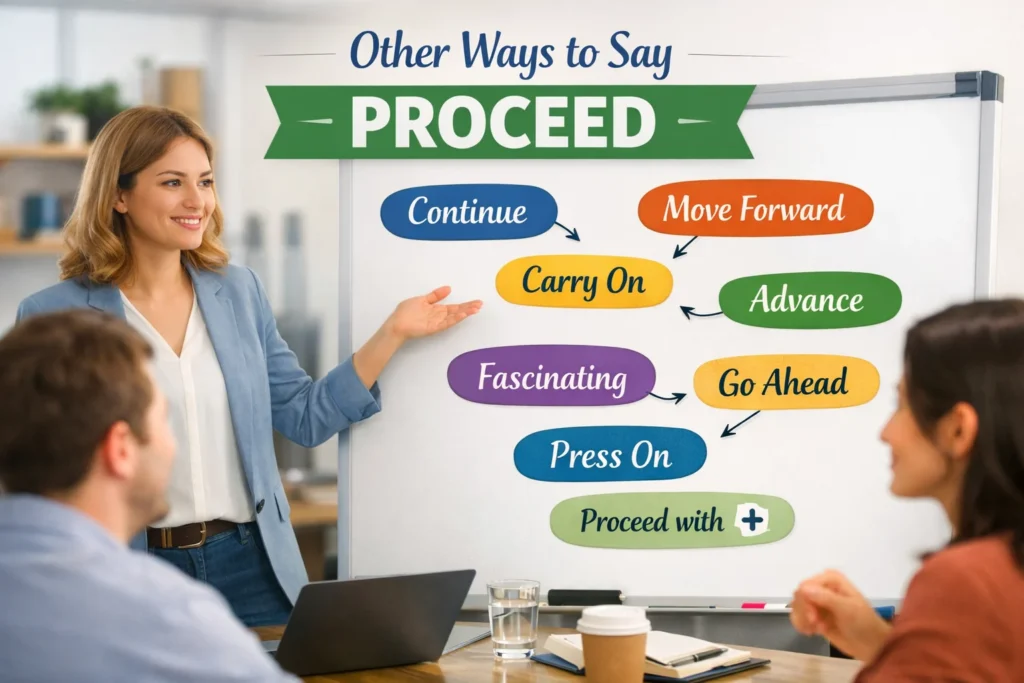
“Proceed” is commonly used to mean “continue” or “move forward.” Some of the best alternatives include: continue, go ahead, carry on, move forward, advance. These options help you sound more natural and context-appropriate in both spoken and written English.
The phrase “proceed” is widely used in English to signal continuation or the next step in a process. Whether you’re giving instructions, speaking in meetings, or writing emails, it’s a useful word.
However, relying on one expression can make your communication sound repetitive. Learning alternatives to “proceed” helps you sound more fluent and adaptable in different situations.
Expanding your vocabulary also improves your ability to express excitement in English, sound more professional, and communicate with confidence across formal and informal settings.
Quick Categories Section
Formal alternatives to “proceed”
- Continue
- Advance
- Carry on
- Progress
Pro Tip: Use these in reports, presentations, or formal discussions.
Casual alternatives
- Go ahead
- Keep going
- Move on
- Go for it
Pro Tip: These sound natural in everyday conversations.
Professional alternatives
- Move forward
- Take the next step
- Continue with the process
- Proceed accordingly
Pro Tip: Choose neutral and clear phrases for workplace communication.
Informal expressions
- Let’s roll
- Get going
- Push on
- Keep it moving
Pro Tip: Avoid these in emails or formal writing.
“The right alternative to ‘proceed’ can instantly make your English sound more natural and confident.”
Common Mistakes Section
- Using “proceed” in casual conversation
Example: “Let’s proceed to the café.” (Too formal) - Overusing the word repeatedly
Example: “Proceed to step one, then proceed to step two.” - Using it without context
Example: “Proceed.” (Unclear in conversation) - Using it in emotional situations
Example: “I’m excited, let’s proceed!” (Sounds unnatural) - Incorrect tone in emails
Example: “Proceed immediately.” (Too harsh)
What Does “Proceed” Mean?
Definition:
“Proceed” means to continue an action or move forward with a process.
Grammar Note:
It is a verb and often followed by “to” + action.
Example Sentence:
“We will proceed to the next stage of the project.”
When to Use “Proceed”
- Giving instructions
- Formal writing
- Meetings and presentations
- Step-by-step processes
Spoken vs Written:
More common in written or formal speech
Formal vs Informal:
Mostly formal
Is It Professional or Polite to Say “Proceed”?
Polite? ✔️ Yes
Professional? ❌ No (in most cases)
While polite, “proceed” can sound stiff in modern business communication.
Business Example:
“Please proceed with the implementation plan.”
Pros and Cons of Using “Proceed”
Pros
- Simple and natural
- Friendly tone
- Common usage
- Easy to understand
Cons
- Too informal for work
- Overused
- Limited emotional range
- Not suitable for formal writing
“Strong vocabulary isn’t about complexity—it’s about choosing the right word for the right moment.”
Other Ways to Say “Proceed” With Examples
These alternatives will help you sound more fluent, confident, and natural in different situations.
Use them according to tone, context, and audience to express excitement, admiration, or approval.
1. Phrase: Continue
Meaning: Keep doing something.
Explanation: A direct and neutral substitute.
Example Sentence: “Please continue your presentation.”
Best Use: formal speech
Worst Use: emotional talk
Tone: neutral, clear
Context Variability: professional / spoken
2. Phrase: Go ahead
Meaning: Start or continue freely.
Explanation: Common in conversations.
Example Sentence: “Go ahead, I’m listening.”
Best Use: casual talk
Worst Use: formal reports
Tone: friendly, relaxed
Context Variability: casual / spoken
3. Phrase: Move forward
Meaning: Progress to the next stage.
Explanation: Common in business settings.
Example Sentence: “Let’s move forward with the plan.”
Best Use: workplace
Worst Use: casual chat
Tone: professional, positive
Context Variability: professional
4. Phrase: Carry on
Meaning: Continue doing something.
Explanation: Slightly more conversational.
Example Sentence: “Carry on with your work.”
Best Use: daily speech
Worst Use: formal writing
Tone: calm, neutral
Context Variability: spoken
5. Phrase: Advance
Meaning: Move ahead or progress.
Explanation: More formal alternative.
Example Sentence: “The project will advance next week.”
Best Use: formal writing
Worst Use: casual speech
Tone: formal, serious
Context Variability: professional
6. Phrase: Keep going
Meaning: Continue without stopping.
Explanation: Encouraging and casual.
Example Sentence: “Keep going—you’re doing great.”
Best Use: encouragement
Worst Use: business email
Tone: supportive, casual
Context Variability: informal
7. Phrase: Progress
Meaning: Move forward gradually.
Explanation: Often used in reports.
Example Sentence: “We are progressing well.”
Best Use: reports
Worst Use: casual talk
Tone: formal, neutral
Context Variability: professional
8. Phrase: Go on
Meaning: Continue speaking or acting.
Explanation: Common in conversation.
Example Sentence: “Go on, tell me more.”
Best Use: conversations
Worst Use: formal writing
Tone: casual, curious
Context Variability: spoken
9. Phrase: Take the next step
Meaning: Move to the next stage.
Explanation: Clear and professional.
Example Sentence: “Let’s take the next step.”
Best Use: business
Worst Use: slang context
Tone: professional, clear
Context Variability: professional
10. Phrase: Push ahead
Meaning: Continue despite difficulty.
Explanation: Implies determination.
Example Sentence: “We must push ahead.”
Best Use: motivation
Worst Use: casual talk
Tone: determined, strong
Context Variability: professional
11. Phrase: Keep moving
Meaning: Continue without stopping.
Explanation: Encourages ongoing action, often in casual contexts.
Example Sentence: “Keep moving—we’re almost there.”
Best Use: encouragement
Worst Use: formal email
Tone: casual, motivating
Context Variability: informal / spoken
12. Phrase: Press on
Meaning: Continue despite difficulty.
Explanation: Suggests determination and resilience.
Example Sentence: “We must press on despite the challenges.”
Best Use: motivation
Worst Use: casual chat
Tone: determined, strong
Context Variability: professional / spoken
13. Phrase: Follow through
Meaning: Complete an action or plan.
Explanation: Focuses on finishing what was started.
Example Sentence: “Make sure you follow through on your commitments.”
Best Use: workplace
Worst Use: casual slang
Tone: professional, responsible
Context Variability: professional
14. Phrase: Continue onward
Meaning: Move ahead in a direction.
Explanation: Slightly formal and descriptive.
Example Sentence: “We will continue onward to the next phase.”
Best Use: formal speech
Worst Use: casual talk
Tone: formal, descriptive
Context Variability: professional
15. Phrase: Step forward
Meaning: Move ahead or take initiative.
Explanation: Often used metaphorically.
Example Sentence: “She decided to step forward and lead the team.”
Best Use: leadership
Worst Use: casual chat
Tone: confident, proactive
Context Variability: professional
“Choosing the right phrase isn’t just vocabulary it’s communication strategy.”
16. Phrase: Get started
Meaning: Begin doing something.
Explanation: Friendly and widely used.
Example Sentence: “Let’s get started on the project.”
Best Use: meetings
Worst Use: formal reports
Tone: friendly, practical
Context Variability: casual / professional
17. Phrase: Begin
Meaning: Start something.
Explanation: Simple and slightly formal.
Example Sentence: “We will begin the session shortly.”
Best Use: formal speech
Worst Use: slang context
Tone: neutral, formal
Context Variability: professional
18. Phrase: Resume
Meaning: Continue after a pause.
Explanation: Common in formal and structured contexts.
Example Sentence: “Let’s resume the discussion.”
Best Use: meetings
Worst Use: casual chat
Tone: formal, neutral
Context Variability: professional
19. Phrase: Act
Meaning: Take action.
Explanation: Short and direct.
Example Sentence: “We need to act quickly.”
Best Use: urgency
Worst Use: casual talk
Tone: direct, urgent
Context Variability: professional
20. Phrase: Execute
Meaning: Carry out a plan.
Explanation: Strong professional term.
Example Sentence: “Execute the strategy as planned.”
Best Use: business
Worst Use: casual speech
Tone: formal, authoritative
Context Variability: professional
21. Phrase: Move along
Meaning: Continue to the next step.
Explanation: Often used in instructions.
Example Sentence: “Let’s move along to the next topic.”
Best Use: presentations
Worst Use: emotional talk
Tone: neutral, guiding
Context Variability: spoken / professional
22. Phrase: Go forward
Meaning: Progress ahead.
Explanation: Similar to “move forward” but simpler.
Example Sentence: “We can go forward with this idea.”
Best Use: planning
Worst Use: slang context
Tone: neutral, clear
Context Variability: professional
23. Phrase: Start up
Meaning: Begin an activity or process.
Explanation: Slightly informal.
Example Sentence: “Let’s start up the system.”
Best Use: tech context
Worst Use: formal writing
Tone: casual, practical
Context Variability: informal / professional
24. Phrase: Proceed further
Meaning: Continue to a deeper level.
Explanation: More formal and specific.
Example Sentence: “We cannot proceed further without approval.”
Best Use: formal writing
Worst Use: casual chat
Tone: formal, precise
Context Variability: professional
25. Phrase: Drive forward
Meaning: Push progress actively.
Explanation: Implies leadership and energy.
Example Sentence: “She will drive the project forward.”
Best Use: leadership
Worst Use: casual talk
Tone: strong, proactive
Context Variability: professional
“Professional English isn’t about big words it’s about the right words.”
26. Phrase: Take action
Meaning: Begin doing something actively.
Explanation: Focuses on initiative.
Example Sentence: “It’s time to take action.”
Best Use: motivation
Worst Use: casual slang
Tone: direct, motivating
Context Variability: professional / spoken
27. Phrase: Continue ahead
Meaning: Move forward.
Explanation: Slightly uncommon but understandable.
Example Sentence: “We will continue ahead as planned.”
Best Use: formal speech
Worst Use: casual talk
Tone: formal, neutral
Context Variability: professional
28. Phrase: Carry forward
Meaning: Continue into the future.
Explanation: Often used in business or finance.
Example Sentence: “We will carry forward these ideas.”
Best Use: workplace
Worst Use: casual chat
Tone: professional, structured
Context Variability: professional
29. Phrase: March on
Meaning: Continue steadily.
Explanation: Strong and slightly dramatic.
Example Sentence: “We must march on toward success.”
Best Use: speeches
Worst Use: business email
Tone: dramatic, strong
Context Variability: spoken
30. Phrase: Keep progressing
Meaning: Continue improving.
Explanation: Focuses on gradual development.
Example Sentence: “Keep progressing and learning.”
Best Use: encouragement
Worst Use: formal report
Tone: positive, supportive
Context Variability: informal / spoken
“Fluency comes from flexibility knowing multiple ways to express the same idea.”
Mini Quiz / Self-Check
1. Which is most professional?
A. Go ahead
B. Move forward
C. Let’s roll
Answer: B
2. Which is best for casual conversation?
A. Advance
B. Proceed accordingly
C. Go on
Answer: C
3. Choose the best sentence:
A. “Let’s proceed, dude.”
B. “Let’s move forward with the proposal.”
C. “Proceed bro.”
Answer: B
Comparison Table: Top Alternatives
| Phrase | Tone | Best Use |
|---|---|---|
| Continue | Neutral | General |
| Go ahead | Casual | Conversations |
| Move forward | Professional | Workplace |
| Carry on | Neutral | Daily speech |
| Advance | Formal | Reports |
| Keep going | Casual | Encouragement |
| Progress | Formal | Updates |
| Go on | Casual | Speaking |
| Take the next step | Professional | Planning |
| Push ahead | Strong | Motivation |
FAQs
1. What are the best alternatives to “proceed”?
Common options include continue, go ahead, and move forward.
2. Is “proceed” formal or informal?
It is generally formal and used in structured communication.
3. Can I use “proceed” in emails?
Yes, but it may sound stiff; try professional reaction phrases instead.
4. What is a casual way to say “proceed”?
“Go ahead” or “keep going” are great informal expressions in English.
5. Why learn other ways to say “proceed”?
It improves fluency and helps adapt tone in different contexts.
Conclusion
Learning other ways to say “proceed” helps you communicate more clearly and naturally in English. It allows you to adjust your tone based on the situation, whether formal, casual, or professional.
Practice these alternatives daily to build confidence and fluency. The key is not just knowing words, but knowing when and how to use them effectively.
CTA: Which alternative do you use most often? Try using a new one today.