
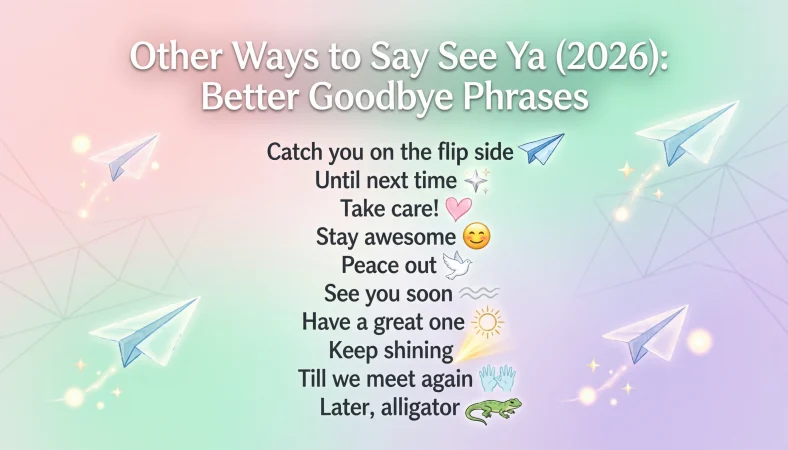
If you want alternatives to other ways to say see ya, try phrases like Goodbye, Catch you later, Take care, See you soon, or Talk to you later.
These options sound more natural, professional or context-appropriate depending on where and how you use them.
The phrase “see ya” is a casual way to say goodbye in spoken English. It is friendly, relaxed, and commonly used among friends, coworkers, and acquaintances.
However, relying on just one phrase can limit your ability to sound fluent. Learning alternatives to other ways to say see ya helps you adapt your tone to different social and professional settings.
Expanding your vocabulary also allows you to express excitement in English, maintain politeness, and communicate with greater confidence.
“Fluent speakers don’t repeat one phrase. They choose expressions that match the moment.”
Quick Categories
Formal Alternatives to “See Ya”
- Goodbye
- Farewell
- I look forward to seeing you again
- Until we meet again
Pro Tip: Use these in formal writing, presentations, or respectful conversations.
Casual Alternatives
- Catch you later
- See you soon
- Talk to you later
- Later
Pro Tip: These are ideal for daily conversations and relaxed environments.
Professional Alternatives
- I’ll be in touch
- Speak with you soon
- Have a great day
- Looking forward to our next meeting
Pro Tip: Choose phrases that maintain warmth without sounding informal.
Informal Expressions
- I’m off
- Take it easy
- See you around
- Bye for now
Pro Tip: Use these only with people you know well.
“Tone matters as much as vocabulary in professional English.”
Common Mistakes
- Using “see ya” in formal emails
Example: See ya at tomorrow’s board meeting. ✘ - Using it with someone you just met
Example: Nice to meet you, see ya. ✘ - Writing it in academic assignments
Example: See ya in the next chapter. ✘ - Overusing it in every conversation
Example: See ya… see ya… see ya again. ✘ - Using it when a respectful tone is required
Example: See ya, Professor. ✘
What Does “See Ya” Mean?
“See ya” is an informal contraction of “see you.” It is used as a farewell that implies you expect to meet again.
Example:
I’m heading home now. See ya tomorrow.
When to Use “See Ya”
Use it in:
- Friendly conversations
- Text messages
- Casual workplace chats
- Informal spoken English
Avoid it in:
- Business writing
- Academic communication
- First-time introductions
Spoken: Very common
Written: Only informal
Formal: No
Informal: Yes
Is It Professional or Polite to Say “See Ya”?
“See ya” is polite but not professional in most contexts.
Business Example:
Instead of: See ya next week.
Say: I look forward to meeting next week.
Polite? ✔️ Yes
Professional? ❌ No (in most cases)
“Professional English replaces casual habits with intentional wording.”
Pros and Cons of Using “See Ya”
Pros
- Simple and natural
- Friendly tone
- Common usage
- Easy to understand
Cons
- Too informal for work
- Overused
- Limited emotional range
- Not suitable for formal writing
Other Ways to Say “See Ya” With Examples
These alternatives will help you sound more fluent, confident, and natural in different situations.
Use them according to tone, context, and audience to express excitement, admiration, or approval.
1. Phrase: Goodbye
Meaning: A standard farewell.
Explanation: Works in both formal and neutral contexts.
Example Sentence: Goodbye, and thank you for your time.
Best Use: Formal settings
Worst Use: Very casual
Tone: Neutral, polite
Context Variability: professional, spoken
2. Phrase: See You Soon
Meaning: You expect to meet again soon.
Explanation: Friendly but slightly more intentional than “see ya.”
Example Sentence: See you soon at the conference.
Best Use: Friendly work
Worst Use: Final goodbyes
Tone: Warm, positive
Context Variability: casual, spoken
3. Phrase: Take Care
Meaning: A caring farewell.
Explanation: Shows concern and kindness.
Example Sentence: Take care on your trip.
Best Use: Polite exits
Worst Use: Fast chats
Tone: Kind, thoughtful
Context Variability: spoken, semi-formal
4. Phrase: Catch You Later
Meaning: You’ll connect again informally.
Explanation: Very common in casual speech.
Example Sentence: Catch you later after class.
Best Use: Friends
Worst Use: Business emails
Tone: Relaxed, friendly
Context Variability: casual, spoken
5. Phrase: Talk to You Later
Meaning: You plan to communicate again.
Explanation: Useful for phone or online conversations.
Example Sentence: Talk to you later this afternoon.
Best Use: Work chats
Worst Use: Formal letters
Tone: Neutral, natural
Context Variability: casual, professional spoken
6. Phrase: Have a Great Day
Meaning: A positive closing wish.
Explanation: Common in professional communication.
Example Sentence: Have a great day ahead.
Best Use: Workplace
Worst Use: Late night
Tone: Polite, upbeat
Context Variability: professional, written
7. Phrase: I’ll Be in Touch
Meaning: Future communication is expected.
Explanation: Frequently used in business contexts.
Example Sentence: I’ll be in touch regarding the update.
Best Use: Professional
Worst Use: Close friends
Tone: Professional, reassuring
Context Variability: professional
8. Phrase: Until Next Time
Meaning: You expect another meeting.
Explanation: Sounds polished and friendly.
Example Sentence: Until next time, take care.
Best Use: Presentations
Worst Use: Quick chats
Tone: Warm, refined
Context Variability: spoken, semi-formal
9. Phrase: Bye for Now
Meaning: Temporary farewell.
Explanation: Suggests you’ll reconnect soon.
Example Sentence: Bye for now, see you tomorrow.
Best Use: Informal work
Worst Use: Formal writing
Tone: Light, friendly
Context Variability: casual
10. Phrase: Speak Soon
Meaning: Another conversation is expected.
Explanation: Concise and professional-friendly.
Example Sentence: Speak soon about the proposal.
Best Use: Emails
Worst Use: Social hangouts
Tone: Efficient, polite
Context Variability: professional
“The more farewell expressions you know, the more natural your English sounds.”
Mini Quiz: Self Check
1. Which phrase is best for a business email?
A. Later
B. I’ll be in touch
C. Catch ya
Answer: B
2. Which is most casual?
A. Farewell
B. Take it easy
C. Goodbye
Answer: B
3. What should replace “see ya” in a meeting?
A. Speak with you soon
B. Later
C. Bye
Answer: A
Comparison Table: Top Alternatives
| Phrase | Tone | Best Use |
|---|---|---|
| Goodbye | Neutral | Universal |
| Take Care | Warm | Polite exits |
| Speak Soon | Professional | Emails |
| Catch You Later | Casual | Friends |
| Farewell | Formal | Ceremonial |
| Have a Great Day | Professional | Workplace |
| Until Next Time | Semi-formal | Presentations |
| Bye for Now | Friendly | Informal work |
| I’ll Be in Touch | Professional | Follow-ups |
| See You Soon | Warm | Ongoing plans |
FAQs
What are the best professional reaction phrases instead of “see ya”?
Use “I’ll be in touch,” “Speak soon,” or “Have a great day.”
Is “see ya” considered rude?
No, it’s friendly, but it may sound too casual in formal situations.
How can learners practice alternatives to other ways to say see ya?
Use one new phrase daily in conversations or emails.
Are these informal expressions in English suitable for writing?
Only in informal messages, never in academic or professional documents.
Why should I learn multiple farewell expressions?
They improve fluency, tone control, and confidence in different contexts.
Conclusion
Learning other ways to say see ya allows you to communicate more precisely and appropriately in both casual and professional environments. Small vocabulary changes can significantly improve how natural and confident you sound.
Practice these expressions regularly, pay attention to tone and choose phrases that match your audience. Mastery comes from using the right words at the right time.
CTA: Try replacing “see ya” with one new phrase today and notice the difference in how you sound.