
Last Updated on April 10, 2026
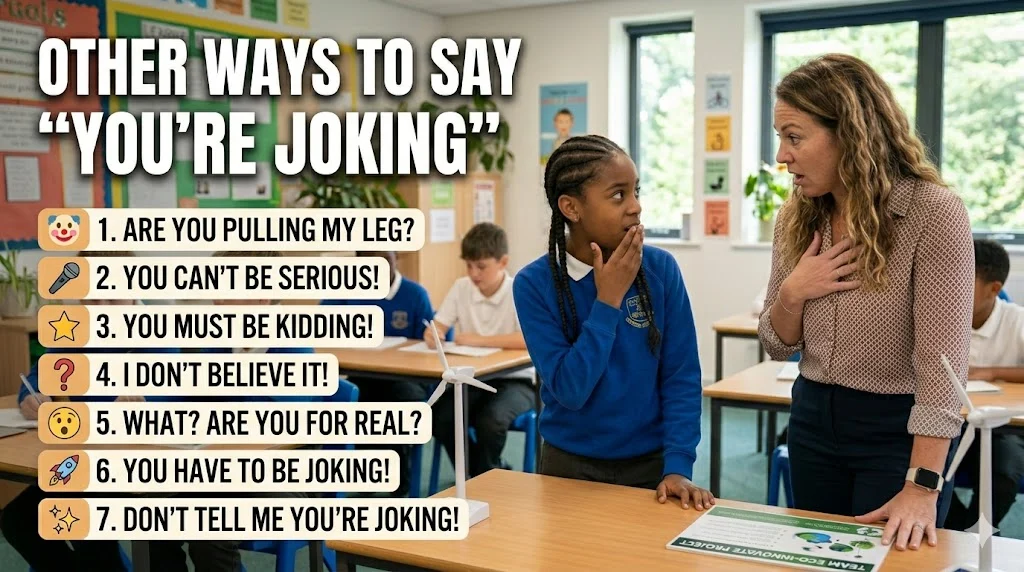
Some common other ways to say “you’re joking” include: are you serious, you must be kidding, no way, you can’t be serious, is this for real. These phrases help you react naturally when something sounds surprising, unbelievable, or funny.
The phrase “you’re joking” is commonly used when someone says something surprising, unbelievable, or humorous. It expresses disbelief while checking whether the speaker is serious.
However, repeating the same expression can make conversations sound repetitive. Learning alternatives to “you’re joking” helps you respond more naturally and confidently in English.
Expanding your vocabulary also helps you express excitement in English, react to surprising news and use more varied informal expressions in English during conversations.
Quick Categories Section
Formal Alternatives to “You’re Joking”
- Are you serious?
- Is that accurate?
- Are you certain?
- Is this correct?
Pro Tip: Use formal alternatives when responding politely in professional discussions.
Casual Alternatives
- No way
- Really?
- You must be kidding
- Are you for real?
Pro Tip: Casual expressions sound natural with friends or peers.
Professional Alternatives
- Is that correct?
- Could you clarify that?
- Did I hear that right?
- Are you certain about that?
Pro Tip: In the workplace, express surprise politely instead of sounding sarcastic.
Informal Expressions
- You’ve got to be kidding
- You can’t be serious
- Get out of here
- Seriously?
Pro Tip: These informal expressions in English can sound rude if used in formal situations.
“The way you react to surprising news shows your communication skills.”
Common Mistakes
- Sounding sarcastic unintentionally
Example: “You’re joking” (in a negative tone) - Using informal phrases in professional settings
Example: “No way!” during a business meeting - Overusing the same phrase
Example: Saying “you’re joking” repeatedly - Using it when someone is serious
Example: Responding with disbelief to important information - Using rude tone or body language
Example: Laughing while saying “you must be kidding”
What Does “You’re Joking” Mean?
Definition:
“You’re joking” is used to express disbelief or surprise when someone says something unexpected or hard to believe.
Grammar:
It is a statement used as a reaction, often implying a question.
Example Sentence:
“You’re joking did they really cancel the event?”
When to Use “You’re Joking”
- When someone says something surprising
- When reacting to unbelievable news
- During casual conversations
- When something sounds funny or exaggerated
Spoken vs Written: Mostly spoken
Formal vs Informal: Informal
Is It Professional or Polite to Say “You’re Joking”?
Polite? ✔️ Sometimes
Professional? ❌ Usually not
Business Example:
“Did I hear that correctly?”
Pros and Cons of Using “You’re Joking”
Pros
- Natural reaction
- Expresses surprise clearly
- Easy to understand
- Common in conversation
Cons
- Can sound sarcastic
- Too informal for work
- May appear dismissive
- Limited emotional range
“Choosing the right reaction phrase helps conversations feel natural.”
Other Ways to Say “You’re Joking” (With Examples)
These other ways to say “you’re joking” will help you sound more fluent, confident, and natural in different situations.
Use them based on tone, context, and audience to react to surprising or unbelievable information.
1. Phrase: Are you serious?
Meaning: Asking if something is true.
Explanation: Common way to express disbelief politely.
Example Sentence: Are you serious about the price?
Best Use: surprise
Worst Use: sarcasm
Tone: curious, surprised
Context Variability: casual / professional / spoken
2. Phrase: You must be kidding
Meaning: Something seems unbelievable.
Explanation: Suggests disbelief in a friendly way.
Example Sentence: You must be kidding that can’t be true.
Best Use: casual reactions
Worst Use: formal meetings
Tone: surprised, informal
Context Variability: casual
3. Phrase: No way
Meaning: Strong disbelief.
Explanation: Short and expressive reaction.
Example Sentence: No way you won the lottery?
Best Use: friends
Worst Use: workplace
Tone: excited, informal
Context Variability: casual / spoken
4. Phrase: You can’t be serious
Meaning: Something seems impossible or surprising.
Explanation: Expresses strong disbelief.
Example Sentence: You can’t be serious about quitting your job.
Best Use: emotional reactions
Worst Use: formal writing
Tone: shocked, informal
Context Variability: casual
5. Phrase: Is this for real?
Meaning: Asking if something is actually true.
Explanation: Friendly expression of surprise.
Example Sentence: Is this for real or just a joke?
Best Use: casual talk
Worst Use: formal settings
Tone: curious, informal
Context Variability: casual / spoken
6. Phrase: Really?
Meaning: Asking for confirmation.
Explanation: Simple reaction showing surprise.
Example Sentence: Really? That’s amazing news.
Best Use: quick reactions
Worst Use: detailed discussions
Tone: curious, neutral
Context Variability: casual / professional
7. Phrase: Are you for real?
Meaning: Checking if something is genuine.
Explanation: Casual expression of disbelief.
Example Sentence: Are you for real about that story?
Best Use: friends
Worst Use: formal meetings
Tone: surprised, informal
Context Variability: casual
8. Phrase: You’ve got to be kidding
Meaning: Something seems unbelievable.
Explanation: Stronger version of “you must be kidding.”
Example Sentence: You’ve got to be kidding that’s unbelievable.
Best Use: surprise
Worst Use: professional emails
Tone: shocked, informal
Context Variability: casual
9. Phrase: Seriously?
Meaning: Asking if something is true.
Explanation: Short and expressive reaction.
Example Sentence: Seriously? That happened today?
Best Use: quick reactions
Worst Use: formal writing
Tone: surprised, informal
Context Variability: casual / spoken
10. Phrase: Is that true?
Meaning: Asking for confirmation.
Explanation: Polite way to express disbelief.
Example Sentence: Is that true about the new rule?
Best Use: workplace
Worst Use: sarcasm
Tone: polite, neutral
Context Variability: professional / spoken
11. Phrase: That can’t be true
Meaning: Something seems impossible or unbelievable.
Explanation: A reaction used when information sounds incorrect or surprising.
Example Sentence: That can’t be true are you sure about the result?
Best Use: disbelief
Worst Use: sarcasm
Tone: surprised, doubtful
Context Variability: casual / spoken
12. Phrase: You’re not serious
Meaning: The speaker doubts that the statement is real.
Explanation: Often used when something sounds shocking or unexpected.
Example Sentence: You’re not serious about quitting your job, are you?
Best Use: surprise
Worst Use: formal writing
Tone: doubtful, informal
Context Variability: casual
13. Phrase: Are you pulling my leg
Meaning: Asking if someone is joking or teasing.
Explanation: A common idiom used in playful conversations.
Example Sentence: Are you pulling my leg, or did that really happen?
Best Use: humor
Worst Use: serious discussions
Tone: playful, informal
Context Variability: casual / spoken
14. Phrase: Get out of here
Meaning: Expressing disbelief or surprise.
Explanation: A casual way to react to unexpected news.
Example Sentence: Get out of here you actually met the celebrity?
Best Use: friendly reactions
Worst Use: workplace meetings
Tone: surprised, playful
Context Variability: casual
15. Phrase: I can’t believe it
Meaning: Something seems very surprising.
Explanation: Expresses shock or amazement.
Example Sentence: I can’t believe it you won the competition!
Best Use: excitement
Worst Use: sarcasm
Tone: amazed, emotional
Context Variability: casual / spoken
16. Phrase: That’s unbelievable
Meaning: Something seems extremely surprising.
Explanation: Highlights strong disbelief or amazement.
Example Sentence: That’s unbelievable you finished the project in one day.
Best Use: strong reactions
Worst Use: formal reports
Tone: surprised, impressed
Context Variability: casual / spoken
17. Phrase: You’re joking, right
Meaning: Asking if something is meant as a joke.
Explanation: Used when a statement sounds unrealistic.
Example Sentence: You’re joking, right? That price is too high.
Best Use: disbelief
Worst Use: professional communication
Tone: skeptical, informal
Context Variability: casual
18. Phrase: Are you messing with me
Meaning: Asking if someone is joking or teasing.
Explanation: Suggests the speaker feels tricked or teased.
Example Sentence: Are you messing with me, or is that actually true?
Best Use: casual talk
Worst Use: formal settings
Tone: playful, doubtful
Context Variability: casual
19. Phrase: Don’t tell me that’s real
Meaning: The speaker hopes the information is not true.
Explanation: Expresses disbelief in a dramatic way.
Example Sentence: Don’t tell me that’s real that sounds laughable.
Best Use: surprise
Worst Use: formal discussion
Tone: shocked, informal
Context Variability: casual
20. Phrase: Is this a joke
Meaning: Asking whether something is meant humorously.
Explanation: Used when a situation seems unrealistic.
Example Sentence: Is this a joke, or did that really happen?
Best Use: disbelief
Worst Use: sensitive situations
Tone: direct, doubtful
Context Variability: casual / spoken
21. Phrase: I don’t believe it
Meaning: Expressing strong disbelief.
Explanation: Indicates that something sounds impossible.
Example Sentence: I don’t believe it you solved the problem already.
Best Use: surprise
Worst Use: professional feedback
Tone: shocked, emotional
Context Variability: casual / spoken
22. Phrase: This must be a joke
Meaning: The speaker assumes something is humorous or fake.
Explanation: Suggests disbelief about a surprising situation.
Example Sentence: This must be a joke there’s no way that happened.
Best Use: casual reactions
Worst Use: workplace discussions
Tone: skeptical, informal
Context Variability: casual
23. Phrase: You’ve got to be joking
Meaning: Something seems unbelievable or ridiculous.
Explanation: A stronger version of expressing disbelief.
Example Sentence: You’ve got to be joking that’s impossible.
Best Use: shock
Worst Use: formal writing
Tone: surprised, informal
Context Variability: casual
24. Phrase: That’s impossible
Meaning: The speaker believes something cannot happen.
Explanation: Shows strong disbelief about a situation.
Example Sentence: That’s impossible how did you finish so quickly?
Best Use: disbelief
Worst Use: discouraging feedback
Tone: skeptical, serious
Context Variability: casual / spoken
25. Phrase: You must be joking
Meaning: The speaker thinks something is a joke.
Explanation: A polite way to question the truth of a statement.
Example Sentence: You must be joking about that deadline.
Best Use: disbelief
Worst Use: formal documents
Tone: surprised, informal
Context Variability: casual
26. Phrase: I can’t be hearing this
Meaning: The speaker is shocked by the information.
Explanation: Used when something sounds unbelievable.
Example Sentence: I can’t be hearing this you actually quit your job?
Best Use: emotional reactions
Worst Use: formal meetings
Tone: shocked, informal
Context Variability: casual
27. Phrase: Say that again
Meaning: Asking someone to repeat surprising information.
Explanation: Shows disbelief or confusion.
Example Sentence: Say that again did you really win the prize?
Best Use: clarification
Worst Use: sarcastic tone
Tone: curious, surprised
Context Variability: casual / professional
28. Phrase: Did you really say that
Meaning: Asking if someone actually meant their statement.
Explanation: Expresses surprise or confusion.
Example Sentence: Did you really say that about the meeting?
Best Use: clarification
Worst Use: criticism
Tone: questioning, neutral
Context Variability: professional / spoken
29. Phrase: That’s hard to believe
Meaning: Something seems unlikely.
Explanation: A polite way to express doubt.
Example Sentence: That’s hard to believe can you explain more?
Best Use: polite disbelief
Worst Use: sarcasm
Tone: neutral, thoughtful
Context Variability: professional / spoken
30. Phrase: No kidding
Meaning: Expressing surprise or emphasis.
Explanation: Sometimes used humorously to acknowledge surprising news.
Example Sentence: No kidding you finished the marathon already?
Best Use: casual reactions
Worst Use: formal communication
Tone: friendly, informal
Context Variability: casual / spoken
Mini Quiz / Self-Check
1. Which phrase sounds most professional?
A. No way
B. Is that true?
C. Get out of here
✅ Answer: B. Is that true?
2. Which phrase is best for casual surprise?
A. No way
B. Is that correct
C. Could you confirm that
✅ Answer: A. No way
3. Which phrase sounds too informal for business?
A. Really?
B. Are you pulling my leg
C. Is that accurate
✅ Answer: B. Are you pulling my leg
4. Which phrase shows strong disbelief?
A. You can’t be serious
B. Is that correct
C. Could you clarify
✅ Answer: A. You can’t be serious
“Strong communication depends on choosing the right tone for the situation.”
Comparison Table: Top Alternatives
| Phrase | Tone | Best Use |
|---|---|---|
| Are you serious | Neutral | Surprise |
| Really | Neutral | Quick reaction |
| You must be kidding | Informal | Casual talk |
| No way | Informal | Excitement |
| Is that true | Professional | Workplace |
| You can’t be serious | Informal | Shock |
| Seriously | Informal | Quick reactions |
| Is this for real | Casual | Surprise |
| Are you pulling my leg | Informal | Humor |
| That’s unbelievable | Neutral | Strong reaction |
FAQs
1. What are the best alternatives to “you’re joking”?
Some common alternatives include “are you serious,” “no way,” and “you must be kidding.”
2. Is “you’re joking” rude?
It can sound rude or sarcastic depending on tone and context.
3. What is a professional way to say “you’re joking”?
You can say “Did I hear that correctly?” or “Is that accurate?”
4. How do I express disbelief politely in English?
Use phrases like “Is that true?” or “Could you clarify that?”
5. Why learn alternatives to “you’re joking”?
Learning other ways to say you’re joking improves fluency and helps you respond naturally in different conversations.
Conclusion
Learning other ways to say “you’re joking” helps you express surprise and disbelief more naturally in English conversations.
By practicing these alternatives to “you’re joking,” you can improve your fluency, adapt your tone to different situations, and communicate more confidently.