
Last Updated on February 11, 2026
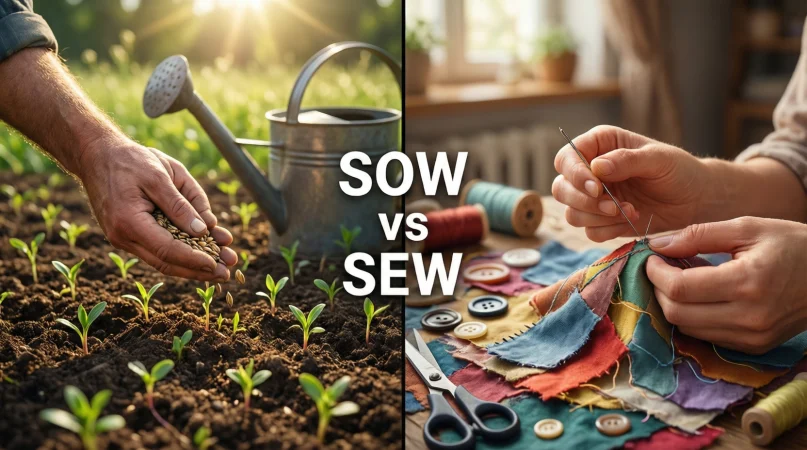
Sow and sew are homophones that sound identical but have completely different meanings. Sow refers to planting seeds or scattering something, while sew means to join fabric or materials using thread and a needle. These words cause frequent confusion in writing because they’re pronounced the same way but serve entirely different purposes in language.
If you’ve ever hesitated before writing about planting seeds or stitching fabric, you’re not alone. The confusion between sow and sew trips up even experienced writers, creating embarrassing mistakes in professional documents, academic papers, and everyday communication. Understanding the precise difference between these two words isn’t just about avoiding errors—it’s about communicating clearly and maintaining credibility in your writing.
The problem stems from their identical pronunciation but completely unrelated meanings. When you’re speaking, context clarifies everything. When you’re writing, however, choosing the wrong word can create confusion, undermine your authority, or even change your entire message. A farmer who wants to “sew seeds” or a tailor who plans to “sow a dress” has made a mistake that signals carelessness to readers.
This comprehensive guide will eliminate any uncertainty you have about these commonly confused words. You’ll learn their precise definitions, understand when to use each one, discover common mistakes to avoid, and master the grammar rules that govern their usage. By the end, you’ll never second-guess yourself when choosing between sow and sew again.
Sow vs Sew: What’s the Difference?
The fundamental difference between these words lies in their completely separate meanings and usage contexts. Sow is a verb that means to plant seeds in soil or to scatter something widely. Sew is also a verb, but it means to join pieces of fabric or other materials together using a needle and thread. Despite sounding identical, they belong to entirely different semantic fields: agriculture versus textile work.
Comparison Table:
| Feature | Sow | Sew |
|---|---|---|
| Part of Speech | Verb | Verb |
| Pronunciation | /soʊ/ (rhymes with “go”) | /soʊ/ (rhymes with “go”) |
| Primary Meaning | To plant seeds; to scatter | To stitch with needle and thread |
| Related Field | Agriculture, gardening, farming | Textiles, fashion, crafts |
| Common Collocations | Sow seeds, sow doubt, sow discord | Sew clothes, sew buttons, sew seams |
| Past Tense | Sowed | Sewed |
| Past Participle | Sown or sowed | Sewn or sewed |
| Noun Form | Sower (person who sows) | Sewer (person who sews) |
This comparison reveals that while both words function as verbs and share pronunciation, they operate in completely different contexts. Sow connects to planting, growth, and distribution. Sew relates to joining, repairing, and creating with fabric. When you sow something, you’re beginning a process of growth or spreading an idea. When you sew something, you’re connecting materials to create or repair an object. The confusion between them stems purely from their homophonic nature, not from any actual similarity in meaning or usage.
Is Sow vs Sew a Grammar, Vocabulary, or Usage Issue?
This confusion falls primarily into the category of vocabulary and spelling rather than grammar. Both words function grammatically as verbs, so using one in place of the other won’t create a grammatical error in sentence structure. However, it creates a semantic error, which means you’ve used the wrong word for your intended meaning.
From a linguistic perspective, sow and sew are non-interchangeable homophones. You cannot substitute one for the other under any circumstances. Using sow when you mean sew, or vice versa, creates an entirely different meaning that will confuse readers or make your sentence nonsensical. This isn’t like choosing between “further” and “farther,” where some overlap exists. These words have zero semantic overlap.
In formal writing, including academic papers, business communications, and published content, using the correct word is essential for maintaining credibility. A mistake here signals either carelessness or lack of knowledge. In casual writing, like text messages or social media posts, readers might forgive the error based on context, but it still creates a moment of confusion and can undermine your message.
The usage distinction also extends to professional contexts. If you’re writing for agricultural publications, you’ll frequently use sow. If you’re creating content for fashion, crafts, or textile industries, sew will appear regularly. Understanding the proper context for each word demonstrates domain knowledge and enhances your authority as a writer or communicator.
How to Use “Sow” Correctly
Sow functions as a regular verb meaning to plant seeds in the ground or to scatter something with the intention of growth or spread. The word carries both literal and figurative meanings, making it versatile in various writing contexts.
In its literal agricultural sense, sow describes the act of planting seeds in soil. Farmers sow wheat in the spring. Gardeners sow tomato seeds in early summer. This usage connects directly to cultivation and the beginning of the growing process. The word emphasizes the action of placing seeds where they can germinate and develop into plants.
Figuratively, sow means to spread or disseminate something, particularly ideas, emotions, or conditions. You can sow doubt in someone’s mind, sow discord among team members, or sow the seeds of rebellion. This metaphorical usage draws from the agricultural meaning—you’re planting something that will grow and spread over time.
Workplace Example: The manager’s inconsistent policies began to sow confusion among employees, leading to decreased productivity and morale problems across multiple departments.
Academic Example: Historical evidence suggests that economic inequality in the early 20th century helped sow the conditions that eventually led to widespread social movements demanding reform.
Technology Example: Software developers must sow good coding practices early in their careers to cultivate habits that will benefit them throughout their professional lives.
The past tense of sow can be either “sowed” or “sown,” though “sown” is more common in modern usage. You might say “I sowed the seeds yesterday” or “I have sown doubt about the project’s viability.” Both forms are correct, but “sown” tends to appear more frequently in formal writing and when using the perfect tenses.
When using sow, consider that it often implies intentionality and future consequences. You sow something expecting it to grow, multiply, or spread. This forward-looking aspect distinguishes it from words like “plant” (which can be more generic) or “scatter” (which may lack the growth implication). Understanding this nuance helps you deploy the word more effectively in your writing.
How to Use “Sew” Correctly
Sew is a verb that specifically describes the action of joining materials together using a needle and thread or a sewing machine. This word belongs exclusively to the realm of textiles, crafts, and fabric work.
The most common usage involves creating or repairing clothing and fabric items. You sew a button back onto a shirt, sew a hem on pants, or sew a quilt from individual patches. The action requires threading a needle and passing it through fabric to create stitches that hold materials together. Unlike sow, sew rarely appears in figurative or metaphorical contexts—it remains firmly tied to its literal meaning.
Sew can describe both hand sewing and machine sewing. The method doesn’t change the word’s usage. Whether you’re using a basic needle and thread or an industrial sewing machine, the verb remains the same. This consistency makes sew straightforward to use correctly once you understand its basic meaning.
Workplace Example: The costume designer needed to sew forty historical garments in three weeks for the theater production, requiring her to work extended hours and hire two assistants to meet the deadline.
Academic Example: Researchers studying traditional textile techniques documented how indigenous communities sew ceremonial garments using methods passed down through generations, preserving cultural heritage through craft.
Technology Example: Modern computerized sewing machines can automatically sew complex embroidery patterns, but understanding manual sewing techniques remains essential for troubleshooting equipment problems and achieving custom results.
The past tense of sew can be either “sewed” or “sewn.” Similar to sow, the “sewn” form appears more commonly in contemporary usage, particularly in the perfect tenses. You would say “I sewed a dress last week” or “I have sewn many quilts over the years.” Both past tense forms are grammatically correct.
One important note involves the noun form. A person who sews is called a “sewer” (pronounced “SOH-er”), which is a homophone for the drainage system (pronounced “SOO-er”). This creates yet another potential point of confusion in written English, though context usually clarifies the intended meaning. When writing about someone who sews, consider using alternative terms like “seamstress,” “tailor,” or “person who sews” to avoid this additional ambiguity.
When You Should NOT Use Sow or Sew
Understanding when not to use these words is as important as knowing their correct applications. Here are specific scenarios where writers commonly make mistakes:
Never use “sow” when discussing:
- Any activity involving needle, thread, or fabric work of any kind
- Repairing clothing, upholstery, or textile items
- Creating garments, quilts, or sewn crafts
- Stitching wounds or surgical procedures (use “suture” or “stitch”)
Never use “sew” when discussing:
- Planting seeds, crops, or vegetation in soil or growing medium
- Spreading ideas, discord, doubt, or any abstract concept
- Agricultural activities, farming operations, or gardening tasks
- Metaphorical planting or cultivation of anything non-physical
Additional misuse scenarios: 5. Don’t use “sow” when you mean “sow” (the female pig)—this is a different word spelled identically but pronounced differently (/saʊ/, rhyming with “cow”) 6. Don’t confuse “sew” with “so” (meaning therefore or very) or “sow” with “so”—these are completely different words despite similar sounds 7. Don’t use “sew” when discussing drainage systems (that’s “sewer,” pronounced differently) 8. Don’t use “sow” in place of “throw” or “scatter” when there’s no implication of growth or future development
Understanding these boundaries prevents the most common errors. The key principle is simple but absolute: sow connects to planting and growth, sew connects to stitching and fabric. No exceptions exist to this rule.
Common Mistakes and How to Avoid Them
Examining specific errors helps cement the correct usage in your mind. Here’s a table showing common mistakes alongside their corrections:
| Correct Sentence | Incorrect Sentence | Explanation |
|---|---|---|
| Farmers sow corn in early May to maximize growing season. | Farmers sew corn in early May to maximize growing season. | Planting seeds requires “sow,” not “sew” which relates to stitching. |
| She learned to sew her own clothes to save money. | She learned to sow her own clothes to save money. | Creating garments with needle and thread requires “sew.” |
| His bitter comments sowed division within the team. | His bitter comments sewed division within the team. | Spreading discord is metaphorical planting, requiring “sow.” |
| The tailor will sew the hem before Friday. | The tailor will sow the hem before Friday. | Fabric work always uses “sew.” |
| They sow wildflower seeds across the meadow each spring. | They sew wildflower seeds across the meadow each spring. | Planting in soil requires “sow.” |
| I need to sew this button back on my jacket. | I need to sow this button back on my jacket. | Attaching with needle and thread requires “sew.” |
Decision Rule Box:
Use SOW when:
- You’re describing planting seeds or crops in soil
- You’re spreading ideas, doubt, discord, or other abstract concepts
- The context involves agriculture, gardening, or metaphorical planting
- Growth or future development is implied
Use SEW when:
- You’re joining fabric or materials with thread and needle
- You’re creating or repairing clothing, quilts, or textile items
- The context involves textiles, fashion, crafts, or stitching
- Physical attachment of materials is the focus
The most reliable way to choose correctly is to ask yourself: “Am I talking about planting/spreading or stitching/joining?” If planting or spreading, use sow. If stitching or joining, use sew. This simple mental check eliminates confusion in nearly every situation.
Sow and Sew in Modern Technology and AI Tools
Both words have found new applications in contemporary technology contexts, though they retain their original meanings. Understanding these modern uses helps you stay current with language evolution.
In agricultural technology, precision farming equipment now automates the sowing process. Farmers use GPS-guided planters that sow seeds at optimal depths and spacing, maximizing yield potential. Agricultural software tracks when farmers sow different crops, helping with rotation planning and resource management. The word “sow” appears frequently in agtech documentation, farming apps, and smart agriculture systems.
For sewing, computer-aided design software allows designers to create garment patterns digitally before anyone physically sews a single stitch. Industrial sewing robots can now sew complex seams with minimal human intervention. Online tutorials teach people how to sew through video platforms, democratizing a skill traditionally passed through apprenticeship.
AI writing tools and grammar checkers now catch sow/sew confusion more reliably than older spell-checkers because they analyze context. However, these tools aren’t perfect. Writers still need to understand the distinction because AI can misidentify the correct word when context is ambiguous or unusual.
Interestingly, both words appear in metaphorical technology discussions. Tech leaders talk about “sowing the seeds” of innovation or disruption. Software architects might discuss how to “sew together” different systems or APIs to create integrated solutions. While the second usage is metaphorical (no actual sewing occurs), it draws from the original meaning of joining separate elements.
Etymology: Understanding the Roots
The word “sow” comes from Old English “sawan,” which traces back to Proto-Germanic “sēan” and ultimately to Proto-Indo-European “seh₁,” meaning to scatter or throw. This ancient root connects to the fundamental human activity of agriculture that began over 10,000 years ago. The word has maintained remarkable consistency in meaning throughout its long history.
“Sew” derives from Old English “siowian” or “siwian,” from Proto-Germanic “siwjanan,” and Proto-Indo-European “siw,” meaning to sew or stitch. Archaeological evidence suggests humans have sewn materials together for at least 40,000 years, making this one of humanity’s oldest crafts. The word’s etymology reflects this ancient practice.
Despite their similar modern pronunciation, these words emerged from completely different linguistic roots. Their convergence in sound occurred through historical phonetic shifts in English, particularly the Great Vowel Shift of the 15th to 18th centuries. Originally, they likely sounded more distinct from each other.
According to linguistics professor Dr. Sarah Mitchell from the University of Edinburgh, “Homophones like sow and sew demonstrate how sound changes in language can create confusion where none existed historically. Writers must rely on meaning rather than sound to distinguish them, which requires conscious attention to vocabulary.”
Case Studies: Real-World Consequences of Confusion
Case Study 1: Agricultural Publication Error A major farming magazine published an article titled “Ten Tips to Sew Success This Season.” The error went unnoticed until after 50,000 copies were printed and distributed. Readers immediately spotted the mistake, and the publication faced ridicule on social media. The editor issued an apology in the next issue and implemented a more rigorous review process. The incident damaged the magazine’s credibility in the agricultural community for over a year.
Case Study 2: Fashion Blog Success A fashion blogger consistently used correct grammar and vocabulary, including proper usage of sew in all contexts. Her attention to detail attracted partnerships with major fabric companies who valued her professionalism. She later revealed that she maintained a personal style guide specifically to avoid common errors like sow/sew confusion. Her authority in the space grew partly because readers trusted her expertise, demonstrated through error-free content.
Error Prevention Checklist
Use this practical checklist to verify correct word choice:
Always use SOW when:
- The sentence involves seeds, crops, or plants
- You’re describing agricultural or gardening activities
- The context is metaphorical planting of ideas or emotions
- Future growth or spreading is implied
- The phrase includes “sow seeds,” “sow discord,” or “sow doubt”
Never use SEW when:
- The topic involves farming, gardening, or agriculture
- You’re discussing abstract concepts being spread
- Growth or cultivation is the main idea
Always use SEW when:
- Needles, thread, or fabric are mentioned
- The context involves clothing, textiles, or crafts
- Joining materials together is the action
- Repair or creation of garments is discussed
Never use SOW when:
- Stitching or fabric work is involved
- The topic relates to fashion, textiles, or crafts
- Physical joining of materials is the focus
Related Grammar Confusions You Should Master
Mastering sow vs sew opens the door to understanding other commonly confused word pairs that plague writers:
- Affect vs Effect (verb vs noun distinction)
- Compliment vs Complement (praise vs completion)
- Principal vs Principle (main person vs fundamental rule)
- Stationary vs Stationery (not moving vs writing materials)
- Discreet vs Discrete (careful vs separate)
- Elicit vs Illicit (evoke vs illegal)
- Ensure vs Insure (guarantee vs protect financially)
- Accept vs Except (receive vs exclude)
- Brake vs Break (stop vs fracture)
- Capital vs Capitol (city vs building)
Each of these pairs requires the same careful attention to meaning and context that you’ve now developed for sow and sew. Building vocabulary precision across multiple word pairs elevates your writing significantly.
FAQs
What is the main difference between sow and sew? Sow means to plant seeds or scatter something for growth, while sew means to join fabric or materials using needle and thread. They sound identical but have completely unrelated meanings and cannot be used interchangeably.
Can sow and sew ever be used interchangeably in any context? No, sow and sew can never be used interchangeably. They have entirely different meanings despite identical pronunciation. Using one in place of the other always creates an error that changes your intended meaning.
How do you pronounce sow and sew correctly? Both sow (the verb) and sew are pronounced identically as /soʊ/, rhyming with “go” and “flow.” Note that sow (the female pig) is pronounced differently as /saʊ/, rhyming with “cow.”
What are the past tense forms of sow and sew? Both words can form their past tense two ways. Sow becomes “sowed” or “sown” (sown is more common). Sew becomes “sewed” or “sewn” (sewn is more common). Both forms are correct for each word.
Is there a trick to remember the difference between sow and sew? Remember that sow has the letter “o” like “soil,” connecting it to planting. Sew has the letter “e” like “needle,” connecting it to stitching. This mnemonic helps anchor each word to its proper context.
Why do sow and sew sound the same if they mean different things? They’re homophones that developed the same pronunciation through historical sound changes in English, particularly during the Great Vowel Shift. Originally, they likely sounded more distinct from each other.
What is the noun form for someone who sews? A person who sews is called a “sewer” (pronounced “SOH-er”). This word is a homophone for the drainage system (pronounced “SOO-er”), creating another potential confusion point in written English.
Can you use sow in a metaphorical sense? Yes, sow frequently appears in metaphorical expressions like “sow the seeds of doubt,” “sow discord,” or “sow confusion.” The metaphor draws from the agricultural meaning of planting something that will grow and spread.
Do professional writers still confuse sow and sew? Yes, even professional writers occasionally confuse these words, particularly when writing quickly or without careful proofreading. The identical pronunciation makes it easy for the wrong word to slip through, which is why editing is essential.
Are there regional differences in how sow and sew are used? No, the distinction between sow and sew remains consistent across all English-speaking regions. Both words maintain the same meanings in American, British, Australian, and other English varieties, though pronunciation may have slight regional variations.
Conclusion
Mastering the difference between sow and sew represents more than just learning two words. It demonstrates your commitment to precision in communication and your understanding of how language works at a fundamental level. These homophones may sound identical, but their meanings occupy completely separate spheres of human activity: agriculture and textiles, planting and stitching, cultivation and creation.
The key to never confusing these words again lies in connecting each one to its proper context. When you think of sow, visualize seeds entering soil or ideas spreading through a community. When you think of sew, picture needle and thread joining fabric pieces together. These mental associations make choosing the correct word automatic rather than deliberate.
Remember that writing errors involving commonly confused words like sow and sew can undermine your credibility more than complex grammar mistakes. Readers may forgive sophisticated errors in punctuation or sentence structure, but mixing up simple vocabulary signals carelessness. Taking the time to verify word choice shows respect for your readers and commitment to clear communication.
Your journey toward vocabulary mastery doesn’t end here. Language contains hundreds of confusing word pairs that deserve the same careful attention you’ve now given to sow and sew. Each pair you master makes your writing clearer, your communication more effective, and your authority as a writer stronger. The investment in learning these distinctions pays dividends throughout your personal, academic, and professional life.