
Last Updated on March 17, 2026
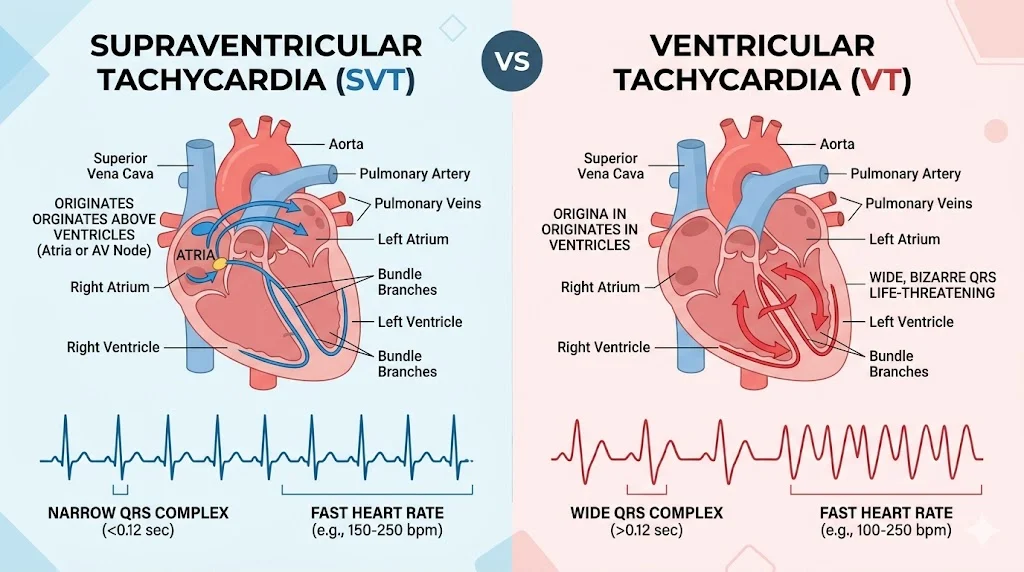
SVT vs VT difference lies in origin and severity. SVT (Supraventricular Tachycardia) starts above the ventricles and is usually less dangerous, while VT (Ventricular Tachycardia) begins in the ventricles and can be life-threatening. Knowing the difference is essential for proper diagnosis, treatment, and managing heart rhythm disorders effectively.
Your heart starts racing out of nowhere. Pounding. Fast. Irregular. And the first terrifying question that crosses your mind is: is this serious?
For millions of people, that moment happens without warning. Sitting at a desk, lying in bed, or mid-conversation and suddenly the heart is doing something it shouldn’t. The instinct is to panic. But here’s what actually matters in that moment: not all fast heartbeats are created equal.
Some are uncomfortable but ultimately harmless. Others are genuine medical emergencies that require immediate attention. The difference often comes down to two conditions that sound almost identical — SVT and VT.
Supraventricular tachycardia. Ventricular tachycardia. Both involve a racing heart. Both can feel frightening in the moment. But they originate in completely different parts of the heart, carry completely different levels of risk, and demand completely different responses.
Confuse them and the consequences can be serious either unnecessary panic over something manageable, or dangerous delay when every minute actually counts.
This is not information that should live only in medical textbooks. Patients deserve to understand what’s happening in their own chest. Caregivers deserve to know when to act. Students deserve a clear explanation that doesn’t require a medical degree to follow.
This guide gives you all of it what SVT and VT are, how they differ, what the symptoms feel like, and how doctors treat each one.
Because understanding your heart isn’t just for cardiologists. It’s for anyone who has one.
Quick Answer / Overview
SVT vs VT can be summarized in a few key points:
| Feature | SVT (Supraventricular Tachycardia) | VT (Ventricular Tachycardia) |
|---|---|---|
| Origin | Above ventricles (atria or AV node) | Ventricles |
| Risk Level | Usually low | High, can be life-threatening |
| Heart Rate | 150–250 bpm | 120–250 bpm |
| Symptoms | Palpitations, dizziness | Chest pain, fainting, cardiac arrest |
| Treatment | Medications, vagal maneuvers | Emergency care, defibrillation |
Definition / Explanation
What is SVT?
SVT stands for Supraventricular Tachycardia.
“Supraventricular” means above the ventricles. This includes the atria and the AV node.
In SVT:
- The heart beats very fast
- The signal starts in the upper chambers
- The rhythm is usually regular
Think of SVT like a stuck accelerator in a car. The engine runs fast, but the system is still in control.
What is VT?
VT stands for Ventricular Tachycardia.
In VT:
- The fast rhythm starts in the ventricles
- The heart may not pump blood well
- It can lead to serious problems
VT is like a car engine running out of control. It may stop working properly at any time.
How the Heart Normally Works
To understand SVT vs VT, you need to know basic heart function.
- The heart has four chambers
- Electrical signals control each heartbeat
- The signal starts in the SA node
- It moves through the AV node to the ventricles
When this system works well, your heart beats in a steady rhythm.
When it fails, arrhythmias like SVT and VT occur.
Key Differences Between SVT vs VT
Location of Origin
- SVT starts in the atria or AV node
- VT starts in the ventricles
Severity
- SVT is often harmless
- VT can be deadly if untreated
ECG Appearance
- SVT shows narrow QRS complexes
- VT shows wide QRS complexes
Blood Flow Impact
- SVT usually maintains blood flow
- VT may reduce or stop blood flow
Advantages and Disadvantages
SVT Advantages and Disadvantages
Advantages:
- Usually not life-threatening
- Can be managed easily
- Responds well to simple treatments
Disadvantages:
- Causes discomfort
- Can recur often
- May affect daily life
VT Advantages and Disadvantages
Advantages:
- Early detection can save lives
- Treatable with modern medicine
Disadvantages:
- High risk of sudden death
- Requires urgent care
- May need long-term treatment
Real-World Examples
Example of SVT
A young adult feels a sudden fast heartbeat after drinking coffee. The heart rate reaches 180 bpm but returns to normal after resting.
This is likely SVT.
Example of VT
An older patient with heart disease collapses suddenly. Their heart is beating very fast but not pumping blood well.
This could be VT and needs emergency care.
Causes of SVT vs VT
Causes of SVT
- Stress
- Caffeine
- Alcohol
- Thyroid problems
- Electrical pathway issues
Causes of VT
- Heart attack
- Cardiomyopathy
- Scar tissue in the heart
- Electrolyte imbalance
Symptoms Comparison
| Symptom | SVT | VT |
|---|---|---|
| Fast heartbeat | Yes | Yes |
| Dizziness | Sometimes | Common |
| Chest pain | Rare | Common |
| Fainting | Rare | Common |
| Cardiac arrest | No | Possible |
Diagnosis Methods
Doctors use several tools:
Electrocardiogram (ECG)
- Main tool for SVT vs VT
- Shows electrical activity
Holter Monitor
- Records heart rhythm over time
Electrophysiology Study
- Maps heart signals
Treatment Options
SVT Treatment
- Vagal maneuvers (deep breathing, coughing)
- Medications
- Catheter ablation
VT Treatment
- Emergency defibrillation
- Antiarrhythmic drugs
- Implantable cardioverter defibrillator (ICD)
Regional / Global Usage
SVT vs VT diagnosis and treatment vary worldwide.
Developed Countries
- Advanced ECG tools
- Quick emergency response
- Access to ICD devices
Developing Regions
- Limited access to equipment
- Delayed diagnosis
- Higher risk in VT cases
Common Mistakes
Confusing SVT with VT
Mistake: Thinking all fast heartbeats are the same
Correction: Check ECG and symptoms carefully
Ignoring Symptoms
Mistake: Ignoring chest pain or fainting
Correction: Seek medical help immediately
Self-Diagnosis
Mistake: Using online info without doctor advice
Correction: Always consult a healthcare professional
Exercises with Answers
Exercise 1
A patient has a fast heart rate but no chest pain. Likely SVT or VT?
Answer: SVT
Exercise 2
Which condition is more dangerous: SVT or VT?
Answer: VT
Exercise 3
Which one shows wide QRS on ECG?
Answer: VT
Exercise 4
Name one treatment for SVT.
Answer: Vagal maneuvers or medication
Exercise 5
What device is used for VT emergencies?
Answer: Defibrillator
Related Concepts or Comparisons
SVT vs Atrial Fibrillation
- SVT is regular
- Atrial fibrillation is irregular
VT vs Ventricular Fibrillation
- VT is fast but organized
- Ventricular fibrillation is chaotic and fatal
FAQs
What is the main difference between SVT vs VT?
SVT starts above the ventricles and is usually safe, while VT starts in the ventricles and can be life-threatening.
Is SVT dangerous compared to VT?
SVT is generally less dangerous than VT, which can lead to cardiac arrest if untreated.
Can SVT turn into VT?
Rarely, but underlying heart disease may increase the risk of VT.
How do doctors diagnose SVT vs VT?
They use ECG readings, patient history, and sometimes advanced tests like electrophysiology studies.
What are common symptoms of SVT vs VT?
SVT causes palpitations, while VT often causes chest pain, dizziness, or fainting.
Can SVT go away on its own?
Yes, many SVT episodes stop without treatment.
Does VT always need emergency care?
Yes, VT often requires urgent medical attention.
What is the best treatment for SVT vs VT?
SVT uses medications or ablation, while VT may require defibrillation or ICD devices.
Can lifestyle changes help prevent SVT vs VT?
Yes, reducing caffeine and stress helps SVT. Heart health management helps prevent VT.
Is exercise safe with SVT vs VT?
Exercise is usually safe for SVT patients but should be guided by a doctor for VT.
Conclusion
Understanding SVT vs VT is essential for heart health awareness. Both conditions involve a fast heartbeat, but they differ greatly in severity and treatment. SVT is usually manageable and less dangerous. VT, on the other hand, can be life-threatening and requires immediate medical care.
Early diagnosis plays a key role. Knowing the symptoms helps you act quickly. If you feel a rapid heartbeat with dizziness or chest pain, do not ignore it. Seek medical help right away.
For long-term health, maintain a healthy lifestyle. Avoid triggers like caffeine and stress. Follow your doctor’s advice and attend regular check-ups.
In summary, learning the difference between SVT vs VT can save lives. Stay informed, stay alert, and take care of your heart.