
Last Updated on May 2, 2026
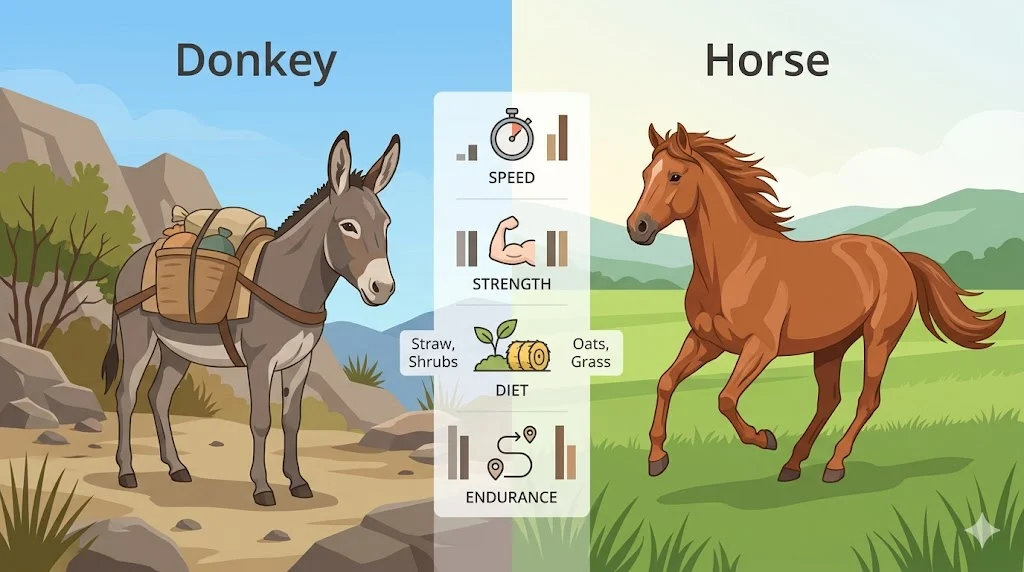
The main difference between a donkey and a horse lies in their size, behavior, and physical build. Horses are generally larger, faster, and more suited for riding and sport, while donkeys are smaller, stronger for their size, and better adapted to harsh environments. Both belong to the equine family but serve different roles in agriculture, transport, and companionship.
The comparison of donkey vs horse is one of the most common topics in animal studies, farming, and general curiosity. At first glance, they may look similar. Both have hooves, long faces, and tails, and both belong to the same animal family. But when you look closely, the differences become clear and important.
People often confuse donkeys and horses because they can live in similar environments and are sometimes used for similar tasks. However, their strength, behavior, diet needs, and even personality are quite different. A horse is fast, elegant, and built for speed. A donkey is strong, steady, and built for endurance in tough conditions.
Understanding donkey vs horse differences helps farmers choose the right animal, helps students learn biology better, and helps animal lovers appreciate both creatures. In rural areas, this knowledge can even affect livelihood and farming success. This article explains everything in a simple way so anyone can understand, even beginners.
Quick Answer: Donkey vs Horse Overview
The simplest way to understand donkey vs horse is this:
- Horses are faster, larger, and used for riding, racing, and transport.
- Donkeys are smaller, stronger for their size, and used for carrying loads and working in rough terrain.
- Horses are more sensitive and social.
- Donkeys are more independent and highly resistant to harsh conditions.
Both animals belong to the equine family but have different evolutionary adaptations.
Definition and Explanation of Donkey vs Horse
What is a Horse?
A horse is a large domesticated animal scientifically known as Equus ferus caballus. Horses are known for their speed, strength, and intelligence. They have been used by humans for thousands of years for transport, farming, warfare, and sports.
Horses prefer open land and require more food and care compared to donkeys. They are social animals and usually live in herds.
What is a Donkey?
A donkey is a domesticated animal known as Equus africanus asinus. It is smaller than a horse and known for its endurance, patience, and ability to survive in harsh climates.
Donkeys are commonly used for carrying goods, especially in rural and mountainous areas. They eat less food and can survive on low-quality vegetation.
Donkey vs Horse: Key Differences Table
| Feature | Donkey | Horse |
| Size | Smaller | Larger |
| Speed | Slow | Fast |
| Strength | Strong for size | Strong overall |
| Temperament | Calm, stubborn | Sensitive, reactive |
| Ear size | Long ears | Short ears |
| Mane | Short and rough | Long and smooth |
| Tail | Thin with tuft | Full long tail |
| Lifespan | 25–40 years | 25–30 years |
| Diet | Low-quality food | High-quality grass and grains |
| Usage | Load carrying | Riding, racing, transport |
This donkey vs horse comparison clearly shows how different they are in structure and behavior.
Advantages and Disadvantages of Donkey vs Horse
Advantages of Donkeys
Donkeys are extremely useful animals in difficult environments.
- Require less food and water
- Can survive in dry regions
- Strong endurance for long working hours
- Low maintenance cost
- Resistant to many diseases
Disadvantages of Donkeys
- Slow movement
- Not suitable for racing or fast transport
- Limited carrying capacity compared to horses
Advantages of Horses
Horses are powerful and versatile animals.
- High speed and agility
- Suitable for sports and racing
- Can carry riders efficiently
- Highly trainable
- Strong social bonding with humans
Disadvantages of Horses
- Require expensive food and care
- Sensitive to climate changes
- Need more medical attention
- Can get stressed easily
Real-World Examples of Donkey vs Horse Usage
Donkey in Daily Life
In rural regions, donkeys are used for:
- Carrying water and firewood
- Transporting goods in mountains
- Farming support in small fields
- Brick and construction work
For example, in hilly areas where vehicles cannot reach, donkeys remain a reliable source of transport.
Horse in Daily Life
Horses are used for:
- Riding and travel
- Horse racing sports
- Police and ceremonial duties
- Tourism activities
- Farming in some regions
In cities, horses are often seen in parades or historical events.
Regional and Global Usage of Donkey vs Horse
Donkey Usage Around the World
Donkeys are widely used in:
- South Asia
- Africa
- Middle Eastern rural regions
They are especially valuable in areas with limited roads and infrastructure.
Horse Usage Around the World
Horses are commonly used in:
- Europe
- North America
- Australia
- Parts of Asia
They are associated with sports, leisure, and professional farming.
Common Mistakes in Understanding Donkey vs Horse
Many people misunderstand the differences between donkey and horse. Here are common mistakes:
Mistake 1: Thinking They Are the Same Animal
Correction: They belong to the same family but are different species.
Mistake 2: Assuming Donkeys Are Weak
Correction: Donkeys are very strong for their size and can carry heavy loads.
Mistake 3: Believing Horses Can Survive Anywhere
Correction: Horses need better food and care than donkeys.
Mistake 4: Thinking Donkeys Are Lazy
Correction: Donkeys are careful and cautious, not lazy.
Mistake 5: Confusing Mules with Donkeys or Horses
Correction: A mule is a hybrid of a horse and a donkey.
Exercises on Donkey vs Horse (With Answers)
Exercise 1: Identify the Animal
- Which animal is faster?
- Which animal survives better in deserts?
- Which animal is used for racing?
Answers:
- Horse
- Donkey
- Horse
Exercise 2: True or False
- Donkeys are larger than horses.
- Horses need more care than donkeys.
- Donkeys are faster than horses.
Answers:
- False
- True
- False
Exercise 3: Match the Uses
- Donkey → ________
- Horse → ________
Options: Riding, Carrying loads
Answers:
- Donkey → Carrying loads
- Horse → Riding
Related Concepts in Donkey vs Horse Comparison
Understanding donkey vs horse also involves related biological and practical concepts:
Mule
A mule is a hybrid between a male donkey and a female horse. It is strong and often used for labor.
Equine Family
Both donkeys and horses belong to the equine family, which includes zebras.
Domestication
Both animals were domesticated thousands of years ago for human use.
Animal Adaptation
Donkeys are adapted for survival in dry, rough environments, while horses are adapted for speed and open grasslands.
FAQs
What is the main difference between donkey vs horse?
The main difference is that horses are faster and larger, while donkeys are stronger for their size and better in harsh environments.
Is a donkey stronger than a horse?
A donkey is not stronger overall, but it is stronger relative to its body size.
Can a donkey and horse reproduce?
Yes, they can produce a mule, but mules are usually sterile.
Which is faster, donkey vs horse?
The horse is much faster than the donkey.
Which animal is easier to maintain?
Donkeys are easier to maintain because they need less food and care.
Why are donkeys stubborn?
Donkeys are cautious animals. They stop when they sense danger, which is often misunderstood as stubbornness.
Where are donkeys most commonly used?
Donkeys are commonly used in rural and mountainous regions for transport and farming.
What is the lifespan difference in donkey vs horse?
Donkeys often live slightly longer, around 25–40 years, while horses live about 25–30 years.
Are donkeys smarter than horses?
Both are intelligent in different ways. Donkeys are more cautious, while horses are more responsive.
Can horses live in deserts like donkeys?
Horses can survive but require more care, while donkeys are naturally adapted to harsh conditions.
Conclusion
The comparison of donkey vs horse shows that both animals are valuable but serve different purposes. Horses are built for speed, riding, and performance, while donkeys are built for endurance, strength, and survival in tough environments.
Neither animal is better in every way. Instead, each has unique strengths that make it important in human life. Horses are ideal for sports, travel, and work requiring speed. Donkeys are ideal for rural transport, farming support, and survival in dry areas.
Understanding these differences helps farmers, students, and animal lovers make better decisions and appreciate nature more deeply. Whether it is a strong horse running across open fields or a steady donkey climbing a rocky path, both play important roles in human history and daily life.