
Last Updated on June 6, 2026
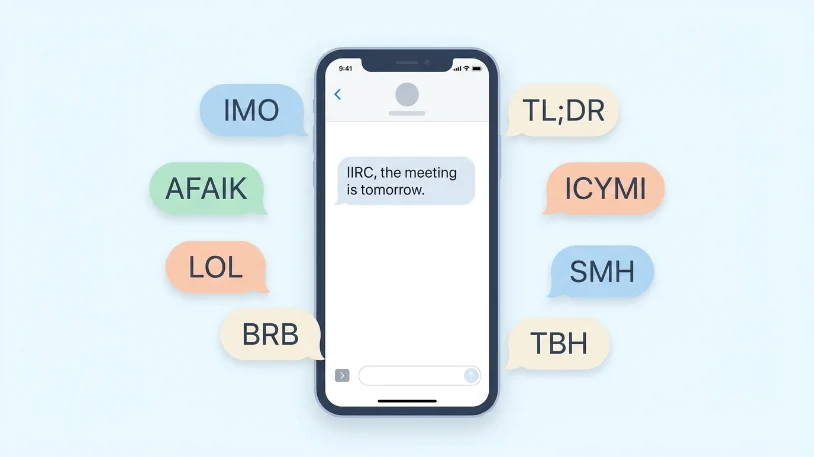
IIRC means “If I Recall Correctly.” It’s an internet slang acronym used in chats and online discussions to show uncertainty or memory-based statements. People use it to sound polite, avoid being overly confident, and soften corrections.
You’ve probably seen IIRC in a chat and paused for a second. It pops up in comments, forums, and messages. Someone writes it casually, and suddenly you feel like you missed a memo.
Here’s the thing. Internet slang evolves fast. What feels obvious to one group can feel cryptic to another.
That’s exactly why understanding the IIRC meaning matters.
It’s not just about decoding letters. It’s about understanding tone, intent, and context. When someone uses IIRC, they’re doing more than sharing information. They’re shaping how that information lands.
In this guide, you’ll learn:
- What IIRC means in chat and text
- How to use it naturally
- When to avoid it completely
- How it compares to similar acronyms like AFAIK and IMO
- Why it matters in digital communication
Let’s break it down.
What Does IIRC Mean? (Clear Definition)
The IIRC full form is:
If I Recall Correctly
Simple. But powerful.
Each word plays a role:
- If → introduces uncertainty
- I recall → refers to memory
- Correctly → signals possible inaccuracy
So when you say IIRC, you’re basically saying:
“I think I remember this right, but I might be wrong.”
That subtle layer changes everything.
IIRC Meaning in Text and Chat
In texting and online conversations, IIRC acts as a softener. It helps you share information without sounding rigid or overly confident.
Why People Use IIRC in Chat
- It reduces the risk of being wrong
- It sounds polite in disagreements
- It fits fast-paced communication
- It shows humility
Think of it like a cushion. You’re still making a point, but you’re not slamming it down.
How IIRC Works in Real Conversations
Let’s make this practical.
Common Examples of IIRC Usage
- “IIRC, the event starts at 6 PM.”
- “IIRC, they changed that policy last year.”
- “IIRC, he already submitted the report.”
Each sentence shares information. But notice the tone. It feels lighter, less forceful.
What Changes Without IIRC
Compare these:
- “The meeting is at 6 PM.”
- “IIRC, the meeting is at 6 PM.”
The first sounds certain. The second invites flexibility.
That’s the magic.
The Real Tone Behind IIRC (What You’re Actually Saying)
At its core, IIRC is a discourse marker. It signals how your statement should be interpreted.
Hidden Signals Behind IIRC
- “I’m not fully sure.”
- “Feel free to correct me.”
- “I’m contributing, not asserting.”
This makes it extremely useful in:
- Discussions
- Debates
- Group chats
- Collaborative work
Tone Comparison Table
| Phrase | Tone | Impact |
|---|---|---|
| That’s wrong | Harsh | Can trigger defensiveness |
| I think that’s wrong | Softer | Opens discussion |
| IIRC, that’s not correct | Polite | Encourages correction |
Where You’ll See IIRC Most Often
You won’t see IIRC in official reports. But you’ll spot it everywhere else.
Online Forums
Places where people rely on memory.
- Reddit-style threads
- Technical discussions
- Gaming communities
People often say:
“IIRC, this feature was removed in version 2.0.”
Messaging Apps
Fast conversations demand shortcuts.
- Discord
- Messenger
Instead of typing full sentences, users compress meaning.
Social Media Comments
Short, quick, reactive.
- Twitter replies
- Instagram comments
- YouTube discussions
You’ll often see:
“IIRC, this happened in 2019.”
When You Should Use IIRC
Not every situation needs it. But when it fits, it works beautifully.
Use IIRC When
- You rely on memory
- You’re not 100% certain
- You want to sound polite
- You’re in casual conversation
Avoid IIRC When
- Writing formal emails
- Creating academic content
- Giving critical instructions
- Sharing verified facts
Quick Decision Guide
| Situation | Use IIRC? |
|---|---|
| Chat with friends | Yes |
| Work Slack discussion | Sometimes |
| Academic paper | No |
| Client email | No |
Common Mistakes People Make With IIRC
Even simple acronyms can be misused.
Frequent Errors
- Using IIRC when you’re completely certain
- Overusing it in every sentence
- Using it in formal writing
- Assuming everyone understands it
Example of Overuse
Bad:
“IIRC, the meeting is tomorrow. IIRC, we need slides.”
Better:
“IIRC, the meeting is tomorrow. We’ll need slides.”
IIRC vs Similar Acronyms (Clear Comparison)
Acronyms often overlap. But they don’t mean the same thing.
Comparison Table
| Acronym | Full Form | Meaning | Tone |
|---|---|---|---|
| IIRC | If I Recall Correctly | Memory-based uncertainty | Polite |
| AFAIK | As Far As I Know | Knowledge limitation | Informative |
| IMO | In My Opinion | Personal belief | Subjective |
| IMHO | In My Humble Opinion | Soft opinion | Polite |
| IDK | I Don’t Know | Lack of knowledge | Direct |
Key Difference: IIRC vs AFAIK
- IIRC → Based on memory
- AFAIK → Based on knowledge
Example:
- “IIRC, the event was canceled.”
- “AFAIK, the event is still happening.”
Is IIRC Still Popular Today?
Short answer. Yes, but with nuance.
Current Usage Trends
- Popular in forums and niche communities
- Less common among younger users who prefer emojis
- Still widely understood in tech and online spaces
Why It Still Matters
Because clarity matters.
Even as slang evolves, people still need ways to express uncertainty. IIRC does that cleanly and efficiently.
Alternatives to IIRC (More Natural Options)
Sometimes, writing it out sounds better.
Casual Alternatives
- “If I remember right”
- “I think”
- “From what I remember”
Professional Alternatives
- “To the best of my knowledge”
- “Based on my understanding”
- “As I recall”
Comparison Table
| Phrase | Formality | Best Use |
|---|---|---|
| IIRC | Casual | Chat |
| I think | Casual | Everyday speech |
| As I recall | Neutral | Semi-formal |
| To the best of my knowledge | Formal | Work |
How to Use IIRC in a Sentence (Practical Guide)
Let’s make this actionable.
Sentence Patterns
- IIRC + statement
- “IIRC, the store closes at 9.”
- Statement + IIRC
- “The store closes at 9, IIRC.”
Best Practice Tips
- Use it once per message
- Place it at the beginning for clarity
- Avoid stacking with other uncertain phrases
IIRC Meaning in English, Urdu, and Global Context
Language matters. So does context.
IIRC Meaning in English
“If I Recall Correctly”
IIRC Meaning in Urdu
“اگر مجھے صحیح یاد ہے”
Why It Works Across Languages
Because the concept is universal. Everyone understands uncertainty.
Understanding IIRC Through NLP Concepts
Let’s go deeper.
Core NLP Terms Explained
- Acronym → Shortened form of a phrase
- Internet slang → Informal digital language
- Abbreviation expansion → Converting IIRC → full phrase
- Text normalization → Interpreting slang correctly
- Tokenization → Breaking text into units
- Lexical semantics → Understanding meaning
- Contextual meaning → Meaning changes with usage
- User intent detection → Recognizing why it’s used
Why NLP Systems Care About IIRC
Search engines and AI need to understand:
- Is the user asking for a definition?
- Is it a conversational phrase?
- What context surrounds it?
That’s how content ranks higher.
Quick Cheat Sheet (Save This)
- Meaning: If I Recall Correctly
- Type: Internet slang
- Tone: Polite uncertainty
- Best Use: Casual conversation
- Avoid In: Formal writing
Real-Life Analogy: Why IIRC Matters
Think of IIRC like saying:
“I might be wrong, but here’s what I remember.”
It’s like raising your hand halfway. You’re participating, but you’re not claiming authority.
That’s why it works so well.
FAQs
What does IIRC mean in texting?
It means “If I Recall Correctly.” People use it to show uncertainty when sharing information.
Is IIRC rude or polite?
It’s generally polite. It softens statements and reduces conflict.
Can I use IIRC in professional emails?
Not recommended. Use full phrases instead.
What’s the difference between IIRC and IMO?
- IIRC → memory-based
- IMO → opinion-based
Is IIRC outdated?
No. It’s still widely used, especially in forums and discussions.
Final Thoughts
Here’s the bottom line.
IIRC isn’t just an acronym. It’s a communication tool.
Use it when you want to:
- Sound thoughtful
- Avoid sounding rigid
- Share information without pressure
But skip it when clarity and authority matter more.
Because sometimes, confidence wins. Other times, humility does.
And IIRC sits right in the middle.