
Last Updated on May 17, 2026
Solfege is a musical system that uses syllables like Do, Re, Mi, Fa, Sol, La, and Ti to represent notes in a scale. It helps musicians develop pitch accuracy, ear training, and sight-singing skills. There are two main types: movable Do, where Do changes based on the key, and fixed Do, where Do always equals C. Solfege is widely used in music education and vocal training to improve musical understanding and performance.
What Is Solfege?
When you first hear someone sing Do, Re, Mi, it might sound playful. However, there’s a powerful system behind those syllables.
Solfege is a method used in music to teach pitch, melody, and note relationships through simple syllables. Instead of saying note names like C, D, or E, you sing Do, Re, Mi.
Think of it like learning a new language. Instead of memorizing abstract symbols, you connect sound directly to your voice. That’s why solfege feels natural once you get into it.
At its core, the solfege meaning in music comes down to this:
It’s a tool that helps you hear music before you play or sing it.
And that’s a game changer.
Solfege Definition in Music Theory
Let’s tighten the definition so you can use it confidently.
Solfege definition:
A system of musical syllables assigned to scale degrees to teach pitch relationships and improve musical hearing.
Here’s the key idea:
- Each syllable represents a position in a scale, not just a note
- It builds your ability to recognize intervals and patterns
- It connects theory with real sound
Without solfege, music theory can feel abstract. With it, everything becomes audible and intuitive.
The Solfege Syllables: Do Re Mi Explained
Now we step into the heart of the system.
The Full Solfege Scale
| Scale Degree | Solfege Syllable | Function |
|---|---|---|
| 1 | Do | Tonic (home note) |
| 2 | Re | Step above tonic |
| 3 | Mi | Defines major/minor quality |
| 4 | Fa | Half-step tension |
| 5 | Sol | Strong, stable tone |
| 6 | La | Emotional color |
| 7 | Ti | Leading tone |
| 8 | Do | Octave (resolution) |
Each syllable carries a feeling. You don’t just memorize them. You experience them.
How Do Re Mi Connect to Sound
Imagine climbing stairs. Each step feels slightly different.
Solfege works the same way. Each syllable has its own “musical gravity.”
- Do feels like home
- Re pulls upward
- Mi sounds stable
- Fa creates tension
- Sol feels open
- La adds warmth
- Ti wants to resolve
This emotional structure is why solfege sticks in your mind.
Fixed Do vs Movable Do Solfege
This is where many beginners get confused. Let’s clear it up quickly.
What Is Fixed Do?
In fixed Do solfege, each syllable matches a specific pitch.
- Do = C
- Re = D
- Mi = E
Always. No exceptions.
Who Uses It?
- Classical musicians
- European conservatories
Pros
- Strong note recognition
- Useful for reading sheet music
Cons
- Doesn’t train relative pitch as effectively
What Is Movable Do?
In movable Do solfege, Do changes depending on the key.
- In C major → Do = C
- In G major → Do = G
This approach focuses on relationships instead of fixed notes.
Why It’s Powerful
- Builds relative pitch
- Helps you understand music structure
- Makes transposing easier
Which One Should You Use?
For most beginners:
👉 Movable Do wins
It trains your ear faster and builds real musical understanding.
Why Solfege Is Important in Music
You might wonder if solfege is worth the effort. It absolutely is.
Key Benefits
- Improves pitch accuracy
- Strengthens ear training
- Boosts sight-singing skills
- Speeds up learning melodies
- Enhances musical memory
Here’s the truth:
Musicians who use solfege don’t guess notes. They recognize them.
How Solfege Works in Real Practice
Theory is useful. Practice is where things click.
Example: Singing a Major Scale
Start simple:
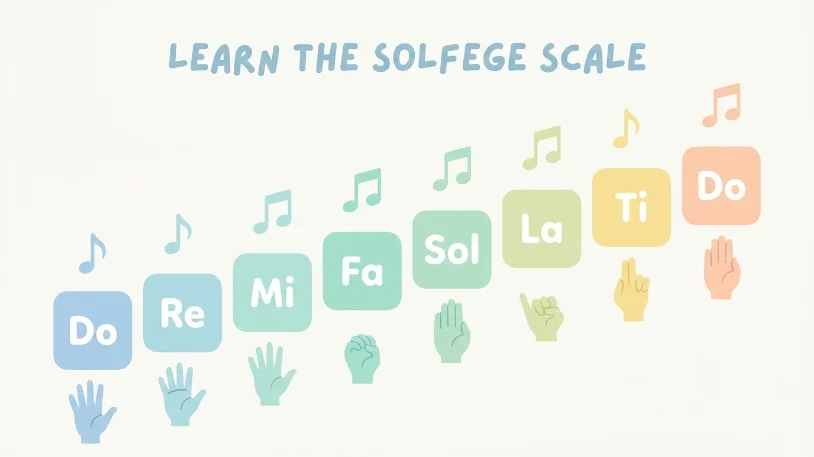
Do → Re → Mi → Fa → Sol → La → Ti → Do
Sing it slowly. Focus on how each step feels.
Now go back down:
Do → Ti → La → Sol → Fa → Mi → Re → Do
That rise and fall trains your ear.
Example: Simple Melody Using Solfege
Take a basic melody like:
“Twinkle Twinkle Little Star”
In solfege, it becomes:
Do Do Sol Sol La La Sol
Suddenly, you see the pattern.
That’s the magic.
Solfege Hand Signs: Learn with Your Body
Music isn’t just sound. It’s physical too.
Solfege hand signs give each syllable a gesture.
Why They Work
- Reinforce memory
- Connect pitch with movement
- Improve vocal control
Quick Overview
- Do → fist
- Re → angled hand
- Mi → flat hand
- Fa → thumb down
- Sol → open palm
- La → curved hand
- Ti → pointing finger
This method comes from structured music education systems and works surprisingly well.
Solfege vs Letter Notes (Do vs C)
Here’s a comparison that clears confusion.
| Feature | Solfege | Letter Notes |
|---|---|---|
| Focus | Relationships | Absolute pitch |
| Learning Style | Auditory | Visual |
| Best For | Ear training | Instrument reading |
| Flexibility | High | Limited |
Simple Way to Think About It
- Solfege = understanding music
- Letter notes = reading music
You need both. However, solfege builds the foundation.
Chromatic Solfege (Sharps and Flats Made Simple)
Once you master basics, you expand.
Additional Syllables
| Note Type | Solfege |
|---|---|
| Sharp Do | Di |
| Sharp Re | Ri |
| Flat Mi | Me |
| Sharp Fa | Fi |
| Sharp Sol | Si |
| Flat La | Le |
This system allows you to sing any melody accurately.
Common Beginner Mistakes in Solfege
Even motivated learners trip up. Here’s what to avoid.
Frequent Errors
- Memorizing without listening
- Ignoring pitch accuracy
- Mixing fixed and movable Do
- Practicing too fast
- Skipping real songs
Quick Fix Tip
Slow down. Accuracy beats speed every time.
How to Learn Solfege Step by Step
Let’s make it practical.
Step-by-Step Plan
Start with the Basics
- Learn Do Re Mi by heart
- Sing daily
Train Your Ear
- Match pitches
- Use a piano or app
Practice Scales
- Up and down
- Different keys
Use Simple Songs
- Apply what you learn
- Focus on patterns
Add Hand Signs
- Reinforce learning
Solfege Exercises for Beginners
Consistency matters more than talent.
Daily Practice Routine (10 Minutes)
- 2 minutes → Scale singing
- 3 minutes → Interval jumps
- 3 minutes → Simple melodies
- 2 minutes → Self-check
Easy Exercises
- Do → Mi → Sol (triad practice)
- Do → Re → Do (interval control)
- Do → Fa → Do (jump training)
Short sessions. Big results.
Practical Tips to Master Solfege Faster
You don’t need hours. You need strategy.
What Actually Works
- Practice daily, even briefly
- Sing out loud, not silently
- Record yourself
- Focus on accuracy first
- Use familiar tunes
Golden Rule
If you can sing it, you understand it.
Who Should Learn Solfege?
This isn’t just for singers.
Perfect for:
- Beginners learning music
- Vocalists improving pitch
- Instrumentalists building ear skills
- Music students studying theory
- Teachers guiding students
If you deal with music, solfege helps.
Solfege in Music Education and Training
Solfege plays a major role in structured learning systems.
Where It’s Used
- Choir training
- Classroom music education
- Vocal coaching
- Composition training
It bridges theory and practice in a natural way.
Solfege vs Scale in Music
This confusion pops up often.
Difference Explained
- Scale = sequence of notes
- Solfege = naming system for those notes
Think of it like this:
A scale is the road.
Solfege is the map.
Frequently Asked Questions
Is solfege the same as Do Re Mi?
Yes. Do Re Mi are the syllables used in solfege.
Is solfege hard to learn?
Not really. It feels strange at first, then becomes natural with practice.
Can you learn solfege without singing?
You can try, but singing makes it far more effective.
Why is solfege important in singing?
It improves pitch accuracy, control, and musical awareness.
Final Thoughts
Solfege might seem simple on the surface. Still, it unlocks something deeper.
It teaches you to hear music, not just play it.
When you understand solfege meaning, you move from guessing notes to knowing them. That shift changes everything.
So start small. Stay consistent. Keep singing.
Because once your ear wakes up, music never sounds the same again.