
Last Updated on September 30, 2026
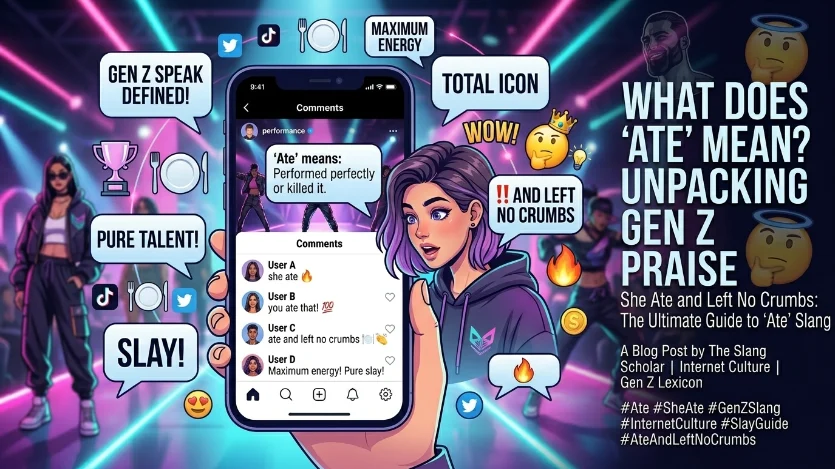
Ate slang meaning refers to a popular Gen Z internet slang expression used to praise someone for doing something exceptionally well, confidently, or impressively. When someone says “you ate” or “you ate that,” it means they performed perfectly or stood out. The phrase is widely used on TikTok, social media, memes, fashion, dance, and performance posts to express strong praise or admiration.
Understanding the Ate Slang Meaning in Modern Internet Language
The internet has a strange habit of turning simple words into cultural signals. One of the clearest examples is the slang word “ate.”
At first glance, it looks like a basic past tense verb. You might think it’s about food. But in Gen Z slang, it has nothing to do with eating meals.
Instead, the “ate slang meaning” refers to someone doing something extremely well, confidently, and impressively. When people say “you ate that,” they are giving high praise.
It’s short. It’s sharp. And it hits harder than a full sentence.
You’ll see it everywhere:
- TikTok comments
- Instagram reels
- Twitter reactions
- Meme pages
- YouTube Shorts
And it always carries the same energy: approval, admiration, and hype.
What Does “Ate” Mean in Slang? Full Breakdown
Core Ate Slang Meaning (Simple Definition)
In internet slang, “ate” means:
Doing something so well that nothing could top it.
It describes performance excellence in any form:
- A dance routine
- A fashion look
- A clever comeback
- A powerful speech
- Even a funny moment online
If someone says:
“She ate.”
They mean she performed flawlessly.
Breaking Down Common Usage
Here are real-world interpretations:
- “You ate that” → You did that perfectly
- “She ate” → She performed amazingly
- “They ate the stage” → Their performance was unforgettable
- “He ate that role” → He acted it perfectly
It’s praise. Pure and simple.
But it also carries attitude. There’s energy behind it. Not just approval, but excitement.
A Simple Analogy
Think of it like this:
If life were a cooking competition, “ate” means someone didn’t just cook well—they completely dominated the kitchen, served perfection, and left everyone speechless.
That’s the vibe.
Origin of “Ate” in Slang Culture and Internet Evolution
The “ate slang meaning” didn’t appear randomly. It evolved through layered cultural influences.
AAVE Influence and Linguistic Roots
The phrase originates from African American Vernacular English (AAVE). In this context, “to eat” or “ate” is used metaphorically to describe domination or excellence.
It connects to expressions like:
- “She devoured that performance”
- “He ate them up”
Language in AAVE often uses physical actions to represent abstract success, and “ate” fits perfectly into that pattern.
Rise Through Music, Ballroom, and Pop Culture
Before TikTok made it global, the phrase was already alive in:
- Hip-hop lyricism
- Drag and ballroom culture
- Black pop culture expression
In ballroom culture especially, “eating” a performance meant destroying the competition with style, confidence, and execution.
TikTok Explosion and Viral Spread
TikTok accelerated everything.
Short-form videos needed:
- Fast reactions
- Punchy comments
- Emotional shorthand
“Ate” became perfect.
By 2020–2023, it exploded across:
- Dance videos
- Fashion transitions
- Makeup transformations
- Meme edits
Now in 2026, it’s fully mainstream internet language.
What Does “Ate and Left No Crumbs” Mean?
One of the most popular variations is:
“Ate and left no crumbs.”
Meaning Explained
This phrase means:
- The performance was flawless
- Nothing could be improved
- Absolute perfection was achieved
Breakdown
- Ate → Did extremely well
- Left no crumbs → Nothing left behind, no mistakes, nothing missing
Together, it means total dominance.
Where You’ll See It
- Fashion runway edits
- Celebrity performances
- Viral dance clips
- Makeup transformations
Example:
“That outfit? She ate and left no crumbs.”
It’s over-the-top praise in the best way.
How to Use “Ate” in Real Conversations and Social Media
Using “ate” correctly depends on tone and context.
Basic Sentence Patterns
You can use it like this:
- “You ate that performance.”
- “She ate with that outfit.”
- “They ate the entire show.”
- “He ate that comeback.”
Short. Direct. Impactful.
Social Media Usage Examples
On TikTok:
- “You ate omg 🔥”
- “She ate and left no crumbs 💅”
On Instagram:
- “This look ate.”
- “You really ate that shoot.”
On YouTube comments:
- “Bro ate this role.”
Tone Matters
The word is informal. It works best in:
- Casual chats
- Online comments
- Meme culture
It does NOT fit:
- Business emails
- Academic writing
- Professional reports
Different Contexts Where “Ate” Is Used
The flexibility of this slang is what made it viral.
Fashion and Style
Used when someone looks amazing:
- Outfit coordination
- Red carpet looks
- Streetwear style
Example:
“That outfit ate.”
Music and Dance
Used for performance excellence:
- Stage presence
- Viral choreography
- Concert energy
Example:
“She ate that choreography.”
Sports Moments
When an athlete performs incredibly well:
“He ate that match.”
Comedy and Memes
Used when someone delivers a perfect joke:
“That roast ate.”
Confidence Moments
Even attitude can “eat”:
“She walked in and ate.”
“Ate” vs Other Slang Words: What’s the Difference?
Language evolves fast online. Here’s how “ate” compares:
| Slang Word | Meaning | Usage Style |
| Ate | Did extremely well | Modern Gen Z slang |
| Slayed | Performed impressively | Slightly older internet slang |
| Killed it | Did very well | General English slang |
| Snatched | Looks perfect | Fashion-focused slang |
| Devoured | Completely dominated | More intense version of “ate” |
Key Insight
“Ate” feels lighter and more flexible.
“Devoured” feels stronger.
“Slayed” feels older but still popular.
Common Mistakes People Make With “Ate”
Even though it’s simple, people misuse it.
Mistake 1: Taking It Literally
Some think it relates to food. It doesn’t.
Mistake 2: Using It in Formal Writing
It belongs in casual speech only.
Mistake 3: Overusing It
If everything “ate,” the word loses impact.
Mistake 4: Wrong Context
Not every situation fits slang praise.
Where You See “Ate” the Most Online
The word thrives in fast content platforms.
TikTok
- Dance trends
- Reaction comments
- Viral edits
- Reels
- Fashion posts
- Influencer content
Twitter / X
- Quick reactions
- Meme replies
YouTube Shorts
- Comment sections
- Highlight clips
Why “Ate” Became So Popular in Internet Culture
Several reasons explain its rise.
1. Short and Fast
One word replaces a full sentence.
2. Emotionally Strong
It carries hype, praise, and energy.
3. Perfect for Algorithms
Short comments boost engagement.
4. Meme-Friendly
Easy to remix and repeat.
5. Influencer Adoption
Creators pushed it into mainstream usage.
Linguistic Insight: Why “Ate” Works So Well
From a language perspective, “ate” is fascinating.
Polysemy (Multiple Meanings)
- Literal: consumed food
- Slang: performed excellently
Lexical Ambiguity
The brain quickly switches meaning based on context.
Sentiment Analysis
In slang usage, “ate” is:
- Always positive
- High praise
- Emotionally charged
FAQ: Ate Slang Meaning Explained
What does “ate” mean in Gen Z slang?
It means someone performed extremely well or impressed others.
Is “ate” a compliment?
Yes. It’s a strong form of praise.
Can you use “ate” for men?
Yes. It works for anyone.
What does “you ate that” mean?
It means you did something perfectly.
Is “ate” formal or informal?
It is strictly informal internet slang.
Conclusion
The “ate slang meaning” is more than just internet vocabulary. It shows how fast language evolves online.
One word now replaces full sentences of praise. That’s efficiency. That’s culture shift.
And honestly, that’s why it sticks.
Because when someone truly performs well, sometimes all you need to say is:
“You ate.”
And everyone understands exactly what that means.