Last Updated on October 5, 2026
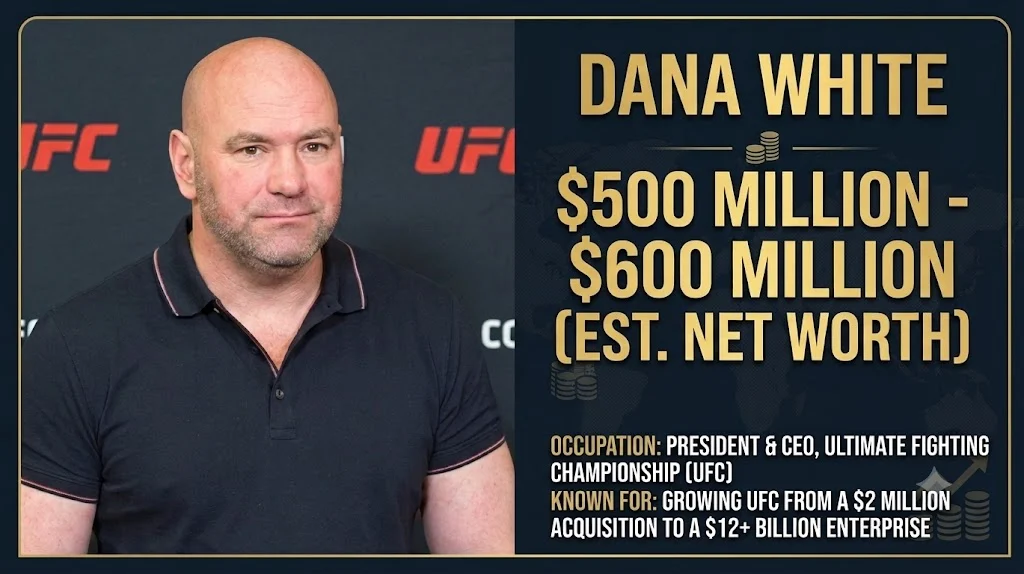
Dana White’s 2026 net worth is estimated at about $600 million, with Forbes previously placing his wealth above that level. His fortune primarily reflects UFC ownership and the 2016 sale, executive and promotional earnings, business ventures and real estate. Estimates vary because White’s private assets, liabilities, compensation and current ownership interests are not fully disclosed.
Key Takeaways
| Category | Dana White |
|---|---|
| Estimated Net Worth (2026) | About $600 million |
| Profession | Business executive, sports promoter and entrepreneur |
| Nationality | American |
| Primary Income Source | UFC leadership, ownership-related wealth and sports businesses |
| Biggest Wealth Driver | UFC ownership and the 2016 sale |
| Industry | Sports, media and combat entertainment |
| Years Active | 1990s–present |
| Current Status | Alive; President and CEO of UFC |
The approximately $600 million figure is an estimate, not a publicly filed personal balance sheet. Forbes reported White’s wealth at more than $600 million in 2025, while Celebrity Net Worth listed $600 million in August 2026. Other outlets continue to publish estimates around $500 million, illustrating the uncertainty surrounding private wealth calculations.
Dana White became wealthy in a way that is unusual even among major sports executives: he was not simply the person hired to run an established league. He became an early equity participant in a struggling combat-sports promotion, helped reshape its business model, remained its public face after a multibillion-dollar sale and continued leading the UFC as it evolved into part of TKO Group Holdings.
That history explains why Dana White net worth searches cannot be answered simply by quoting a salary.
The largest identifiable wealth event in White’s career came in 2016, when the UFC was sold to WME-IMG and its investment partners for just over $4 billion. Contemporary reporting put White’s ownership at approximately 9%, producing a reported $360 million value for his stake before taxes. Forbes later estimated White’s overall fortune at more than $600 million.
Why Readers Search This Topic
People searching for Dana White’s net worth generally want to understand three things:
- How much wealth he has accumulated.
- How much of that wealth came from the UFC.
- Whether his fortune is still growing through UFC, TKO-related interests and newer ventures.
The important distinction is between income and net worth. A highly paid executive can earn millions annually without owning a major stake in the underlying business. White’s early UFC equity changed that equation.
What Makes This Person Financially Significant
White’s financial story is essentially an ownership-and-brand-building case study.
When the Fertitta brothers purchased the UFC in 2001 for approximately $2 million, White became president and held an ownership interest. The promotion subsequently developed television, pay-per-view, sponsorship, live-event and licensing revenue streams. By 2016, the UFC transaction valued the organization at more than $4 billion.
The subsequent formation of TKO Group Holdings gave UFC access to a larger public sports-and-entertainment platform alongside WWE. TKO reported $4.735 billion of consolidated revenue for 2025 and described UFC and WWE as key businesses within the group.
Biography
| Field | Publicly Reported Information |
|---|---|
| Full Name | Dana Frederick White Jr. |
| Known As | Dana White |
| Date of Birth | July 28, 1969 |
| Age in 2026 | 57 |
| Birthplace | Manchester, Connecticut, U.S. |
| Nationality | American |
| Occupation | Business executive, sports promoter, entrepreneur |
| Industry | Sports and entertainment |
| Education | Attended Quincy College and University of Massachusetts Boston; did not complete a degree |
| Years Active | 1990s–present |
| Spouse | Anne White |
| Children | Three |
| Known For | Leading the UFC |
| Current Estimated Net Worth | About $600 million |
| Current Status | Alive; UFC President and CEO |
White’s birth date and basic biographical information are widely documented. His current professional position is also confirmed by UFC and Meta, which describe him as UFC President and CEO.
Early Life
Dana White was born in Manchester, Connecticut, in 1969 and grew up in Massachusetts. His interest in boxing and combat sports eventually became the foundation of his professional career.
Rather than following a conventional corporate path, White moved toward the fight business. His early experience included boxing instruction and management work before he became involved with mixed martial arts.
That practical exposure proved important. White learned the promotional side of combat sports before acquiring an executive position within the UFC.
Career Beginning
White’s transition into the UFC began through fighter management. He managed fighters including Tito Ortiz and Chuck Liddell and developed relationships with Lorenzo and Frank Fertitta.
According to Forbes’ account of the UFC’s history, White recognized that the struggling promotion could potentially become much larger if it were marketed and operated differently. He approached the Fertitta brothers about acquiring it.
In January 2001, the Fertittas purchased the UFC for approximately $2 million, with White becoming president and receiving an ownership interest.
Dana White Net Worth
Current Estimated Net Worth
The most defensible 2026 editorial estimate is approximately $600 million, while acknowledging a reasonable publicly reported range of roughly $500 million to more than $600 million.
Forbes reported in February 2025 that White’s net worth exceeded $600 million. Celebrity Net Worth listed him at $600 million in August 2026. Meanwhile, several 2026 publications continue to use estimates around $500 million to $520 million.
Net worth figures are estimates based on publicly available information and may vary.
The difference exists because there is no public, continuously updated Dana White balance sheet showing every asset, liability, private-company interest and contractual compensation arrangement.
Several variables make the calculation particularly difficult:
- Current private-business ownership is not fully disclosed.
- Compensation arrangements can include bonuses and performance-related payments.
- Real-estate values fluctuate.
- Private businesses require valuation assumptions.
- Taxes and liabilities are generally private.
- Some published estimates rely on historical UFC transactions rather than current asset statements.
The $600 million figure should therefore be treated as a reported wealth estimate, not an audited personal net-worth figure.
Major Wealth Sources
White’s fortune can be broadly traced to:
- UFC ownership and the 2016 transaction
- Long-term UFC executive compensation
- Promotional and performance-related income
- Business ventures in combat sports
- Real estate
- Investment and equity interests
- Brand and commercial relationships
The UFC remains the central economic engine of the story.
Net Worth Growth Timeline
| Year | Major Career Event | Estimated Financial Impact |
|---|---|---|
| 1990s | Works in boxing and fighter management | Early career foundation; amount not publicly disclosed |
| 2001 | UFC acquired by Lorenzo and Frank Fertitta for about $2 million; White becomes president and equity participant | Major long-term wealth-creation opportunity |
| 2004 | The Ultimate Fighter launches and expands UFC’s television profile | Strengthened UFC’s media and brand economics |
| 2010 | UFC reaches a reported $2 billion valuation following a minority investment | Demonstrated substantial appreciation of the business |
| 2011 | UFC secures major Fox broadcasting agreement | Expanded media distribution and commercial reach |
| 2016 | UFC sold for more than $4 billion; White’s reported 9% interest was valued at about $360 million before taxes | Largest publicly documented wealth event |
| 2023 | UFC and WWE combine within TKO Group Holdings | Created a broader sports-and-entertainment corporate platform |
| 2025 | Forbes estimates White’s net worth at more than $600 million | Latest major high-profile wealth estimate from Forbes |
| 2026 | White continues leading UFC while expanding Zuffa Boxing and Power Slap and serving on Meta’s board | Additional business exposure; current personal financial impact not publicly quantifiable |
The timeline demonstrates an important point: White’s wealth did not primarily emerge from one exceptionally large annual salary. The defining event was the appreciation of an equity position in a business that grew dramatically over roughly 15 years.
2001: The $2 Million UFC Acquisition
The UFC’s purchase price was approximately $2 million in 2001. The organization was then far removed from the multibillion-dollar sports property it would become.
White’s value creation came from helping develop the promotion’s commercial infrastructure, brand identity and event strategy.
2016: The $4 Billion UFC Sale
The 2016 transaction is the clearest publicly documented wealth milestone.
Forbes reported that White held approximately 9% of the UFC before the sale and that his interest was worth about $360 million in the transaction. The Los Angeles Times similarly reported that White sold part of his 9% interest while remaining president.
The distinction between $360 million of transaction value and $360 million of after-tax wealth matters. The former is the figure supported by contemporary reporting; taxes and subsequent spending or investment are separate questions.
2023–2026: From UFC Ownership to TKO and New Ventures
In 2023, UFC became part of TKO Group Holdings alongside WWE. TKO’s filings describe UFC as part of the operating business and identify White as UFC’s CEO.
White also expanded his business involvement into Power Slap and Zuffa Boxing. UFC announced Power Slap in 2022, describing it as a combat-sports promotion created by White, Lorenzo Fertitta and Craig Piligian.
Income Sources
| Income Source | Estimated Contribution | Confidence Level |
|---|---|---|
| UFC ownership / 2016 transaction | Major historical wealth driver; approximately $360M reported transaction value | High |
| UFC executive compensation | Exact current compensation not publicly disclosed | Medium |
| TKO-related interests | Current personal holdings not fully disclosed | Low–Medium |
| Power Slap | Financial contribution not publicly disclosed | Medium |
| Zuffa Boxing | Financial contribution not publicly disclosed | Medium |
| Real estate | Significant asset category; exact current portfolio value unavailable | Medium |
| Brand partnerships | Amounts generally not publicly disclosed | Low–Medium |
| Meta board compensation | Compensation exists, but its effect on total net worth is relatively small compared with UFC wealth | Medium |
Primary Career Income
White’s executive income from the UFC has been significant, but exact current compensation is not publicly disclosed in a manner that permits a complete personal-income calculation.
Some secondary publications cite annual compensation around $20 million, but that figure should not be treated as an audited current salary. Celebrity Net Worth currently lists a $20 million salary figure, while other reports have described compensation structures involving UFC profits.
Business Ownership
Business ownership is the most important component of White’s wealth story.
His early UFC interest exposed him to the dramatic increase in the value of the promotion. The 2016 sale transformed that equity into hundreds of millions of dollars of transaction value.
The key lesson is that White participated in the value creation of the enterprise, rather than relying exclusively on wages.
Equity Holdings
White’s current equity position is more difficult to quantify.
Forbes reported in 2025 that White maintained ownership shares in the combined TKO business. However, current SEC materials do not provide a simple public figure that can be used as a complete measure of White’s personal economic interest in UFC/TKO.
That uncertainty is one reason a precise 2026 net-worth calculation would be misleading.
Investments
White has diversified beyond UFC.
His business activities include Power Slap, Zuffa Boxing and other commercial interests. In 2025, he also joined Meta’s board of directors, expanding his corporate involvement into technology. Meta officially announced his appointment in January 2025.
Royalties & Licensing
UFC’s business model includes licensing and consumer products in addition to media rights and live events. TKO describes UFC and WWE’s revenue architecture as including media rights, live events, partnerships and marketing, and consumer-products licensing.
White’s individual royalty income from these activities is not publicly itemized.
Brand Partnerships
White’s visibility has created commercial opportunities around UFC and his other businesses. However, specific personal endorsement contracts and payments are generally private.
Accordingly, these should be treated as potential supplementary income rather than assigned invented dollar amounts.
Speaking Engagements
White has appeared extensively in interviews, media appearances and public events, but there is insufficient reliable public information to calculate speaking fees as a meaningful component of his net worth.
Passive Income
There is no sufficiently detailed public record showing White’s complete passive-income portfolio.
It would therefore be inappropriate to assign a specific annual passive-income figure.
Business Strategy Behind the Wealth
Business Model
White’s wealth was built around a powerful sports-media flywheel:
fighters → events → personalities → media → audience → sponsorships → licensing → stronger brand value → more valuable media rights.
The UFC’s current corporate structure reflects this diversified model. TKO identifies media rights, live events, partnerships and marketing, and consumer-products licensing as principal revenue activities.
This is considerably more scalable than relying solely on ticket sales.
Competitive Advantage
The UFC’s competitive advantage has several components.
Brand positioning: UFC developed a recognizable global identity around one standardized competition format.
Scalability: A single event can be monetized through live attendance, broadcast rights, streaming, sponsorship, licensing and merchandise.
Talent pipeline: The promotion can continuously introduce new fighters, allowing the product to refresh itself without rebuilding the brand from scratch.
Media leverage: Valuable content creates negotiating power with broadcasters and streaming platforms.
Global reach: Meta describes UFC as broadcasting to more than 975 million households across more than 170 countries.
White’s role has been particularly important in connecting the sports product with its audience. His promotional identity became part of the UFC’s commercial personality.
Assets & Investments
Real Estate
White has accumulated substantial real-estate holdings, particularly in Las Vegas.
One of the best-documented properties is his Tournament Hills/Pine Island Court compound. Contemporary reporting documented a $1.65 million purchase in 2006 and subsequent acquisitions of neighboring properties. Later reports have placed the expanded estate’s value around $50 million, although that is an estimated market value rather than a verified sale price.
The distinction is important: an asking price or estimated market value does not equal realizable cash proceeds.
Vehicles
White is known publicly for owning high-value vehicles, but a complete current inventory and independently verified aggregate value are not publicly disclosed.
Accordingly, this article does not assign a precise dollar figure to his automobile collection.
Investment Portfolio
White’s complete investment portfolio is private.
The publicly visible portions of his business interests include combat-sports ventures and his corporate role at Meta. The size of any broader securities portfolio, private investments or cash holdings is not publicly disclosed.
Private Businesses
Power Slap is one of White’s most significant post-UFC entrepreneurial ventures.
UFC announced the promotion in November 2022, identifying White, Lorenzo Fertitta and Craig Piligian as its creators.
White has also been involved in the development of Zuffa Boxing. UFC coverage in 2026 documents White’s active role in expanding the promotion and building its event calendar.
The private nature of these businesses makes their contribution to White’s personal net worth difficult to quantify.
Luxury Assets
White’s lifestyle includes luxury real estate and other high-value personal assets. However, publicly circulating valuations for aircraft, watches, cars and collectibles often lack sufficient documentation to support their inclusion in a precise net-worth calculation.
For that reason, this analysis does not treat every reported luxury item as verified wealth.
Financial Analysis
Revenue Quality
The economics surrounding White’s principal business are stronger than a conventional single-event sports promotion because UFC monetizes several layers of the same intellectual property.
TKO reported $4.735 billion in consolidated 2025 revenue and said UFC and WWE continued to benefit from live events, global partnerships and long-term media-rights agreements.
For White personally, the important point is that the underlying business has multiple revenue channels.
Cash Flow Stability
Long-term media-rights agreements can make sports businesses more predictable than businesses dependent entirely on box-office sales.
TKO said it entered 2026 with long-term media-rights agreements covering UFC and WWE.
That does not guarantee White’s personal income because his exact compensation arrangements are private, but it provides important context for the durability of the business from which his wealth originated.
Business Sustainability
UFC’s sustainability depends on several factors:
- audience demand
- fighter availability
- media-rights economics
- sponsorship demand
- international expansion
- regulatory conditions
- competition from other combat-sports promotions
The organization has also demonstrated an ability to expand its intellectual property into adjacent categories.
Competitive Positioning
The UFC has spent decades building a recognizable combat-sports brand. Its integration into TKO gives it access to a larger corporate ecosystem containing WWE and other sports and entertainment assets.
TKO’s 2025 annual report describes the company’s leadership and operational expertise in scaling sports and entertainment businesses as a competitive advantage.
Long-Term Wealth Potential
White’s future wealth will depend less on the original 2001 investment alone and more on the value of his continuing economic interests, compensation, private ventures and investment returns.
Zuffa Boxing and Power Slap create potential additional upside, but assigning a dollar value to that upside would require assumptions about ownership and enterprise valuation that are not sufficiently public.
Market Risks
The main risks include:
- changing media-rights economics
- fragmentation of sports viewing
- competition for consumer attention
- regulatory developments
- injuries affecting major fighters and events
- sponsorship-market cycles
- private-business valuation uncertainty
- personal spending and investment decisions
A major sports brand can remain valuable while individual events or quarters perform unevenly.
Net Worth Comparison
The following figures illustrate how different combat-sports and sports-entertainment fortunes can be structured. They are not a ranking and are not directly comparable because each fortune is built from different assets.
| Person | Profession | Estimated Net Worth | Difference vs. Dana White |
|---|---|---|---|
| Dana White | UFC executive / promoter | ~$600M | — |
| Conor McGregor | MMA fighter / entrepreneur | ~$200M | Public estimates differ by roughly $400M |
| Ari Emanuel | Sports and entertainment executive | ~$1B | Public estimates differ by roughly $400M |
| Vince McMahon | Wrestling promoter / entertainment executive | ~$3.4B | Public estimates differ by roughly $2.8B |
For White, the approximately $600 million figure comes from Forbes’ reported estimate above $600 million and Celebrity Net Worth’s August 2026 estimate. Celebrity Net Worth currently places McGregor at $200 million and Ari Emanuel at $1 billion, while Forbes’ real-time profile placed Vince McMahon at $3.4 billion in September 2026.
The comparison demonstrates the importance of ownership structure. McGregor’s fortune was heavily influenced by fighting income and entrepreneurial exits; White’s wealth was built primarily through sports-promotion ownership and executive leadership; McMahon’s fortune was built around decades of WWE ownership and appreciation.
Challenges & Financial Risks
White’s financial story is not risk-free.
UFC Business Risk
Combat sports depend on stars, event schedules, media distribution and consumer demand. Any prolonged decline in audience engagement could affect the underlying business.
Private-Asset Valuation Risk
Power Slap and other private interests cannot be valued with the same precision as publicly traded shares.
Media-Rights Risk
Sports rights are valuable but cyclical. Future negotiations could produce different economics from current agreements.
Diversification Risk
White’s expansion into additional combat-sports businesses provides diversification, but it also means more capital, management attention and execution risk.
Personal Asset Risk
Luxury real estate and other physical assets can represent substantial wealth while remaining illiquid. Their market values can also differ considerably from published estimates.
Philanthropy
White’s charitable activity is most visibly connected to UFC’s broader community initiatives.
In 2019, UFC reported that White personally donated $25,000 to the Jimmy Fund in support of cancer research and care.
He has also participated in UFC community programs supporting veterans, first responders and disaster-recovery initiatives. In 2025, UFC reported that White and the organization contributed to HomeAid Hawaiʻi’s Maui Housing Initiative, which supported interim housing for wildfire survivors.
In 2026, UFC’s Freedom 250 community program included White’s participation in a visit to Walter Reed National Military Medical Center and support for veteran-focused organizations.
These activities are important for understanding the public-facing side of White’s business brand, although charitable involvement should not be treated as a direct measure of personal net worth.
Future Net Worth Projection
A precise future net-worth number would require assumptions about assets and liabilities that are not publicly disclosed.
Instead, the more useful approach is to identify the variables that could affect White’s wealth.
Growth Drivers
Potential positive drivers include:
- continued UFC media-rights growth
- international expansion
- sponsorship growth
- live-event economics
- licensing and consumer products
- Zuffa Boxing expansion
- Power Slap growth
- appreciation of public or private business interests
- investment returns
Zuffa Boxing is particularly notable because White has been directly involved in launching and expanding the promotion in 2026. UFC reporting shows the organization conducting multiple events and expanding internationally.
Potential Risks
Future wealth could also be affected by:
- weaker media-rights negotiations
- changes in sports consumption
- competition from boxing and other combat sports
- regulatory developments
- private-company valuation changes
- real-estate market movements
- taxes and personal spending
For these reasons, a range-based approach is more defensible than claiming that White will reach a specific future dollar figure.
Interesting Financial Facts
- White’s wealth is fundamentally an equity story. His biggest identifiable financial event was tied to ownership in UFC rather than simply executive salary.
- The UFC was purchased for about $2 million in 2001. By 2016, the promotion was sold for more than $4 billion.
- White’s reported 2016 stake value was about $360 million. Forbes reported his approximately 9% interest at that transaction.
- White remained involved after selling the UFC. His continued leadership allowed him to participate in the company’s subsequent growth rather than exiting the sports business completely.
- UFC became part of TKO alongside WWE in 2023. This changed the corporate context around White’s leadership role.
- White joined Meta’s board in 2025. Meta officially announced his election alongside John Elkann and Charlie Songhurst.
- Power Slap was created in 2022. White, Lorenzo Fertitta and Craig Piligian were identified by UFC as its creators.
- White is now involved in multiple combat-sports properties. UFC reporting in 2026 documents his continuing involvement in UFC, Power Slap and the development of Zuffa Boxing.
Frequently Asked Questions
What is Dana White’s net worth in 2026?
Dana White’s net worth is estimated at about $600 million in 2026. Forbes previously estimated his wealth at more than $600 million, while Celebrity Net Worth lists $600 million. Other publications use lower figures, so the number should be treated as an estimate.
How did Dana White make his money?
Most of White’s fortune originated from his involvement with the UFC, including his early ownership interest and the 2016 sale of the promotion. He has also earned executive compensation and expanded into other businesses including Power Slap and Zuffa Boxing.
How much did Dana White make from selling the UFC?
Forbes reported that White’s approximately 9% UFC interest was worth about $360 million in the 2016 transaction. That figure represents the reported transaction value of the stake before taxes, rather than a verified amount of money White retained afterward.
Does Dana White still own part of the UFC?
Public reporting indicates that White retained an ownership interest following the UFC’s 2016 sale and later maintained ownership shares in the combined TKO business. However, his current exact economic ownership percentage is not publicly disclosed in a sufficiently clear way to assign a reliable value.
Is Dana White a billionaire?
Publicly available estimates do not currently place White at billionaire status. The most prominent estimates in 2026 cluster around approximately $500 million to more than $600 million.
How much does Dana White make per year?
Exact current compensation is not publicly disclosed. Celebrity Net Worth lists a $20 million salary estimate, while historical reporting has described compensation structures involving UFC profits. Those figures should not be treated as an audited current annual income number.
What businesses does Dana White own or operate?
White remains President and CEO of UFC and has been involved in Power Slap and Zuffa Boxing. He also joined Meta’s board of directors in 2025. The precise ownership stakes and valuations of his private ventures are not fully public.
Where does Dana White live?
White’s primary public association is with Las Vegas, where he has built a substantial residential compound. Reports have documented his acquisition of multiple properties in the Tournament Hills/Pine Island Court area.
Conclusion
Dana White’s wealth is best understood as the result of ownership, brand building and long-term participation in the growth of the UFC, rather than simply the result of a large executive salary.
The defining financial event was the UFC’s 2016 sale for more than $4 billion, when White’s reported 9% interest was valued at approximately $360 million before taxes. Forbes later estimated his overall fortune at more than $600 million, while other 2026 estimates remain lower.
Today, White remains central to UFC while also expanding into Zuffa Boxing and Power Slap and maintaining a broader business profile that includes his Meta board position.
The central uncertainty is not whether White created substantial wealth; the public record makes that clear. The uncertainty is the exact value of his current private assets, liabilities, compensation arrangements and ownership interests.
For that reason, Dana White net worth is best stated as approximately $600 million in 2026, with the important caveat that net worth figures are estimates based on publicly available information and may vary.