Last Updated on October 7, 2026
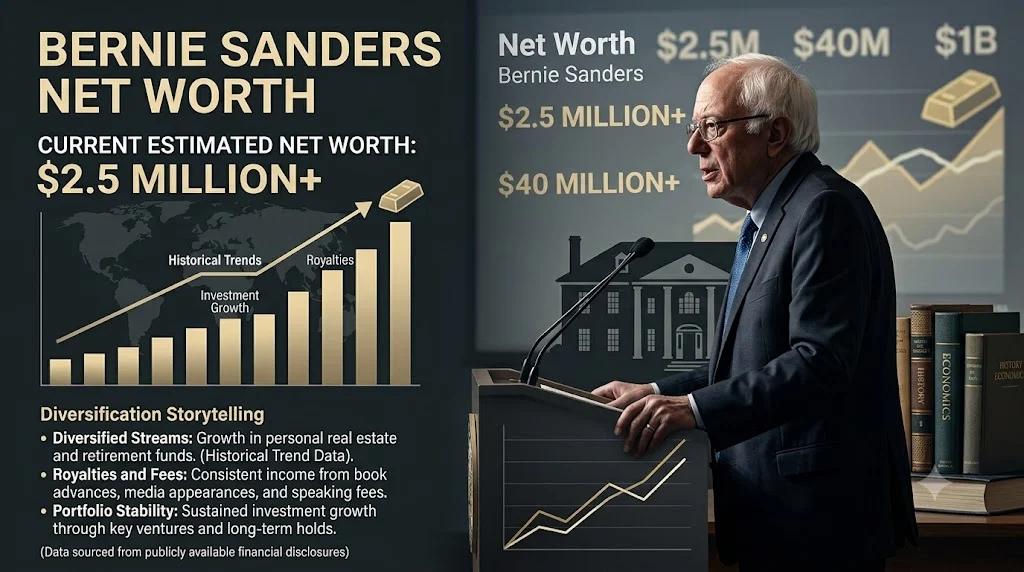
Bernie Sanders’ 2026 net worth is generally estimated at roughly $2.5 million to $3 million, based on public financial disclosures and published estimates. His wealth comes primarily from his Senate career, book royalties, real estate, pensions and retirement assets. Estimates vary because congressional disclosures use ranges and do not establish one complete household balance sheet.
Key Takeaways
| Financial Detail | 2026 Public Picture |
|---|---|
| Estimated Net Worth | Approximately $2.5 million–$3 million in widely published estimates |
| Profession | U.S. senator, author, former mayor and U.S. representative |
| Nationality | American |
| Primary Income Source | Senate salary and publishing income |
| Biggest Identifiable Wealth Components | Residential real estate, retirement assets, cash/deposit accounts and accumulated publishing income |
| Industry | Government, politics, publishing and media |
| Years Active | More than five decades in public and political life |
| Current Status | Serving his fourth U.S. Senate term representing Vermont |
The range above should be treated as an estimate, not an audited personal balance sheet. Recent published estimates include about $2.5 million from TheStreet and $3 million from Celebrity Net Worth, while Finance Monthly places the 2026 figure in a $2 million-$3 million range. Historical Forbes reporting estimated Sanders at $2.5 million in 2019.
Most importantly, Sanders’ campaign committees and political organizations should not be added to his personal net worth. Campaign cash is legally and financially distinct from an individual’s personal assets.
Why Readers Search This Topic
Searches for Bernie Sanders net worth usually begin with a straightforward question: how much money has the longtime Vermont politician accumulated after decades in public life?
The answer is more nuanced than a single number. Sanders has spent most of his career in government, but his financial profile changed significantly after his presidential campaigns turned him into a nationally recognized author. His books generated substantial advances and royalties, while his long public-service career produced salary, pension and retirement benefits. Real estate has also been an important part of the household balance sheet.
What Makes This Person Financially Significant
Sanders is unusual from a financial-research perspective because his wealth has not primarily been associated with ownership of a large corporation, a technology company or a substantial portfolio of individual stocks.
Instead, the public record shows a combination of earned government income, intellectual property, residential property, retirement assets and publishing royalties.
The latest Senate financial disclosure covering calendar year 2025 was filed on August 13, 2026. It reported $200,000 in publishing royalties from Penguin Random House, up from $148,750 reported for calendar year 2024.
That publishing income is particularly important when analyzing how Sanders accumulated wealth: the scalable financial asset associated with his public profile has largely been his intellectual property and audience, rather than equity in an operating business.
Biography
| Field | Publicly Confirmed Information |
|---|---|
| Full Name | Bernard Sanders |
| Known As | Bernie Sanders |
| Date of Birth | September 8, 1941 |
| Age in 2026 | 85 |
| Birthplace | Brooklyn, New York |
| Nationality | American |
| Occupation | U.S. Senator, author, former mayor, former U.S. representative |
| Industry | Government, politics, publishing |
| Education | James Madison High School; Brooklyn College; University of Chicago |
| Years Active | More than five decades |
| Spouse | Jane Sanders |
| Children | Four |
| Known For | Long congressional career, Vermont politics, presidential campaigns and political books |
| Current Estimated Net Worth | Approximately $2.5 million–$3 million in published 2026 estimates |
| Current Status | Serving in the U.S. Senate |
Sanders’ official biography says he attended James Madison High School, Brooklyn College and the University of Chicago before moving to Vermont, where he worked as a carpenter and documentary filmmaker. He was elected mayor of Burlington in 1981, later served 16 years in the U.S. House and entered the Senate after winning election in 2006. He was reelected in 2024 and is serving his fourth Senate term.
Early Life
Bernie Sanders was born in Brooklyn, New York, in 1941. His early education included James Madison High School and Brooklyn College before he transferred to the University of Chicago.
After college, Sanders moved to Vermont. His early working life included jobs as a carpenter and documentary filmmaker, a markedly different financial foundation from politicians who entered public life after established careers in law, finance or corporate management.
His early years are financially relevant because there is no public evidence of a large inherited business or family corporate fortune forming the foundation of his later wealth.
Career Beginning
Sanders’ political career accelerated after his move to Vermont. In 1981, he won the Burlington mayoralty by 10 votes. He served as mayor for eight years before winning election to the U.S. House in 1990, where he represented Vermont for 16 years.
He then entered the Senate after winning the 2006 election and took office in January 2007. His public career subsequently expanded through Senate leadership positions, two presidential campaigns and a growing publishing career.
Bernie Sanders Net Worth Overview
Current Estimated Net Worth
As of 2026, the most defensible way to present Bernie Sanders’ net worth is as a range rather than an exact number.
Published estimates currently cluster around $2.5 million to $3 million. TheStreet reports approximately $2.5 million, Celebrity Net Worth reports $3 million, and Finance Monthly gives a $2 million-$3 million range.
Historical Forbes reporting estimated Sanders’ fortune at approximately $2.5 million in 2019, while Forbes later reported that his book advances and royalties totaled about $2.5 million from 2011 through 2022 alone.
However, those figures should not be interpreted as if Sanders has publicly certified a precise $2.5 million or $3 million balance sheet.
The latest Senate disclosure uses statutory valuation bands. A recent analysis of the 2025 filing places the disclosed-value assets at approximately $662,000 to $1.8 million, while noting that some pension and retirement interests have no precise reported value. That disclosure-based figure should not automatically be treated as total net worth because congressional reporting does not capture every asset in the same manner and can exclude or separately treat personal residences and certain retirement interests.
Net worth figures are estimates based on publicly available information and may vary.
Why Net Worth Estimates Vary
There are several reasons different websites report different figures:
- Congressional disclosures use ranges. A bank account may be reported as $100,001-$250,000 rather than its exact balance.
- Not every retirement entitlement has a stated market value.
- Residential property is not always presented like an investment asset.
- Liabilities are also reported in ranges.
- Household assets can involve joint ownership or spousal ownership.
- Real estate values fluctuate with the market.
- Book royalties vary substantially from year to year.
- Published net-worth sites use different methodologies.
The Senate’s disclosure system itself explains that annual reports include assets, income, transactions, liabilities and other financial interests, rather than producing a single audited net-worth statement.
Major Wealth Sources
The public record points to five principal categories:
- Senate and congressional compensation
- Book advances and royalties
- Residential real estate
- Pension and retirement assets
- Cash and deposit accounts
There is no reliable public evidence that a major private operating company or large corporate equity stake is a central component of Sanders’ personal fortune.
Net Worth Growth Timeline
| Year / Period | Major Career Event | Estimated Financial Impact |
|---|---|---|
| 1981–1989 | Mayor of Burlington | Created long-term public-service income and municipal pension benefits |
| 1991–2006 | U.S. House representative | Added congressional salary, retirement benefits and public-profile value |
| 2007 onward | U.S. Senate career | Established a long-running six-figure federal salary and retirement accumulation |
| 2015–2016 | Presidential campaign and publishing expansion | Major increase in national visibility and book-related income |
| 2016 | Our Revolution released | One of the largest documented publishing-income periods |
| 2017 | Major book income continues | Household income exceeded $1 million, with publishing accounting for a substantial share |
| 2018 | Continued book royalties | Household AGI remained above $500,000 |
| 2019 | Forbes estimated fortune around $2.5 million | Public benchmark for accumulated wealth |
| 2022 | It’s OK to Be Angry About Capitalism royalties | $170,000 in disclosed royalties |
| 2024 | Publishing remains significant | $148,750 reported from Penguin Random House |
| 2025 | Fight Oligarchy publishing period | $200,000 in royalties reported in the 2025 disclosure |
| 2026 | Latest disclosure becomes public | Public estimates remain in the low-single-digit millions |
How the Timeline Changed His Financial Profile
The most important financial inflection point was not Sanders’ Senate salary. It was the transformation of his public profile into a commercially valuable publishing platform.
Forbes reported that Sanders received approximately $2.5 million in book advances and royalties from 2011 through 2022. The publication also noted that this amount exceeded what he earned from his Senate job over that period.
The 2016 campaign was particularly important. Sanders received a reported $795,000 advance connected with Our Revolution, while total book-related income reported around that period reached much higher levels when multiple titles and editions were included.
The pattern demonstrates that his wealth growth was episodic rather than driven by a steadily rising salary.
Income Sources
| Income Source | Publicly Documented Contribution | Confidence Level |
|---|---|---|
| Senate salary | $174,000 annual salary for a rank-and-file senator | High |
| Book royalties | $200,000 disclosed for calendar 2025 | High |
| Book royalties | $148,750 disclosed for calendar 2024 | High |
| Burlington pension | $6,221.52 disclosed for calendar 2024 | High |
| Real estate | Material household asset, exact current value not established by disclosure alone | Medium |
| Retirement accounts | Material household assets, but several values are reported in ranges or are not ascertainable | Medium |
| Individual-stock portfolio | No major current individual-stock portfolio identified in recent public reporting | High |
| Business ownership | No major private operating business identified as a material wealth source | Medium/High |
Primary Career Income
Sanders’ Senate salary is the most predictable recurring component of his personal income.
The base salary for rank-and-file members of Congress has remained $174,000 since 2009, absent an enacted pay increase.
Over a career spanning the House and Senate, that compensation provides a substantial cumulative income base, although salary should not be confused with accumulated wealth. Taxes, living expenses, mortgage payments and other costs reduce the amount available for saving and investment.
Business Ownership
Unlike many high-profile politicians whose net-worth stories involve law firms, corporate holdings or family businesses, Sanders does not have a major publicly identified private company that explains his wealth.
His financial model is better understood as a professional-income and intellectual-property model.
Equity Holdings
Recent reporting based on Sanders’ disclosures indicates that he has not maintained the kind of large individual-stock portfolio often associated with congressional financial profiles.
His wife’s retirement accounts contain mutual funds, but the disclosure explicitly distinguishes those funds from individually held stocks.
That distinction matters: owning a diversified retirement fund is financially different from directly selecting and owning individual corporate shares.
Investments
The latest public disclosures identify bank deposits, retirement interests, pension arrangements and mutual-fund-based retirement holdings.
The 2025 filing includes large cash/deposit categories, including $100,001-$250,000 at North Country Federal Credit Union and another $100,001-$250,000 at the U.S. Senate Federal Credit Union, according to analyses of the filing.
These figures are ranges, not exact balances.
Royalties & Licensing
Publishing has been the most visible scalable source of non-salary income.
For calendar 2025, Sanders reported $200,000 from Penguin Random House. The filing does not break that amount into individual titles, advances, territories or units sold.
For calendar 2024, he reported $148,750 from the same publisher.
Historically, Forbes calculated approximately $2.5 million in book advances and royalties from 2011 through 2022.
Brand Partnerships
There is no strong public evidence that commercial brand endorsements constitute a meaningful part of Sanders’ wealth.
Unlike celebrity athletes and entertainers, his public financial profile is not built around endorsement contracts.
Speaking Engagements
Some historical speaking and appearance income has been disclosed, but the amounts have generally been small relative to book income and Senate compensation.
In several documented cases, Sanders directed appearance-related payments to charity.
Passive Income
Passive and semi-passive financial income includes interest, dividends, pensions and publishing royalties.
The latest disclosures show pension income and income associated with bank and retirement accounts, but they do not provide enough information to construct a precise annual passive-income total.
Business Strategy Behind the Wealth
Business Model
Calling Sanders’ finances a conventional “business model” would be misleading because he does not appear to have built his fortune through ownership of a large commercial enterprise.
His wealth-creation structure is better described as:
public-service career → national audience → intellectual property → publishing income → asset accumulation
His political career created an unusually durable audience. That audience increased demand for books, which converted public recognition into private publishing income.
This is visible in the timing of his financial history. The major publishing surge occurred after his first presidential campaign, when his national profile expanded substantially. Forbes identified the post-2016 period as the key phase in his accumulation of book income.
Competitive Advantage
From a financial perspective, Sanders’ principal advantage has been audience durability.
Unlike a conventional business that needs physical infrastructure, inventory or employees to monetize demand, an established author can reuse intellectual property through:
- New editions
- Audiobooks
- E-books
- Paperback editions
- Foreign editions
- Speaking and media exposure
- Related publishing agreements
His recent books illustrate that model. It’s OK to Be Angry About Capitalism was published by Crown in 2023, while Fight Oligarchy was released by Crown in 2025.
The financial limitation is equally important: publishing income is less predictable than salary. A major advance or bestseller can create a temporary income spike, while later years may produce much smaller royalty checks.
Assets & Investments
Real Estate
Real estate has historically been one of the clearest components of the Sanders household balance sheet.
Public reporting has identified a Burlington, Vermont, residence and a North Hero, Vermont, summer property. Earlier reporting also identified a Washington, D.C., townhouse, which was subsequently reported as sold in 2021.
The North Hero property was purchased in 2016 for roughly $575,000 according to historical reporting.
A major caution is necessary here: current online property estimates should not simply be added to the latest Senate disclosure and presented as exact net worth. The disclosure system uses different treatment for residences, liabilities and other assets.
Vehicles
There is no reliable current public evidence establishing a substantial luxury-vehicle collection that materially affects Sanders’ net worth.
Investment Portfolio
Recent disclosures do not show a large portfolio of individually selected public-company stocks.
Instead, the household’s investment exposure appears to be concentrated in retirement accounts, mutual funds, cash and other conventional financial assets.
Private Businesses
No major private operating company has been publicly established as a significant component of Sanders’ personal fortune.
Organizations associated with Sanders’ political activities should also not automatically be treated as personal assets.
Luxury Assets
No reliable public evidence establishes a major collection of luxury watches, foreign vehicles, yachts or other high-value collectible assets.
That absence is significant because some celebrity net-worth articles inflate estimates by assuming expensive lifestyle assets that are not actually documented.
Financial Analysis
Revenue Quality
Sanders’ income has two distinct qualities.
Salary and pension income are relatively predictable. His Senate salary provides recurring compensation, while his Burlington pension provides a smaller retirement-linked income stream.
Publishing income is more volatile but scalable. The $200,000 reported for 2025 was substantially above the $148,750 reported for 2024, illustrating how book income can move independently of salary.
Cash Flow Stability
The financial profile appears more stable than the headline royalty figures might suggest because publishing is layered on top of long-term government compensation and accumulated assets.
However, book royalties cannot reasonably be extrapolated indefinitely at the 2025 level.
Wealth Concentration
The public record points toward concentration in:
- Residential property
- Retirement assets
- Cash and deposits
- Publishing-related intellectual property
It does not indicate that Sanders’ wealth depends heavily on one publicly traded company’s share price.
That makes his net worth less exposed to daily stock-market volatility than the portfolios of some wealthy public officials, although real estate, interest rates and publishing demand remain relevant.
Business Sustainability
The most durable financial engine has been the combination of long-term public income and intellectual property.
The publishing component remains particularly notable because Sanders has continued producing books decades into his political career. Penguin Random House lists Fight Oligarchy among his recent titles and describes Sanders as the longest-serving independent in congressional history.
Long-Term Wealth Potential
Future changes in Sanders’ net worth would most plausibly be influenced by:
- Continued publishing income
- Real-estate appreciation or depreciation
- Retirement-account performance
- Pension income
- Household spending
- Mortgage balances
- Tax obligations
- Future book contracts
The public record does not support a precise numerical forecast because several of these variables are not publicly observable.
Net Worth Comparison
The following comparison is descriptive rather than a ranking. Published estimates and disclosure-based figures use different methodologies and should not be treated as directly equivalent.
| Person | Profession | Published / Disclosure-Based Estimate | Difference vs. Sanders’ Approx. $2.5M–$3M Range |
|---|---|---|---|
| Bernie Sanders | U.S. senator / author | $2.5M–$3M | Baseline |
| Elizabeth Warren | U.S. senator / author | About $7M–$8M+ in 2026 estimates | Published estimates are several million dollars higher |
| Mitch McConnell | U.S. senator | About $35M on Celebrity Net Worth; other 2026 estimates are higher | Published estimates are substantially higher |
| Alexandria Ocasio-Cortez | U.S. representative | Roughly $80,000 on Celebrity Net Worth; disclosure-based figures remain far below Sanders’ published estimate | Published estimates are substantially lower |
Elizabeth Warren’s 2026 estimate from TheStreet is at least $8 million, with Quiver cited at about $7.09 million. Celebrity Net Worth lists Mitch McConnell at $35 million as of July 2026. Celebrity Net Worth’s August 2026 estimate for Alexandria Ocasio-Cortez is $80,000, while her latest disclosure shows relatively modest financial assets and student-loan liabilities.
These comparisons demonstrate why source methodology matters: a published net-worth number may incorporate property estimates and assumptions that a congressional disclosure itself does not provide.
Challenges & Financial Risks
Publishing Income Volatility
Sanders’ book income has historically fluctuated sharply.
A major advance or bestseller can produce hundreds of thousands of dollars in one year, but there is no guarantee that a later title will produce comparable royalties.
Real Estate Risk
Residential property can appreciate over decades, but market values are not guaranteed and mortgage balances reduce equity.
The 2025 filing contains two mortgage entries in the $100,001-$250,000 range, with one identified as a refinancing. They should not simply be added together because the disclosure rules and filing comments indicate the later entry relates to refinancing.
Retirement-Asset Uncertainty
Several retirement interests are disclosed through ranges or without ascertainable market values. This creates uncertainty when trying to reconstruct a household balance sheet.
Disclosure Limitations
Congressional financial disclosures are transparency documents, not audited financial statements.
They are designed to reveal financial interests and potential conflicts, not to provide investors with a precise personal net-worth statement. The Senate’s disclosure guidance specifically uses valuation categories and reporting thresholds.
Philanthropy
Sanders has a documented history of charitable giving, including directing royalties from his book The Speech to charity.
His disclosures recorded royalties from the book being directed to charitable purposes, and historical reporting documented donations associated with those proceeds.
Sanders and his wife also reported significant charitable contributions in their released tax returns. For example, their 2018 return showed approximately $18,950 in charitable giving, around 3.4% of adjusted gross income. Their charitable giving also included proceeds from The Speech that were sent directly to charities rather than claimed as personal tax deductions.
Public reporting has described recipients or beneficiary categories including senior centers, low-income organizations, educational organizations, environmental causes and housing advocacy groups.
Philanthropy is relevant to financial analysis because it can reduce disposable household wealth while simultaneously forming part of a public figure’s long-term public record. It should not, however, be treated as an investment or an income source.
Future Net Worth Projection
A precise dollar forecast would imply information that is not publicly available, particularly regarding current property values, retirement balances, spending, taxes and future publishing contracts.
A more useful approach is to identify the directional drivers.
Potential Growth Drivers
- Continued book sales and royalties
- Additional publishing agreements
- Appreciation in Vermont residential property
- Investment and retirement-account returns
- Continued pension payments
- Accumulation from future salary income
Potential Constraints
- Declining royalty income after a book cycle
- Mortgage obligations
- Income and property taxes
- Normal household spending
- Lower publishing demand
- Real-estate market weakness
- Retirement-account market volatility
The 2025 disclosure provides evidence that publishing remains an active income stream: Sanders reported $200,000 in royalties for the year.
That does not establish that future annual royalties will remain at $200,000. Therefore, the most responsible projection is scenario-based rather than a single numerical prediction: Sanders’ wealth can remain supported by recurring government income, pensions and existing assets, while the pace of additional accumulation will depend heavily on the durability of publishing income and asset values.
Interesting Financial Facts
- Sanders’ 2025 disclosed book income was $200,000, exceeding his $174,000 annual congressional salary.
- His 2024 publishing income was $148,750, showing that royalties remained a meaningful source of income even after the initial post-2016 publishing surge.
- Forbes calculated roughly $2.5 million in book advances and royalties between 2011 and 2022.
- Sanders’ largest documented publishing-income years followed his rise to national prominence, illustrating how political visibility can translate into intellectual-property income.
- His Burlington municipal pension remains an active income source. The 2024 disclosure reported $6,221.52 from the City of Burlington pension.
- His latest financial disclosure does not resemble a large individual-stock trading portfolio. Much of the reported investment exposure is connected with cash, retirement funds and mutual funds.
- The Sanders household has used real estate as a long-term store of wealth, including properties in Vermont and, historically, Washington, D.C.
- Political campaign cash is not personal wealth. Sanders’ campaign committees have raised substantial sums over multiple election cycles, but those funds belong to political committees and cannot simply be added to his personal net worth.
Frequently Asked Questions
What is Bernie Sanders’ net worth in 2026?
Published 2026 estimates generally place Bernie Sanders’ net worth at approximately $2.5 million to $3 million. The exact amount cannot be confirmed because congressional financial disclosures use ranges and do not create an audited net-worth statement.
How does Bernie Sanders make his money?
His documented income sources include his Senate salary, book royalties, a Burlington municipal pension, investment-related income and wealth associated with real estate and retirement assets.
How much does Bernie Sanders earn from books?
His 2025 Senate disclosure reported $200,000 in royalties from Penguin Random House. His 2024 disclosure reported $148,750 from the same publisher.
What is Bernie Sanders’ Senate salary?
The annual salary for a rank-and-file U.S. senator is $174,000. That has been the standard congressional salary since 2009, absent an enacted increase.
Does Bernie Sanders own stocks?
Recent reporting based on his financial disclosures does not identify a large portfolio of individually held corporate stocks. His household does have retirement accounts containing mutual funds and other investment vehicles.
Does Bernie Sanders own real estate?
Yes. Public reporting has documented Sanders household property in Vermont, including a Burlington residence and a North Hero summer property. A Washington, D.C., townhouse was also historically owned but was reported sold in 2021.
Did Bernie Sanders become wealthy from politics?
His political career supplied decades of salary, retirement benefits and public visibility, but the public record indicates that book publishing was an especially important source of additional wealth. Forbes reported approximately $2.5 million in book advances and royalties from 2011 through 2022.
Are Bernie Sanders’ campaign funds part of his net worth?
No. Campaign committees maintain separate financial accounts and legal purposes. Campaign receipts and cash balances should not be treated as Sanders’ personal assets.
Conclusion
Bernie Sanders’ net worth in 2026 is best understood as a low-single-digit-million-dollar fortune, with widely published estimates clustering around $2.5 million to $3 million. The public record points to a combination of decades of congressional compensation, Vermont and federal retirement benefits, residential real estate, financial accounts and most significantly during several periods book advances and royalties.
The latest disclosure adds an important update: Sanders reported $200,000 in publishing royalties during calendar year 2025, compared with $148,750 in 2024. That makes publishing one of the clearest currently documented sources of non-salary income in his financial profile.
At the same time, no public filing establishes an exact household net worth. Asset values are reported in ranges, some retirement interests are difficult to value, liabilities can involve refinancing, and real-estate values change over time.
The broader financial story is therefore less about a single headline number and more about how a decades-long public career created a durable platform for salary, pensions, property ownership and intellectual-property income.