
Last Updated on October 1, 2026
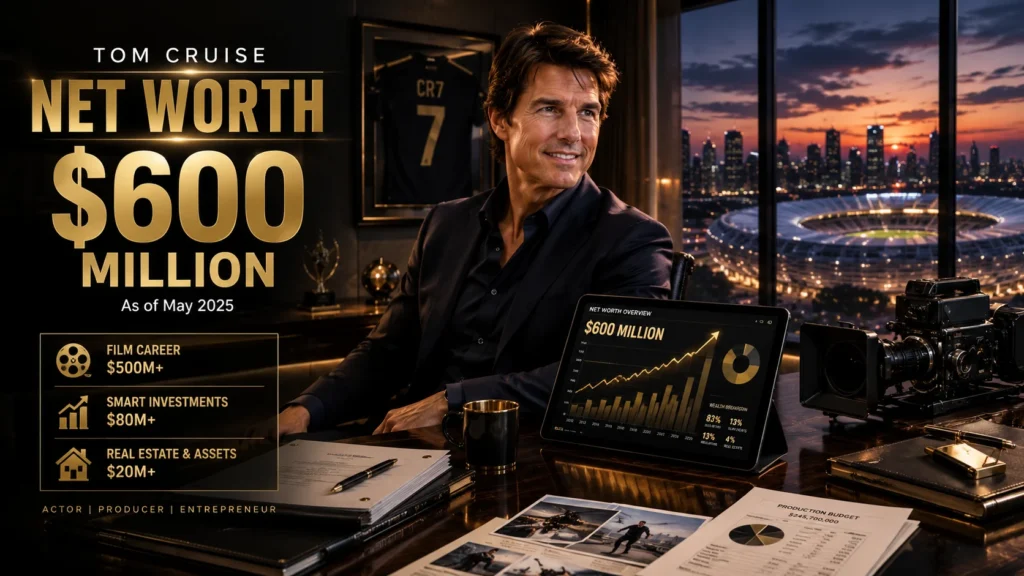
Tom Cruise’s 2026 net worth is widely estimated at $600 million, built primarily through acting, producing, and lucrative profit-participation deals on blockbuster films. His wealth is difficult to verify precisely because private investments, liabilities, taxes, contracts, and complete asset holdings are not publicly disclosed.
Key Takeaways
| Metric | Tom Cruise |
|---|---|
| Estimated Net Worth, 2026 | $600 million widely reported; analytical estimates vary |
| Profession | Actor, Film Producer |
| Nationality | American |
| Primary Income Source | Film acting and producer compensation |
| Biggest Wealth Driver | High-value blockbuster compensation and backend participation |
| Industry | Film & Entertainment |
| Years Active | 1981–present |
| Current Status | Alive and professionally active |
The $600 million figure is a public estimate, not an audited personal balance sheet. Celebrity Net Worth lists $600 million as of September 15, 2026, while other analytical estimates place Cruise lower because they discount unknown liabilities, taxes, private assets and unverified compensation claims.
Tom Cruise has spent more than four decades turning movie-star recognition into an unusually sophisticated entertainment business model. The answer to Tom Cruise net worth in 2026 is commonly reported as approximately $600 million, but the more important story is how that wealth was created.
Cruise did not build his fortune simply by collecting conventional actor salaries. Over time, he developed greater leverage as a producer, franchise creator, and negotiator capable of participating in the economic upside of successful films.
His compensation structure has been particularly important. Variety reported that Cruise accepted relatively modest upfront fees for later Mission: Impossible films in exchange for substantial first-dollar gross participation. Variety also reported that his Top Gun: Maverick compensation could exceed $100 million once salary, box-office participation and later entertainment revenue were considered.
That distinction matters because a film’s box-office gross is not the same thing as an actor’s income. Production budgets, marketing costs, theater splits, distribution expenses, taxes, commissions and other deductions stand between ticket sales and personal wealth.
Cruise’s financial story is therefore best understood as a combination of star power, ownership-like participation, producing leverage, franchise economics and decades of capital accumulation.
Why Readers Search This Topic
Searchers generally want three answers:
- How much is Tom Cruise worth in 2026?
- How did he make his money?
- How much of that wealth can actually be supported by public evidence?
The first question has a relatively simple answer: about $600 million is the most frequently cited current estimate. The second requires understanding his compensation agreements and producing career. The third is where responsible financial analysis becomes important.
What Makes This Person Financially Significant
Cruise represents an unusual case in Hollywood economics.
He has repeatedly combined the roles of lead actor and producer, particularly within major commercial franchises. The Academy’s records identify Cruise as a producer of Top Gun: Maverick, which received a Best Picture nomination, while his film career includes four competitive Academy Award acting nominations and, more recently, an Academy Honorary Award.
The result is a career in which the value of his personal brand has been connected directly to film economics rather than merely to an employment salary.
Biography
| Field | Publicly Reported Information |
|---|---|
| Full Name | Thomas Cruise Mapother IV |
| Known As | Tom Cruise |
| Date of Birth | July 3, 1962 |
| Age in 2026 | 64 |
| Birthplace | Syracuse, New York, U.S. |
| Nationality | American |
| Occupation | Actor, Film Producer |
| Industry | Film & Entertainment |
| Years Active | 1981–present |
| Known For | Top Gun, Mission: Impossible, Jerry Maguire, Rain Man, Risky Business |
| Children | Three publicly documented children |
| Awards | Three Golden Globes, Honorary Palme d’Or, Academy Honorary Award |
| Current Estimated Net Worth | About $600 million widely reported |
| Current Status | Alive and professionally active |
| Official Website | TomCruise.com |
The Golden Globes database records seven nominations and three wins for Cruise. His Academy Awards record includes competitive nominations for Born on the Fourth of July, Jerry Maguire, Magnolia and Top Gun: Maverick as a producer, while the Academy also awarded him an Honorary Oscar in 2025.
Early Life
Thomas Cruise Mapother IV was born on July 3, 1962, in Syracuse, New York. His father worked as an electrical engineer, while his mother was a teacher and amateur actor. The family moved frequently during Cruise’s childhood because of his father’s employment.
Cruise attended several schools and initially considered other career paths before turning seriously toward acting. Tom Cruise athletic interests and performance abilities eventually helped redirect his ambitions toward entertainment.
His childhood circumstances are relevant to the later financial story because Cruise did not enter Hollywood with a large publicly documented family fortune. His wealth was accumulated through his own professional career.
Career Beginning
Cruise made his film debut in Endless Love in 1981 and subsequently appeared in Taps and The Outsiders. His breakthrough arrived with Risky Business in 1983.
Top Gun in 1986 transformed that breakthrough into international stardom. From there, Cruise expanded into dramatically different genres, including Rain Man, Born on the Fourth of July, A Few Good Men, Jerry Maguire, Magnolia, Minority Report and The Last Samurai.
The crucial financial transition came when Cruise increasingly participated in the production and economics of his movies rather than functioning solely as an actor.
Tom Cruise Net Worth Overview
Current Estimated Net Worth
Tom Cruise’s 2026 net worth is widely estimated at approximately $600 million.
Celebrity Net Worth lists $600 million and updated its Cruise profile on September 15, 2026. Parade also reported a $600 million estimate for 2026.
However, that should not be confused with an independently verified balance sheet.
A separate 2026 methodology from Grizzly Bulls places its base estimate at approximately $460 million, with a broader $320 million to $650 million range. That illustrates an important point: even sophisticated estimates can produce materially different answers when the underlying financial information is private.
For this article, $600 million is used as the headline public estimate, while a broad analytical range is more appropriate for financial interpretation.
Net worth figures are estimates based on publicly available information and may vary.
The main reasons include:
- Private investment holdings are not fully disclosed.
- Contract terms are often confidential.
- Gross movie compensation is not the same as retained wealth.
- Taxes and commissions reduce gross earnings.
- Property values fluctuate.
- Liabilities are generally private.
- Some reported compensation figures are estimates rather than contractual disclosures.
Major Wealth Sources
Cruise’s fortune appears to have been built primarily from five interconnected sources:
- Film acting compensation
- Producer fees and production participation
- Backend and profit participation
- Real estate and other personal assets
- Long-term residual, licensing and entertainment income
The first three are particularly important.
Variety reported that Cruise’s later Mission: Impossible agreements included a relatively low upfront salary in exchange for a substantial percentage of first-dollar gross. That arrangement allows a star to participate in revenue before a studio has fully recouped all costs, creating significantly greater upside than a conventional fixed salary.
Net Worth Growth Timeline
| Period | Major Career Event | Directional Financial Impact |
|---|---|---|
| 1981–1983 | Film debut and Risky Business breakthrough | Established high-value leading-man career |
| 1986 | Top Gun becomes a major global hit | Major increase in earning power and brand value |
| 1988–1990 | Rain Man and Born on the Fourth of July | Expanded commercial and critical leverage |
| 1996 | First Mission: Impossible film | Shift toward franchise ownership/producer economics |
| 1996–2000 | Jerry Maguire and Mission: Impossible II | Reinforced premium compensation position |
| 2000s | Continued blockbuster and producer work | Increased long-term earning capacity |
| 2010s | Mission: Impossible becomes a durable global franchise | Significant recurring franchise economics |
| 2018 | Mission: Impossible – Fallout | Franchise reached a new commercial high point |
| 2022 | Top Gun: Maverick | Major wealth-creation event through backend participation |
| 2023–2025 | Continued franchise and producer activity | Maintained premium commercial leverage |
| 2025 | Mission: Impossible – The Final Reckoning and Honorary Oscar | Reinforced long-term career and brand value |
| 2026 | Continued film activity and new projects | Ongoing opportunity for additional earnings |
Analysis of the Wealth Timeline
The most important turning point was not a single salary.
It was Cruise’s transition from being paid to appear in successful films to participating more directly in the financial success of those films.
That distinction explains why comparing Cruise’s wealth solely with actor salaries can be misleading.
The original Mission: Impossible arrived in 1996, with Cruise serving as both star and producer. His official website describes the franchise as a project he helped conceive and produce from its first installment.
The model became even more powerful as the franchise expanded.
Top Gun: Maverick provides the clearest modern example. Variety reported that Cruise’s compensation could exceed $100 million from salary, box-office compensation and later home-entertainment and streaming participation.
The film ultimately became Cruise’s first $1 billion-plus worldwide box-office movie and grossed approximately $1.5 billion globally.
Income Sources
| Income Source | Estimated Contribution | Confidence Level |
|---|---|---|
| Film acting | Core historical income source | High |
| Backend/profit participation | Potentially one of his largest wealth drivers | High |
| Producing | Material component of major franchise economics | High |
| Mission: Impossible compensation | Major cumulative contributor | Medium–High |
| Top Gun: Maverick compensation | Reported nine-figure project payday | Medium–High |
| Residuals/licensing | Long-term supplementary income | Medium |
| Real estate | Material asset component, exact current value unclear | Medium |
| Brand partnerships | Not a primary documented wealth source | Low |
| Speaking engagements | No reliable public contribution estimate | Low |
| Private investments | Details largely undisclosed | Low |
The table intentionally avoids fabricated percentages. There is no public audited statement showing exactly what proportion of Cruise’s $600 million estimate comes from each category.
Primary Career Income
Acting remains the foundation of Cruise’s wealth.
His career has included decades of high-profile commercial films, and Forbes has repeatedly documented Cruise among Hollywood’s highest-paid stars. In 2012, Forbes listed $75 million in annual celebrity earnings associated with his Mission: Impossible – Ghost Protocol period; Forbes also reported $40 million in earnings in its 2015 celebrity ranking.
These figures represent annual earnings during particular measurement periods, not current net worth.
Business Ownership
Cruise’s most important business role is arguably not conventional corporate ownership but economic participation in film production.
His producing credits give him greater influence over projects and can create compensation opportunities unavailable to actors working strictly under standard acting agreements.
Equity Holdings
There is no reliable public disclosure establishing a large portfolio of publicly traded equities owned by Cruise.
Consequently, claims assigning precise values to stocks, funds or private-company stakes should be treated cautiously.
Investments
Cruise’s complete investment portfolio is private.
Public reporting has concentrated far more heavily on his film economics and real estate than on a conventional investment portfolio. That makes it inappropriate to assign unsupported dollar values to stocks, venture investments or private businesses.
Royalties & Licensing
Cruise’s films continue to generate economic activity through theatrical distribution, television licensing, home entertainment, streaming and merchandise.
Forbes has noted the enormous licensing and merchandising ecosystems surrounding the Mission: Impossible and Top Gun franchises, although franchise-wide revenue should never be treated as Cruise’s personal income.
Brand Partnerships
Unlike some celebrity entrepreneurs, Cruise’s wealth does not appear to depend heavily on consumer-brand endorsements.
His economic value is primarily tied to his own entertainment brand and the commercial performance of films in which he acts and produces.
Speaking Engagements
No reliable public evidence establishes speaking engagements as a meaningful component of Cruise’s fortune.
It is therefore excluded from the core wealth calculation.
Passive Income
Residuals, licensing and continuing exploitation of his film catalogue can provide long-term income, but precise annual amounts are not publicly available.
Business Strategy Behind the Wealth
Business Model
Cruise’s business model can be summarized as:
Star power → franchise creation → producing leverage → profit participation → long-term intellectual-property economics.
That is substantially different from the traditional actor model.
A conventional actor may receive a fixed fee for completing a production. Cruise has repeatedly sought arrangements that allow him to participate in the financial upside if audiences respond strongly.
This creates a form of performance-linked compensation.
Competitive Advantage
Cruise’s competitive advantage rests on several factors.
Brand positioning: His name itself has become a commercial signal for large-scale theatrical entertainment.
Franchise leverage: Mission: Impossible and Top Gun provide recognizable intellectual property with global audiences.
Production involvement: Producing gives Cruise additional influence and potential economic participation.
Theatrical commitment: Cruise has publicly advocated for theatrical cinema, and Top Gun: Maverick demonstrated the commercial value of that strategy.
Physical performance and spectacle: Cruise’s willingness to perform elaborate practical action sequences has become part of the marketing proposition of his films.
The financial insight is important: Cruise’s personal brand itself has become an economic asset.
Assets & Investments
Real Estate
Cruise has historically owned valuable real estate in California, Colorado and elsewhere.
One of the best-documented properties is his Telluride ranch in Colorado. Forbes reported that Cruise listed the ranch for $59 million in 2014 and later marketed the property for $39.5 million in 2021. The property included hundreds of acres and a large main residence plus a guest house.
Forbes also reported the 2015 sale of Cruise’s Hollywood Hills compound for $11.4 million.
These transactions demonstrate that real estate has been an important component of Cruise’s asset history, but historical purchase prices and asking prices should not automatically be treated as current net worth.
The exact value of all properties currently owned by Cruise is not publicly established.
Vehicles
Cruise has long been associated with automobiles, motorcycles and aviation-related interests, particularly because of his action-film persona.
However, a complete, independently verified inventory of personally owned vehicles and their current market values is not publicly available.
For that reason, no speculative collection value is included in the net worth calculation.
Investment Portfolio
Cruise’s complete securities and investment portfolio has not been publicly disclosed.
There is insufficient evidence to assign a precise value to stocks, bonds, funds or private investments.
Private Businesses
Cruise’s production activities represent the most important publicly visible business component of his wealth.
His role as actor-producer allows him to capture more economic value from successful productions than a standard acting contract would necessarily provide.
Luxury Assets
Cruise has historically owned luxury homes and has been associated with aviation and high-value personal assets.
But asset ownership should not be confused with liquidity. A $20 million home, for example, is not equivalent to $20 million in cash that can be immediately invested.
Financial Analysis
Cruise’s financial story is unusually interesting because it combines income generation with contractual leverage.
Revenue Quality
Movie-star income is inherently cyclical.
A major film can produce an enormous payday, but film production also involves long development periods, unpredictable release schedules and significant commercial risk.
Cruise mitigates some of that volatility by attaching his economics to established franchises.
Cash Flow Stability
His cash flow is unlikely to resemble that of a salaried executive.
Instead, income can arrive unevenly, with major production and participation payments concentrated around successful releases.
The advantage is enormous upside. The disadvantage is that the income stream is less predictable.
Business Sustainability
The sustainability of Cruise’s wealth is supported by three characteristics:
- A large existing capital base
- Long-lived intellectual property
- Continued ability to command premium compensation
The main uncertainty is whether theatrical audiences will continue supporting the type of large-scale films that underpin his business model.
Competitive Positioning
Cruise’s competitive position is unusually durable because his commercial identity is not dependent on a single character.
Ethan Hunt is important, but Cruise has repeatedly generated successful films outside Mission: Impossible, including Top Gun: Maverick.
That diversification reduces the risk associated with relying on one franchise.
Long-Term Wealth Potential
At a $600 million estimated net worth, the mathematical impact of future film earnings becomes different from the impact it would have earlier in his career.
For example, an additional $20 million retained after taxes and expenses would increase a $600 million fortune by only about 3.3%.
This means that future wealth growth is increasingly dependent on capital preservation, asset appreciation and high-value participation deals, rather than simply working more.
Market Risks
Cruise’s primary financial risks include:
- Declining theatrical attendance
- Increasing production budgets
- Streaming-related changes in film economics
- Franchise fatigue
- Film delays
- Insurance and production costs
- Changes in international box-office markets
- Tax and entertainment-industry policy changes
Reuters reported in 2025 that U.S. and Canadian box-office revenue remained below 2019 levels, illustrating the structural challenges facing theatrical entertainment even as major event movies continued to attract audiences.
Industry Trends
Cruise’s strategy is particularly exposed to the continuing debate over theatrical versus streaming economics.
His business model works best when a film becomes an international theatrical event.
That makes Top Gun: Maverick an important proof point: the movie showed that an established franchise, theatrical exclusivity and event-level marketing could still generate exceptional results.
Mission: Impossible – The Final Reckoning also opened strongly in 2025, generating $190 million worldwide during its first weekend according to Reuters.
Net Worth Comparison
The following comparison uses publicly reported 2026 estimates from Celebrity Net Worth where available. These figures are estimates and are not audited personal balance sheets.
| Person | Profession | Estimated Net Worth | Difference vs. Tom Cruise |
|---|---|---|---|
| Tom Cruise | Actor / Producer | $600M | — |
| Brad Pitt | Actor / Producer | $400M | $200M |
| Robert Downey Jr. | Actor / Producer | $300M | $300M |
| Leonardo DiCaprio | Actor / Producer | $300M | $300M |
| Dwayne Johnson | Actor / Producer / Entrepreneur | $800M | $200M |
Celebrity Net Worth lists Brad Pitt at $400 million, Robert Downey Jr. at $300 million, Leonardo DiCaprio at $300 million and Dwayne Johnson at $800 million in 2026.
The important analytical point is not the ranking itself. These fortunes have different structures.
Cruise’s wealth is heavily tied to film compensation and profit participation, whereas other actors have built larger portions of their fortunes through consumer brands, production companies, investments or other businesses.
Challenges & Financial Risks
Cruise’s publicly documented financial risks are less about conventional corporate debt and more about the economics of blockbuster filmmaking.
Film Production Risk
Large action movies can cost hundreds of millions of dollars before marketing.
Reuters reported that Mission: Impossible – The Final Reckoning had a production budget of roughly $400 million, illustrating the enormous financial stakes surrounding Cruise’s modern blockbuster projects.
Box-Office Volatility
A star’s compensation may rise dramatically when a film succeeds but can become much less lucrative if audience demand weakens.
Backend participation magnifies both the upside and the dependence on commercial performance.
Franchise Dependence
Mission: Impossible remains one of Cruise’s most important commercial assets.
A significant decline in the franchise’s future earning power could reduce his ability to generate very large individual project paydays.
Private-Financial Uncertainty
The largest analytical problem is not a known loss.
It is the absence of a complete public balance sheet.
Without access to private liabilities, investment statements, tax information and contractual agreements, no outside publication can calculate Cruise’s exact net worth with accounting-level certainty.
Philanthropy
Cruise has been publicly described as a philanthropist, although the precise dollar value of his lifetime charitable giving is not comprehensively disclosed.
His public profile has included support for charitable causes, and his broader legacy has increasingly been connected with the film industry and cinema itself.
The most defensible approach is to avoid assigning a specific lifetime donation figure unless it is supported by a primary charitable source.
From a financial-analysis perspective, philanthropy should also be kept separate from net worth. Donations reduce personal assets, while charitable involvement can affect reputation and public brand value in ways that are difficult to quantify.
Cruise’s 2025 Honorary Oscar recognized his longstanding contribution to filmmaking and commitment to cinema.
Future Net Worth Projection
A precise future net worth number would imply knowledge that is not publicly available, so a scenario-based approach is more responsible.
Growth Drivers
Cruise’s wealth could increase through:
- New major acting contracts
- Producer participation
- Successful franchise releases
- New intellectual property
- Licensing and catalogue income
- Real-estate appreciation
- Continued international theatrical demand
- Long-term investment returns
Potential Risks
His future wealth could also be affected by:
- Lower theatrical revenues
- Rising production costs
- Failed or delayed films
- Reduced backend participation
- Changing streaming economics
- Taxes and personal expenditure
- Declining demand for legacy franchises
Reasonable Long-Term Interpretation
If Cruise continues to secure premium participation agreements and maintains a high level of commercial success, his net worth could continue rising over time.
However, moving from an estimated $600 million fortune to substantially higher levels would likely require either several major blockbuster successes or significant appreciation in private and investment assets.
Therefore, a responsible 2026 outlook is continued potential for wealth growth, but with substantial uncertainty around the pace and size of that growth.
No precise future dollar figure should be presented as a forecast.
Interesting Financial Facts
- Cruise’s first billion-dollar worldwide film was Top Gun: Maverick. The movie crossed the $1 billion threshold in 2022 and eventually approached $1.5 billion globally.
- His compensation strategy is more important than his headline salary. Variety reported that Cruise’s later Mission: Impossible contracts traded a lower upfront fee for substantial first-dollar gross participation.
- Cruise has earned money as both actor and producer. His producing role has been particularly important to the economics of Mission: Impossible.
- His Telluride ranch was once marketed for $59 million. Forbes reported the listing in 2014, later reporting a $39.5 million asking price in 2021.
- Cruise has been nominated for four competitive Academy Awards. His nominations include acting performances and Top Gun: Maverick as a producer.
- He received an Academy Honorary Award in 2025. The Academy recognized his contribution to cinema and his commitment to the theatrical experience.
- Cruise has three Golden Globe wins from seven nominations. His wins include Born on the Fourth of July, Jerry Maguire and Magnolia.
- The size of a movie’s box office should never be confused with Cruise’s personal earnings. Production, marketing, distribution, exhibitor shares, taxes and other costs mean only a fraction of gross ticket revenue can ultimately become personal compensation.
Frequently Asked Questions
What is Tom Cruise’s net worth in 2026?
Tom Cruise’s net worth is widely estimated at about $600 million in 2026. Celebrity Net Worth lists that figure as of September 2026, although independent estimates vary because his complete assets, liabilities and private contracts are not publicly disclosed.
How did Tom Cruise make his money?
Cruise built his fortune primarily through acting, producing and profit participation in blockbuster films. His ability to negotiate backend compensation has been particularly important to the economics of films such as Mission: Impossible and Top Gun: Maverick.
How much did Tom Cruise make from Top Gun: Maverick?
Variety reported that Cruise’s total compensation from Top Gun: Maverick could exceed $100 million, including salary, ticket-sales participation and later home-entertainment and streaming revenue.
Is Tom Cruise a billionaire?
There is no reliable public evidence establishing Tom Cruise as a billionaire. The most widely cited 2026 estimate is approximately $600 million.
Does Tom Cruise own Mission: Impossible?
Cruise is a producer and major creative force behind the franchise, but the franchise’s studio ownership and his personal economic interest should not be treated as the same thing. His public website states that he conceived the film adaptation and produced the first film.
How much money did Tom Cruise make from Mission: Impossible?
Exact lifetime compensation has not been publicly audited. Trade and entertainment publications have reported very large cumulative earnings, particularly because Cruise’s compensation has included producer fees and backend participation. Variety reported substantial first-dollar gross participation for later installments.
What is Tom Cruise’s biggest asset?
There is no publicly verified single “biggest asset” in his personal balance sheet. From a wealth-generation perspective, his most important economic asset may be his global entertainment brand and ability to negotiate participation in successful films.
Is Tom Cruise still making movies in 2026?
Yes. Cruise remains professionally active. His recent work includes Mission: Impossible – The Final Reckoning, while his career continues to include acting and producing projects. The Cannes Film Festival listed him in connection with the 2025 Mission: Impossible premiere and a 2026 Top Gun presentation.
Conclusion
Tom Cruise net worth is widely estimated at about $600 million in 2026, but the headline figure only tells part of the story.
His fortune is the result of an unusually durable combination of acting income, producing power, franchise economics and profit participation. Rather than relying exclusively on fixed Hollywood salaries, Cruise has repeatedly negotiated opportunities to participate in the financial success of his films.
Top Gun: Maverick demonstrated the potential of that model on a massive scale, while the Mission: Impossible franchise illustrates how decades of intellectual-property value can generate recurring economic opportunities.
At the same time, responsible net-worth reporting requires acknowledging what cannot be known. Cruise’s complete investment portfolio, liabilities, taxes, private contracts and current property holdings are not publicly available.
That makes $600 million a useful public benchmark rather than a verified accounting figure.
His future wealth will depend less on simply appearing in more movies and more on whether he can continue converting his extraordinary entertainment brand into profitable producer relationships, franchise participation and long-term assets.
Net worth figures are estimates based on publicly available information and may vary.