Last Updated on September 30, 2026
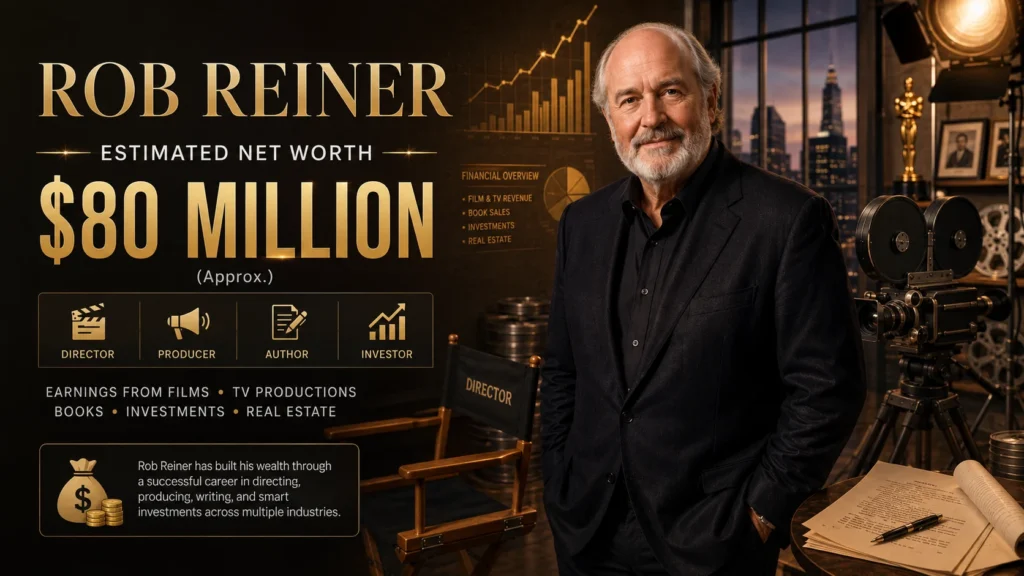
Rob Reiner’s net worth was widely estimated at about $200 million at the time of his death in December 2025. His wealth came from acting, directing, producing, Castle Rock Entertainment, long-term entertainment income and valuable California real estate. The figure remains an estimate because his private assets, liabilities and estate arrangements were not fully public.
Key Takeaways
| Financial Detail | Information |
|---|---|
| Estimated Net Worth | About $200 million at death |
| Profession | Actor, director, producer, writer |
| Nationality | American |
| Primary Wealth Sources | Film/television career, production, Castle Rock Entertainment, real estate |
| Major Known Asset | High-value Los Angeles-area residential real estate |
| Industry | Film and television entertainment |
| Years Active | 1960s–2025 |
| Current Status | Deceased; died December 14, 2025, aged 78 |
The approximately $200 million figure is the estimate most consistently reported by major secondary coverage following Reiner’s death, with Celebrity Net Worth serving as the underlying source cited by outlets including EFE and Parade. It should not be confused with a court-certified valuation of his estate.
Rob Reiner built wealth through something considerably more durable than a single acting salary: he participated in several stages of the entertainment value chain.
He became famous as an actor on All in the Family, established himself as a director with films including This Is Spinal Tap, Stand by Me, The Princess Bride, When Harry Met Sally, Misery and A Few Good Men, and then expanded into production through Castle Rock Entertainment. The Television Academy describes him as a director, producer, writer and performer and notes that Castle Rock also produced the television phenomenon Seinfeld.
That combination is important when examining Rob Reiner net worth. His financial story was not simply about what Hollywood paid him to appear in movies. It was also about ownership, production economics, intellectual property and decades of asset accumulation.
Why Readers Search This Topic
Search interest around Reiner’s finances has increased since his death because readers want to understand how a performer who became famous in television ultimately accumulated an estate estimated at roughly $200 million.
There is also a natural question about how much of that wealth came from his directing career versus Castle Rock, acting, television rights and property.
What Makes This Person Financially Significant
Reiner’s career demonstrates an important distinction in entertainment economics: income and wealth are not the same thing.
A director can receive a fee for making a film, while a producer or company owner can participate in the economics surrounding a production. Reiner’s move from performer to filmmaker and company founder therefore changed the potential scale and durability of his earnings.
His co-founding of Castle Rock Entertainment in 1987 was particularly significant. Contemporary reporting confirms that Reiner and four partners established the company with Coca-Cola’s entertainment division, while later reporting documented Castle Rock’s involvement with Seinfeld.
Biography
Rob Reiner Biography
| Field | Publicly Reported Information |
|---|---|
| Full Name | Robert Reiner |
| Known As | Rob Reiner |
| Born | March 6, 1947 |
| Birthplace | The Bronx, New York City |
| Died | December 14, 2025 |
| Age at Death | 78 |
| Nationality | American |
| Occupations | Actor, director, producer, writer |
| Education | UCLA/theater studies |
| Years Active | From the 1960s through 2025 |
| Best Known For | All in the Family, This Is Spinal Tap, Stand by Me, The Princess Bride, When Harry Met Sally, A Few Good Men |
| Production Company | Castle Rock Entertainment, co-founder |
| Father | Carl Reiner |
| Mother | Estelle Reiner |
| Estimated Wealth at Death | Approximately $200 million |
| Current Status | Deceased |
The Television Academy confirms Reiner’s March 6, 1947 birth date, Bronx birthplace and December 14, 2025 death date. It also identifies his parents as Carl Reiner and Estelle Reiner and records his work as a performer, writer, director and producer.
Early Life
Rob Reiner was born into a prominent New York entertainment family. His father, Carl Reiner, was a celebrated comedian, actor, writer and producer, while his mother, Estelle Reiner, was an actress and singer.
The family later moved to New Rochelle, New York. Reiner’s upbringing gave him unusually close exposure to television, comedy and performance, although his professional career ultimately developed into something much broader than acting.
He studied theater at UCLA and entered professional entertainment through writing and performing. The Television Academy notes that he worked as a writer on The Smothers Brothers Comedy Hour, an early step that placed him around some of the most important comedy talent of the period.
Career Beginning
Reiner’s first major breakthrough came as Michael “Meathead” Stivic on All in the Family.
The role transformed him into a nationally recognizable television actor and earned him two Emmy Awards.
The financial importance of All in the Family extends beyond its salary. It gave Reiner something increasingly valuable in entertainment: a recognizable name that could later support opportunities behind the camera.
That transition became the defining financial development of his career.
Rob Reiner Net Worth Overview
Current Estimated Net Worth
The most widely cited estimate places Rob Reiner’s net worth at approximately $200 million at the time of his death in December 2025. Celebrity Net Worth lists $200 million, while EFE, Parade and other outlets repeated that estimate after his death. Fortune also described the estate as being widely estimated at around $200 million in 2026 coverage.
That figure should be treated as an estimate, not an audited balance sheet.
Net worth figures are estimates based on publicly available information and may vary.
There are several reasons for the uncertainty:
- Private company interests may not have a publicly observable market value.
- Film and television participation agreements are generally private.
- Real estate values fluctuate.
- Personal liabilities are rarely completely disclosed.
- Estate taxes, legal expenses and administrative costs can change the eventual distributable estate.
- Intellectual-property income can continue after an individual’s death.
- Public net-worth websites use different methodologies.
The distinction is especially important in Reiner’s case because the figure now being discussed is effectively an estate estimate, rather than a conventional living-person net-worth estimate.
Major Wealth Sources
Reiner’s wealth appears to have been built through several interconnected categories.
Film and television career: His acting, directing, producing and writing career generated decades of professional income.
Production ownership: Castle Rock Entertainment represented a move from individual creative labor toward business ownership.
Film and television intellectual property: His association with successful productions created potential long-term economic value beyond original theatrical releases or production fees.
Real estate: Reiner and his family owned valuable property in Los Angeles-area markets, including a longtime Brentwood residence and a Malibu property.
Long-tail entertainment income: Older films and television productions can continue generating licensing, distribution and other revenues, although Reiner’s individual contractual participation has not been publicly disclosed in sufficient detail to calculate a reliable annual figure.
Net Worth Growth Timeline
Rob Reiner Wealth and Career Timeline
| Year | Major Career Event | Potential Financial Impact |
|---|---|---|
| 1960s | Early writing and entertainment work | Established professional career |
| 1971 | All in the Family breakthrough | Major increase in visibility and earning power |
| 1970s | Two Emmy wins | Strengthened market position as an established television performer |
| 1984 | Directed This Is Spinal Tap | Beginning of influential directing run |
| 1986 | Stand by Me | Expanded directing reputation |
| 1987 | Co-founded Castle Rock Entertainment | Added company ownership to career income |
| 1987 | The Princess Bride | Added another enduring film property to his body of work |
| 1989 | When Harry Met Sally | Major commercial and cultural success |
| 1990 | Misery | Demonstrated ability to work outside comedy |
| 1992 | A Few Good Men | Major directing/producing milestone; Best Picture Oscar nomination |
| 1993 | Castle Rock acquired by Turner Broadcasting | Potentially significant liquidity/ownership event; individual proceeds not publicly established here |
| 1990s–2000s | Continued directing, producing and acting | Diversified career income |
| 2010s | Continued film/television work and advocacy | Extended professional longevity |
| 2023 | Directed/produced Albert Brooks: Defending My Life | Demonstrated continued creative activity |
| 2025 | Continued professional involvement including Spinal Tap II | Additional late-career activity |
| Dec. 2025 | Death at age 78 | Wealth transitioned from personal net worth to estate assets |
The career timeline illustrates why assigning a single annual salary to Reiner would be misleading. His economic position developed over several decades and changed substantially as he moved from acting into directing and ownership.
The Most Important Wealth-Creation Turning Point
From a business perspective, Castle Rock was arguably more consequential than any single directing paycheck.
Contemporary Los Angeles Times reporting confirms the company was founded in 1987 by Reiner, Martin Shafer, Andrew Scheinman, Glenn Padnick and Alan Horn, with Coca-Cola’s entertainment division involved in its initial financing.
The company’s later television activities included Seinfeld, demonstrating how Reiner became connected to the economics of television production rather than merely working as hired creative talent.
Importantly, claims that Castle Rock sold for a precisely documented billion-dollar amount should be treated cautiously. The sources reviewed for this article confirm the Turner transaction but do not provide a sufficiently authoritative public record of Reiner’s personal proceeds. Therefore, it would be inappropriate to convert a reported company transaction value directly into Reiner’s personal wealth.
Income Sources
| Income Source | Estimated Contribution | Confidence Level |
|---|---|---|
| Acting | Not publicly quantifiable | High that it contributed |
| Directing | Not publicly quantifiable | High |
| Producing | Not publicly quantifiable | High |
| Castle Rock ownership | Potentially substantial, exact proceeds undisclosed | High that it contributed |
| Film/TV residual or participation income | Not publicly disclosed | Medium |
| Real estate appreciation | Potentially substantial | Medium |
| Brand partnerships | No reliable public figure identified | Low |
| Speaking engagements | No reliable public figure identified | Low |
| Passive investment income | Not publicly disclosed | Low |
A responsible net-worth analysis should distinguish known wealth sources from known dollar amounts.
The public record strongly supports the first category. It does not provide enough information to produce a defensible percentage breakdown of the $200 million estimate.
Primary Career Income
Reiner’s acting and directing career provided the foundation.
His role on All in the Family established his initial mainstream earning power, while his subsequent directing career put him in a position to work on commercially successful and culturally durable films. The Directors Guild of America records Stand by Me, When Harry Met Sally and A Few Good Men among his major directing credits and notes his membership in the DGA from 1974.
Business Ownership
Castle Rock was the most obvious transition from professional labor to ownership.
Instead of simply being paid to direct a film, Reiner became a stakeholder in a company capable of producing multiple films and television programs.
That distinction matters because business ownership can create value through several channels: operating profits, company appreciation, intellectual property and eventual sale proceeds.
Equity Holdings
Reiner’s precise ownership percentage in Castle Rock and his subsequent financial arrangements were not sufficiently disclosed in the sources reviewed to calculate his exact equity proceeds.
That uncertainty is one of the main reasons a $200 million estimate should not be reverse-engineered into a false line-by-line balance sheet.
Investments
No comprehensive, authoritative public inventory of Reiner’s stock portfolio or private investment holdings is available.
Claims circulating online about specific securities or investment values should therefore not be treated as confirmed unless supported by public filings or direct documentation.
Royalties & Licensing
Reiner’s filmography included properties with long commercial lives.
Movies such as The Princess Bride, When Harry Met Sally, Stand by Me and A Few Good Men have remained commercially relevant decades after release. The economic rights associated with such properties can generate ongoing licensing and distribution value.
However, Reiner’s personal contractual participation in those revenues was not publicly disclosed in enough detail to calculate annual royalty income.
Brand Partnerships
There is insufficient reliable public information to identify brand partnerships as a material component of Reiner’s wealth.
They should therefore not be included in a numerical net-worth calculation.
Speaking Engagements
Reiner was a public figure and activist, but there is no reliable public record establishing speaking fees as a significant component of his fortune.
Passive Income
Passive income likely existed in some form through property, intellectual property and investments, but its size is unknown.
Any website giving a precise annual passive-income figure without supporting documentation should be treated skeptically.
Business Strategy Behind the Wealth
Business Model
Reiner’s financial trajectory can be understood as a progression through four stages:
Talent → personal brand → production capability → ownership.
He first monetized his talent as a performer.
He then used that visibility to establish himself as a director.
Next, he entered production and company formation through Castle Rock.
Finally, decades of earnings could be converted into assets such as real estate and other investments.
That is a more informative model than simply saying that Reiner “made money from movies.”
Competitive Advantage
Reiner’s competitive advantage came from the combination of creative credibility, commercial range and longevity.
His filmography covered comedy, drama, thriller and political material. The Directors Guild of America highlights the range from This Is Spinal Tap and The Princess Bride to Misery and A Few Good Men.
His ability to move between genres reduced dependence on one narrow audience.
More importantly, his move into production created a degree of scalability. A director has a finite number of hours; a production company can own or participate in many projects simultaneously.
That is the central business lesson in Reiner’s wealth creation: the largest financial leverage came when his creative reputation became attached to business ownership and intellectual property rather than only personal labor.
Assets & Investments
Real Estate
Real estate was an important publicly reported component of Reiner’s wealth.
His longtime Brentwood residence became one of the best-known properties associated with his estate. People reported that the Reiners had lived in the property since 1991 and that it had previously been owned by Norman Lear; the house was originally built by Henry Fonda in 1936.
Later reporting has placed the property’s value in the multimillion-dollar range. A September 2026 report described the home as a roughly $14 million property and discussed the complications surrounding any future sale. That is a market-related estimate, not an independently established component of Reiner’s $200 million net-worth figure.
Reiner was also associated with a Malibu Colony beachfront residence. Property reporting indicates that he acquired the home in 1994 and that the approximately 2,755-square-foot property included five bedrooms and ocean-facing features.
Some secondary net-worth sources have placed the Malibu property around $15 million–$20 million, but those figures should be considered estimates rather than verified appraisal values.
Vehicles
There is no sufficiently authoritative public inventory of Rob Reiner’s vehicle collection or vehicle values.
Accordingly, vehicles should not be treated as a significant quantified component of his net worth.
Investment Portfolio
Reiner’s complete investment portfolio was private.
There is no public filing that provides a complete personal balance sheet covering stocks, bonds, private funds and other financial instruments.
Private Businesses
Castle Rock Entertainment is the most important publicly documented business connection.
Reiner co-founded the company in 1987, and its production activities eventually included major film and television properties.
Luxury Assets
Apart from real estate, reliable public evidence does not establish a complete inventory of art, collectibles, jewelry, aircraft or other luxury assets.
For that reason, such categories should not be assigned speculative dollar values.
Financial Analysis
Revenue Quality
Reiner’s wealth had an unusually diversified income structure for a filmmaker.
Acting income is generally tied to individual projects. Directing income is also project-based. Production ownership, however, can produce exposure to multiple projects and longer-lived intellectual property.
That made the Castle Rock component strategically important.
Cash Flow Stability
Entertainment cash flows can be volatile.
A successful film may generate significant revenue, but directing opportunities can fluctuate. By contrast, established film and television libraries can provide more durable economic value through licensing and distribution.
Reiner’s decades-long career meant that he accumulated exposure to both types.
Business Sustainability
The strongest sustainability feature was his intellectual-property footprint.
Films made decades earlier remained culturally recognizable and commercially exploitable. That does not mean every title generated large profits for Reiner personally; ownership and participation terms differ by project.
But the persistence of his filmography helped make his career economically durable.
Competitive Positioning
Reiner’s greatest advantage was not simply box-office performance.
It was the ability to establish a recognizable creative brand across multiple genres and then combine that reputation with production expertise.
His transition from All in the Family performer to director of major films and Castle Rock co-founder illustrates this progression clearly.
Long-Term Wealth Potential
Had Reiner remained alive, future wealth would have depended partly on continued professional income and asset appreciation.
After his death, the framework changes.
The economic question is now whether the estate’s assets appreciate, decline, generate licensing revenue, incur taxes and expenses, or are sold.
Consequently, “future Rob Reiner net worth” should really be interpreted as future estate value, not future personal earning power.
Market Risks
The main financial risks affecting an entertainment estate include:
- Real-estate market declines
- Changes in film and television distribution
- Streaming economics
- Licensing changes
- Legal expenses
- Tax obligations
- Estate administration costs
- Changes in intellectual-property valuations
- Potential asset-sale discounts
These factors can make the eventual value received by heirs materially different from a headline $200 million estimate.
Net Worth Comparison
The following comparison uses published third-party estimates and is intended only to provide context. These figures are not directly comparable because each person’s assets, ownership structures and estimation methodology differ.
| Person | Profession | Published Estimated Net Worth | Difference vs. Reiner’s $200M Estimate |
|---|---|---|---|
| Rob Reiner | Actor/Director/Producer | $200M | — |
| Martin Scorsese | Director/Producer | $200M | $0 |
| Ron Howard | Actor/Director/Producer | $200M | $0 |
| Steve Martin | Actor/Comedian/Writer | $150M | -$50M |
Celebrity Net Worth currently lists Martin Scorsese and Ron Howard at approximately $200 million and Steve Martin at approximately $150 million.
These comparisons illustrate why celebrity net-worth figures should not be treated as audited financial statements. Two people can have the same headline estimate while having radically different asset mixes.
Challenges & Financial Risks
Estate Uncertainty
The most important current uncertainty is not Reiner’s career income but the administration of his estate.
Fortune reported in June 2026 that the Reiner estate was widely estimated at around $200 million and examined disputes surrounding family trusts and inheritance.
Estate value can change as assets are appraised, debts are settled, taxes are calculated and property is sold or retained.
Real Estate Risk
The Brentwood property illustrates an unusual estate risk.
September 2026 reporting said California disclosure requirements could affect the marketability of the home following the deaths that occurred there. The report cited a real-estate adviser who was not involved in the sale and described potential challenges in marketing the property.
That does not establish a definitive loss in value, but it demonstrates why the appraised value of an asset and the price it ultimately realizes can be different.
Entertainment Industry Risk
The film industry has undergone major changes involving streaming, theatrical windows and television distribution.
For an estate containing entertainment-related assets, those structural changes can affect future licensing economics.
Legal and Administrative Costs
Estate litigation, professional fees, taxes and asset-management costs can reduce the amount eventually distributed to beneficiaries.
These costs are particularly important when a headline net-worth estimate is mistaken for the amount heirs will actually receive.
Philanthropy
Reiner’s public life extended well beyond entertainment.
The Television Academy records his involvement in early-childhood education through California’s First 5 initiative, as well as his work supporting marriage equality, voting rights and social-justice causes.
He also co-founded the American Foundation for Equal Rights in 2008. His publisher biography describes the organization as part of his broader advocacy work and notes his leadership in a California tobacco-tax initiative intended to fund early-childhood development.
From a financial-analysis perspective, philanthropy should not automatically be treated as a wealth-building strategy. Its more measurable effects are often reputational, social and institutional.
Future Net Worth Projection
What Happens to Rob Reiner’s Wealth After Death?
Rob Reiner cannot accumulate new personal income after his death, so conventional net-worth projections no longer apply.
The more useful framework is estate-value projection.
Future estate value may be influenced by:
- Appreciation or depreciation of real estate
- Film and television licensing
- Intellectual-property income
- Asset sales
- Taxes
- Legal expenses
- Estate administration costs
- Investment performance
- Distribution to beneficiaries
Potential Growth Drivers
The strongest potential growth driver is the continued economic life of Reiner’s entertainment work.
Classic films can remain commercially valuable for decades through streaming, television licensing, physical media, theatrical re-releases and other distribution channels.
Real estate could also appreciate if Los Angeles luxury-property markets remain strong.
Potential Risks
The principal downside risks are property-market weakness, estate expenses, taxes, litigation and changing economics for older entertainment libraries.
Because the underlying holdings are not completely public, assigning a precise future dollar value would create false precision.
Interesting Financial Facts
- Reiner’s career began on the opposite side of the camera from where much of his wealth was ultimately created. His breakthrough came as an actor on All in the Family, but his later career became heavily associated with directing and production.
- Castle Rock was founded in 1987. Reiner launched the company with Martin Shafer, Andrew Scheinman, Glenn Padnick and Alan Horn.
- Castle Rock’s television strategy became particularly important. Contemporary reporting noted that the company produced Seinfeld, demonstrating the company’s ability to generate value beyond Reiner’s own films.
- Reiner directed across multiple genres. His credits moved from comedy to coming-of-age drama, romance and psychological thriller, including This Is Spinal Tap, Stand by Me, When Harry Met Sally and Misery.
- His Brentwood residence had Hollywood provenance before Reiner owned it. People reported that the property had been owned by Norman Lear and was originally built by Henry Fonda.
- The $200 million figure is an estimate rather than a public audited estate statement. Celebrity Net Worth is the principal source repeatedly cited by post-death coverage.
- Reiner remained professionally active late in life. The Television Academy records posthumous recognition connected to The Bear and notes his later documentary work.
- The value of his estate cannot be inferred simply by adding the estimated value of properties to $200 million. Doing so would risk double-counting assets already incorporated into the overall net-worth estimate.
Frequently Asked Questions
What was Rob Reiner’s net worth?
Rob Reiner’s net worth was widely estimated at approximately $200 million at the time of his death in December 2025. The figure is an estimate, not a publicly audited personal balance sheet.
How did Rob Reiner make his money?
His wealth came from a decades-long entertainment career encompassing acting, directing, producing and writing, together with business ownership through Castle Rock Entertainment and valuable California real estate.
Did Rob Reiner own Castle Rock Entertainment?
Rob Reiner was one of Castle Rock Entertainment’s co-founders. The company was established in 1987 with Martin Shafer, Andrew Scheinman, Glenn Padnick and Alan Horn.
Was Rob Reiner a billionaire?
No reliable source reviewed for this article establishes Rob Reiner as a billionaire. The commonly reported estimate at his death was approximately $200 million.
What were Rob Reiner’s most financially important movies?
His most prominent directing credits included This Is Spinal Tap, Stand by Me, The Princess Bride, When Harry Met Sally, Misery and A Few Good Men. Their long cultural lives potentially contributed to the durability of his career and associated intellectual-property economics.
Did Rob Reiner own property in Los Angeles?
Yes. His longtime Brentwood residence was one of his best-known properties, and reporting has also connected him with a Malibu Colony beachfront home. Exact current values remain estimates.
Who inherits Rob Reiner’s money?
The ultimate distribution of an estate depends on wills, trusts, beneficiary designations, applicable law, taxes, debts and estate proceedings. Public reporting in 2026 has discussed disputes involving family trusts, but a complete authoritative public accounting of the final distribution was not available in the sources reviewed.
Will Rob Reiner’s net worth increase after his death?
His personal net worth cannot increase through new personal earnings, but the value of his estate can change. Real estate, investments and entertainment-related assets may appreciate or decline, while taxes, expenses and legal costs can reduce the amount ultimately distributed.
Conclusion
Rob Reiner net worth was widely estimated at about $200 million at the time of his death in 2025, but the most important story is how that wealth was created.
Reiner transformed a successful acting career into a much broader entertainment business career. He became a director of major films, a producer, a company founder and an owner of valuable assets. His Castle Rock involvement was particularly important because it connected his career to the economics of television and film production rather than relying solely on individual performance fees.
His California real estate holdings added another long-term store of value, while his extensive filmography created an intellectual-property legacy capable of retaining economic relevance after his death.
The $200 million figure should therefore be viewed as a best-publicly-supported headline estimate, not a precise accounting of every asset and liability.
The future financial story belongs to the estate: property valuations, entertainment revenues, taxes, legal costs, investment performance and eventual distributions will determine how much of that headline figure remains and how the assets are ultimately transferred.