Last Updated on September 30, 2026
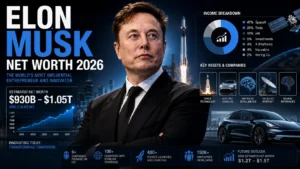
Elon Musk’s latest major-index net worth estimate is about $942 billion, with most of his wealth tied to SpaceX and Tesla equity. Estimates vary with share prices, ownership calculations, options and private-company valuations. Net worth figures are estimates based on publicly available information and may vary.
Key Takeaways
| Metric | Latest publicly supported information |
| Estimated Net Worth | About $942 billion on Bloomberg’s September 20, 2026 snapshot; Forbes showed $886.4 billion on September 16 |
| Profession | Entrepreneur, engineer, technology executive |
| Nationality | American; born in South Africa |
| Primary Income/Wealth Source | Equity ownership in SpaceX and Tesla |
| Biggest Asset | SpaceX equity |
| Industry | Technology, aerospace, automotive, artificial intelligence, satellite communications |
| Years Active | 1990s–present |
| Current Status | Alive; CEO of Tesla and SpaceX |
Bloomberg’s September 20 index listed Musk at $942 billion, while Forbes’ September 16 real-time figure was $886.4 billion. Those figures should not be treated as contradictory accounting statements: billionaire indexes update at different times and use different assumptions about assets, options, liabilities and private-company interests.
Introduction
Why Readers Search This Topic
The search for Elon Musk net worth is really a question about how entrepreneurial equity can become an enormous personal fortune. Musk’s wealth is not primarily a conventional salary story. It is the market value of stakes and options connected to companies he helped build, particularly SpaceX and Tesla.
The difference matters. A billionaire’s net worth can rise by tens of billions without the person receiving anything close to that amount in cash.
What Makes This Person Financially Significant
Musk’s financial story spans internet payments, electric vehicles, rockets, satellite communications, artificial intelligence and social media. His early exits from Zip2 and PayPal supplied capital for later ventures, while Tesla and SpaceX transformed that capital into much larger equity positions.
Tesla’s SEC filings show that Musk has historically received little or no conventional cash salary and that his compensation has been overwhelmingly linked to equity incentives. SpaceX’s 2026 public listing made another major portion of his wealth easier to value using public-market prices.
Biography
| Field | Publicly documented information |
| Full Name | Elon Reeve Musk |
| Known As | Elon Musk |
| Date of Birth | June 28, 1971 |
| Age in 2026 | 55 |
| Birthplace | Pretoria, South Africa |
| Nationality | United States |
| Occupation | Entrepreneur, CEO, technology executive |
| Industry | Technology and advanced engineering |
| Education | University of Pennsylvania — physics and business |
| Years Active | 1990s–present |
| Known For | Tesla, SpaceX, PayPal, X, xAI and other technology ventures |
| Current Estimated Net Worth | Approximately $886 billion–$942 billion, depending on source date and methodology |
| Current Status | Alive; CEO of Tesla and SpaceX |
Tesla’s investor-relations biography identifies Musk as Tesla’s CEO since 2008 and notes his leadership roles at SpaceX, as well as his earlier co-founding of Zip2 and PayPal. It also identifies his University of Pennsylvania degrees in physics and business.
Early Life
Musk was born in Pretoria, South Africa, in 1971. His early interest in computing became an important foundation for his later career. Tesla’s own published biography has described his early programming interests, while public biographies document his move through Canada and eventually to the United States.
He studied at the University of Pennsylvania, earning degrees associated with physics and business. His career subsequently moved toward software and internet businesses rather than a conventional engineering or corporate path.
Career Beginning
Musk’s first major entrepreneurial chapter began with Zip2, an internet software company founded in the 1990s with his brother Kimbal Musk and Greg Kouri. Compaq acquired Zip2 in 1999 for more than $300 million in cash and stock options, according to contemporary company history.
He subsequently co-founded X.com, an online financial-services company that became part of PayPal. eBay acquired PayPal in 2002. Tesla’s historical biography records Musk as PayPal’s largest shareholder at the time of the eBay transaction.
That sequence is central to understanding Musk’s wealth: early liquidity was repeatedly redeployed into higher-risk ventures rather than consumed as personal wealth.
Elon Musk Net Worth Overview
Current Estimated Net Worth
The most recent major billionaire-index figure available for this article is $942 billion, from Bloomberg’s September 20, 2026 index. Bloomberg identified SpaceX as Musk’s largest asset and said his fortune was primarily derived from SpaceX and Tesla.
Forbes, using a different date and methodology, reported $886.4 billion on September 16, 2026. Forbes also reported that SpaceX’s June IPO had pushed Musk’s fortune above the trillion-dollar threshold at one point before subsequent market movements reduced the figure.
Accordingly, a responsible publication should describe Musk’s current net worth as roughly $0.9 trillion rather than pretending there is one permanently correct number.
Net worth figures are estimates based on publicly available information and may vary.
The primary reasons include:
- Tesla’s constantly changing share price.
- SpaceX’s public-market valuation after its 2026 IPO.
- Different treatment of Musk’s options and restricted shares.
- Different assumptions about liabilities and pledged shares.
- Valuation methodology for private or restricted interests.
- Different market-close timestamps.
- Whether unvested performance awards are included.
Major Wealth Sources
Musk’s wealth is overwhelmingly an equity-ownership story, not a salary story.
SpaceX is now the dominant disclosed source. Reuters reported that Musk disclosed a 48.4% SpaceX stake as of June 30, 2026, worth more than $900 billion at the market prices cited in August.
Tesla remains another major source. A June 2026 SEC filing reported 699.58 million Tesla shares beneficially owned, equivalent to 19.9% under the filing’s specified calculation, including restricted shares issued under the implementation agreement. Bloomberg’s methodology separately described Musk as owning about 11% of Tesla when excluding certain restricted shares.
This illustrates why simple multiplication of a headline ownership percentage by a stock price can produce a misleading net-worth figure.
Net Worth Growth Timeline
| Year | Major Career Event | Estimated Financial Impact |
| 1999 | Zip2 acquired by Compaq | Created Musk’s first major entrepreneurial liquidity event |
| 2002 | PayPal acquired by eBay | Provided capital for later Tesla and SpaceX investments |
| 2002 | SpaceX founded | Established the business that would eventually become his largest asset |
| 2004 | Musk invested heavily in Tesla | Increased exposure to an early-stage electric-vehicle company |
| 2008 | Tesla and SpaceX faced major financing and execution pressure | Wealth was concentrated in highly risky ventures |
| 2010 | Tesla IPO | Created a public market for a major portion of Musk’s Tesla equity |
| 2012 | Musk first appeared on Forbes’ billionaire list at about $2 billion | Tesla’s rising valuation began turning founder equity into substantial wealth |
| 2020–21 | Tesla’s market capitalization surged | Musk’s fortune increased dramatically with Tesla shares |
| 2021 | Forbes estimated Musk’s fortune at more than $270 billion at one October 2021 point | Demonstrated the sensitivity of his wealth to Tesla’s share price |
| 2022 | Forbes 400 estimated Musk at $251 billion | Tesla and SpaceX remained the principal wealth engines |
| 2025 | New Tesla performance award granted | Created potential future equity value tied to ambitious milestones |
| 2026 | SpaceX acquired xAI and subsequently went public | Made a much larger portion of Musk’s private-company wealth observable through public markets |
Historical estimates vary by date. Forbes reported Musk at $271.3 billion in October 2021 and $251 billion on its September 2022 Forbes 400 measurement. Forbes’ historical reporting also shows that he first entered its billionaire list in 2012 with approximately $2 billion.
What the Timeline Shows
The important financial pattern is not simply that Musk’s wealth increased.
It is that his wealth increasingly became leveraged to enterprise value.
A rise in Tesla’s or SpaceX’s valuation can increase Musk’s net worth enormously without generating an equivalent amount of personal cash. Conversely, a decline in the underlying securities can erase tens or hundreds of billions of paper wealth quickly.
That distinction explains why Musk’s net worth can move much faster than his personal income.
Income Sources
| Income Source | Estimated Contribution | Confidence Level |
| SpaceX equity appreciation | Dominant wealth driver | High |
| Tesla equity appreciation | Major wealth driver | High |
| Tesla equity compensation | Potentially substantial, subject to vesting and conditions | High |
| Early technology-company exits | Important source of initial capital | High |
| Private-company interests | Material but difficult to value independently | Medium |
| Investment portfolio | Not comprehensively disclosed | Low |
| Royalties/licensing | No reliable evidence of being a major wealth source | Low |
| Brand partnerships | Not a significant disclosed source of wealth | Low |
| Speaking engagements | No reliable public estimate of material contribution | Low |
| Passive income | Not publicly disclosed in sufficient detail | Low |
Primary Career Income
Musk is unusual among corporate executives because conventional salary is not the central mechanism through which he accumulated wealth.
Tesla reported that Musk’s base salary was eliminated altogether in May 2019 at his request. Tesla’s 2025 filing says he had historically earned a minimum-wage-level salary but never accepted it.
Business Ownership
The major wealth mechanism is ownership.
Musk owns substantial stakes in businesses whose value is determined by investors and capital markets. That means his wealth is primarily the economic value of ownership, rather than annual wages.
Equity Holdings
Tesla’s 2026 SEC disclosure reported 699,580,882 shares beneficially owned under its specified methodology, or 19.9% of the relevant share base. The filing also explains that certain performance-based shares were excluded from beneficial ownership calculations because Musk did not have dispositive or voting control over them.
Tesla also disclosed that all 12 tranches of Musk’s 2018 CEO Performance Award had vested and become exercisable following the resolution of the related Delaware litigation, although the resulting shares remain subject to service-related conditions under the implementation agreement.
Investments
Musk has historically invested personal capital into companies he considered strategically important, particularly Tesla and SpaceX.
The investment pattern is notable because he repeatedly converted proceeds from one technology venture into exposure to another. The Zip2 and PayPal exits helped finance later ambitions in aerospace and electric vehicles.
Royalties & Licensing
There is no reliable public evidence that royalties or conventional licensing income represents a major component of Musk’s current wealth.
Brand Partnerships
Musk’s public profile is commercially significant, but there is insufficient reliable evidence to treat brand partnerships as a major component of his personal net worth.
Speaking Engagements
No sufficiently reliable public dataset supports a material estimate for speaking income. It should therefore not be inserted into a net-worth calculation.
Passive Income
Musk’s passive income from dividends, interest and other investments is not publicly disclosed in enough detail to produce a defensible estimate.
Business Strategy Behind the Wealth
Business Model
Musk’s wealth-building strategy can be understood as a sequence of concentrated bets on capital-intensive technologies.
The pattern was:
Internet software → payments → electric vehicles → space infrastructure → satellite connectivity → AI and digital platforms.
Each stage supplied either capital, technical experience, strategic relationships or credibility for the next.
SpaceX’s 2026 prospectus describes the combined company as operating across space, connectivity and AI after its acquisition of xAI. The business now includes rockets, Starlink, X and AI capabilities under a broader corporate structure.
Competitive Advantage
The financial advantage of Musk’s model is not simply “being first.”
It is vertical integration plus founder-controlled capital allocation.
SpaceX combines rocket manufacturing, launch operations and satellite connectivity. Following the xAI transaction, the company also gained AI infrastructure and software capabilities. SpaceX’s regulatory materials describe Starlink as serving approximately 10.3 million customers across 164 countries and territories as of March 31, 2026.
Tesla similarly combines vehicle manufacturing with energy storage, software and charging infrastructure.
The strategic benefit is potential scalability: once expensive infrastructure is built, additional customers can potentially be served at lower incremental cost.
The risk is equally important. Vertical integration requires enormous capital expenditure and increases exposure to execution risk across several industries simultaneously.
Assets & Investments
Real Estate
Musk has historically owned a significant collection of California properties, but he subsequently sold much of his real-estate portfolio.
Public reporting has documented his move toward comparatively modest housing arrangements in Texas and elsewhere. His current real-estate holdings are not comprehensively disclosed, so assigning a precise dollar value to his residential property portfolio would be speculative.
Vehicles
Musk is closely associated with Tesla vehicles, but there is no authoritative public inventory of his current personal vehicle collection that can support a precise valuation.
A net-worth article should therefore avoid repeating internet estimates of a “car collection” as though they were audited assets.
Investment Portfolio
The most important identifiable investments are the businesses in which Musk has meaningful ownership interests.
These include Tesla, SpaceX and interests associated with Neuralink and The Boring Company. Tesla’s official biography identifies Musk as a founder of The Boring Company and Neuralink.
Private Businesses
Private-company interests are particularly difficult to value because there is no continuous public stock price.
Before SpaceX became public, this was a major reason billionaire indexes could disagree substantially about Musk’s net worth. The 2026 SpaceX IPO reduced that uncertainty by establishing a public market valuation, although the stock remains subject to normal market volatility.
Luxury Assets
No reliable public disclosure supports assigning a large separate value to yachts, jewelry, aircraft or other luxury assets in Musk’s current net worth.
The safest methodology is to focus on identifiable equity and publicly supported assets rather than internet estimates of luxury possessions.
Financial Analysis
Revenue Quality
Tesla generated $94.83 billion in 2025 revenue, including $65.82 billion from automotive sales, $12.77 billion from energy generation and storage, and $12.53 billion from services and other activities. Tesla’s 2025 net income attributable to common shareholders was $3.79 billion.
The numbers show an important distinction: Tesla is a large operating company, but revenue alone does not determine Musk’s wealth. The market’s valuation of Tesla’s future growth prospects has historically been much more consequential to Musk’s net worth than his annual salary.
Cash Flow Stability
Tesla’s business has a much more established operating history than many of Musk’s newer ventures.
SpaceX, meanwhile, has developed recurring economics around launches and Starlink. Its 2026 prospectus positions Starlink as a large connectivity operation while describing AI as a newly developed segment following the xAI acquisition.
That diversification could make Musk’s wealth less dependent on any single technology over the long run, but it also creates more complicated valuation questions.
Business Sustainability
The sustainability question is increasingly about whether Musk can convert ambitious technologies into durable cash-generating businesses.
Tesla has demonstrated commercial scale.
SpaceX has demonstrated launch and satellite-network scale.
AI remains a more rapidly evolving and capital-intensive opportunity.
SpaceX’s regulatory disclosures explicitly warn that its AI segment is newly formed and exposed to execution, competitive and operational risks.
Competitive Positioning
SpaceX has a strong position in commercial launch and satellite connectivity, while Tesla remains a major electric-vehicle and energy-storage company.
The key financial question is whether these businesses can continue converting technological scale into high returns on capital.
That is more important to Musk’s future wealth than whether he receives a traditional executive paycheck.
Long-Term Wealth Potential
Musk’s wealth has unusually high sensitivity to asset prices.
Using the reported 48.4% SpaceX ownership figure as a simplified illustration, a 10% change in a $1.77 trillion SpaceX valuation would imply roughly an $85.7 billion change in the gross value of that stake before considering dilution, options, taxes, liabilities and other adjustments. This is an illustration, not a prediction of Musk’s net worth. Reuters reported the 48.4% stake, while SpaceX’s IPO was priced at a $1.77 trillion valuation.
That sensitivity explains both the speed of Musk’s wealth creation and the speed at which it can reverse.
Net Worth Comparison
The table below uses Bloomberg’s September 20, 2026 snapshot rather than mixing dates from different billionaire rankings.
| Person | Profession | Estimated Net Worth | Difference vs. Musk |
| Elon Musk | Technology entrepreneur | $942B | — |
| Larry Page | Google co-founder | $298B | $644B |
| Jeff Bezos | Amazon founder | $279B | $663B |
| Sergey Brin | Google co-founder | $277B | $665B |
| Michael Dell | Technology entrepreneur | $262B | $680B |
| Mark Zuckerberg | Meta co-founder | $236B | $706B |
These figures illustrate the extraordinary concentration of Musk’s wealth in his major company stakes. They should be read as snapshots, not permanent rankings: stock prices, exchange rates, private-company valuations and billionaire-index methodologies can change the numbers quickly.
Challenges & Financial Risks
Tesla Stock Volatility
Tesla represents a significant portion of Musk’s identifiable wealth, so major changes in Tesla’s market value can materially affect his net worth.
SpaceX Valuation Risk
The SpaceX IPO created a public market for a major component of Musk’s fortune, but it also means that market sentiment can now change the value of that stake continuously.
AI Investment Risk
SpaceX’s acquisition of xAI creates a potentially powerful combination of infrastructure, connectivity and AI.
It also adds capital requirements and execution risk.
SEC-filed SpaceX materials say the AI division lost $6.4 billion in 2025 while generating $3.2 billion of revenue, highlighting the capital intensity of the business.
Industry Competition
Tesla faces competition across electric vehicles, batteries and autonomous-driving technology.
SpaceX faces competition in launch, satellite communications and emerging space infrastructure.
AI competition is even more intense, with major technology companies and specialist AI laboratories investing billions in computing infrastructure and model development.
Legal and Regulatory Exposure
Musk’s companies operate in heavily regulated industries, including transportation, telecommunications, aerospace and artificial intelligence.
Tesla’s compensation history has also involved extensive shareholder and Delaware litigation. The Delaware Supreme Court ultimately reversed the earlier rescission of Musk’s 2018 performance award in December 2025, and Tesla’s 2026 filing describes the subsequent implementation process.
Philanthropy
Musk’s philanthropy has included large transfers of Tesla shares to charitable organizations.
Reuters reported that Musk donated approximately 268,000 Tesla shares worth about $108.2 million to unnamed charities near the end of 2024. Reuters also reported earlier donations of approximately $1.95 billion in Tesla shares in 2022 and $5.74 billion in 2021 to the Musk Foundation.
His philanthropic activity has focused on areas including artificial intelligence, education, scientific research and other causes.
From a financial perspective, stock donations are important because they can represent significant transfers of wealth without requiring the donor to sell shares first.
Philanthropy can also affect public perception and the broader reputation of a founder-led company, although charitable giving should not automatically be treated as a business investment or financial return.
Future Net Worth Projection
Growth Drivers
The largest potential drivers of Musk’s future wealth are:
- SpaceX’s long-term market valuation.
- Starlink subscriber and revenue growth.
- Tesla’s vehicle, energy and software businesses.
- Autonomous-driving and robotics development.
- AI infrastructure and model commercialization.
- Potential expansion of space-based computing.
- The performance of Musk’s other private-company interests.
SpaceX’s current corporate structure gives Musk exposure to several of these themes simultaneously. The company’s regulatory materials describe operations spanning rockets, Starlink, X and AI following the xAI acquisition.
Potential Risks
The principal risks are equally broad:
- Tesla valuation compression.
- Lower-than-expected vehicle or energy growth.
- SpaceX execution problems.
- Starlink capital requirements.
- AI losses and heavy infrastructure spending.
- Regulatory restrictions.
- Competition.
- Dilution from future equity issuance.
- Musk’s concentrated ownership exposure.
Long-Term Outlook
There is no defensible single dollar projection for Musk’s future net worth using currently public information.
A range would depend overwhelmingly on future valuations of SpaceX and Tesla. Because these assets represent such a large share of his fortune, even modest percentage changes in their market values can translate into tens of billions of dollars of personal wealth movement.
The most useful way to think about Musk’s future net worth is therefore as a valuation sensitivity problem, not a salary-growth forecast.
Interesting Financial Facts
- Musk’s conventional Tesla salary is effectively zero. Tesla says it eliminated his base-salary accrual in May 2019 at his request.
- His first Forbes billionaire-list appearance was in 2012 at about $2 billion.
- SpaceX became a public company in 2026. Reuters reported that its IPO raised $75 billion at $135 per share, valuing the company at about $1.77 trillion at pricing.
- Musk’s SpaceX stake is unusually large. Reuters reported a 48.4% stake as of June 30, 2026.
- Tesla’s 2025 CEO performance award contains 423.7 million restricted shares. Those shares are subject to multiple performance, market-capitalization and service conditions rather than being equivalent to immediately spendable wealth.
- Tesla generated $94.83 billion of revenue in 2025. Automotive sales accounted for $65.82 billion, while energy generation and storage contributed $12.77 billion.
- SpaceX acquired xAI in February 2026. The transaction combined Musk’s aerospace, satellite, AI and social-media interests under a larger corporate structure.
- A large net worth does not mean an equivalent amount of cash. Musk’s fortune is predominantly tied to company equity, so its value can change dramatically without a corresponding personal cash transaction.
Frequently Asked Questions
What is Elon Musk’s net worth in 2026?
The latest Bloomberg snapshot available for September 2026 puts Elon Musk’s net worth at about $942 billion. Forbes reported $886.4 billion several days earlier, illustrating how rapidly the estimate can change.
How did Elon Musk become so rich?
Musk built his fortune primarily through ownership of companies he founded or helped build. Early proceeds from Zip2 and PayPal supplied capital for later investments, while Tesla and SpaceX eventually became the dominant sources of his wealth.
Does Elon Musk receive a salary from Tesla?
Tesla reported that Musk’s base-salary accrual was eliminated in May 2019 at his request. His compensation is instead heavily linked to performance-based equity awards.
What is Elon Musk’s biggest asset?
SpaceX is currently his biggest identifiable asset. Bloomberg identifies SpaceX as the largest component of his fortune, while Reuters reported that Musk owned 48.4% of SpaceX as of June 30, 2026.
How much Tesla stock does Elon Musk own?
A June 2026 SEC filing reported 699,580,882 Tesla shares beneficially owned under the filing’s specified calculation, representing 19.9% of the relevant share base. Other estimates use different treatments of restricted shares and options.
Did Elon Musk become a trillionaire?
Forbes reported that Musk became the world’s first trillionaire on June 12, 2026, following SpaceX’s public-market debut. His wealth subsequently moved below that level as market values changed.
Is Elon Musk’s net worth mostly cash?
No. His wealth is predominantly connected to equity stakes and options in businesses such as SpaceX and Tesla. Net worth therefore should not be confused with cash available in a bank account.
Why do Forbes and Bloomberg give different Elon Musk net worth figures?
They use different calculation dates, market prices and methodologies for valuing securities, options, restricted interests and liabilities. For example, Forbes reported $886.4 billion on September 16, while Bloomberg reported $942 billion on September 20.
Conclusion
Elon Musk net worth is best understood as the market value of an unusually concentrated portfolio of entrepreneurial equity rather than as accumulated salary or cash savings.
His financial journey began with software and payments, but the decisive wealth creation came from Tesla and SpaceX. The 2026 SpaceX IPO changed the transparency of that fortune by putting a major part of Musk’s largest asset into public markets. The acquisition of xAI also broadened his exposure to artificial intelligence, social media, satellite connectivity and space infrastructure.
The latest major-index estimates place his wealth around $0.9 trillion, but the precise figure will continue moving with Tesla and SpaceX valuations.
The balanced long-term view is therefore straightforward: Musk’s wealth has substantial potential to increase if his companies create additional enterprise value, but the same concentration that produced extraordinary gains also makes his fortune unusually sensitive to market declines, execution problems, regulation and competition.
Net worth figures are estimates based on publicly available information and may vary.