
Last Updated on September 29, 2026
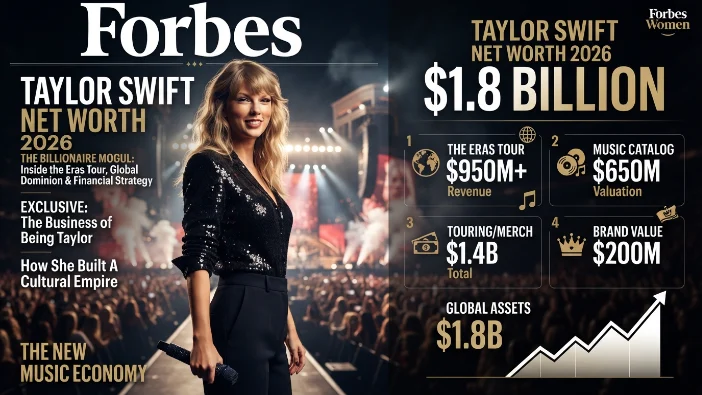
Taylor Swift has an estimated $2 billion net worth in 2026, according to Forbes. Her wealth is primarily tied to music royalties and touring, her music catalog, and real estate. Estimates vary because private assets, liabilities, taxes and catalog valuations are not publicly disclosed.
Disclaimer: Net worth figures are estimates based on publicly available information and may vary.
Key Takeaways
| Category | Latest publicly available information |
| Estimated Net Worth | $2 billion |
| Profession | Singer-songwriter, producer, performer |
| Nationality | American |
| Primary Income Source | Music royalties, touring and catalog ownership |
| Biggest Asset Category | Music rights and accumulated music/touring wealth |
| Industry | Music & entertainment |
| Years Active | 2006–present |
| Current Status | Active recording artist and business operator |
Forbes’ 2026 valuation puts Swift at approximately $2 billion. A June 2026 Forbes report broke that estimate into roughly $1 billion from royalties and touring, $900 million for her music catalog and $100 million in real estate. These are valuation estimates rather than audited personal financial statements.
Introduction
Why Readers Search This Topic
Searches for Taylor Swift net worth are no longer simply celebrity-gossip queries. Swift has become an unusually useful case study in how intellectual property, touring economics, ownership rights, merchandising, licensing and personal branding can compound into billionaire-level wealth.
The important question is therefore not just how much Taylor Swift is worth, but how the underlying economic machine produces that wealth.
What Makes This Person Financially Significant
Swift’s financial story differs from that of many celebrity billionaires because her fortune has been built overwhelmingly around entertainment assets she created or controls rather than a technology company, inherited industrial business or diversified corporate empire.
Forbes says Swift became a billionaire in 2023 based on the value of her music and performances, making her an unusual example of a creator reaching billionaire status principally through music-related assets.
Her Eras Tour subsequently generated an estimated $2.2 billion in ticket gross, according to Pollstar, across 149 shows and more than 10 million tickets. Importantly, that $2.2 billion is tour revenue, not Swift’s personal profit.
Biography
| Field | Publicly confirmed information |
| Full Name | Taylor Alison Swift |
| Known As | Taylor Swift |
| Date of Birth | December 13, 1989 |
| Age in 2026 | 36 |
| Birthplace | Reading, Pennsylvania, U.S. |
| Nationality | American |
| Occupation | Singer-songwriter, performer, producer |
| Industry | Music & entertainment |
| Education | High school education; pursued music professionally as a teenager |
| Years Active | 2006–present |
| Known For | Songwriting, albums, touring, music ownership and re-recordings |
| Grammy Awards | 14 wins |
| Estimated Net Worth | Approximately $2 billion in 2026 |
| Current Status | Active |
The Recording Academy confirms that Swift was born in Reading, Pennsylvania, on December 13, 1989. It also lists 14 Grammy wins from 58 nominations, including four Album of the Year victories—the most for any artist.
Early Life
Swift grew up in Pennsylvania and developed an interest in songwriting and performing while still young. Her ambition increasingly centered on country music, leading her to Nashville as a teenager.
Her early career was notable because songwriting was not simply a performance skill for her—it became a core economic asset. The Recording Academy notes that Swift wrote or co-wrote every song on her debut album, released in 2006 when she was 16.
That distinction became financially important later. An artist who writes songs can potentially participate in several layers of music economics, including songwriting and publishing royalties, rather than relying exclusively on performance fees.
Career Beginning
Swift signed with Big Machine Records and released her self-titled debut album in 2006.
Her early commercial breakthrough accelerated with Fearless, followed by increasingly successful releases including Speak Now, Red, 1989, Reputation, Lover, Folklore, Evermore, Midnights and The Tortured Poets Department.
The business significance of this progression is cumulative: each successful album can continue generating royalties, licensing opportunities and catalog value long after its initial release.
Taylor Swift Net Worth in 2026
Current Estimated Net Worth
The most useful current benchmark is approximately $2 billion, based on Forbes’ 2026 estimate. Forbes reported in June 2026 that Swift’s estimated fortune consisted of approximately:
- $1 billion from royalties and touring
- $900 million attributed to her music catalog
- $100 million in real estate
This should not be interpreted as a balance sheet published by Swift or her accountants.
Net worth figures are estimates based on publicly available information and may vary.
Different publications can arrive at different numbers because they make different assumptions about:
- Music-catalog valuation
- Future royalty income
- Real-estate values
- Cash and investments
- Taxes
- Business expenses
- Debt and liabilities
- Private-company interests
- The value assigned to intellectual property
For example, Celebrity Net Worth listed Swift at $1.8 billion in July 2026, while Forbes’ more recent reporting placed the figure at $2 billion.
Major Wealth Sources
Swift’s wealth can broadly be understood through six interconnected engines:
- Music royalties and publishing
- Music catalog ownership
- Concert touring
- Merchandising and licensing
- Film and audiovisual projects
- Real estate and accumulated investments
The critical distinction is that gross revenue is not the same as personal wealth. A $2.2 billion tour gross, for example, must support promoters, venues, production, transportation, staff, taxes and other costs before the artist’s retained earnings are calculated.
Net Worth Growth Timeline
| Year | Major Career Event | Estimated Financial Impact |
| 2006 | Debut album released | Established songwriting, recording and royalty assets |
| 2010 | Fearless wins Album of the Year | Major expansion of catalog value and commercial reach |
| 2014 | 1989 era begins | Major transition into global pop and higher commercial scale |
| 2016 | Forbes reported $170M annual earnings | One of the strongest earning years of her career |
| 2019 | New Universal/Republic arrangement; masters dispute intensifies | Future recordings structured around greater ownership |
| 2021 | Folklore and Evermore era | Continued catalog and streaming monetization |
| 2023 | Eras Tour begins; billionaire milestone | Forbes estimated $1.1B net worth by year-end |
| 2024 | Eras Tour concludes | Tour estimated at roughly $2.2B gross |
| 2025 | Regains first six album masters; major new projects | Greater control over lifetime music IP |
| 2026 | Forbes estimate reaches approximately $2B | Catalog, royalties, touring and real estate underpin valuation |
Forbes estimated Swift at $1.1 billion in December 2023, including $500 million for her music catalog, $500 million from royalties and touring, and $150 million in real estate.
By 2026, Forbes was using a roughly $2 billion valuation.
What Changed Financially?
The most important shift was not simply higher concert revenue.
It was ownership.
Swift’s financial model increasingly moved from:
create → license → perform → receive income
toward:
create → own → license → perform → monetize → retain long-term intellectual-property value
That difference can materially affect lifetime wealth.
Income Sources
| Income Source | Estimated Contribution | Confidence Level |
| Music royalties | Major component; exact annual amount undisclosed | High |
| Touring | Major historical contributor | High |
| Music catalog | Estimated ~$900M valuation in Forbes’ 2026 breakdown | High |
| Real estate | Approximately $100M in Forbes’ 2026 breakdown | High |
| Film/streaming projects | Material but not separately disclosed | Medium |
| Merchandise/licensing | Material, exact contribution undisclosed | Medium |
| Brand partnerships | Historically significant, current amount undisclosed | Medium |
| Speaking engagements | No reliable public recurring figure | Low |
Primary Career Income
Music remains the economic foundation.
Swift earns through several layers of the music ecosystem rather than from a single salary. Recording, songwriting, publishing, streaming, licensing, physical sales and performance can all contribute to the overall economic value of her work.
Forbes estimated that Swift earned $202 million in 2025, making her the second-highest-paid musician that year.
Business Ownership
Swift’s business interests are closely intertwined with her music career.
Rather than separating “artist” and “business owner” into completely different activities, her model uses companies and contractual structures to manage touring, production, merchandise, intellectual property and related commercial activities.
The resulting advantage is greater control over how her work is monetized.
Equity Holdings
There is no comprehensive public disclosure of Swift’s personal stock portfolio.
Accordingly, claims assigning precise values to individual publicly traded holdings should not be treated as established fact without documentary evidence.
Investments
Real estate is the clearest publicly documented non-music asset category.
Beyond property, Swift’s private investment portfolio has not been disclosed in sufficient detail to construct a reliable public asset-by-asset valuation.
Royalties & Licensing
Royalties are particularly important because successful music can continue generating cash flow years after release.
Swift’s songwriting catalog provides an additional layer of economics, while ownership of master recordings provides control over the recorded versions themselves.
Her 2025 acquisition of the first six albums’ masters significantly strengthened that position. Swift said publicly that she had regained ownership of her music, videos, concert films, album art, photography and unreleased songs associated with her earlier work.
Brand Partnerships
Swift has historically worked with major brands and commercial partners, although current contract economics are generally private.
The financial significance of these relationships is less about a single endorsement fee and more about the ability to extend a music audience into merchandise, advertising, licensing and consumer products.
Speaking Engagements
There is no reliable public evidence supporting a recurring, material speaking-fee contribution to Swift’s fortune.
It should therefore not be treated as a meaningful standalone wealth source.
Passive Income
Royalties and intellectual-property licensing can function as relatively passive income compared with touring.
This is one reason catalog ownership is so important: an owned music asset can potentially generate revenue without requiring the owner to perform a concert every night.
Business Strategy Behind the Wealth
Business Model
Swift’s economic model can be described as a vertically integrated creator-IP business.
She creates intellectual property, builds an audience around it, distributes that IP through multiple channels and increasingly retains ownership over the underlying assets.
The channels include:
- Recorded music
- Publishing
- Streaming
- Touring
- Merchandise
- Film
- Licensing
- Physical products
- Fan experiences
The model resembles a media company more than a conventional salaried performer.
Competitive Advantage
Swift’s strongest financial advantage is the combination of creative ownership and unusually strong demand.
The Eras Tour demonstrates the scalability of that model. Pollstar estimated $2.2 billion in gross ticket sales from 149 performances and 10.055 million tickets.
The other advantage is catalog longevity.
A touring business is inherently episodic. A music catalog, by contrast, can continue generating economic value over decades.
That creates a two-layer wealth model:
Active income: touring, new releases, merchandise and projects.
Long-duration assets: masters, publishing rights, recordings and catalog-related intellectual property.
The re-recording strategy added another unusual dimension. By releasing “Taylor’s Version” albums, Swift created commercially competitive alternatives to earlier recordings while building new recordings that she controlled.
Forbes’ analysis noted that her re-recorded albums all debuted at No. 1 on the Billboard 200.
Assets & Investments
Real Estate
Real estate is one of the better-documented components of Swift’s wealth.
Forbes estimated her real-estate holdings at roughly $100 million in its 2026 $2 billion valuation.
Earlier Forbes reporting put her real-estate investments at more than $150 million, illustrating an important point: property valuations and the composition of a celebrity’s portfolio can change over time.
Publicly reported properties have included homes in New York, California, Rhode Island and Tennessee.
Vehicles
Swift’s personal vehicle collection is not a sufficiently transparent asset class to assign a reliable net-worth figure.
Claims circulating online about the value of celebrity vehicle collections frequently mix reported purchases, old estimates and speculation.
Investment Portfolio
Swift’s broader securities portfolio is not publicly disclosed in a manner that permits a reliable valuation.
It would therefore be inappropriate to manufacture a list of stocks or investment balances.
Private Businesses
Swift operates through business entities associated with her career and commercial activities, but detailed private-company financial statements are generally unavailable.
The economic value of those businesses is consequently difficult to isolate from the broader value of her entertainment operation.
Luxury Assets
Swift owns luxury personal assets, but they are not believed to be the principal drivers of her billionaire valuation.
Her fortune is fundamentally an intellectual-property and entertainment business fortune, rather than a luxury-goods collection.
Financial Analysis
Revenue Quality
Swift’s wealth has an unusual combination of high-margin intellectual property and high-revenue live entertainment.
Touring can produce enormous gross revenue but also carries substantial operating costs.
Music rights are different.
Once a recording has been created, additional streams, downloads, licenses or other uses can generate incremental revenue without recreating the original production cost.
That makes a mature catalog economically attractive.
Cash Flow Stability
Touring revenue is cyclical.
Catalog royalties are comparatively durable.
This distinction matters because a billionaire valuation based partly on intellectual property can remain resilient even when the artist is between tours.
Swift’s ownership of an increasingly large portion of her music therefore potentially makes the underlying wealth less dependent on constant touring activity.
Business Sustainability
The strongest sustainability factor is catalog depth.
Swift has accumulated a large body of commercially successful work over roughly two decades. The Recording Academy describes her career as spanning country, pop, folk and alternative music and records 14 Grammy wins through the 2026 awards.
This creates multiple monetization windows for older material.
Competitive Positioning
Swift’s competitive position is unusual because the product is simultaneously:
- Music
- Intellectual property
- Live entertainment
- Personal brand
- Fan community
- Merchandise
- Cultural event
The Eras Tour effectively converted a back catalog into a new commercial product.
Instead of marketing only the newest album, Swift monetized multiple eras of her career simultaneously.
Long-Term Wealth Potential
The most significant long-term asset is likely the ownership of intellectual property, not any single concert tour.
If her catalog continues generating royalties and licensing income for decades, the economic life of those assets can substantially exceed the active touring life of the artist.
Market Risks
The major risks include:
- Changes in music-consumption behavior
- Streaming economics
- Shifts in consumer spending
- Touring costs
- Concentration in entertainment-related assets
- Catalog valuation assumptions
- Changes in copyright and licensing rules
- Reputational or contractual disruptions
There is also a valuation risk: a private catalog is not priced continuously like a publicly traded stock.
Net Worth Comparison
The following figures are published estimates, not audited personal balance sheets, and should not be interpreted as a ranking of financial quality.
| Person | Profession | Estimated Net Worth | Difference vs. Swift |
| Taylor Swift | Musician | ~$2.0B | — |
| Rihanna | Musician/entrepreneur | ~$1.0B | Swift ~+$1.0B |
| Beyoncé Knowles-Carter | Musician | ~$1.0B | Swift ~+$1.0B |
Forbes’ current profiles put Rihanna and Beyoncé at approximately $1 billion each, while Forbes’ 2026 reporting places Swift at approximately $2 billion.
The underlying business models also differ.
Rihanna’s fortune has a major cosmetics component through Fenty Beauty, while Beyoncé’s wealth is primarily tied to her long music career. Forbes’ profile identifies music and cosmetics as the major sources for Rihanna and music as the major source for Beyoncé.
Swift’s model is much more concentrated around music IP, touring and related entertainment assets.
Challenges & Financial Risks
Catalog Ownership Risk
Swift’s long-running dispute over her early masters illustrates the financial importance of recording ownership.
In 2025 she reacquired the masters of her first six albums from Shamrock Capital. The transaction’s financial terms were not publicly disclosed.
Reports that assign a precise purchase price should therefore be treated cautiously unless clearly identified as estimates.
Touring Risk
The Eras Tour produced extraordinary gross sales, but tours are operationally complex.
Costs include stadium rentals, production, transportation, crew, insurance, security, marketing and taxes.
Therefore, the $2.2 billion figure should never be presented as Swift’s personal earnings. Pollstar explicitly describes it as the tour’s gross.
Industry Competition
The music industry remains highly competitive, with consumer attention fragmented across streaming platforms, social media and increasingly diverse forms of entertainment.
Swift’s historical performance does not guarantee identical future commercial results.
Philanthropy
Swift has made substantial publicly documented charitable contributions.
In October 2024, she donated $5 million to Feeding America to support hunger-relief efforts following Hurricanes Helene and Milton. Reuters reported the donation based on Feeding America’s announcement.
During the Eras Tour, food banks in multiple cities also received donations connected with her concerts. The Chronicle of Philanthropy documented these contributions and their local impact.
Philanthropy can influence public perception and strengthen relationships between an entertainer and local communities, although it should not be treated as a direct financial return on investment.
Future Net Worth Projection
A precise future net-worth number would be misleading because Swift’s private financial statements, tax position, investment portfolio and future contractual arrangements are not public.
Instead, the important variables are identifiable.
Growth Drivers
- Continued music royalties
- Long-term catalog monetization
- Ownership of early masters
- New album releases
- Streaming growth
- Merchandise and licensing
- Film and streaming projects
- Potential future tours
- Appreciation of real estate
- Continued global demand for her catalog
Forbes estimated that Swift earned $202 million during 2025, while its reporting also highlighted an estimated $80 million after fees from her Disney+ concert-film and docuseries deal.
Downside Factors
Future wealth could be affected by:
- Lower touring activity
- Higher production costs
- Changes in streaming economics
- Lower catalog valuations
- Higher taxes
- Real-estate market declines
- Consumer-spending weakness
The most defensible conclusion is that Swift has moved toward a wealth model increasingly supported by long-lived intellectual property, reducing her dependence on any single tour.
Interesting Financial Facts
- The Eras Tour generated an estimated $2.2 billion in gross ticket sales. Pollstar recorded 149 shows and more than 10 million tickets.
- Swift’s Eras Tour became the first tour to exceed $2 billion in gross revenue, according to Pollstar’s final estimate.
- Swift’s concert film generated about $261.7 million worldwide, according to Box Office Mojo.
- Forbes estimated Swift’s net worth at $1.1 billion in December 2023, illustrating how rapidly her wealth valuation changed during the Eras era.
- Forbes’ 2026 valuation assigns about $900 million to Swift’s music catalog, demonstrating how much of her fortune is connected to intellectual property rather than physical possessions.
- Swift earned an estimated $202 million in 2025, according to Forbes’ highest-paid-musicians calculations.
- Swift has 14 Grammy wins, including four Album of the Year awards.
- Swift’s 2025 acquisition returned ownership of the masters of her first six albums to her, completing a long-running campaign around music ownership.
Frequently Asked Questions
What is Taylor Swift’s net worth in 2026?
Forbes estimates Taylor Swift’s net worth at approximately $2 billion in 2026. The estimate is primarily associated with royalties and touring, her music catalog and real estate.
How did Taylor Swift become a billionaire?
Swift became a billionaire largely through music-related wealth: songwriting, royalties, touring and the value of her music catalog. Forbes identified her as a billionaire in 2023 during the Eras Tour.
Does Taylor Swift own her music?
As of 2025, Swift had regained the master recordings of her first six albums from Shamrock Capital. She also said she owns her subsequent recordings under her newer arrangement.
How much did the Eras Tour make?
Pollstar estimated the Eras Tour’s total gross at approximately $2.2 billion, from more than 10 million tickets across 149 shows. Gross revenue is not the same as Swift’s personal profit.
How much does Taylor Swift make per year?
Her annual income varies substantially depending on touring and releases. Forbes estimated $202 million in 2025.
How much is Taylor Swift’s music catalog worth?
Forbes’ 2026 valuation attributed approximately $900 million of Swift’s fortune to her music catalog.
How much real estate does Taylor Swift own?
Public reporting has identified a substantial real-estate portfolio. Forbes’ 2026 net-worth breakdown assigned approximately $100 million to real estate, while earlier Forbes reporting estimated more than $150 million.
Is Taylor Swift the richest female musician?
Forbes’ 2026 reporting places Swift at approximately $2 billion and identifies her as the world’s wealthiest female musician in its coverage. Rihanna and Beyoncé were each estimated at approximately $1 billion in Forbes’ current profiles.
Conclusion
Taylor Swift’s wealth is best understood not as the result of one blockbuster tour or a collection of celebrity possessions, but as the accumulation of music intellectual property, songwriting, royalties, touring economics, catalog ownership and long-term brand value.
The biggest structural change in recent years has been ownership. Swift’s acquisition of her early masters gave her greater control over the economics of her recorded work, while the Eras Tour demonstrated the enormous commercial value of her back catalog and fan relationship.
With Forbes estimating her fortune at approximately $2 billion in 2026, the future value of Taylor Swift net worth will depend less on whether she can reproduce another Eras Tour and more on how effectively her extensive intellectual-property portfolio continues producing royalties, licensing revenue and new commercial opportunities.