
Last Updated on May 18, 2026
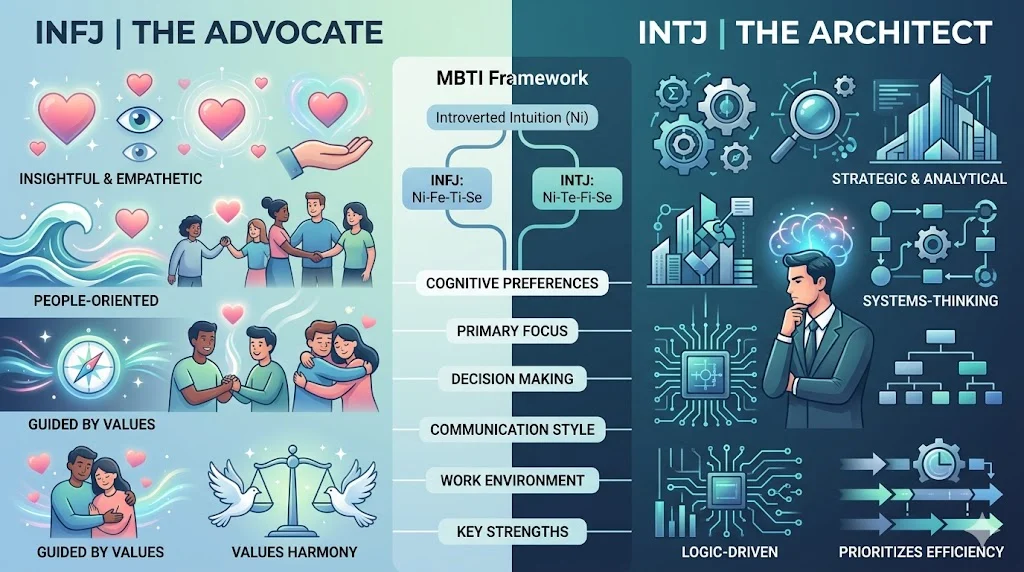
The difference between INFJ vs INTJ lies mainly in their decision-making style and emotional expression. INFJs are guided by feelings, values, and empathy, while INTJs rely on logic, systems, and strategic thinking. Both are introverted and intuitive, but they process the world in very different ways.
INFJ focuses on people and emotional harmony, while INTJ focuses on efficiency, structure, and long-term planning.
The comparison of INFJ vs INTJ is one of the most searched topics in personality psychology. Many people struggle to understand these two types because they look similar on the surface. Both are quiet, thoughtful, and future-focused. Both enjoy deep thinking and prefer meaningful conversations over small talk.
But inside, they are very different.
INFJ types are often called “the Counselor.” They focus on emotions, meaning, and human connection. INTJ types are known as “the Architect.” They focus on logic, strategy, and building systems that work.
This confusion matters because people often mislabel themselves or others. A wrong understanding can affect relationships, career choices, and self-awareness. Some think they are INFJ when they are actually INTJ, or the other way around.
In this guide, you will learn the real differences between INFJ vs INTJ in simple language. We will explore their thinking patterns, strengths, weaknesses, real-life behavior, and common mistakes. You will also find examples, exercises, and FAQs to make everything clear and practical.
Quick Answer Overview
If you want a fast understanding of INFJ vs INTJ, here it is:
- INFJ = Emotion-led intuition (people-focused insight)
- INTJ = Logic-led intuition (system-focused strategy)
Both types share:
- Introversion (I)
- Intuition (N)
- Judging (J)
The real difference is:
- INFJ uses Feeling (F) as a decision filter
- INTJ uses Thinking (T) as a decision filter
In short:
- INFJ asks: “What feels right for people?”
- INTJ asks: “What works best logically?”
Definition of INFJ vs INTJ
What is INFJ?
INFJ stands for:
- Introverted
- Intuitive
- Feeling
- Judging
INFJs are deeply emotional, but not always openly expressive. They understand people easily and often sense emotions without being told. They care about meaning, values, and helping others grow.
They are driven by internal ideals and a strong sense of purpose.
Key traits:
- Empathetic and sensitive
- Future-focused
- Idealistic
- Private but warm
- Strong intuition about people
What is INTJ?
INTJ stands for:
- Introverted
- Intuitive
- Thinking
- Judging
INTJs are strategic thinkers who focus on logic and efficiency. They prefer systems, planning, and problem-solving over emotional discussion. They often think several steps ahead.
They are driven by logic and long-term achievement.
Key traits:
- Logical and analytical
- Independent thinkers
- Strategic planners
- Highly organized
- Goal-oriented
Core Differences in INFJ vs INTJ
Understanding INFJ vs INTJ becomes easier when we compare their core functions and behavior.
Cognitive Function Breakdown
| Aspect | INFJ | INTJ |
| Dominant Function | Introverted Intuition (Ni) | Introverted Intuition (Ni) |
| Secondary Function | Extraverted Feeling (Fe) | Extraverted Thinking (Te) |
| Decision Style | Emotion + values | Logic + efficiency |
| Focus | People and meaning | Systems and results |
| Energy Direction | Emotional insight | Strategic execution |
Both share intuition (Ni), but the way they act on it is different.
INFJ vs INTJ Thinking Style
INFJ Thinking Style
INFJs process the world through emotional patterns. They ask:
- How will this affect people?
- Is this morally right?
- Does this align with my values?
They often make decisions based on empathy and emotional impact.
Example:
An INFJ manager may delay a strict decision if it hurts team morale.
INTJ Thinking Style
INTJs process the world through logic and structure. They ask:
- What is the most efficient solution?
- Does this system make sense?
- What is the long-term outcome?
They focus on results over emotions.
Example:
An INTJ manager will implement a strict rule if it improves productivity, even if it feels uncomfortable for the team.
INFJ vs INTJ Communication Style
INFJ Communication
- Warm and supportive
- Indirect to avoid conflict
- Emotion-aware
- Uses soft language
INFJs often “read between the lines” and expect others to do the same.
INTJ Communication
- Direct and clear
- Logical and structured
- Minimal emotional expression
- Focus on facts
INTJs often find emotional conversation unnecessary unless it supports a logical goal.
INFJ vs INTJ in Relationships
INFJ in Relationships
INFJs are deeply loyal and emotionally invested. They want meaningful and long-term connections. They are highly sensitive to emotional changes.
Strengths:
- Deep emotional bonding
- Strong empathy
- Loyal and committed
Weaknesses:
- Overthinking emotions
- Avoiding conflict
- Emotional burnout
INTJ in Relationships
INTJs are loyal but less emotionally expressive. They show love through actions rather than words.
Strengths:
- Stability and commitment
- Problem-solving in relationships
- Long-term thinking
Weaknesses:
- Emotional distance
- Difficulty expressing feelings
- Can appear cold
Advantages and Disadvantages of INFJ vs INTJ
INFJ Advantages
- Strong emotional intelligence
- Deep understanding of people
- Inspirational and supportive
- Visionary mindset
INFJ Disadvantages
- Emotional overload
- Over-sacrificing for others
- Difficulty setting boundaries
INTJ Advantages
- Excellent strategic planning
- Strong independence
- High efficiency
- Logical decision-making
INTJ Disadvantages
- Emotional detachment
- Overly critical thinking
- Struggles with emotional expression
Real-World Examples of INFJ vs INTJ
INFJ Example
A teacher notices a student struggling emotionally and adjusts teaching style to support their confidence. The INFJ focuses on emotional growth over strict performance.
INTJ Example
A software engineer designs a system that reduces errors by 40%. Even if it requires major changes, the INTJ prioritizes efficiency and scalability.
Career Choices: INFJ vs INTJ
Best Careers for INFJ
- Counselor
- Psychologist
- Teacher
- Writer
- Social worker
INFJs prefer roles involving human connection and meaning.
Best Careers for INTJ
- Engineer
- Data analyst
- Scientist
- Business strategist
- Architect
INTJs prefer structured systems and problem-solving roles.
INFJ vs INTJ in Daily Life Behavior
INFJ Daily Behavior
- Reflective and introspective
- Emotionally aware of surroundings
- Prefers deep conversations
- Needs emotional downtime
INTJ Daily Behavior
- Structured routine
- Goal-oriented tasks
- Focused on productivity
- Prefers logical discussions
Common Mistakes in INFJ vs INTJ Identification
Mistake 1: Confusing Introversion with Personality Type
Being quiet does not mean INFJ or INTJ. Introversion is only one trait.
Mistake 2: Thinking INFJ Means Emotional Only
INFJs are intuitive first, not just emotional. They also think deeply and analytically.
Mistake 3: Assuming INTJs Have No Emotions
INTJs feel emotions but process them internally and logically.
Mistake 4: Misreading Behavior in Stress
Under stress:
- INFJ may become overly logical or detached
- INTJ may become emotionally reactive or confused
Exercises to Identify INFJ vs INTJ
Exercise 1: Decision Check
Ask yourself:
- Do I prioritize people’s feelings or logical outcomes?
Answer:
- Feelings → INFJ tendency
- Logic → INTJ tendency
Exercise 2: Conflict Response
Think about conflict:
- Do you avoid it to maintain harmony?
- Or do you confront it directly for resolution?
Exercise 3: Planning Style
- Do you plan based on emotional impact?
- Or based on efficiency and systems?
Answers Explanation
These exercises are not absolute tests but help identify dominant patterns in INFJ vs INTJ behavior.
Related Concepts and Comparisons
INFJ vs INTJ vs INFP
- INFJ: structured empathy
- INTJ: structured logic
- INFP: flexible emotions
INFJ vs INTJ vs ENFJ
- INFJ: introverted emotional insight
- INTJ: introverted logical strategy
- ENFJ: extroverted emotional leadership
Thinking vs Feeling in MBTI
- Thinking (T): logic-driven decisions
- Feeling (F): value-driven decisions
This is the core divider in INFJ vs INTJ.
Regional and Global Popularity of INFJ vs INTJ
MBTI personality types, including INFJ vs INTJ, are widely used in:
- Career counseling
- Corporate team building
- Education systems
- Online personality communities
INTJ is often associated with tech and leadership fields globally, while INFJ is more common in counseling, teaching, and creative support roles.
FAQs
What is the main difference between INFJ vs INTJ?
INFJ focuses on emotions and people, while INTJ focuses on logic and systems.
Can INFJ and INTJ behave similarly?
Yes, both are introverted and intuitive, so they may appear similar in behavior.
Which is rarer, INFJ or INTJ?
Both are considered rare, but INFJ is often labeled as the rarest MBTI type.
Do INFJs and INTJs get along?
Yes, they can complement each other well with emotion and logic balance.
Can an INFJ become INTJ?
Personality type does not change, but behavior can adapt over time.
Are INTJs emotionless?
No, INTJs feel emotions but prefer not to express them openly.
Which is better for leadership, INFJ or INTJ?
Both are strong. INFJ leads through empathy, INTJ leads through strategy.
How to quickly identify INFJ vs INTJ?
Check decision-making: feelings (INFJ) vs logic (INTJ).
Are INFJ and INTJ compatible in relationships?
Yes, they can balance emotional depth and logical stability.
Why is INFJ vs INTJ comparison so popular?
Because both types are similar on the surface but very different internally.
Conclusion
The comparison of INFJ vs INTJ reveals two powerful but very different personality styles. INFJs lead with empathy, emotional insight, and human connection. INTJs lead with logic, structure, and long-term strategic thinking. Both share intuition and introversion, which makes them appear similar, but their decision-making systems are fundamentally different.
Understanding these differences helps improve self-awareness, relationships, and career decisions. If you are INFJ, embrace emotional intelligence and meaning-driven thinking. If you are INTJ, embrace logic, planning, and system-building strengths.
Neither type is better. They simply solve life problems in different ways. When both styles are understood properly, they can complement each other and create balanced teams, relationships, and personal growth.