Last Updated on June 11, 2026
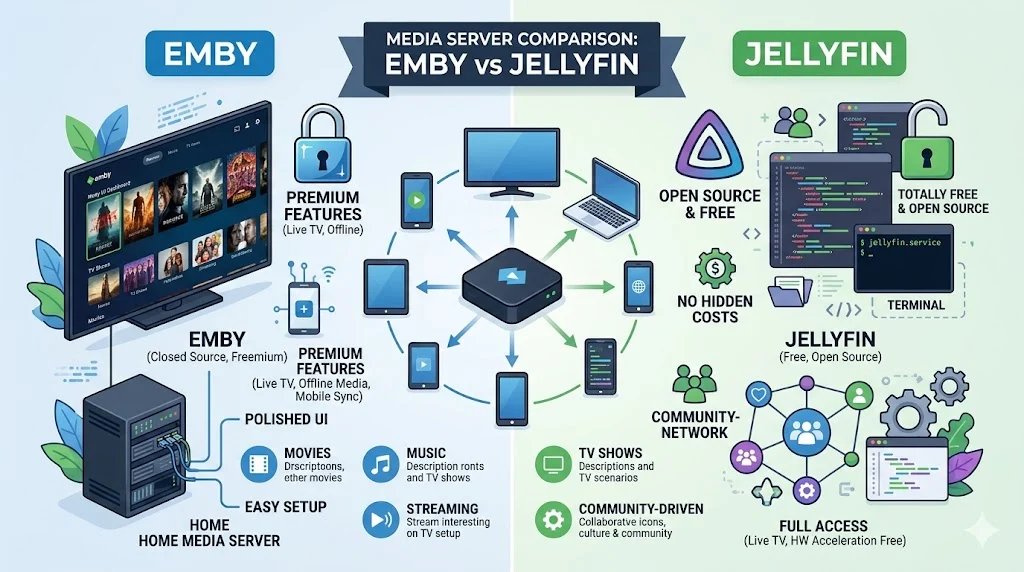
Emby vs Jellyfin is a comparison between two popular media server platforms used for organizing and streaming personal movies, TV shows, and music. Emby is a partly closed-source platform with premium features, while Jellyfin is a fully free and open-source alternative. Both allow users to build a personal Netflix-style media library, but they differ in cost, customization, privacy, and community control.
Choosing the right media server can feel confusing, especially when comparing Emby vs Jellyfin. Both platforms help you organize and stream your personal media collection across devices like smart TVs, phones, and web browsers. At first glance, they look very similar. They even share the same origin story.
But there is a key difference. Emby is partly closed-source and offers premium features behind a subscription. Jellyfin is fully free and open-source, built by the community after splitting from Emby’s older codebase.
This difference affects everything from privacy to customization and long-term cost. Many users struggle to decide which one fits their needs. Some want simplicity and official support. Others want full control and no subscription fees.
In this guide, we will explore Emby vs Jellyfin in detail. You will learn how they work, where they shine, and where they fall short. We will also compare performance, features, device support, and real-world usage so you can confidently choose the right media server for your home setup.
Quick Answer: Emby vs Jellyfin Overview
If you want a fast summary of Emby vs Jellyfin, here it is:
- Emby is a polished, commercial-friendly media server with premium features and official apps.
- Jellyfin is a free, open-source media server with no paywalls and strong community development.
- Both allow streaming of movies, shows, music, and live TV from your personal server.
- Emby is easier for beginners who want stability and official support.
- Jellyfin is better for users who want freedom, privacy, and no subscription costs.
In short:
- Choose Emby if you want convenience and professional support.
- Choose Jellyfin if you want full control and zero cost.
What is Emby?
Emby is a media server platform that helps you organize and stream your personal media collection. It runs on a server (like a PC or NAS) and allows you to watch content on multiple devices.
Key Features of Emby
- Centralized media library management
- Streaming to smart TVs, phones, tablets, and browsers
- Metadata fetching (posters, descriptions, ratings)
- Parental controls
- Live TV and DVR support (premium)
- User accounts and profiles
- Hardware transcoding (premium feature)
Emby uses a freemium model. The basic version is free, but advanced features require a subscription called Emby Premiere.
Emby Strengths
- Polished user interface
- Official apps for many devices
- Stable updates
- Good customer support
- Easy setup for beginners
Emby Weaknesses
- Many features locked behind paywall
- Closed-source core components
- Less community control compared to Jellyfin
What is Jellyfin?
Jellyfin is a free and open-source media server that lets you manage and stream your personal media without any subscription.
It was created as a fork of Emby when Emby became closed-source. Since then, Jellyfin has grown into a strong independent project.
Key Features of Jellyfin
- 100% free and open-source
- No premium subscription
- Media streaming across devices
- Metadata management
- User profiles and permissions
- Live TV support (via plugins)
- Plugin ecosystem for customization
- Active community development
Jellyfin Strengths
- Completely free forever
- No tracking or licensing restrictions
- Highly customizable
- Strong privacy focus
- Community-driven improvements
Jellyfin Weaknesses
- Fewer official apps than Emby
- Setup can be more technical
- Occasional instability depending on plugins
- Hardware transcoding setup may require manual configuration
Emby vs Jellyfin: Core Comparison Table
| Feature | Emby | Jellyfin |
| Cost | Freemium (paid premium features) | Completely free |
| Source Code | Partially closed-source | Fully open-source |
| Device Apps | Official apps for many platforms | Community apps and web-based access |
| Hardware Transcoding | Paid feature | Free but requires setup |
| Live TV | Premium feature | Free via plugins |
| Ease of Use | Very beginner-friendly | Moderate technical skill needed |
| Privacy | Some tracking features | No tracking |
| Community Support | Moderate | Very strong |
| Updates | Controlled by company | Community-driven |
| Customization | Limited | Highly customizable |
Emby vs Jellyfin: Advantages and Disadvantages
Emby Advantages
Emby is designed for users who want a smooth experience.
- Simple installation process
- Clean and modern interface
- Stable performance
- Official apps with consistent updates
- Good support documentation
Emby Disadvantages
- Premium paywall for key features
- Less freedom for advanced users
- Closed ecosystem limits transparency
- Some features require subscription even for basic use cases
Jellyfin Advantages
Jellyfin is built for freedom and control.
- No cost at all
- Fully open-source transparency
- No account requirement for cloud services
- Strong plugin support
- Privacy-focused architecture
Jellyfin Disadvantages
- Setup can be complex for beginners
- Fewer polished mobile apps
- Occasional compatibility issues with devices
- Requires more manual configuration for advanced features
Real-World Use Cases of Emby vs Jellyfin
Home Media Streaming
If you want a simple home Netflix-style system:
- Emby is easier for beginners
- Jellyfin gives more freedom for advanced users
Example:
A family with smart TVs may prefer Emby for its simple setup and official apps.
Tech Enthusiasts and Developers
For users who enjoy customization:
- Jellyfin is ideal
- You can modify plugins and server behavior
Example:
A Linux user running a NAS server may prefer Jellyfin for full control.
Budget-Conscious Users
- Jellyfin is the clear winner
- No subscription or hidden costs
Example:
A student building a home media server will benefit from Jellyfin’s zero-cost model.
Business or Managed Environments
- Emby is better due to official support
- Stable updates and customer service matter more here
Regional and Global Usage
Emby Usage
Emby is widely used in:
- North America
- Europe
- Commercial environments
- Users who prefer paid support
It is popular among users who want plug-and-play media systems.
Jellyfin Usage
Jellyfin is popular in:
- Asia (including tech communities)
- Open-source enthusiast groups
- Self-hosting communities worldwide
- Privacy-focused users
Its popularity grows in regions where open-source software is highly valued.
Emby vs Jellyfin: Performance Comparison
Performance depends on hardware and setup, but general trends are:
Emby Performance
- Optimized out-of-the-box
- Better default transcoding support
- Lower setup complexity
Jellyfin Performance
- Highly efficient when configured correctly
- Depends heavily on hardware setup
- Can outperform Emby with optimization
Key factor:
Hardware transcoding (GPU support) matters more than software choice.
Common Mistakes in Emby vs Jellyfin Setup
Mistake 1: Ignoring Hardware Requirements
Many users underestimate server load.
Fix:
Use a CPU with transcoding support or a GPU.
Mistake 2: Poor Library Organization
Messy folders lead to bad metadata.
Fix:
Organize files like:
- Movies → Movie Name (Year)
- TV Shows → Show Name → Season folders
Mistake 3: Not Configuring Remote Access
Users often forget external streaming setup.
Fix:
Enable secure remote access and port forwarding carefully.
Mistake 4: Overusing Plugins in Jellyfin
Too many plugins can cause instability.
Fix:
Install only necessary plugins.
Mistake 5: Not Enabling Hardware Transcoding
Fix:
Enable GPU acceleration in settings for smoother playback.
Exercises with Answers (Emby vs Jellyfin Learning)
Exercise 1
Which platform is fully open-source?
Answer: Jellyfin
Exercise 2
Which platform requires a subscription for premium features?
Answer: Emby
Exercise 3
Which is better for complete beginners?
Answer: Emby, due to easier setup and official apps
Exercise 4
Which platform is more customizable?
Answer: Jellyfin
Exercise 5
What is the main purpose of both Emby vs Jellyfin?
Answer: To stream personal media like movies, shows, and music
Related Concepts and Comparisons
Plex vs Emby vs Jellyfin
- Plex: Most user-friendly, but heavily commercial
- Emby: Balanced but partially paid
- Jellyfin: Fully free and open-source
Media Server vs Cloud Streaming
- Media server (Emby/Jellyfin): You control content
- Cloud streaming (Netflix): Content controlled by provider
Transcoding Explained
Transcoding is converting video formats so devices can play them smoothly.
- Important for remote streaming
- Requires CPU or GPU power
FAQs
What is Emby vs Jellyfin used for?
Both are used to stream personal media like movies, TV shows, and music from a home server.
Is Jellyfin really free forever?
Yes, Jellyfin is completely free and open-source with no subscription plans.
Is Emby better than Jellyfin?
Emby is better for beginners, while Jellyfin is better for advanced users who want control.
Does Jellyfin support smart TVs?
Yes, but app availability depends on the device and community support.
Can Emby and Jellyfin run on the same server?
Yes, but they must use different ports and configurations.
Which is safer for privacy: Emby vs Jellyfin?
Jellyfin is more private because it does not track users or require accounts.
Do both support live TV?
Yes, both support live TV, but Emby often requires premium features while Jellyfin uses plugins.
Which one is easier to install?
Emby is easier due to guided setup and official apps.
Which is better for low-end hardware?
Jellyfin can be optimized for low-end systems, but Emby is more efficient out of the box.
Can I switch from Emby to Jellyfin?
Yes, migration is possible by moving media libraries and metadata with some manual setup.
Conclusion
Choosing between Emby vs Jellyfin depends on your goals, budget, and technical comfort.
Emby is ideal for users who want a smooth, polished experience with official support and minimal setup effort. It is especially useful for families or users who prefer simplicity and stability, even if it comes with premium costs.
Jellyfin is the best choice for users who value freedom, privacy, and full control. It removes subscription barriers and gives you complete ownership of your media server. However, it may require more technical effort to configure and maintain.
If you want a plug-and-play solution, Emby is a strong choice. If you want a long-term, cost-free, and open-source system, Jellyfin is the better option.
Ultimately, both platforms are powerful. The right choice depends on whether you value convenience or control more.