Last Updated on April 22, 2026
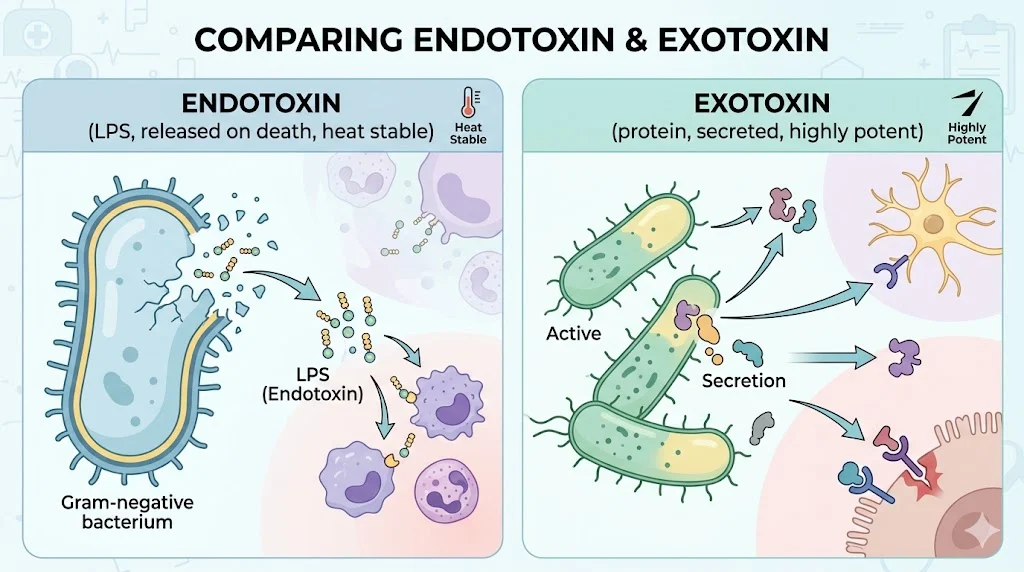
Endotoxin vs exotoxin: Endotoxins are toxic components found in the outer membrane of certain bacteria and are released when the bacteria die. Exotoxins are actively secreted proteins produced by bacteria that can cause specific and severe damage to host cells. Both play key roles in infections, but differ in structure, release, and effects.
When studying bacteria and disease, the terms endotoxin vs exotoxin often cause confusion. Both are toxins produced by bacteria, but they behave very differently in the body. Understanding this difference is important for students, healthcare workers, and anyone learning about infections.
Think of toxins like weapons. Some are released only when bacteria break apart, while others are actively sent out to attack. This is the core idea behind endotoxins and exotoxins.
Many people mix them up because both can cause fever, inflammation, and illness. But their source, strength, and effects are not the same. Knowing the difference helps in diagnosis, treatment, and prevention of diseases.
In this guide, you will learn the difference in a simple and clear way. We will cover definitions, examples, real-world uses, and common mistakes. By the end, you will understand endotoxin vs exotoxin with confidence.
Quick Answer / Overview
Here is a simple comparison of endotoxin vs exotoxin:
| Feature | Endotoxin | Exotoxin |
| Source | Gram-negative bacteria | Gram-positive and Gram-negative bacteria |
| Structure | Lipopolysaccharide (LPS) | Protein |
| Release | Released when bacteria die | Secreted actively |
| Toxicity | Moderate | Very high |
| Specificity | General effects | Specific target cells |
| Heat Stability | Heat stable | Heat sensitive |
| Immune Response | Weak | Strong |
| Vaccine Use | Rarely used | Can be converted to toxoids |
Definition and Explanation
What is Endotoxin
Endotoxin is a toxin found in the outer membrane of Gram-negative bacteria. It is part of the bacterial structure.
- Made of lipopolysaccharide
- Released when bacteria break or die
- Causes fever, inflammation, and shock
Simple example:
Imagine a balloon filled with harmful liquid. The toxin is released only when the balloon bursts.
What is Exotoxin
Exotoxin is a protein toxin produced and released by bacteria during growth.
- Secreted outside the cell
- Highly potent
- Targets specific cells or organs
Simple example:
Think of a syringe injecting poison directly into a target. That is how exotoxins act.
Advantages and Disadvantages
Endotoxin
Advantages (from bacteria’s perspective):
- Hard to destroy due to heat stability
- Triggers strong immune response that can damage host
Disadvantages:
- Less specific in action
- Released only after bacterial death
Exotoxin
Advantages:
- Highly potent and targeted
- Helps bacteria spread quickly
Disadvantages:
- Easily destroyed by heat
- Recognized quickly by immune system
Real-World Examples
Endotoxin Examples
- Escherichia coli infections
- Salmonella infections
- Septic shock caused by Gram-negative bacteria
Real-life scenario:
A patient with severe infection develops fever and low blood pressure due to endotoxin release after bacterial death.
Exotoxin Examples
- Clostridium botulinum produces botulinum toxin
- Corynebacterium diphtheriae produces diphtheria toxin
- Staphylococcus aureus produces enterotoxins
Real-life scenario:
Food poisoning caused by toxins already present in contaminated food.
Regional and Global Usage
The concept of endotoxin vs exotoxin is important worldwide:
- In developing countries, bacterial infections are more common due to sanitation issues
- Hospitals globally monitor endotoxin levels in drugs and medical equipment
- Vaccines like diphtheria toxoid are based on exotoxins
In countries like Pakistan, awareness of bacterial infections helps reduce disease spread through hygiene and vaccination.
Common Mistakes
Here are frequent mistakes students make:
Confusing Structure
❌ Endotoxin is a protein
✔️ Endotoxin is lipopolysaccharide
Confusing Release
❌ Exotoxins are released on death
✔️ Exotoxins are actively secreted
Assuming Same Toxicity
❌ Both are equally toxic
✔️ Exotoxins are usually more potent
Ignoring Heat Stability
❌ Exotoxins survive heat
✔️ Endotoxins are more heat stable
Exercises with Answers
Exercise 1
Question: Which toxin is released when bacteria die?
A. Exotoxin
B. Endotoxin
Answer: B. Endotoxin
Exercise 2
Question: Which toxin is protein in nature?
A. Endotoxin
B. Exotoxin
Answer: B. Exotoxin
Exercise 3
Question: Which toxin is more specific in action?
A. Endotoxin
B. Exotoxin
Answer: B. Exotoxin
Exercise 4
Question: True or False
Endotoxins are heat sensitive
Answer: False
Exercise 5
Question: Match the following
| A | B |
| Exotoxin | Protein |
| Endotoxin | Lipopolysaccharide |
Related Concepts or Comparisons
Gram-Positive vs Gram-Negative Bacteria
- Gram-negative bacteria contain endotoxins
- Both types can produce exotoxins
Toxoid
- Modified exotoxin used in vaccines
- Example: tetanus vaccine
Immune Response
- Endotoxins trigger general inflammation
- Exotoxins trigger targeted immune reactions
FAQs
What is the main difference between endotoxin vs exotoxin?
Endotoxins are part of bacterial cell walls and released on death, while exotoxins are secreted proteins with specific actions.
Which is more dangerous, endotoxin or exotoxin?
Exotoxins are usually more dangerous due to their high potency and targeted effects.
Can endotoxins be used in vaccines?
Rarely. Exotoxins are modified into toxoids for vaccines, not endotoxins.
Do all bacteria produce exotoxins?
No. Only certain bacteria produce exotoxins.
Are endotoxins heat stable?
Yes, endotoxins are heat stable and difficult to destroy.
Why are exotoxins more specific?
Because they target specific cells or organs, like nerves or intestines.
Can exotoxins be neutralized?
Yes, antibodies can neutralize exotoxins effectively.
What diseases are caused by exotoxins?
Diseases like tetanus, botulism, and diphtheria are caused by exotoxins.
Do Gram-positive bacteria produce endotoxins?
No, endotoxins are mainly found in Gram-negative bacteria.
Why is endotoxin important in medicine?
It plays a role in septic shock and is tested in drugs for safety.
Conclusion
Understanding endotoxin vs exotoxin is essential for anyone studying biology, medicine, or health sciences. While both are harmful bacterial toxins, their differences are clear when broken down simply.
Endotoxins are structural components released when bacteria die. They cause general symptoms like fever and inflammation. Exotoxins, on the other hand, are actively secreted proteins that target specific cells and cause severe damage.
The key takeaway is this: endotoxins are less specific but still dangerous, while exotoxins are highly potent and precise in their action.
For practical use, always remember:
- Endotoxin equals cell wall toxin
- Exotoxin equals secreted protein toxin
This understanding helps in diagnosis, treatment, and prevention of bacterial diseases. Keep practicing with examples and comparisons to strengthen your knowledge.