Last Updated on June 18, 2026
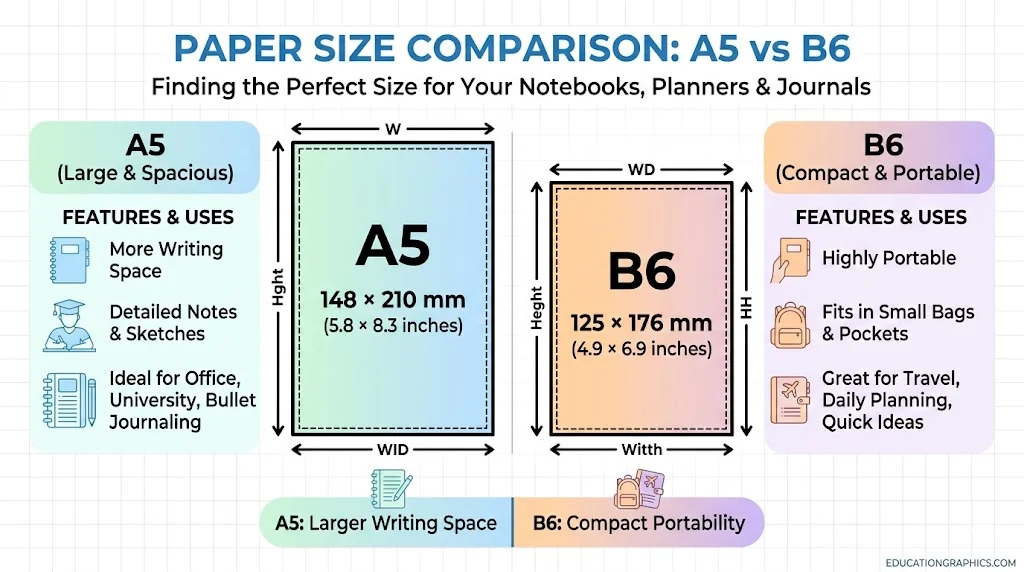
A5 and B6 are two common paper sizes used in printing, notebooks, planners, and books. A5 is larger (148 × 210 mm) and offers more writing space, while B6 is slightly smaller (125 × 176 mm) and feels more compact and portable. The choice between A5 vs B6 depends on whether you prefer readability and space or portability and convenience.
Choosing between A5 vs B6 paper sizes can seem simple, but it often confuses students, professionals, designers, and stationery lovers. Whether you’re comparing B6 vs A5 for a planner, notebook, or journal, understanding the differences is essential. Both sizes are widely used in notebooks, planners, journals, and printed materials. However, the B6 paper size feels more compact, while A5 offers additional writing space. Knowing the exact B6 size including the B6 size in inches can also help you choose the format that best fits your needs, as both sizes feel different in hand, fit differently in bags, and serve different purposes.
The A5 vs B6 comparison is especially important in today’s world where planners and notebooks are part of daily productivity systems. Many people buy notebooks without knowing the actual size difference, only to realize later that the space is too small or too large for their needs.
A5 offers a more spacious writing area, making it ideal for detailed notes, study work, and structured planning. B6, on the other hand, is more compact and portable, making it perfect for travel journals, pocket notebooks, and quick note-taking.
This guide explains A5 vs B6 in simple terms, so you can confidently choose the right size for your needs without confusion.
Quick Answer Overview of A5 vs B6
A5 vs B6 can be understood in one simple way:
A5 is larger and gives more writing space.
B6 is smaller and more portable.
Both sizes belong to international paper size systems, but they are used differently depending on purpose.
A5 is commonly used for notebooks, academic notes, and planners.
B6 is commonly used for diaries, pocket journals, and compact planners.
If you need space, choose A5.
If you need portability, choose B6.
Definition of A5 Paper Size
A5 is part of the ISO 216 standard paper system. It measures 148 × 210 millimeters or 5.8 × 8.3 inches.
It is exactly half the size of A4 paper, which is the most commonly used office paper size.
Key Features of A5
A5 paper is widely used because:
- It provides a balanced writing space
- It is easy to carry
- It fits most bags and folders
- It is ideal for structured note-taking
A5 is often used in education, business, and creative work. It is large enough for detailed writing but still portable enough for daily use.
In the A5 vs B6 comparison, A5 clearly represents the “standard productivity size.”
Definition of B6 Paper Size
B6 is part of the B series paper sizes, which are slightly less common than A series but still widely used in books and stationery.
It measures 125 × 176 millimeters or 4.9 × 6.9 inches.
Key Features of B6
B6 paper size is known for:
- Compact and lightweight feel
- Easy portability in small bags or pockets
- Comfortable reading size for books and journals
- Minimal space usage
Unlike A5, B6 is not based on halving A4. Instead, it comes from a geometric scaling system that allows better variation between sizes.
In the A5 vs B6 debate, B6 represents convenience and portability over writing space.
A5 vs B6 Comparison Table
Here is a simple comparison of A5 vs B6 to help you understand the difference clearly:
| Feature | A5 | B6 |
| Dimensions | 148 × 210 mm | 125 × 176 mm |
| Inches | 5.8 × 8.3 in | 4.9 × 6.9 in |
| Writing Space | Larger | Smaller |
| Portability | Moderate | High |
| Common Use | Notebooks, planners, study notes | Journals, pocket books, diaries |
| Reading Comfort | High | Medium |
| Bag Fit | Fits most bags | Fits small bags and pockets |
| Weight | Slightly heavier | Lighter |
This table shows that A5 vs B6 is mainly a trade-off between space and portability.
Key Differences Between A5 vs B6
The A5 vs B6 difference goes beyond size. It affects usability, comfort, and purpose.
Writing Space Difference
A5 provides significantly more writing space. This makes it ideal for:
- Long notes
- Diagrams
- Study material
- Business planning
B6 has less space, so it is better for:
- Short notes
- Journaling
- Daily logs
- Quick ideas
Portability Difference
B6 is easier to carry. It fits small bags, jackets, and even large pockets. A5 is still portable but slightly larger.
Reading Experience
Books in A5 feel more spacious and easier to read for long periods. B6 books feel compact and can be read comfortably on the go.
Practical Usage Difference
A5 supports structured work.
B6 supports mobility and minimalism.
Advantages and Disadvantages of A5 vs B6
Understanding pros and cons helps make the right choice.
Advantages of A5
- More writing space for detailed notes
- Better for studying and office work
- Easier to organize content
- Suitable for diagrams and charts
Disadvantages of A5
- Slightly larger and less portable
- Not ideal for pocket use
- Can feel bulky for quick notes
Advantages of B6
- Highly portable and lightweight
- Easy to carry anywhere
- Great for journaling and personal notes
- Minimal and compact design
Disadvantages of B6
- Limited writing space
- Not ideal for detailed study notes
- Smaller layout may feel cramped
In A5 vs B6, neither is better overall. It depends on purpose.
Real World Examples of A5 vs B6 Usage
A5 in Daily Life
A5 is commonly used in:
- School notebooks
- University lecture notes
- Office meeting notebooks
- Weekly planners
- Sketchbooks
Example: A student uses an A5 notebook for math notes because it allows diagrams and formulas.
B6 in Daily Life
B6 is used in:
- Travel journals
- Pocket diaries
- Small planners
- Personal reflection notebooks
- Reading journals
Example: A traveler uses a B6 journal to quickly write daily experiences while moving.
Regional and Global Usage of A5 vs B6
Different regions prefer different sizes based on tradition and stationery trends.
A5 Usage Globally
A5 is widely used in:
- Europe
- Asia
- Educational institutions worldwide
It is a standard choice for academic and professional notebooks.
B6 Usage Globally
B6 is more popular in:
- Japan
- Creative journaling communities
- Minimalist stationery users
In Japan especially, B6 is widely used for planners and journals due to its compact design.
How to Choose Between A5 vs B6
Choosing between A5 vs B6 depends on your lifestyle.
Choose A5 if you:
- Take detailed notes
- Study regularly
- Prefer structured writing space
- Use notebooks for work or education
Choose B6 if you:
- Travel often
- Prefer minimal stationery
- Write short notes or journals
- Want a compact notebook
Simple Rule
A5 is for productivity.
B6 is for portability.
Common Mistakes When Choosing A5 vs B6
Many people make mistakes when selecting between A5 vs B6.
Mistake 1: Ignoring Purpose
Buying A5 for travel journaling can feel bulky. Buying B6 for study notes can feel cramped.
Mistake 2: Confusing Size Systems
A series and B series are different. A5 and B6 are not directly interchangeable.
Mistake 3: Not Considering Bag Size
Some users forget to check whether the notebook fits their daily carry bag.
Mistake 4: Assuming Bigger is Always Better
More space is not always better. It depends on writing style.
Exercises on A5 vs B6 with Answers
Exercise 1
Which is larger, A5 or B6?
Answer: A5 is larger.
Exercise 2
Which size is better for travel journaling?
Answer: B6 is better due to portability.
Exercise 3
A5 measures 148 × 210 mm. What is its main advantage?
Answer: It provides more writing space.
Exercise 4
If you need compact notes, which should you choose?
Answer: B6.
Exercise 5
True or False: B6 is larger than A5.
Answer: False.
Related Concepts to A5 vs B6
Understanding A5 vs B6 becomes easier when you know related paper systems.
A Series Paper Sizes
Includes A4, A5, A6, etc. Each size is half of the previous.
B Series Paper Sizes
Includes B4, B5, B6, etc. These are slightly larger variations between A sizes.
Common Notebook Sizes
- A4 for office documents
- A5 for notebooks and planners
- B5 for academic books
- B6 for journals and compact planners
FAQs
What is the main difference between A5 vs B6?
A5 is larger and provides more writing space, while B6 is smaller and more portable.
Is A5 bigger than B6?
Yes, A5 is significantly bigger than B6 in both height and width.
Which is better for students, A5 or B6?
A5 is better for students because it allows more space for notes and diagrams.
Is B6 good for notebooks?
Yes, B6 is great for compact notebooks, journals, and travel writing.
Can A5 and B6 be used for planners?
Yes, both are used for planners depending on whether you prefer space or portability.
Is A5 too big for daily use?
No, A5 is widely used for daily study and office work.
Why is B6 popular in Japan?
B6 is popular due to its compact size and convenience for journaling and planners.
Which is more popular globally, A5 or B6?
A5 is more widely used globally, especially in education and office environments.
Does B6 fit in pockets?
It fits in larger pockets or small bags but not standard pockets.
Which should I choose for journaling?
Choose B6 if you prefer portability, and A5 if you prefer writing space.
Conclusion
The A5 vs B6 comparison comes down to one simple idea: space versus portability. A5 gives you a larger writing area, making it perfect for students, professionals, and anyone who writes detailed notes. It supports structured thinking and long writing sessions.
B6 offers a compact and lightweight experience. It is ideal for people who travel, journal, or prefer minimal stationery. It fits easily into small bags and encourages quick, simple writing.
When choosing between A5 vs B6, there is no universal best option. The right choice depends on your lifestyle, writing habits, and personal preference. If you need productivity and structure, A5 is the better choice. If you need freedom and mobility, B6 is ideal.
Understanding this difference helps you select the perfect notebook or planner that truly fits your daily needs.