
Last Updated on April 22, 2026
AVRT vs AVNRT: Both are types of fast heart rhythms (supraventricular tachycardia), but AVRT uses an extra electrical pathway outside the AV node, while AVNRT involves a loop within the AV node itself. AVNRT is more common and usually less associated with structural abnormalities. Understanding the difference helps guide diagnosis and treatment.
Fast heart rhythms can feel scary. Your heart may race, skip, or pound hard. Many people hear terms like AVRT and AVNRT and feel confused. These are common types of abnormal heart rhythms.
Both belong to a group called Supraventricular Tachycardia (SVT). They start above the heart’s ventricles. But they are not the same.
The confusion happens because symptoms look very similar. A person may feel a sudden fast heartbeat in both cases. Doctors often need tests to tell them apart.
Knowing the difference matters. It helps doctors choose the right treatment. It also helps patients understand their condition better.
This guide explains AVRT vs AVNRT in a simple and clear way. It is useful for beginners and also helpful for deeper learning.
Quick Answer / Overview
| Feature | AVRT | AVNRT |
| Full Name | Atrioventricular Reentrant Tachycardia | Atrioventricular Nodal Reentrant Tachycardia |
| Pathway | Uses an extra pathway outside AV node | Uses two pathways inside AV node |
| Common Condition | Often linked with accessory pathway | Most common SVT type |
| Age Group | Often younger patients | Common in adults |
| ECG Pattern | May show pre-excitation (e.g., WPW) | Usually normal baseline ECG |
| Risk Level | Slightly higher in some cases | Generally benign |
| Treatment | Medications or ablation | Medications or ablation |
Definition / Explanation
What is AVRT?
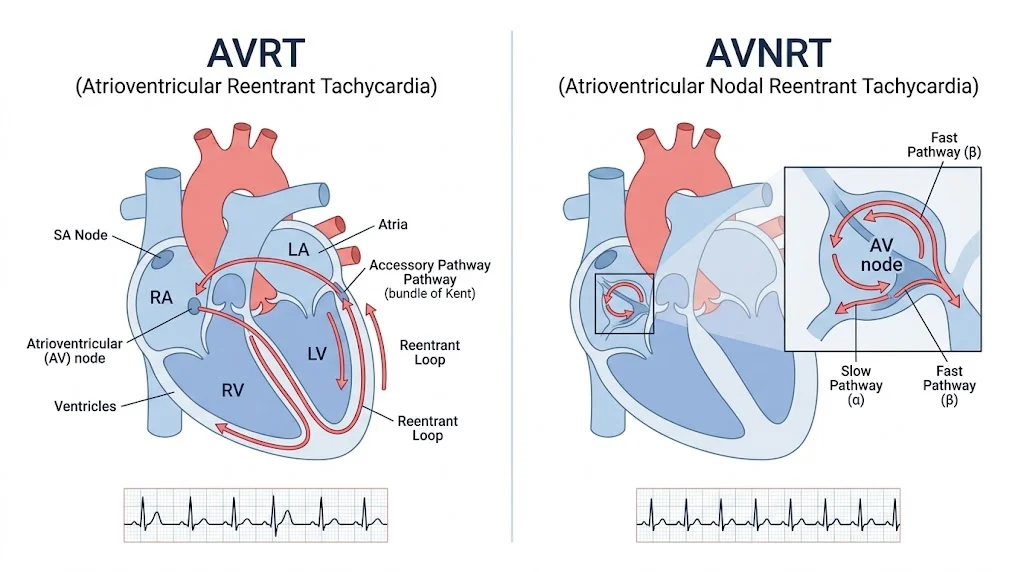
AVRT stands for Atrioventricular Reentrant Tachycardia. It happens when there is an extra electrical pathway between the atria and ventricles.
Normally, electrical signals travel through the AV node. In AVRT, signals can travel in a loop using:
- The normal AV node
- An accessory pathway (extra connection)
This loop causes a fast heartbeat.
A well-known condition linked to AVRT is Wolff-Parkinson-White Syndrome (WPW).
Simple analogy:
Think of two roads between two cities instead of one. Traffic can go in circles, causing congestion.
What is AVNRT?
AVNRT stands for Atrioventricular Nodal Reentrant Tachycardia. It happens inside the AV node.
The AV node has two pathways:
- Fast pathway
- Slow pathway
A loop forms between these two pathways. This creates a rapid heart rhythm.
Simple analogy:
Inside one road, there are two lanes. Traffic circles within the same area instead of going outside.
How the Electrical Loop Works
AVRT Loop
- Signal goes down AV node
- Returns via accessory pathway
- Forms a circular loop
AVNRT Loop
- Signal travels slow pathway
- Returns via fast pathway
- Loop stays within AV node
Symptoms Comparison
Both AVRT and AVNRT share many symptoms:
- Sudden fast heartbeat
- Palpitations
- Dizziness
- Shortness of breath
- Chest discomfort
Key Differences
- AVRT may start at a younger age
- AVNRT often starts later in life
- AVRT may show specific ECG changes
Advantages and Disadvantages
AVRT
Advantages (Clinical Perspective):
- Easier to detect if WPW pattern present
- Clear pathway target for ablation
Disadvantages:
- Risk of more serious arrhythmias in some cases
- May involve structural abnormalities
AVNRT
Advantages:
- Most common and well-understood
- Usually benign
- High success rate with treatment
Disadvantages:
- Harder to detect without episodes
- Symptoms may be recurrent
Real-World Examples
Example 1: Young Athlete
A 20-year-old feels sudden racing heart during exercise. ECG shows WPW pattern.
→ Likely AVRT
Example 2: Office Worker
A 35-year-old feels sudden palpitations while sitting. No prior ECG changes.
→ Likely AVNRT
Regional / Global Usage
- AVNRT is the most common SVT worldwide
- AVRT is more noticeable in regions with higher WPW diagnosis
- In developing countries, diagnosis may be delayed due to limited ECG access
In places like Pakistan, awareness is improving, but many cases still go undiagnosed.
Diagnosis
Doctors use:
- ECG (Electrocardiogram)
- Holter monitor
- Electrophysiology study
Key Diagnostic Clues
| Feature | AVRT | AVNRT |
| Delta Wave | Present in WPW | Absent |
| P Wave | Visible differently | Often hidden |
| Rhythm Start | Sudden | Sudden |
Treatment Options
Non-Medical Methods
- Vagal maneuvers (e.g., coughing, cold water splash)
Medications
- Beta blockers
- Calcium channel blockers
Advanced Treatment
- Catheter ablation
Ablation success rates:
- AVNRT: Very high (over 95%)
- AVRT: Also high but depends on pathway
Comparison Table
| Aspect | AVRT | AVNRT |
| Mechanism | Accessory pathway loop | Dual pathway loop |
| Complexity | Slightly more complex | Simpler mechanism |
| Risk | Moderate in some cases | Low |
| Commonality | Less common | Most common SVT |
| Cure Rate | High with ablation | Very high |
Common Mistakes
Mistake 1: Thinking Both Are the Same
Correction: They have different pathways and mechanisms.
Mistake 2: Ignoring Symptoms
Correction: Always seek medical advice for repeated palpitations.
Mistake 3: Misreading ECG
Correction: Only trained professionals should interpret ECG.
Mistake 4: Delaying Treatment
Correction: Early diagnosis improves outcomes.
Exercises with Answers
Exercise 1
Which condition uses an accessory pathway?
A. AVNRT
B. AVRT
Answer: B. AVRT
Exercise 2
Which is more common?
A. AVRT
B. AVNRT
Answer: B. AVNRT
Exercise 3
Which condition is linked with WPW syndrome?
Answer: AVRT
Exercise 4
Where does AVNRT occur?
Answer: Inside the AV node
Related Concepts or Comparisons
- Supraventricular Tachycardia (SVT)
- Atrial fibrillation
- Atrial flutter
- Ventricular tachycardia
AVRT vs AVNRT vs SVT
Both AVRT and AVNRT are types of SVT. SVT is the broader category.
FAQs
What is the main difference between AVRT vs AVNRT?
AVRT uses an extra pathway, while AVNRT uses dual pathways within the AV node.
Is AVNRT more common than AVRT?
Yes, AVNRT is the most common form of supraventricular tachycardia.
Can AVRT be dangerous?
It can be more serious in some cases, especially if linked with WPW syndrome.
How is AVNRT treated?
It is treated with medications or catheter ablation.
Do AVRT and AVNRT have the same symptoms?
Yes, symptoms are very similar, including palpitations and dizziness.
Can these conditions be cured permanently?
Yes, catheter ablation can cure both AVRT and AVNRT in many cases.
Is AVNRT life-threatening?
Usually not. It is generally considered benign.
How do doctors diagnose AVRT vs AVNRT?
They use ECG, monitoring, and electrophysiology studies.
Can stress trigger AVNRT or AVRT?
Yes, stress, caffeine, and lack of sleep can trigger episodes.
Which condition is easier to treat?
Both are treatable, but AVNRT often has slightly higher success rates.
Conclusion
AVRT vs AVNRT can seem confusing at first. Both cause fast heart rhythms and similar symptoms. But the key difference lies in how the electrical signal travels.
AVRT uses an extra pathway outside the AV node. AVNRT stays within the AV node using two internal pathways. This difference helps doctors choose the right treatment.
AVNRT is more common and usually less risky. AVRT may be linked with conditions like WPW syndrome. Both can be managed well with modern treatments.
If you experience repeated fast heartbeats, do not ignore them. Early diagnosis is important. Simple tests like ECG can help identify the problem.
Modern treatments like catheter ablation offer high success rates. Many patients live normal lives after treatment.
Understanding these conditions empowers you to make better health decisions. Always consult a healthcare professional for proper diagnosis and care.