
Last Updated on April 28, 2026
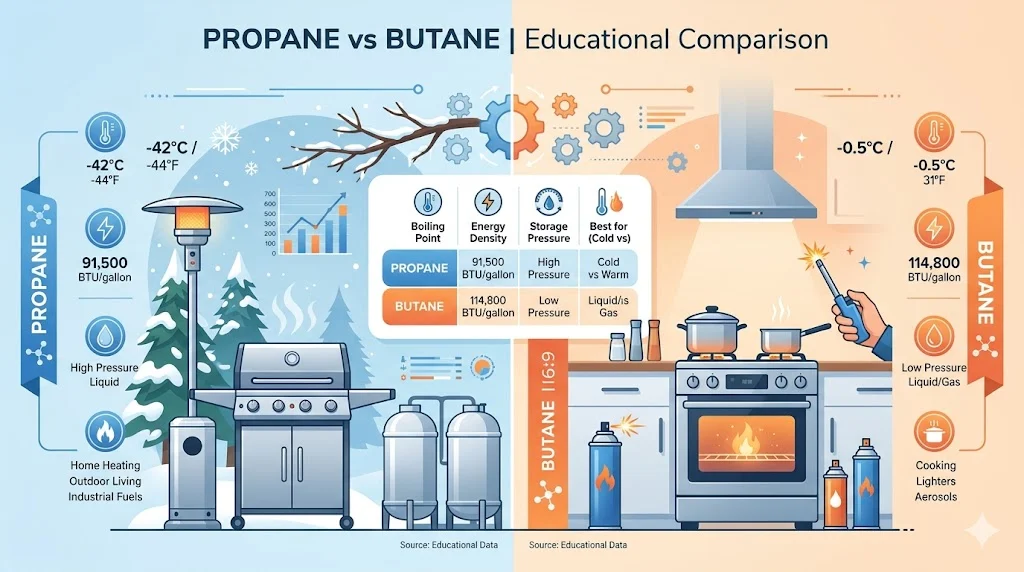
Propane and butane are both hydrocarbon gases used as fuels, but they behave differently in real life. Propane works better in cold temperatures and high pressure, while butane performs best in mild weather and indoor or portable use. The main difference lies in their boiling points, energy behavior, and suitability for climate conditions.
The comparison of propane vs butane is important because both fuels are widely used in homes, industries, camping, heating systems, and portable devices. Many people think they are the same because both are part of LPG (liquefied petroleum gas), but their behavior is quite different in real conditions.
This confusion often leads to wrong fuel choices. For example, someone camping in cold weather may find butane useless, while propane works smoothly. On the other hand, indoor heaters may perform better with butane in mild climates.
Understanding propane vs butane helps you choose the right fuel for safety, performance, and cost efficiency. It also helps avoid issues like poor flame output, fuel waste, or equipment failure. In simple words, knowing the difference saves money and improves performance in daily use.
In this guide, we will explore everything about propane vs butane, including properties, advantages, disadvantages, real-world usage, and common mistakes. We will also include tables, examples, exercises, and FAQs to make learning easy for beginners and useful for advanced readers.
Quick Answer Overview
When comparing propane vs butane, the key difference is performance under temperature.
- Propane works in very cold temperatures and high pressure systems
- Butane works best in warm or moderate temperatures
- Propane is stored at higher pressure than butane
- Butane produces slightly more energy per unit volume but is less versatile
In simple terms:
Propane = cold weather fuel
Butane = mild weather fuel
Both are used in LPG cylinders, but their usage depends on climate, application, and equipment design.
What is Propane and Butane
What is Propane?
Propane is a three-carbon hydrocarbon gas (C₃H₈). It is colorless, odorless, and highly flammable. It is commonly extracted from natural gas processing and petroleum refining.
Propane is stored as a liquid under pressure and turns into gas when released. It is widely used for heating, cooking, engines, and industrial processes.
Key characteristics of propane:
- Low boiling point: around -42°C
- Works in freezing temperatures
- High pressure storage
- Clean-burning fuel
What is Butane?
Butane is a four-carbon hydrocarbon gas (C₄H₁₀). Like propane, it is also colorless and flammable. It is mainly used in portable stoves, lighters, and indoor heating devices.
Butane becomes less effective in cold weather because it does not vaporize easily at low temperatures.
Key characteristics of butane:
- Boiling point: around -0.5°C
- Best for warm climates
- Lower pressure storage than propane
- Higher energy density per volume
Propane vs Butane Comparison Table
| Feature | Propane | Butane |
| Chemical formula | C₃H₈ | C₄H₁₀ |
| Boiling point | -42°C | -0.5°C |
| Cold weather performance | Excellent | Poor |
| Energy per liter | Lower | Higher |
| Storage pressure | Higher | Lower |
| Common use | Heating, camping, industry | Lighters, indoor stoves |
| Availability in winter | Yes | Limited |
| Safety | Highly safe with proper handling | Safe but less stable in cold |
Propane vs Butane: Advantages and Disadvantages
Advantages of Propane
Propane offers strong performance in a wide range of environments.
- Works in freezing temperatures
- Reliable pressure output in cold climates
- Suitable for outdoor and industrial use
- Easy ignition even in harsh conditions
- Widely available globally
Propane is often preferred in regions with cold winters or high altitude areas.
Disadvantages of Propane
Despite its benefits, propane has limitations.
- Requires stronger and heavier storage tanks
- Slightly lower energy density per liter
- Higher pressure increases storage complexity
- Not always ideal for small portable devices
Advantages of Butane
Butane is efficient and convenient in controlled environments.
- Higher energy output per liter
- Lower pressure storage requirements
- Lightweight and portable cylinders
- Ideal for indoor cooking and small appliances
- Cleaner flame in stable temperatures
Disadvantages of Butane
Butane has important limitations.
- Poor performance in cold weather
- Does not vaporize below freezing point
- Not suitable for outdoor winter use
- Limited industrial applications
Real-World Uses of Propane vs Butane
Propane Uses
Propane is used in many heavy-duty and outdoor applications:
- Home heating systems
- Outdoor BBQ grills
- Camping in cold regions
- Forklifts and industrial engines
- Agricultural heating systems
- Backup generators
For example, in cold mountain areas, propane is used for heating homes because it continues to vaporize even in freezing conditions.
Butane Uses
Butane is commonly used in smaller and indoor applications:
- Cigarette lighters
- Portable camping stoves (summer use)
- Indoor heaters in warm climates
- Aerosol propellants
- Small gas burners
For example, butane is commonly used in kitchen stoves in countries with mild winters.
Regional and Global Usage Patterns
The usage of propane vs butane varies by geography.
Cold Regions
Countries with cold climates prefer propane:
- Canada
- Northern USA
- Northern Europe
- Russia
Reason: Butane becomes ineffective in freezing temperatures.
Warm Regions
Butane is more common in warmer climates:
- South Asia
- Middle East
- Southeast Asia
Reason: Temperatures remain above butane’s boiling point.
Mixed LPG Systems
Many countries use a blend of propane and butane known as LPG.
This allows:
- Year-round usability
- Balanced performance
- Cost efficiency
Common Mistakes in Propane vs Butane Usage
Many users make errors when choosing between propane and butane.
Mistake 1: Using Butane in Cold Weather
Butane stops vaporizing in low temperatures. This leads to weak flame or no flame.
Mistake 2: Assuming Both Are Interchangeable
Even though both are LPG gases, appliances may not support both fuels equally.
Mistake 3: Ignoring Pressure Ratings
Propane requires stronger cylinders due to higher pressure.
Mistake 4: Using Indoor Butane Heaters Outdoors in Winter
This reduces efficiency and may cause safety risks.
Mistake 5: Not Checking Appliance Compatibility
Some devices are designed only for propane or butane.
Exercises with Answers
Exercise 1
Which fuel works better in freezing weather?
A. Butane
B. Propane
Answer: Propane
Exercise 2
Which fuel has higher energy per liter?
A. Propane
B. Butane
Answer: Butane
Exercise 3
True or False: Butane is suitable for extreme cold climates.
Answer: False
Exercise 4
Fill in the blank: Propane boiling point is approximately ________.
Answer: -42°C
Exercise 5
Which is more commonly used in lighters?
A. Propane
B. Butane
Answer: Butane
Related Concepts and Comparisons
Propane vs LPG
LPG is a mixture of propane and butane. It is used in household cylinders.
Propane vs Natural Gas
- Propane is stored in cylinders
- Natural gas is delivered through pipelines
Butane vs Isobutane
Isobutane is a structural variation of butane with better low-temperature performance.
Safety Considerations
Both propane and butane are safe when handled properly.
Key safety tips:
- Store cylinders upright
- Keep away from open flames
- Use in ventilated areas
- Check for leaks regularly
- Avoid overheating cylinders
Safety is especially important in enclosed spaces.
FAQs
What is the main difference between propane vs butane?
The main difference is temperature performance. Propane works in cold weather, while butane works in warm conditions.
Can I use propane instead of butane?
Yes, in most cases propane can replace butane if the appliance supports higher pressure.
Which is safer, propane or butane?
Both are safe when used correctly. Propane requires more careful storage due to higher pressure.
Why does butane stop working in winter?
Butane does not vaporize below -0.5°C, so it stops producing gas in cold weather.
Is propane more expensive than butane?
Prices vary by region, but propane is often slightly more expensive due to higher storage and handling requirements.
Can I mix propane and butane?
Yes, LPG is often a mixture of both gases for balanced performance.
Which burns cleaner, propane or butane?
Both burn cleanly, but propane produces slightly more consistent combustion in varying conditions.
What is better for camping, propane or butane?
Propane is better for cold-weather camping, while butane is fine for summer camping.
Which has more energy, propane or butane?
Butane has higher energy per liter, but propane is more practical in real-world conditions.
Are propane and butane interchangeable?
Not always. It depends on appliance design and temperature conditions.
Conclusion
The comparison of propane vs butane shows that both fuels have important but different roles. Propane is best suited for cold environments, outdoor use, and high-pressure systems. Butane is ideal for indoor use, portable devices, and warm climates.
Choosing the right fuel depends on temperature, equipment compatibility, and usage environment. If used correctly, both fuels are efficient, clean, and reliable energy sources.
For best results, always match the fuel type with your climate and device requirements. In cold regions, propane is the clear winner. In mild conditions, butane offers cost-effective and efficient performance.
Understanding propane vs butane helps users avoid common mistakes and improves safety, performance, and fuel efficiency in everyday life.