
Last Updated on May 15, 2026
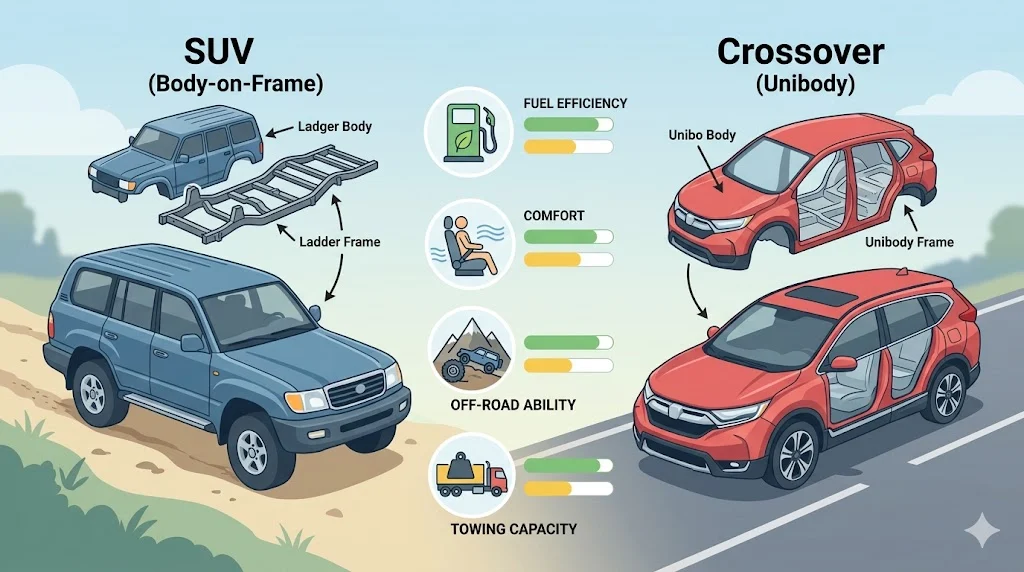
SUV vs crossover, the key difference lies in construction. SUVs use a truck-based body-on-frame design for strength and off-road capability, while crossovers use a car-based unibody design for comfort, fuel efficiency, and everyday driving. Choose SUVs for rugged use and towing, and crossovers for city driving and family comfort.
When choosing a vehicle, many people get confused between SUV vs crossover. They look similar. They sit high. Both carry families and luggage. But they are not the same.
This confusion matters. The wrong choice can cost you money, fuel, and comfort. Some people buy an SUV but never go off-road. Others choose a crossover but need towing power.
Understanding the difference helps you pick the right vehicle for your life. Do you drive in the city? Travel long roads? Need space for kids? Or want power for rough terrain?
This guide will explain everything in simple words. You will learn what each type means, how they differ, and which one is best for you.
Quick Answer / Overview
| Feature | SUV | Crossover |
| Structure | Body-on-frame | Unibody |
| Ride Comfort | Moderate | High |
| Fuel Efficiency | Lower | Better |
| Off-road Ability | Strong | Limited |
| Towing Capacity | High | Moderate |
| Driving Feel | Truck-like | Car-like |
Simple Answer:
- Choose an SUV for strength and off-road power
- Choose a crossover for comfort and daily driving
Definition / Explanation
What is an SUV?
SUV stands for Sport Utility Vehicle. It is built on a truck chassis using a body-on-frame design.
Think of it like a pickup truck with a closed cabin.
Key traits:
- Strong frame
- Handles rough roads
- Good for towing
- Higher ground clearance
What is a Crossover?
A crossover is built using a car platform. It uses a unibody structure where the body and frame are one unit.
Think of it like a car with SUV styling.
Key traits:
- Smooth ride
- Better fuel economy
- Easier handling
- Ideal for city driving
How SUVs and Crossovers Are Built
Body-on-Frame (SUV)
- Separate body and frame
- Strong and durable
- Handles heavy loads
Unibody (Crossover)
- Single integrated structure
- Lightweight
- More efficient
Simple Analogy:
- SUV = Strong metal ladder (heavy-duty)
- Crossover = Solid shell (light and smooth)
Advantages and Disadvantages
SUV Advantages
- Strong towing capacity
- Better off-road performance
- Durable for harsh conditions
- Higher ground clearance
SUV Disadvantages
- Poor fuel efficiency
- Rougher ride
- Harder to handle in cities
- Higher maintenance cost
Crossover Advantages
- Smooth and comfortable ride
- Better fuel economy
- Easier to drive and park
- Lower cost overall
Crossover Disadvantages
- Limited off-road ability
- Lower towing capacity
- Less rugged
Real-World Examples
Popular SUVs
- Toyota Land Cruiser
- Ford Everest
- Nissan Patrol
These are ideal for:
- Off-road driving
- Heavy-duty use
- Rural areas
Popular Crossovers
- Honda CR-V
- Toyota Corolla Cross
- Kia Sportage
These are ideal for:
- Daily commuting
- Family trips
- City driving
SUV vs Crossover: Driving Experience
SUV Driving Feel
- Feels like a truck
- Higher seating position
- Strong but less smooth
Crossover Driving Feel
- Feels like a car
- Smooth steering
- Comfortable suspension
Fuel Efficiency Comparison
| Vehicle Type | Average Fuel Economy |
| SUV | 6–10 km/l |
| Crossover | 10–16 km/l |
Crossovers win in fuel savings, especially in cities.
Interior Space and Comfort
Both offer good space, but:
- SUVs focus on durability
- Crossovers focus on comfort
Families often prefer crossovers because:
- Better seating comfort
- Smooth ride
- Lower noise
Safety Comparison
Both SUVs and crossovers are safe, but:
- Crossovers often perform better in crash tests
- SUVs offer better visibility due to height
Regional / Global Usage
In Pakistan and Similar Regions
SUVs are popular for:
- Rough roads
- Rural areas
- Long-distance travel
Crossovers are popular for:
- City driving
- Fuel savings
- Daily use
Global Trends
- Crossovers are growing fast worldwide
- SUVs remain popular for off-road and luxury use
Common Mistakes
Mistake 1: Thinking They Are the Same
Correction:
SUVs and crossovers differ in build and performance.
Mistake 2: Buying an SUV for City Use
Correction:
A crossover is better for daily driving.
Mistake 3: Ignoring Fuel Costs
Correction:
SUVs consume more fuel.
Mistake 4: Choosing Based on Looks Only
Correction:
Focus on usage, not appearance.
Exercises with Answers
Exercise 1
Which vehicle is better for off-road driving?
A. Crossover
B. SUV
Answer: B. SUV
Exercise 2
Which is more fuel-efficient?
A. SUV
B. Crossover
Answer: B. Crossover
Exercise 3
Which feels more like a car?
A. SUV
B. Crossover
Answer: B. Crossover
Exercise 4
Which is better for towing?
A. SUV
B. Crossover
Answer: A. SUV
Related Concepts or Comparisons
Hatchback vs Sedan vs SUV
- Hatchback: Small and efficient
- Sedan: Balanced comfort
- SUV: Large and powerful
AWD vs 4WD
- AWD: Automatic power to all wheels
- 4WD: Manual control for off-road
Compact SUV vs Full-Size SUV
- Compact: Smaller, efficient
- Full-size: Large, powerful
When Should You Choose an SUV?
Choose an SUV if you:
- Drive on rough roads
- Need towing power
- Travel in mountains or deserts
- Want a rugged vehicle
When Should You Choose a Crossover?
Choose a crossover if you:
- Drive daily in the city
- Want better fuel economy
- Need family comfort
- Prefer smooth handling
FAQs
What is the main difference between SUV vs crossover?
The main difference in SUV vs crossover is construction. SUVs use body-on-frame, while crossovers use unibody design.
Which is better: SUV or crossover for daily use?
A crossover is better for daily use due to comfort, fuel efficiency, and easy handling.
Is a crossover safer than an SUV?
In many cases, crossovers perform better in crash tests due to their unibody structure.
Can a crossover go off-road?
Yes, but only light off-road. SUVs are better for tough terrain.
Why are crossovers more popular today?
Because they offer comfort, efficiency, and practicality for modern drivers.
Are SUVs more expensive than crossovers?
Yes, SUVs usually cost more due to their size and power.
Which lasts longer: SUV or crossover?
SUVs may last longer under heavy use, but both can last long with proper maintenance.
Is a crossover good for long trips?
Yes, crossovers are excellent for long trips due to comfort and fuel efficiency.
Do SUVs consume more fuel than crossovers?
Yes, SUVs generally use more fuel due to heavier weight.
Which is better for families: SUV or crossover?
Crossovers are often better for families because they offer comfort, safety, and efficiency.
Conclusion
Choosing between SUV vs crossover depends on your needs. Both vehicles offer space, safety, and style, but they serve different purposes.
SUVs are strong and powerful. They are best for rough roads, towing and heavy-duty use. If you travel in tough conditions or need strength, an SUV is the right choice.
Crossovers are smooth and efficient. They are perfect for city driving, family use, and daily commuting. If comfort and fuel savings matter most, a crossover is the better option.
Think about your driving habits. Consider your budget, fuel costs, and road conditions. Do not choose based on looks alone.
A smart choice will save money, improve comfort, and make your driving experience better.