Last Updated on June 10, 2026
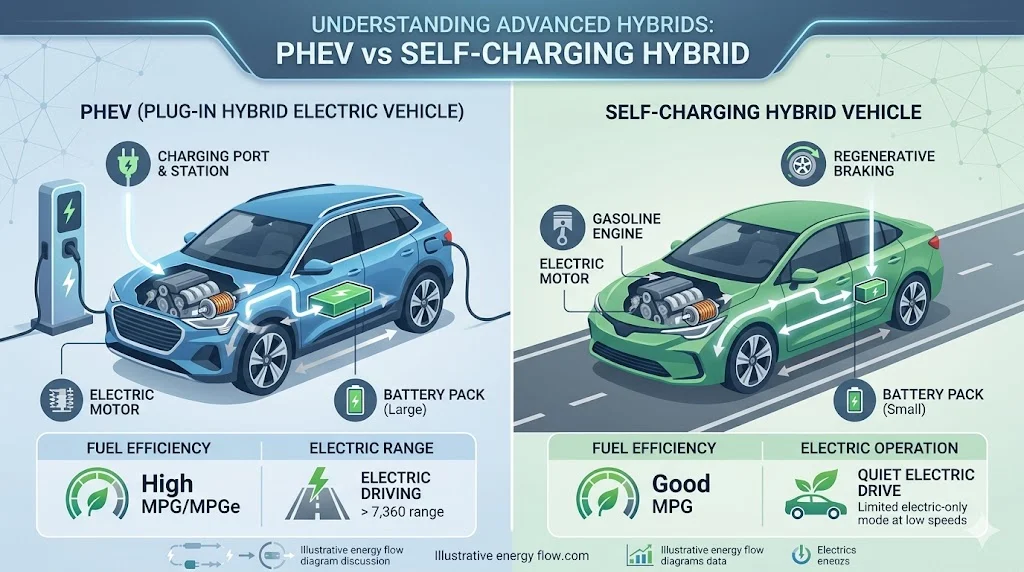
A PHEV vs hybrid comparison explains the key difference in how each vehicle uses electricity and fuel. A hybrid car uses a small battery to assist a gasoline engine and cannot be plugged in. A PHEV (Plug-in Hybrid Electric Vehicle) has a larger battery that can be charged externally and can drive longer distances on electricity alone.
The debate of PHEV vs hybrid is becoming more important as drivers look for fuel-saving and eco-friendly cars. Many people want better mileage, lower fuel costs, and reduced emissions. But they often get confused between these two technologies.
At first glance, both PHEV (Plug-in Hybrid Electric Vehicle) and hybrid cars look similar. They both use a combination of an electric motor and a gasoline engine. However, they work in very different ways.
A hybrid car charges itself while driving. A PHEV can also be plugged into an external power source. This simple difference changes everything, including driving range, fuel savings, and cost.
This article will break down PHEV vs hybrid in a simple and clear way. You will learn how each system works, their advantages and disadvantages, real-world examples, and which one may suit your lifestyle best. Whether you are a beginner or planning to buy a car soon, this guide will help you make a smart decision.
Quick Answer Overview
When comparing PHEV vs hybrid, the main difference is charging and electric range.
A hybrid car uses gasoline and a small battery that charges automatically while driving. It cannot be plugged in. It mainly improves fuel efficiency.
A PHEV has a larger battery and can be charged using a wall charger or charging station. It can drive short distances using only electricity before switching to gasoline.
In simple terms:
- Hybrid = self-charging fuel saver
- PHEV = plug-in electric + fuel backup
Definition of Hybrid Cars
A hybrid vehicle combines a gasoline engine with an electric motor. The system automatically switches between the two power sources depending on driving conditions.
How Hybrid Cars Work
Hybrid cars use three main components:
- Internal combustion engine (ICE)
- Electric motor
- Small battery pack
The battery is charged through:
- Regenerative braking
- Engine power while driving
The electric motor assists the engine during acceleration and low-speed driving.
Key Features of Hybrid Cars
- No external charging required
- Better fuel efficiency than regular cars
- Smooth city driving performance
- Automatic power switching
Hybrid cars are ideal for drivers who want fuel savings without changing their driving habits.
Definition of PHEV (Plug-in Hybrid Electric Vehicle)
A PHEV is a more advanced version of a hybrid car. It has a larger battery and can be charged using an external power source.
How PHEV Works
A PHEV also uses:
- Gasoline engine
- Electric motor
- Large battery pack
But unlike hybrids, it can be charged from:
- Home charging points
- Public EV chargers
Electric Driving Mode
A key feature of PHEV vs hybrid is electric-only driving. A PHEV can travel 20 to 80 kilometers (or more depending on model) without using fuel.
After the battery runs out, it works like a normal hybrid car.
Key Features of PHEV
- External charging required for full benefit
- Longer electric driving range
- Lower fuel usage in daily commutes
- Higher battery capacity
PHEV vs Hybrid Quick Comparison Table
| Feature | Hybrid | PHEV |
| Charging | Self-charging | Plug-in required |
| Battery size | Small | Large |
| Electric-only driving | Very limited | Yes (20–80 km or more) |
| Fuel usage | Moderate | Lower (if charged regularly) |
| Cost | Lower | Higher |
| Best for | City + highway mix | Short daily commutes |
How PHEV vs Hybrid Works in Real Life
Hybrid Driving Scenario
Imagine driving in a city with traffic lights and stop-and-go traffic. A hybrid car:
- Uses electric motor at low speeds
- Switches to gasoline during acceleration
- Charges battery while braking
You never need to plug it in.
PHEV Driving Scenario
Now imagine the same drive with a PHEV:
- Starts in electric mode
- Drives silently using battery
- Switches to gasoline after battery depletes
- Can be recharged at home overnight
If you charge it daily, you may use very little fuel.
Advantages of Hybrid Cars
Understanding PHEV vs hybrid requires looking at both sides.
Fuel Efficiency
Hybrid cars significantly improve mileage compared to traditional petrol cars.
No Charging Required
You do not need to install charging equipment or worry about charging stations.
Lower Cost
Hybrids are generally cheaper than PHEVs.
Reliable Long Distance Travel
Since they rely on gasoline when needed, they are suitable for long trips.
Disadvantages of Hybrid Cars
Limited Electric Driving
Hybrids cannot run long distances on electricity alone.
Less Fuel Savings Than PHEV
They are efficient but not as fuel-saving as plug-in hybrids.
Smaller Battery
Battery capacity is limited, meaning less electric assistance.
Advantages of PHEV
Long Electric Range
A major benefit in PHEV vs hybrid is electric-only driving capability.
Lower Fuel Consumption
If charged regularly, fuel usage can drop significantly.
Environmentally Friendly
Reduced emissions during electric driving.
Flexible Driving
Works as an EV for short trips and hybrid for long trips.
Disadvantages of PHEV
Higher Cost
PHEVs are more expensive due to larger battery systems.
Charging Required
To get full benefit, you must charge regularly.
Heavier Vehicle
Larger batteries add weight, affecting efficiency in some cases.
Maintenance Complexity
More complex systems than standard hybrids.
Real-World Examples of PHEV vs Hybrid
Popular Hybrid Cars
- Toyota Corolla Hybrid
- Honda Insight
- Toyota Prius (standard hybrid version)
These cars are known for reliability and fuel efficiency.
Popular PHEV Cars
- Mitsubishi Outlander PHEV
- Toyota Prius Prime
- Hyundai Tucson Plug-in Hybrid
These models offer electric driving range along with fuel backup.
PHEV vs Hybrid in Daily Life
City Driving
- Hybrid: Very efficient
- PHEV: Excellent if charged daily
Highway Driving
- Hybrid: Reliable and efficient
- PHEV: Uses gasoline more often
Short Commutes
- Hybrid: Good
- PHEV: Best option (can use only electric mode)
Long Trips
- Hybrid: Very practical
- PHEV: Good, but depends on charging habits
Regional and Global Usage Trends
Hybrid Popularity
Hybrid vehicles are widely used in countries with:
- Limited charging infrastructure
- High fuel prices
- Dense urban traffic
Japan is a leader in hybrid adoption.
PHEV Popularity
PHEVs are growing in:
- Europe
- China
- Urban areas with EV infrastructure
Governments often support PHEVs with tax incentives.
Common Mistakes in Understanding PHEV vs Hybrid
Thinking Both Are the Same
Many people assume all hybrid vehicles can be plugged in. This is incorrect.
Ignoring Charging Habits
A PHEV without charging behaves almost like a regular hybrid but less efficiently due to weight.
Overestimating Electric Range
Some users expect long EV-like performance from hybrids, which is not true.
Not Considering Driving Pattern
Choosing the wrong type for your lifestyle can reduce savings.
Exercises with Answers
Exercise 1
Which vehicle can be charged using a plug?
A) Hybrid
B) PHEV
Answer: B) PHEV
Exercise 2
Which system charges itself while driving?
A) Hybrid
B) PHEV
Answer: A) Hybrid
Exercise 3
A driver travels 30 km daily and can charge at home. Which is better?
Answer: PHEV is better due to electric-only daily driving.
Exercise 4
Which is generally cheaper to buy?
A) Hybrid
B) PHEV
Answer: Hybrid
Exercise 5
Which has a larger battery?
A) Hybrid
B) PHEV
Answer: PHEV
Related Concepts and Comparisons
PHEV vs EV
- EV: Fully electric, no fuel engine
- PHEV: Electric + fuel backup
Hybrid vs Mild Hybrid
- Mild hybrid only assists engine
- Full hybrid can drive short distances electrically
Fuel Efficiency Technologies
- Regenerative braking
- Start-stop systems
- Aerodynamic design improvements
FAQs
What is the main difference between PHEV vs hybrid?
A hybrid cannot be plugged in, while a PHEV can be charged externally and drive longer on electricity.
Is a PHEV better than a hybrid?
It depends on usage. PHEV is better for short daily trips if you can charge it regularly.
Do hybrids need charging stations?
No, hybrids charge themselves while driving.
How far can a PHEV go on electricity?
Most PHEVs can travel 20 to 80 kilometers on electric power alone.
Which is cheaper, PHEV or hybrid?
Hybrid vehicles are usually cheaper to buy.
Is maintenance higher for PHEVs?
Yes, slightly due to more complex systems and larger batteries.
Which is better for long road trips?
Hybrids are often more convenient because they do not rely on charging.
Does a PHEV save more fuel than a hybrid?
Yes, but only if it is regularly charged.
Can a PHEV work without charging?
Yes, but it will behave like a heavier hybrid and lose efficiency.
Is hybrid technology outdated compared to PHEV?
No, hybrids are still widely used and very practical.
Conclusion
The comparison of PHEV vs hybrid shows that both technologies aim to reduce fuel consumption and emissions, but they serve different needs.
A hybrid is simple, affordable, and practical. It is ideal for drivers who want better mileage without changing habits. A PHEV offers more advanced technology with longer electric driving range, but it requires regular charging to unlock its full benefits.
If your daily commute is short and you can charge at home, a PHEV can save more fuel. If you prefer simplicity and lower upfront cost, a hybrid is a strong choice.
In the end, the best option depends on your driving style, budget, and access to charging infrastructure. Understanding these differences helps you make a smarter, future-ready decision.