
Last Updated on May 17, 2026
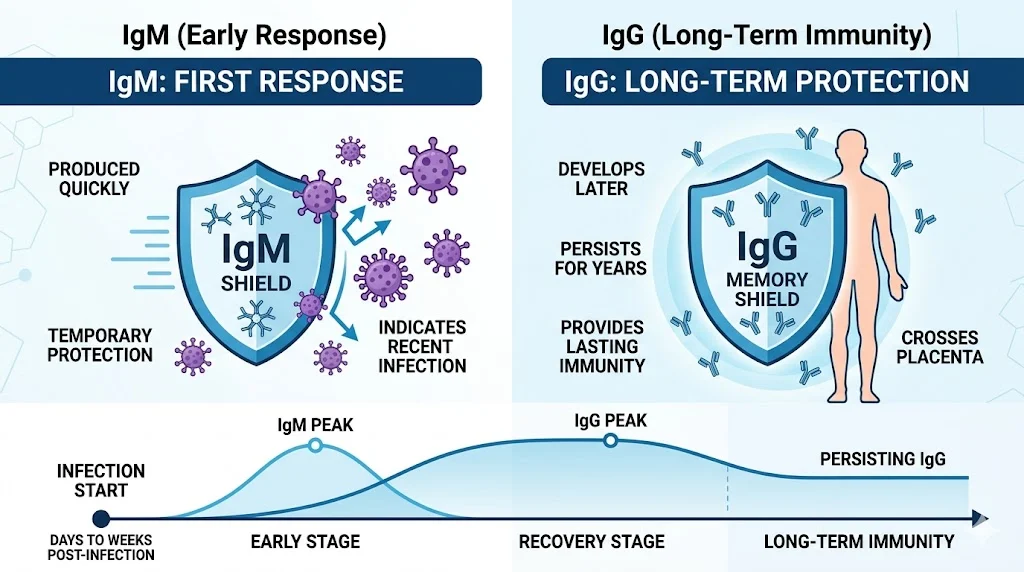
IgM and IgG are two major types of antibodies that play key roles in the immune system. IgM is the first antibody produced during an initial infection, while IgG appears later and provides long-term immunity. Understanding IgM vs IgG helps in diagnosing infections, determining disease stage, and evaluating immune protection.
The human immune system is complex, but antibodies are one of its most important defenses. Among them, IgM and IgG are the most commonly tested in medical labs. Yet, many people confuse them or do not fully understand what they mean in blood test results.
When doctors order tests for infections, especially viral or bacterial diseases, they often check IgM vs IgG levels. These results help determine whether an infection is new, ongoing, or from the past. This is why understanding the difference is very important for patients, students, and healthcare learners.
IgM is usually the first responder. It appears quickly when the body detects a new infection. IgG comes later and stays longer, acting like immune memory. Together, they tell a complete story of the body’s immune response.
In this article, you will learn the clear differences between IgM and IgG, how they work, when they appear, and what their test results mean. We will also explore real-life examples, common mistakes, and practice exercises to make the concept simple and practical.
Quick Answer / Overview of IgM vs IgG
IgM vs IgG refers to two types of antibodies produced by the immune system at different stages of infection.
- IgM (Immunoglobulin M): First antibody produced during early infection. Indicates recent or active infection.
- IgG (Immunoglobulin G): Produced later. Indicates past infection or long-term immunity.
Key idea:
IgM = “Now infection”
IgG = “Past infection or immunity”
What is IgM?
Definition of IgM
IgM stands for Immunoglobulin M. It is a type of antibody produced by the immune system as the first line of defense when a new infection enters the body.
Role of IgM in the Immune System
IgM acts like an emergency response team. It is the first antibody to appear during infection and helps:
- Detect and bind to pathogens quickly
- Activate complement system (immune defense proteins)
- Neutralize bacteria and viruses in early stages
When is IgM Produced?
- Appears within 3 to 7 days after infection
- Peaks early in the immune response
- Decreases once IgG takes over
Key Characteristics of IgM
- Large antibody (pentamer structure)
- Fast response
- Short-lived presence in blood
- Indicates recent infection
What is IgG?
Definition of IgG
IgG stands for Immunoglobulin G. It is the most common antibody found in blood and body fluids. It provides long-term protection after infection or vaccination.
Role of IgG in the Immune System
IgG acts like a memory guard. It:
- Remembers past infections
- Provides long-term immunity
- Helps fight recurring infections faster
- Crosses the placenta to protect newborns
When is IgG Produced?
- Appears 7 to 14 days after infection
- Increases during recovery phase
- Remains in the body for months or years
Key Characteristics of IgG
- Small and highly effective antibody
- Long-lasting immunity
- Most abundant antibody in the body
- Indicates past infection or immunity
IgM vs IgG: Quick Comparison Table
| Feature | IgM | IgG |
| Full Name | Immunoglobulin M | Immunoglobulin G |
| First Response | Yes | No |
| Time of Appearance | Early (3–7 days) | Later (7–14 days) |
| Duration | Short-term | Long-term |
| Function | Initial defense | Memory & protection |
| Infection Stage | Active/recent infection | Past infection/recovery |
| Abundance | Low | High |
| Placenta Crossing | No | Yes |
How IgM vs IgG Work in the Immune Response
Step 1: Infection enters body
Virus or bacteria enters through air, food, or contact.
Step 2: IgM response begins
The immune system produces IgM antibodies quickly.
Step 3: Early defense stage
IgM attacks pathogens but is not highly specific.
Step 4: IgG production starts
The immune system creates IgG antibodies for targeted defense.
Step 5: Long-term immunity
IgG remains in the body for future protection.
IgM vs IgG in Blood Tests
Doctors often use antibody tests to understand infection stages.
Interpretation of Results
| IgM Result | IgG Result | Meaning |
| Positive | Negative | Early infection |
| Positive | Positive | Active or recent infection |
| Negative | Positive | Past infection or immunity |
| Negative | Negative | No infection or very early stage |
Why IgM vs IgG Testing is Important
- Detects early infection
- Confirms past exposure
- Helps track disease progression
- Useful in viral diseases and immunology studies
Advantages and Disadvantages of IgM vs IgG Testing
Advantages
IgM Testing
- Detects infection early
- Helps in rapid diagnosis
- Useful in acute diseases
IgG Testing
- Shows immunity status
- Helps confirm past infection
- Useful for vaccination monitoring
Disadvantages
IgM Testing
- May give false positives
- Not always specific
- Disappears quickly
IgG Testing
- Cannot detect early infection
- May stay positive for life even after recovery
- Cannot indicate active infection alone
Real-World Examples of IgM vs IgG
Example 1: Viral Infection (Flu-like illness)
- Day 3: IgM appears → infection is recent
- Day 10: IgG appears → recovery starts
- After recovery: IgG remains
Example 2: Vaccination Response
After vaccination:
- IgM may appear briefly
- IgG increases strongly
- IgG provides long-term protection
Example 3: Pregnancy Testing (Torch infections concept)
Doctors test IgM vs IgG to determine if infection occurred during pregnancy or before it.
Regional and Global Usage of IgM vs IgG Testing
Medical Use Worldwide
IgM vs IgG testing is widely used in:
- Hospitals
- Diagnostic laboratories
- Blood screening centers
- Research institutions
Common Diseases Tested
- Viral infections
- Bacterial infections
- Parasitic infections
- Autoimmune conditions
Public Health Importance
During outbreaks, IgM vs IgG helps:
- Track infection spread
- Estimate immunity levels in populations
- Guide vaccination strategies
Common Mistakes in Understanding IgM vs IgG
Mistake 1: Thinking IgG means active infection
Correction: IgG usually indicates past infection or immunity.
Mistake 2: Assuming IgM always means disease
Correction: IgM may persist or show false positives in some cases.
Mistake 3: Ignoring timing of infection
Correction: Timing of symptoms is important for interpretation.
Mistake 4: Relying only on one antibody
Correction: Both IgM and IgG must be interpreted together.
Exercises on IgM vs IgG
Exercise 1
Q: A patient has positive IgM and negative IgG. What does it mean?
A: Early or recent infection.
Exercise 2
Q: What does negative IgM and positive IgG indicate?
A: Past infection or immunity.
Exercise 3
Q: Which antibody appears first, IgM or IgG?
A: IgM appears first.
Exercise 4
Q: Which antibody provides long-term immunity?
A: IgG provides long-term immunity.
Exercise 5
Q: If both IgM and IgG are positive, what is likely happening?
A: Active or recent infection in transition phase.
Related Concepts and Comparisons
IgM vs IgG vs IgA
- IgA: Found in mucosal areas (saliva, tears, gut)
- IgM: First responder
- IgG: Long-term immunity
Antibodies vs Antigens
- Antigens: Foreign substances causing infection
- Antibodies: Proteins that fight antigens
Serology Testing
IgM vs IgG tests are part of serology, which studies blood serum for immune responses.
FAQs
What is the main difference between IgM vs IgG?
IgM is an early antibody for recent infection, while IgG indicates past infection and long-term immunity.
Can IgG be present without infection?
Yes, IgG can remain after vaccination or past infection.
Does IgM always mean active disease?
Not always. It may appear in early recovery or false positives.
How long does IgM stay in the body?
Usually a few weeks, depending on infection type.
How long does IgG stay in the body?
Months to years, sometimes lifelong.
Which is more important IgM or IgG?
Both are important; they give different information about infection timing.
Can you have IgG without IgM?
Yes, this usually indicates past infection.
Why do doctors test IgM vs IgG together?
To understand infection stage and immune response clearly.
Is IgG protection permanent?
Not always permanent, but often long-lasting.
Can IgM appear again after recovery?
Rarely, but possible in reinfection or immune response changes.
Conclusion
Understanding IgM vs IgG is essential for interpreting immune responses and blood test results. These two antibodies work together but serve very different purposes in the body. IgM acts as the first responder during a new infection, providing immediate but short-term defense. IgG develops later and offers long-term immunity by remembering past infections.
In medical practice, IgM vs IgG testing helps doctors determine whether an infection is new, ongoing, or from the past. This is especially important in viral diseases, vaccinations, and public health monitoring.
For students and healthcare learners, mastering the difference between IgM and IgG builds a strong foundation in immunology. For patients, it helps in understanding lab reports more clearly and avoiding confusion.
The key takeaway is simple: IgM tells you “what is happening now,” while IgG tells you “what has happened before.” Together, they give a complete picture of immune health and protection.