
Last Updated on June 7, 2026
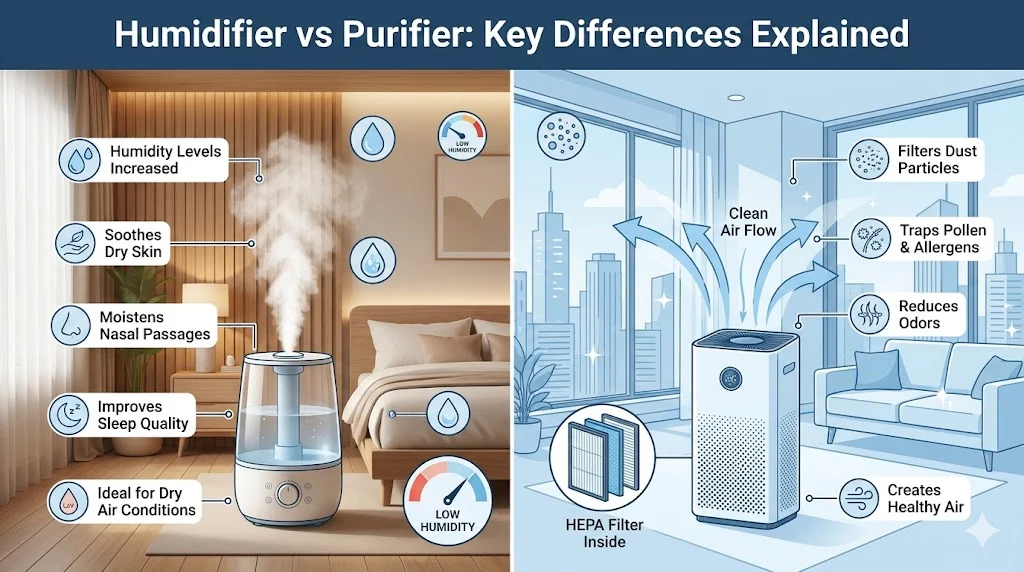
A humidifier adds moisture to dry indoor air to improve comfort, breathing, and skin health. A purifier removes pollutants like dust, smoke, and allergens to improve air quality. The main difference in “humidifier vs purifier” is that one adds moisture, while the other cleans the air.
Many people confuse a humidifier vs purifier because both are used indoors to improve air quality and comfort. However, they solve very different problems. One focuses on moisture levels in the air, while the other focuses on removing harmful particles.
This confusion is common in homes, especially where people suffer from allergies, dry skin, asthma, or seasonal air pollution. Some people buy the wrong device and expect it to solve all air-related problems. This leads to disappointment and wasted money.
Understanding the difference between a humidifier and a purifier is important for health, comfort, and energy efficiency. The right choice depends on your environment, climate, and personal needs.
In this guide, we will clearly explain humidifier vs purifier in simple language. You will learn how each device works, when to use it, benefits and drawbacks, real-life examples, and how to choose the right one. By the end, you will be able to confidently decide which device suits your home or office best.
Quick Answer Overview: Humidifier vs Purifier
A humidifier increases humidity in dry air by releasing water vapor or mist. It is mainly used in dry climates or winter seasons.
A purifier cleans the air by filtering dust, smoke, pollen, bacteria, and other pollutants. It is used in polluted or allergen-heavy environments.
Simple Summary
- Humidifier = Adds moisture to air
- Purifier = Removes impurities from air
They do not replace each other. In fact, many homes need both devices depending on conditions.
Definition and Explanation of Humidifier vs Purifier
What is a Humidifier?
A humidifier is a device that increases moisture levels in indoor air. It works by releasing water vapor, steam, or fine mist into the environment.
When the air is too dry, it can cause:
- Dry skin
- Cracked lips
- Nose irritation
- Sore throat
- Static electricity
Humidifiers help restore balance by maintaining ideal humidity levels (usually 30% to 50%).
Types of Humidifiers
- Evaporative humidifier
- Ultrasonic humidifier
- Steam vaporizers
- Impeller humidifiers
Each type uses a different method to add moisture, but the goal is the same: improve air humidity.
What is a Purifier?
A purifier, often called an air purifier, is a device that removes harmful particles from the air. It uses filters or technology like HEPA filters, activated carbon, or ionization.
It helps remove:
- Dust
- Smoke
- Pollen
- Pet dander
- Mold spores
- Airborne bacteria
Purifiers are especially useful in cities with high pollution or in homes with allergy sufferers.
Types of Air Purifiers
- HEPA filter purifiers
- Activated carbon purifiers
- UV air purifiers
- Ionizer purifiers
Each type targets different pollutants, but all aim to improve air cleanliness.
Key Differences: Humidifier vs Purifier
| Feature | Humidifier | Purifier |
| Main Function | Adds moisture | Removes pollutants |
| Improves | Air dryness | Air quality |
| Works on | Humidity levels | Air particles |
| Best for | Dry climates | Polluted environments |
| Health benefit | Skin, throat, breathing comfort | Allergy relief, asthma control |
| Maintenance | Water refilling, cleaning | Filter replacement |
| Energy use | Low to moderate | Moderate |
This table clearly shows that humidifier vs purifier is not a competition but a comparison of two different solutions.
How Humidifier vs Purifier Works in Real Life
How a Humidifier Works
A humidifier pulls in water from a tank and converts it into mist or vapor. This moisture spreads into the air and increases humidity levels.
Think of it like watering dry soil. The air becomes softer and more comfortable to breathe.
How a Purifier Works
A purifier pulls air through filters. Dust and pollutants get trapped inside, and clean air is released back into the room.
Think of it like a sieve that catches unwanted particles while allowing clean air to pass.
Advantages and Disadvantages of Humidifier vs Purifier
Advantages of Humidifier
- Reduces dryness in air
- Improves skin hydration
- Helps with sinus congestion
- Reduces snoring caused by dry air
- Supports respiratory comfort
Disadvantages of Humidifier
- Can cause mold if overused
- Needs regular cleaning
- Does not remove pollutants
- May increase humidity too much
Advantages of Purifier
- Removes allergens and dust
- Reduces asthma triggers
- Improves indoor air quality
- Helps in polluted cities
- Reduces smoke and odors
Disadvantages of Purifier
- Does not add moisture
- Requires filter replacement
- Can be noisy
- May be expensive depending on model
Real-World Examples of Humidifier vs Purifier Use
Example 1: Dry Winter Home
In winter, indoor heating makes air dry. A humidifier is useful here to prevent dry skin and sore throat.
Example 2: Urban Apartment
In a polluted city, smoke and dust enter homes. A purifier helps clean the air and reduce allergies.
Example 3: Allergy-Prone Family
A family with asthma or pollen allergies benefits more from a purifier than a humidifier.
Example 4: Balanced Environment
Some homes use both devices. The purifier cleans the air, and the humidifier maintains moisture balance.
Regional and Global Usage of Humidifier vs Purifier
Dry Regions
In areas with dry climates, humidifiers are more popular. These regions often face:
- Low humidity
- Dry skin problems
- Respiratory discomfort
Polluted Urban Areas
In large cities, purifiers are more common due to:
- Vehicle emissions
- Industrial pollution
- Indoor dust accumulation
Cold Countries
In cold regions, heating systems dry out air, increasing humidifier demand.
Humid Countries
In humid climates, purifiers are more useful because moisture is already high, but air pollution may still exist.
Common Mistakes in Humidifier vs Purifier Use
Mistake 1: Using Humidifier in Already Humid Air
This can cause mold growth and breathing discomfort.
Mistake 2: Thinking Purifier Adds Moisture
A purifier does NOT increase humidity. It only cleans air.
Mistake 3: Not Cleaning Devices
Both devices require maintenance. Dirty machines reduce effectiveness.
Mistake 4: Placing Devices in Wrong Location
Purifiers work best in closed rooms. Humidifiers should not be placed near electronics.
Mistake 5: Ignoring Room Size
Small devices in large rooms are ineffective for both humidifier vs purifier usage.
Exercises with Answers: Humidifier vs Purifier
Exercise 1
Question: You have dry skin and cracked lips in winter. Which device helps more?
Answer: Humidifier
Exercise 2
Question: Your home has dust and smoke from traffic pollution. What should you use?
Answer: Air purifier
Exercise 3
Question: Can a purifier increase humidity?
Answer: No
Exercise 4
Question: What happens if you overuse a humidifier?
Answer: It may cause excess humidity and mold growth
Exercise 5
Question: Which device helps with allergies caused by pollen?
Answer: Purifier
Related Concepts and Comparisons
Humidifier vs Dehumidifier
- Humidifier adds moisture
- Dehumidifier removes moisture
Purifier vs Dehumidifier
- Purifier cleans air
- Dehumidifier controls humidity
HEPA Filters in Purifiers
HEPA filters trap very fine particles, improving purification efficiency.
Ideal Indoor Air Balance
Healthy indoor air requires:
- Proper humidity (30–50%)
- Clean air with minimal pollutants
Both humidifier vs purifier can work together for balance.
FAQs
What is the main difference between humidifier vs purifier?
A humidifier adds moisture to air, while a purifier removes dust and pollutants.
Do I need a humidifier or purifier for allergies?
A purifier is better for allergies because it removes allergens like dust and pollen.
Can I use humidifier and purifier together?
Yes, many homes use both for balanced air quality and comfort.
Does a humidifier clean the air?
No, a humidifier only adds moisture and does not remove pollutants.
Which is better for dry skin, humidifier vs purifier?
A humidifier is better for dry skin and hydration.
Which is better for asthma, humidifier vs purifier?
A purifier is more effective for asthma management.
Is a purifier useful in winter?
Yes, especially if indoor pollution or dust is present.
Can a humidifier cause mold?
Yes, if humidity becomes too high or the device is not cleaned properly.
Do air purifiers remove viruses?
Some purifiers with HEPA or UV technology can reduce airborne viruses.
Which is more expensive, humidifier vs purifier?
Air purifiers are generally more expensive due to advanced filtration systems.
Conclusion
Understanding humidifier vs purifier is essential for creating a healthy indoor environment. While both devices improve air-related comfort, they solve different problems. A humidifier is best for dry air conditions, helping with skin, breathing, and general comfort. A purifier is ideal for polluted or allergen-heavy environments, improving overall air quality.
Choosing between them depends on your specific needs. In many cases, using both devices together provides the best results. A purifier keeps the air clean, while a humidifier maintains proper moisture levels.
For long-term health and comfort, assess your environment carefully before buying. If your air feels dry, choose a humidifier. If your air feels dusty or polluted, choose a purifier. For balanced indoor air, consider using both in combination.