Last Updated on May 19, 2026
PIE (Post-Inflammatory Erythema) and PIH (Post-Inflammatory Hyperpigmentation) are two different skin conditions that appear after acne or skin injury. PIE causes red or pink marks due to blood vessel changes, while PIH causes brown or dark spots due to excess melanin. Understanding the difference between pie vs pih is important for choosing the correct treatment and improving skin faster.
Many people notice marks left on their skin after acne, pimples, burns, or minor injuries. These marks often do not look like active acne but still affect skin appearance. Two of the most commonly confused conditions are PIE and PIH. This confusion is why the topic “pie vs pih” is widely searched in skincare and dermatology.
PIE stands for Post-Inflammatory Erythema. PIH stands for Post-Inflammatory Hyperpigmentation. Both appear after skin inflammation, but they behave very differently in the skin. PIE looks red, pink, or sometimes purple, while PIH looks brown, gray, or dark. Because they appear similar at first glance, many people use the wrong treatments and see slow results.
Understanding pie vs pih is important because the cause, skin layer affected, and treatment methods are not the same. Using the wrong approach can delay healing or even worsen the condition. This guide explains everything in simple language so anyone can understand how to identify, treat, and prevent these skin concerns effectively.
Quick Answer / Overview
PIE and PIH are both post-acne marks but differ in cause and color.
- PIE is caused by damaged or dilated blood vessels and appears red or pink.
- PIH is caused by excess melanin production and appears brown or dark.
In simple terms, pie vs pih is a comparison between vascular redness and pigment-based dark spots. PIE is more common in lighter skin tones, while PIH is more common in medium to darker skin tones. Both conditions can fade over time, but treatment approaches differ significantly.
Definition and Explanation of Pie vs PIH
What is PIE (Post-Inflammatory Erythema)?
PIE occurs when the skin becomes inflamed due to acne, irritation, or injury. After healing, tiny blood vessels near the surface remain widened or damaged. This creates red, pink, or sometimes purplish marks.
Key points:
- Vascular in nature (blood vessel related)
- Not pigment based
- Common after acne or skin trauma
- More visible in fair skin tones
PIE is not “stain” on skin but a vascular response.
What is PIH (Post-Inflammatory Hyperpigmentation)?
PIH occurs when the skin produces excess melanin during healing. Melanin is the pigment that gives skin its color. After inflammation, melanocytes become overactive and leave dark marks.
Key points:
- Pigment based condition
- Appears brown, black, or gray
- Common in all skin types but more in medium to dark skin tones
- Triggered by acne, cuts, burns, or irritation
PIH is essentially a “melanin overproduction response.”
Pie vs PIH Comparison Table
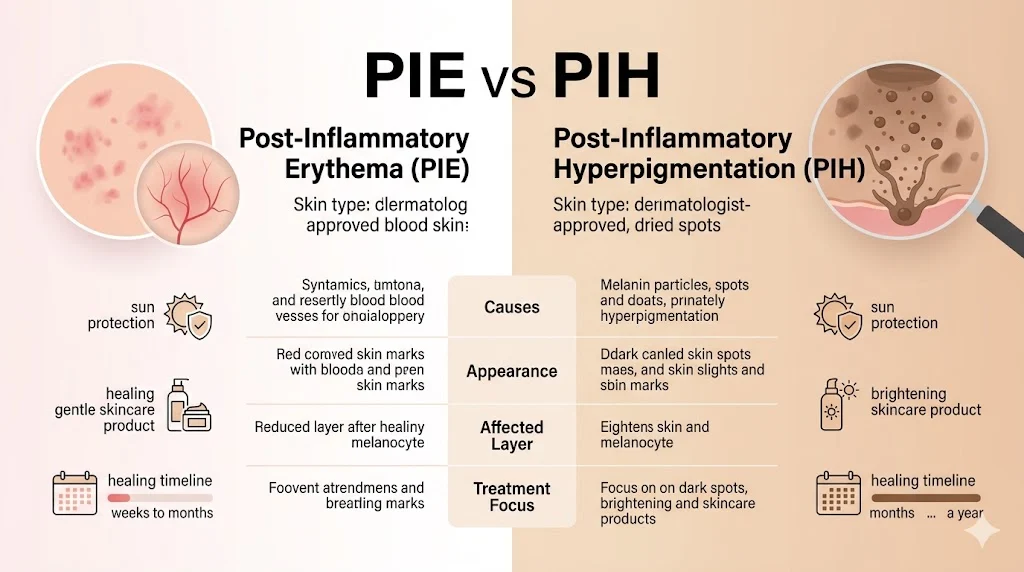
| Feature | PIE (Post-Inflammatory Erythema) | PIH (Post-Inflammatory Hyperpigmentation) |
| Cause | Blood vessel dilation | Excess melanin production |
| Color | Red, pink, purple | Brown, dark brown, black |
| Skin layer | Dermal blood vessels | Epidermal or dermal pigment |
| Common in | Fair skin tones | Medium to dark skin tones |
| Itching/pain | Usually none | Usually none |
| Sun sensitivity | Moderate | High |
| Healing time | Weeks to months | Months to years |
| Treatment focus | Vascular healing | Pigment reduction |
Understanding this table is key to mastering pie vs pih differences.
Causes of Pie vs PIH
Both PIE and PIH originate from skin inflammation, but their pathways differ.
Common causes include:
- Acne and pimples
- Picking or squeezing skin
- Cuts or wounds
- Burns or irritation
- Allergic reactions
- Dermatological procedures like peeling or laser
Why PIE happens
Inflammation damages small blood vessels. These vessels remain dilated even after healing.
Why PIH happens
Inflammation triggers melanocytes to produce excess melanin as a defense response.
In pie vs pih comparison, inflammation is the shared root cause but the biological response differs.
Symptoms of Pie vs PIH
Symptoms of PIE
- Red or pink flat marks
- Blanching (may fade temporarily when pressed)
- More visible after heat or exercise
- No scaling or texture change
Symptoms of PIH
- Brown, gray, or dark patches
- Does not fade when pressed
- More visible in sunlight
- May persist longer than PIE
Recognizing symptoms correctly is the first step in treating pie vs pih effectively.
Treatment Options for PIE
PIE treatment focuses on reducing redness and supporting vascular healing.
Topical treatments
- Niacinamide
- Azelaic acid
- Vitamin C serums
- Centella asiatica
Medical treatments
- Pulsed dye laser (PDL)
- IPL (Intense Pulsed Light)
- Vascular lasers
Lifestyle care
- Daily sunscreen use
- Avoid picking skin
- Gentle skincare routine
PIE generally responds well to laser treatments compared to PIH.
Treatment Options for PIH
PIH treatment focuses on reducing melanin and speeding up cell turnover.
Topical treatments
- Retinoids (retinol, tretinoin)
- Hydroquinone (doctor supervised)
- Azelaic acid
- Vitamin C
- Kojic acid
- Alpha arbutin
Procedures
- Chemical peels (glycolic acid, salicylic acid)
- Laser treatments (Q-switched laser)
- Microneedling
Sun protection
- SPF 30 or higher is essential
- Sunscreen prevents darkening of PIH
PIH treatment is usually slower than PIE treatment.
Advantages and Disadvantages of Treatments in Pie vs PIH
PIE treatment pros
- Faster response to laser
- Improves significantly with time
- Non-pigment related, easier to manage in many cases
PIE treatment cons
- Requires vascular-focused treatments
- May worsen with sun exposure or heat
PIH treatment pros
- Many topical options available
- Improves with consistent skincare
- Treatable without procedures in mild cases
PIH treatment cons
- Slow fading process
- Can worsen with sun exposure
- Harder in darker skin tones if not treated correctly
Real-World Examples of Pie vs PIH
Example 1
A teenager with acne develops red marks after pimples heal. These fade in 2–3 months. This is PIE.
Example 2
An adult squeezes pimples and gets dark brown spots that last for a year. This is PIH.
Example 3
Someone uses harsh skincare products and develops both red and brown marks. This is a combination of pie vs pih.
Regional and Global Usage of Pie vs PIH Terms
The terms PIE and PIH are widely used in:
- Dermatology clinics
- Skincare communities
- Online skincare education platforms
In Western dermatology, PIE is often discussed under vascular erythema. PIH is more widely recognized globally, especially in Asia, Africa, and the Middle East where pigmentation issues are more common due to higher melanin levels.
Understanding pie vs pih is especially important in multicultural skincare practices.
Common Mistakes in Pie vs PIH Identification
Mistake 1: Confusing PIE with acne
Red marks are often mistaken for active acne.
Mistake 2: Using whitening creams for PIE
PIE is vascular, not pigment-based, so whitening products may not help.
Mistake 3: Ignoring sunscreen
Both PIE and PIH worsen without sun protection.
Mistake 4: Picking skin
Picking increases inflammation and worsens both conditions.
Mistake 5: Using same treatment for both
PIE and PIH require different treatment strategies.
Avoiding these mistakes improves outcomes significantly in pie vs pih management.
Exercises with Answers
Exercise 1
Identify the condition:
A red mark appears after acne and fades when pressed.
Answer: PIE
Exercise 2
Identify the condition:
A dark brown spot appears after a pimple and does not fade when pressed.
Answer: PIH
Exercise 3
Which condition requires pigment reduction treatment?
Answer: PIH
Exercise 4
Which condition is related to blood vessels?
Answer: PIE
Exercise 5
True or False:
PIE and PIH are treated exactly the same way.
Answer: False
Related Concepts and Comparisons
Understanding pie vs pih connects to several skincare concepts:
- Acne scars vs acne marks
- Hyperpigmentation types
- Skin inflammation response
- Melanin production cycle
- Skin healing process
Related comparisons
- PIE vs acne scars
- PIH vs melasma
- Red marks vs dark spots
- Post-acne marks vs active acne
These comparisons help deepen understanding of skin recovery.
FAQs
What is the main difference between PIE and PIH?
PIE is red or pink due to blood vessels, while PIH is dark due to excess melanin.
Is pie vs pih permanent?
No, both are usually temporary but may take months to fade.
Which is harder to treat, PIE or PIH?
PIH is generally harder and slower to treat than PIE.
Can sunscreen help with pie vs pih?
Yes, sunscreen is essential for both conditions to prevent worsening.
Does PIE turn into PIH?
Yes, in some cases PIE can transition into PIH if inflammation continues or sun exposure occurs.
Can skincare products remove PIE?
Some products help, but lasers are often more effective for PIE.
Is PIH common in all skin types?
Yes, but it is more common in medium to darker skin tones.
How long does PIE take to fade?
It may take a few weeks to several months depending on severity.
How long does PIH take to fade?
It can take several months to years without proper treatment.
Can diet affect pie vs pih?
Indirectly yes, as inflammation levels in the body can affect skin healing.
Conclusion
Understanding pie vs pih is essential for anyone dealing with post-acne marks or skin discoloration. Although both conditions appear after inflammation, they are fundamentally different in cause, appearance, and treatment approach. PIE is related to blood vessels and appears red or pink, while PIH is related to melanin and appears brown or dark.
Correct identification is the first step toward effective treatment. Using the wrong skincare products can delay healing or worsen the condition. PIE often responds faster to vascular treatments like lasers, while PIH requires consistent pigment-reducing skincare and sun protection.
For best results, a simple routine with gentle skincare, sunscreen, and targeted treatment is recommended. Patience is important because both conditions take time to fade naturally. With proper care, both PIE and PIH can improve significantly, restoring clear and even-toned skin.