Last Updated on May 19, 2026
A blouse and a shirt are both upper-body garments, but they differ in design, fit, fabric, and styling purpose. A blouse is usually softer, looser, and more decorative, often worn by women, while a shirt is more structured and commonly worn by both men and women. The distinction between blouse vs shirt helps in choosing the right outfit for formal, casual, or cultural occasions.
The terms blouse vs shirt are often used in daily fashion conversations, but many people still confuse them. At first glance, both look similar because they cover the upper body and come with sleeves, buttons, and collars. However, they are not the same in design, structure, and purpose.
Understanding the difference between blouse vs shirt is important for fashion learners, shoppers, designers, and anyone who wants to dress appropriately for different occasions. A blouse usually feels softer and more decorative. A shirt looks more structured and formal. These differences affect comfort, styling, and even cultural meaning in many regions.
This confusion becomes stronger in modern fashion because designers now mix elements of both. Women wear shirts as fashion pieces, and men sometimes wear soft-style shirts that look like blouses. Still, the core differences remain important.
In this guide, you will learn everything about blouse vs shirt in simple language. From definitions to real-world examples, advantages, mistakes, and FAQs, this article will help you clearly understand how they differ and when to use each one.
Quick Answer: Blouse vs Shirt Overview
A blouse is a loose, soft, and often decorative upper garment mainly designed for women. A shirt is a structured upper garment made for both men and women, usually with collars and button-down fronts.
In simple terms:
- Blouse = soft, flowy, feminine, decorative
- Shirt = structured, tailored, formal or casual
Definition of Blouse vs Shirt
What is a Blouse?
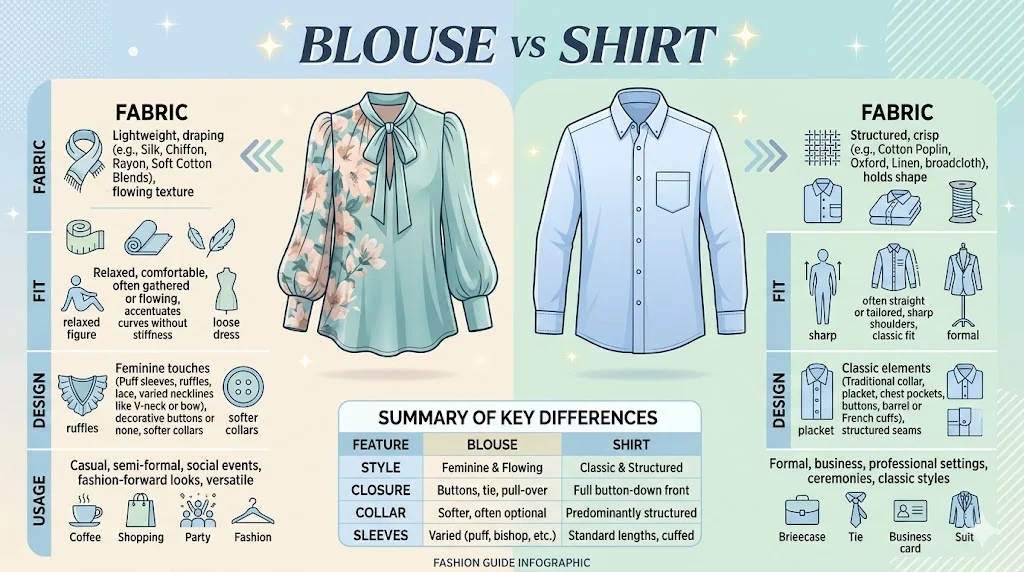
A blouse is a loose-fitting upper garment traditionally worn by women. It is made from soft fabrics like silk, chiffon, georgette, or cotton blends. A blouse often includes decorative elements such as ruffles, lace, embroidery, or gathers.
Blouses are designed for comfort and style rather than strict structure. They may or may not have collars and are often worn tucked or untucked depending on fashion trends.
Key features of a blouse:
- Soft and flowy structure
- Light fabrics
- Feminine design elements
- Decorative patterns
- Less rigid tailoring
What is a Shirt?
A shirt is a more structured upper-body garment worn by both men and women. It typically includes a collar, buttons down the front, and a defined shape that follows the body more closely than a blouse.
Shirts are made from fabrics like cotton, linen, denim, or polyester blends. They are widely used in formal, business, and casual settings.
Key features of a shirt:
- Structured design
- Collar and button front
- Straight or tailored fit
- Suitable for formal and casual wear
- Minimal decoration compared to blouse
Blouse vs Shirt: Key Differences
| Feature | Blouse | Shirt |
| Fit | Loose and flowy | Structured and fitted |
| Fabric | Soft, delicate fabrics | Strong, durable fabrics |
| Design | Decorative and stylish | Simple and formal |
| Gender use | Mainly women | Men and women |
| Collar | Optional or decorative | Standard feature |
| Occasions | Casual, festive, semi-formal | Formal, office, casual |
| Styling focus | Fashion and elegance | Professional and versatility |
Blouse vs Shirt: Advantages and Disadvantages
Advantages of Blouse
- Comfortable for long wear due to loose fit
- Stylish and fashionable appearance
- Suitable for traditional and festive events
- Available in many creative designs
- Enhances feminine look
Disadvantages of Blouse
- Not always suitable for formal office wear
- Less structured appearance
- Can be less durable depending on fabric
- Limited versatility compared to shirts
Advantages of Shirt
- Highly versatile for all occasions
- Suitable for professional environments
- Durable and long-lasting fabrics
- Easy to style with trousers, jeans, skirts
- Unisex clothing option
Disadvantages of Shirt
- Can feel stiff compared to blouses
- Less decorative variety
- Formal shirts may feel uncomfortable in hot weather
- May not suit festive traditional looks
Real-World Examples of Blouse vs Shirt
To understand blouse vs shirt better, let’s look at practical examples.
Example of Blouse
- A silk embroidered blouse worn with a saree
- A chiffon loose blouse with floral patterns
- A designer ruffled blouse for parties
- A traditional ethnic blouse for cultural events
Example of Shirt
- White cotton office shirt with trousers
- Denim shirt worn casually with jeans
- Checked flannel shirt for winter
- Formal button-down shirt for meetings
These examples show how blouse vs shirt differs in purpose and styling.
Regional and Global Usage of Blouse vs Shirt
South Asia
In countries like India, Pakistan, and Bangladesh:
- Blouses are commonly worn with sarees and lehengas
- Shirts are used for school, office, and casual wear
Here, blouse vs shirt distinction is strongly cultural.
Western Countries
In Europe and the United States:
- The term “blouse” often refers to women’s stylish tops
- Shirts are universal for both genders
- The difference is more about formality and structure
Global Fashion Trends
Modern fashion has blurred lines:
- Women wear oversized shirts as fashion items
- Blouses are redesigned with shirt-like collars
- Hybrid styles combine blouse softness with shirt structure
Still, blouse vs shirt remains a useful distinction in fashion classification.
Common Mistakes in Understanding Blouse vs Shirt
Mistake 1: Thinking They Are the Same
Many people believe blouse and shirt are identical. This is incorrect because their structure and purpose differ.
Mistake 2: Assuming Blouse is Only Traditional
Blouses are not only traditional. Modern blouses are highly fashionable and trendy.
Mistake 3: Considering Shirts Only Formal
Shirts are also casual. Denim shirts and printed shirts are everyday wear.
Mistake 4: Ignoring Fabric Differences
Fabric plays a key role in blouse vs shirt distinction. Soft fabrics usually indicate blouse style.
Mistake 5: Gender Restriction Thinking
Shirts are unisex, but blouses are becoming more gender-neutral in modern fashion.
Exercises: Blouse vs Shirt Practice
Exercise 1: Identify the Garment
- A loose silk top with embroidery
- A cotton button-down formal outfit
- A chiffon decorative festive top
- A denim casual wear upper garment
Answers:
- Blouse
- Shirt
- Blouse
- Shirt
Exercise 2: Fill in the Blanks
- A ______ is usually more structured and formal.
- A ______ is often loose and decorative.
- Shirts are made from stronger fabrics like cotton and ______.
- Blouses are commonly worn with ______ in South Asia.
Answers:
- Shirt
- Blouse
- denim
- sarees
Exercise 3: True or False
- Shirts are only for men. (False)
- Blouses are usually looser than shirts. (True)
- Shirts never have buttons. (False)
- Blouses are always formal wear. (False)
Related Concepts and Comparisons
Understanding blouse vs shirt also connects to other fashion terms:
Top vs Blouse vs Shirt
- Top: General term for any upper garment
- Blouse: Decorative feminine top
- Shirt: Structured button-down top
Shirt vs T-shirt
- Shirt: Collared and structured
- T-shirt: Casual, round neck, no buttons
Blouse vs Tunic
- Blouse: Shorter and fitted loosely
- Tunic: Longer and more flowing
FAQs
What is the main difference between blouse vs shirt?
The main difference is structure. A blouse is soft and loose, while a shirt is structured and tailored.
Can men wear a blouse?
Traditionally no, but modern fashion allows unisex and gender-neutral blouse-style tops.
Is a blouse formal or casual?
A blouse can be both, but it is mostly used in semi-formal or festive settings.
Are shirts only for office wear?
No, shirts can be casual, formal, or even sporty depending on design and fabric.
Which is more comfortable, blouse vs shirt?
Blouses are usually more comfortable because they are loose and soft.
Can a blouse be worn with jeans?
Yes, modern fashion often pairs blouses with jeans for a trendy look.
Is a shirt more durable than a blouse?
Generally yes, because shirts are made from stronger fabrics like cotton and denim.
Why do people confuse blouse vs shirt?
Because both cover the upper body and sometimes share similar features like buttons and sleeves.
Are blouses still in fashion?
Yes, blouses are widely used in ethnic wear and modern fashion designs.
Can shirts replace blouses?
In some casual fashion cases yes, but culturally and traditionally they serve different purposes.
Conclusion
Understanding blouse vs shirt helps you make better fashion choices for every occasion. A blouse is soft, decorative, and often linked with feminine or ethnic styles. A shirt is structured, versatile, and widely used in formal and casual wear.
Both garments play important roles in modern fashion. Blouses add elegance and creativity, while shirts provide professionalism and simplicity. Choosing between blouse vs shirt depends on comfort, occasion, and personal style.
For best results, build a wardrobe that includes both. This gives you flexibility for office, parties, cultural events, and daily wear. Fashion today is about balance, and knowing the difference between blouse vs shirt helps you dress with confidence and clarity.