
Last Updated on October 6, 2026
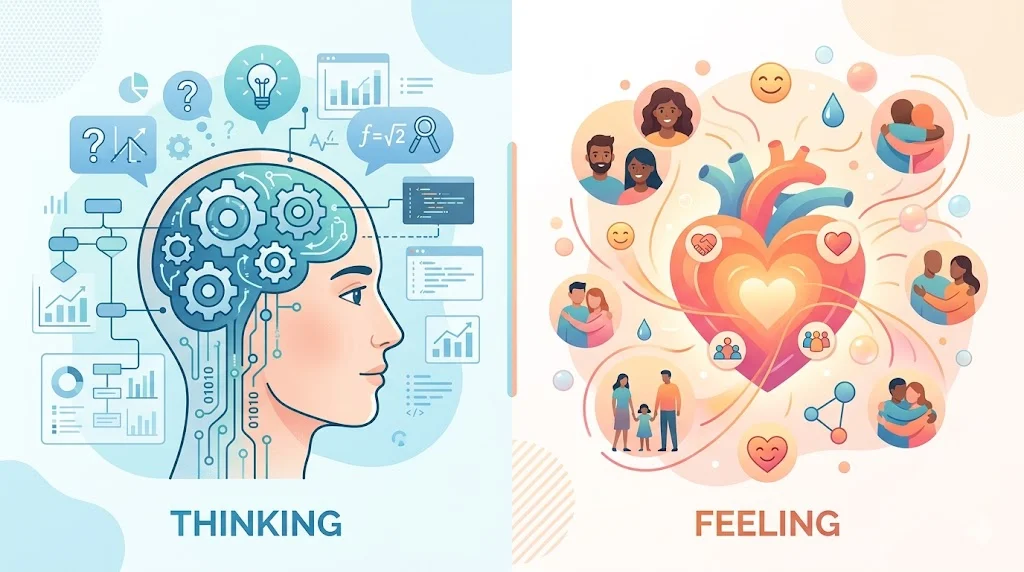
Thinking vs feeling refers to two different ways people make decisions and understand the world. Thinking focuses on logic, facts, and analysis, while feeling relies on emotions, values, and empathy. Both are essential, and the best decisions often combine the two.
Have you ever made a decision and later wondered, “Did I think this through, or did I just follow my feelings?” This is a common question. Many people struggle with the balance between thinking and feeling.
The concept of thinking vs feeling is important in daily life. It affects how we choose careers, handle relationships, solve problems, and even manage stress. Some people rely more on logic. Others trust their emotions. Both approaches have strengths and weaknesses.
The confusion comes when we think one is better than the other. In reality, both thinking and feeling are useful. The key is knowing when to use each.
In this guide, you will learn the difference between thinking and feeling, their advantages, real-life examples, common mistakes, and practical exercises. By the end, you will understand how to use both effectively for smarter and more balanced decisions.
Quick Answer / Overview
Thinking vs feeling is about how people process information and make decisions.
| Aspect | Thinking | Feeling |
| Basis | Logic and analysis | Emotions and values |
| Focus | Facts and fairness | People and harmony |
| Decision Style | Objective | Subjective |
| Strength | Clear reasoning | Emotional intelligence |
| Risk | Can seem cold | Can be biased |
Simple idea:
- Thinking asks: “What makes sense?”
- Feeling asks: “What feels right?”
Definition / Explanation
What Is Thinking?
Thinking is a decision-making process based on logic, facts, and objective analysis.
People who prefer thinking:
- Focus on data and evidence
- Value fairness and consistency
- Make decisions based on reason
- Avoid emotional bias
Example:
Choosing a job based on salary, growth, and stability.
What Is Feeling?
Feeling is a decision-making process based on emotions, values, and personal beliefs.
People who prefer feeling:
- Consider how decisions affect others
- Value harmony and relationships
- Trust their instincts
- Make decisions based on personal values
Example:
Choosing a job because it feels meaningful or fulfilling.
Thinking vs Feeling in Simple Terms
- Thinking = Head
- Feeling = Heart
Both are natural human abilities. Everyone uses both, but most people have a preference.
Advantages and Disadvantages
Advantages of Thinking
- Clear and logical decisions
- Less emotional bias
- Better for complex problem-solving
- Strong in technical or analytical work
Disadvantages of Thinking
- May ignore emotions
- Can seem cold or distant
- May hurt relationships
- Over-analysis can delay decisions
Advantages of Feeling
- Strong emotional awareness
- Better relationships
- Empathy and compassion
- Quick intuitive decisions
Disadvantages of Feeling
- Can be biased
- May ignore facts
- Decisions can change with mood
- Risk of emotional overwhelm
Thinking vs Feeling Comparison Table
| Feature | Thinking | Feeling |
| Decision Basis | Logic | Emotions |
| Approach | Analytical | Intuitive |
| Strength | Accuracy | Empathy |
| Weakness | Lack of emotion | Lack of objectivity |
| Best Use | Problem-solving | Relationship building |
| Risk | Overthinking | Emotional bias |
Real-World Examples
Workplace Decisions
Thinking Approach:
A manager chooses an employee based on performance metrics.
Feeling Approach:
A manager chooses someone who is kind and works well with the team.
Relationships
Thinking:
Ending a relationship because it is not working logically.
Feeling:
Staying because of emotional attachment.
Buying Decisions
Thinking:
Comparing price, quality, and reviews.
Feeling:
Buying because you “love” the product.
Education Choices
Thinking:
Choosing a degree with high job demand.
Feeling:
Choosing a passion-based field.
Regional / Global Usage
The balance of thinking vs feeling can vary across cultures.
Western Cultures
- Often value logic and independence
- Encourage analytical thinking
- Focus on individual decisions
Eastern Cultures
- Value harmony and relationships
- Encourage emotional awareness
- Focus on group decisions
Workplace Trends
Modern workplaces now value both:
- Data-driven decisions (thinking)
- Emotional intelligence (feeling)
This combination leads to better leadership.
Common Mistakes
Ignoring Emotions Completely
Some people believe logic is always better. This is not true.
Problem:
Decisions may hurt others or fail socially.
Fix:
Consider emotional impact along with logic.
Relying Only on Feelings
Making decisions based only on emotions can be risky.
Problem:
Poor long-term results.
Fix:
Check facts before deciding.
Confusing Feelings with Facts
Feeling something strongly does not make it true.
Example:
“I feel like this will fail” is not evidence.
Overthinking
Too much thinking can delay action.
Solution:
Set a time limit for decisions.
Emotional Overreaction
Strong emotions can cloud judgment.
Solution:
Pause before deciding.
Exercises with Answers
Exercise 1: Identify Thinking or Feeling
Decide whether each example is thinking or feeling.
- Choosing a phone based on specs
- Helping a friend because they are sad
- Picking a job with higher salary
- Staying in a job you enjoy
Answers:
- Thinking
- Feeling
- Thinking
- Feeling
Exercise 2: Balanced Decision
Scenario:
You receive two job offers. One pays more. The other feels more fulfilling.
Task:
List one thinking reason and one feeling reason.
Sample Answer:
- Thinking: Higher salary supports financial goals
- Feeling: Second job gives personal satisfaction
Exercise 3: Improve Decision
Scenario:
You made a decision based only on emotion.
Task:
Add one logical factor.
Example Answer:
Check costs, risks, or long-term effects.
Related Concepts or Comparisons
Logic vs Emotion
- Logic = structured reasoning
- Emotion = internal experience
Both work together in decision-making.
Head vs Heart Decisions
This is another way to describe thinking vs feeling.
- Head = thinking
- Heart = feeling
Rational vs Intuitive Thinking
- Rational = slow, logical
- Intuitive = fast, emotional
Analytical vs Empathetic Approach
- Analytical = data-focused
- Empathetic = people-focused
How to Balance Thinking and Feeling
Step 1: Pause
Do not decide immediately. Take time to reflect.
Step 2: Ask Two Questions
- What makes sense?
- What feels right?
Step 3: Combine Both
Look for a solution that satisfies logic and emotion.
Step 4: Check Consequences
Think about:
- Short-term effects
- Long-term effects
Step 5: Make the Decision
Trust a balanced approach.
When to Use Thinking
Use thinking when:
- Solving complex problems
- Managing finances
- Making business decisions
- Evaluating risks
When to Use Feeling
Use feeling when:
- Building relationships
- Helping others
- Making personal choices
- Understanding emotions
FAQs
What is the main difference between thinking vs feeling?
Thinking focuses on logic and facts, while feeling focuses on emotions and values in decision-making.
Is thinking better than feeling?
No. Both are important. The best approach combines thinking and feeling.
Can a person be both thinking and feeling?
Yes. Everyone uses both, but most people have a preference.
How do I know if I am a thinking or feeling person?
Observe your decisions. If you rely on logic, you lean toward thinking. If you rely on emotions, you lean toward feeling.
Why is thinking vs feeling important?
It helps you understand decision-making styles and improve personal and professional choices.
Can thinking and feeling conflict?
Yes. Logic and emotions can lead to different conclusions.
How can I improve my decision-making?
Use both logic and emotion. Analyze facts and consider feelings.
Is emotional decision-making bad?
Not always. It is useful in relationships but should be balanced with logic.
What careers suit thinking types?
Engineering, finance, data analysis, and research roles.
What careers suit feeling types?
Counseling, teaching, healthcare, and social work.
Conclusion
The debate of thinking vs feeling is not about choosing one over the other. It is about balance. Thinking gives clarity, structure, and accuracy. Feeling adds empathy, meaning, and human connection.
In real life, the best decisions come from combining both. Relying only on thinking can make decisions cold and disconnected. Depending only on feeling can lead to bias and poor outcomes.
A smart approach is simple. Pause. Reflect. Ask what makes sense and what feels right. Then choose a path that respects both logic and emotion.
Professionally, this balance improves leadership, teamwork, and problem-solving. Personally, it leads to better relationships and satisfaction.
Start practicing today. Notice your decision style. Adjust when needed. Over time, you will develop a balanced mindset that leads to smarter, more meaningful choices.