
Last Updated on May 16, 2026
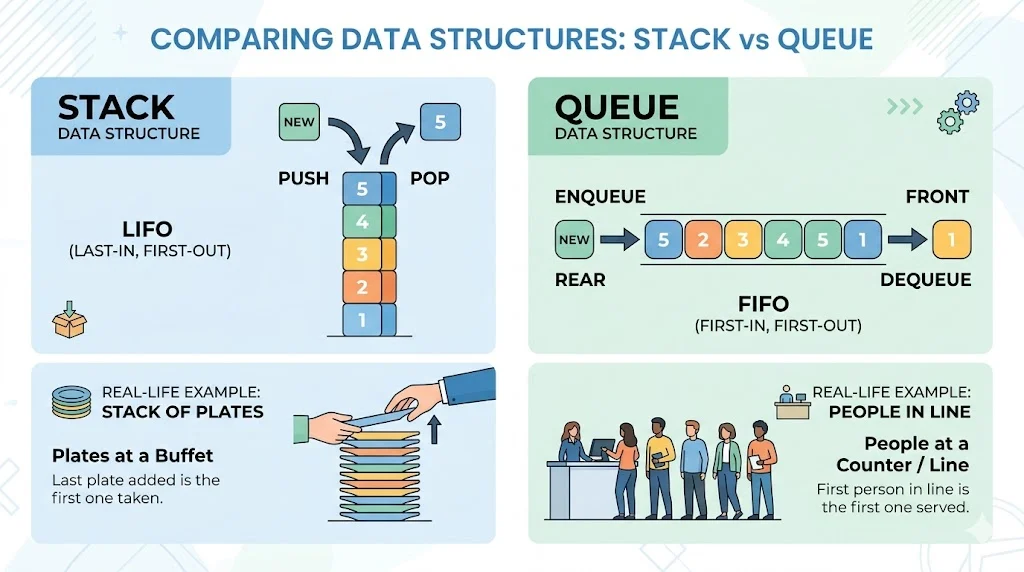
Stack vs queue is a comparison of two fundamental data structures. A stack follows LIFO (Last In, First Out), while a queue follows FIFO (First In, First Out). They are widely used in programming for managing data flow, memory, and tasks.
When learning programming, you often meet two simple but powerful ideas: stack vs queue. At first, they look similar. Both store data. Both allow you to add and remove items. But they behave very differently.
This difference matters a lot. It affects how programs run, how memory is used, and how tasks are handled.
Many beginners get confused. When should you use a stack? When should you use a queue? Why do they even exist?
Think of real life. A stack is like a pile of plates. You take the top plate first. A queue is like a line at a ticket counter. The first person in line gets served first.
Understanding this concept will make your coding stronger. It will help you solve problems faster and design better systems.
In this guide, you will learn everything about stack vs queue in a simple and clear way.
Quick Answer / Overview
| Feature | Stack | Queue |
| Order | LIFO (Last In, First Out) | FIFO (First In, First Out) |
| Insert Operation | Push | Enqueue |
| Remove Operation | Pop | Dequeue |
| Access | Top element only | Front and rear |
| Use Case | Undo operations, recursion | Scheduling, buffering |
Simple Summary:
- Stack → Last item added is removed first
- Queue → First item added is removed first
Definition / Explanation
What is a Stack?
A stack is a linear data structure that follows LIFO (Last In, First Out).
Think of stacking books:
- You place a book on top
- You remove the top book first
Stack Operations
- Push → Add an element
- Pop → Remove top element
- Peek/Top → View top element
- isEmpty → Check if empty
Example
Push: 10, 20, 30
Stack becomes: [10, 20, 30]
Pop → removes 30
Remaining: [10, 20]
What is a Queue?
A queue is a linear data structure that follows FIFO (First In, First Out).
Think of a line:
- First person enters first
- First person leaves first
Queue Operations
- Enqueue → Add element
- Dequeue → Remove element
- Front → View first element
- Rear → View last element
Example
Enqueue: 10, 20, 30
Queue: [10, 20, 30]
Dequeue → removes 10
Remaining: [20, 30]
Advantages and Disadvantages
Stack Advantages
- Simple to implement
- Efficient memory use
- Useful for recursion
- Fast operations (O(1))
Stack Disadvantages
- Limited access (only top element)
- Risk of overflow
- Not ideal for large data traversal
Queue Advantages
- Fair data processing
- Good for scheduling
- Easy to manage order
- Works well with real-time systems
Queue Disadvantages
- Slower than stack in some cases
- Requires more memory handling
- Limited direct access
Real-World Examples
Stack in Real Life
- Browser history (Back button)
- Undo/Redo in editors
- Expression evaluation
- Call stack in programming
Queue in Real Life
- Printer queue
- Call center waiting system
- Ticket booking line
- CPU task scheduling
Stack vs Queue Comparison Table
| Aspect | Stack | Queue |
| Principle | LIFO | FIFO |
| Ends Used | One end | Two ends |
| Data Access | Last inserted | First inserted |
| Real-Life Model | Stack of plates | Waiting line |
| Complexity | O(1) operations | O(1) operations |
| Implementation | Arrays or Linked Lists | Arrays or Linked Lists |
Regional / Global Usage
Stack and queue are used worldwide in software systems.
Global Usage
- Operating systems use stacks for memory management
- Web browsers use stacks for navigation
- Networks use queues for packet handling
Industry Usage
- Banking systems use queues for transaction handling
- Gaming engines use stacks for undo moves
- AI systems use queues in search algorithms
Common Mistakes
Mistake 1: Mixing LIFO and FIFO
❌ Thinking stack works like queue
✔ Stack removes last element first
Mistake 2: Wrong Operation Usage
❌ Using pop in queue
✔ Use dequeue for queue
Mistake 3: Ignoring Overflow
❌ Not checking capacity
✔ Always check before push/enqueue
Mistake 4: Confusing Front and Rear
❌ Removing from rear in queue
✔ Always remove from front
Exercises with Answers
Exercise 1
Question:
Push 5, 10, 15 into a stack. What is popped first?
Answer:
15
Exercise 2
Question:
Enqueue 1, 2, 3 into a queue. What is dequeued first?
Answer:
1
Exercise 3
Question:
Stack operations: Push A, B, C → Pop → Result?
Answer:
C removed
Exercise 4
Question:
Queue operations: Enqueue A, B, C → Dequeue → Result?
Answer:
A removed
Exercise 5
Question:
Which uses FIFO?
Answer:
Queue
Related Concepts or Comparisons
Stack vs Queue vs Deque
- Stack → LIFO
- Queue → FIFO
- Deque → Both ends access
Stack vs Heap
- Stack → Fixed size, fast
- Heap → Dynamic memory
Queue Types
- Simple Queue
- Circular Queue
- Priority Queue
- Deque
Stack Types
- Fixed stack
- Dynamic stack
Implementation Overview
Stack Using Array (Pseudo Code)
push(x):
top = top + 1
stack[top] = x
pop():
x = stack[top]
top = top – 1
return x
Queue Using Array
enqueue(x):
rear = rear + 1
queue[rear] = x
dequeue():
x = queue[front]
front = front + 1
return x
Time Complexity
| Operation | Stack | Queue |
| Insert | O(1) | O(1) |
| Delete | O(1) | O(1) |
| Access | O(n) | O(n) |
FAQs
What is the main difference in stack vs queue?
Stack uses LIFO, while queue uses FIFO for data handling.
Where is stack used in real life?
Stack is used in undo operations, recursion, and browser history.
Where is queue used in programming?
Queue is used in scheduling, buffering, and task management systems.
Which is faster: stack or queue?
Both are equally fast for insertion and deletion with O(1) complexity.
Can stack be implemented using queue?
Yes, stack can be simulated using queues with special logic.
Can queue be implemented using stack?
Yes, using two stacks, a queue can be implemented.
What is LIFO in stack vs queue?
LIFO means last element added is removed first in a stack.
What is FIFO in stack vs queue?
FIFO means first element added is removed first in a queue.
Which is better: stack or queue?
It depends on the use case. Stack is for reverse order, queue is for sequential order.
Are stack and queue linear data structures?
Yes, both are linear data structures.
Conclusion
Understanding stack vs queue is essential for every programmer. These two data structures may look simple, but they power many systems behind the scenes.
A stack works on the LIFO principle. It is ideal for tasks like undo operations, recursion, and expression evaluation. A queue works on FIFO. It is perfect for scheduling, buffering, and managing tasks in order.
The key is to choose the right structure for the right problem. If you need reverse order processing, use a stack. If you need fair and sequential processing, use a queue.
Practice with examples. Build small programs. Solve problems using both structures.
With time, you will not just understand stack vs queue, you will use them naturally in your coding journey.