
Last Updated on June 13, 2026
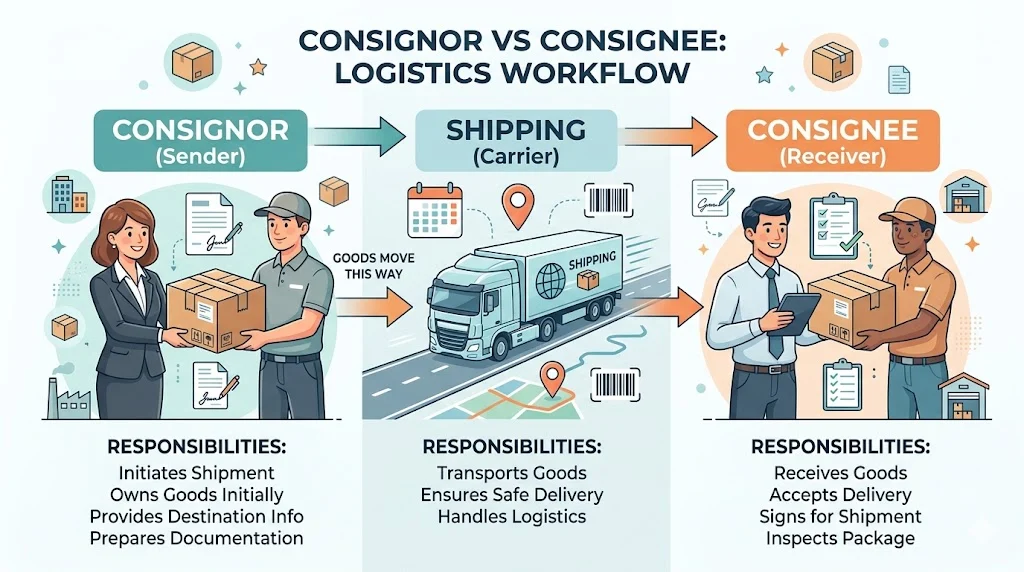
Consignor vs consignee refers to two key roles in shipping and logistics. The consignor is the sender of goods, while the consignee is the receiver. Understanding the difference helps avoid delivery errors, legal issues, and confusion in trade transactions.
In shipping and logistics, small words can carry big meaning. Two such terms are consignor and consignee. They look similar. They sound similar. But they mean very different things.
This confusion can lead to mistakes. Goods may go to the wrong person. Payments may get delayed. Legal problems can also arise.
If you send or receive goods, you need to know these terms. They are used in invoices, shipping labels, contracts, and customs forms. You will see them in both local and global trade.
Think of it like this. One person sends a package. Another person receives it. These two roles are the core of any delivery system.
In this guide, you will learn the full difference between consignor vs consignee. You will also see real examples, common mistakes, and simple exercises. By the end, you will feel confident using both terms correctly.
Quick Answer / Overview
| Term | Meaning | Role | Example |
| Consignor | Person who sends goods | Seller / Shipper | A company shipping products |
| Consignee | Person who receives goods | Buyer / Receiver | A customer receiving goods |
Simple rule:
- Consignor = Sender
- Consignee = Receiver
Definition of Consignor vs Consignee
What is a Consignor?
A consignor is the person or business that sends goods to another party.
They are usually:
- The seller
- The exporter
- The owner of goods before delivery
Example:
A clothing brand ships 500 shirts to a retailer. The brand is the consignor.
What is a Consignee?
A consignee is the person or business that receives the goods.
They are usually:
- The buyer
- The importer
- The final receiver
Example:
The retailer who receives the shirts is the consignee.
Consignor vs Consignee Explained with a Simple Analogy
Think about sending a gift:
- You buy a gift and send it to your friend
- You are the consignor
- Your friend is the consignee
That is it. The idea is simple. But in business, it involves contracts, shipping documents, and payments.
Key Differences Between Consignor vs Consignee
| Feature | Consignor | Consignee |
| Role | Sender of goods | Receiver of goods |
| Ownership | Owns goods before shipping | Owns goods after delivery |
| Responsibility | Prepares and dispatches goods | Accepts and checks goods |
| Location | Origin | Destination |
| Documents | Listed as sender | Listed as receiver |
| Payment Role | Receives payment | Makes payment |
Advantages and Disadvantages
Consignor Advantages
- Control over shipping process
- Can choose transport method
- Maintains ownership until delivery
Consignor Disadvantages
- Responsible for packaging
- Risk during transport
- Handles documentation
Consignee Advantages
- Receives goods ready to use or sell
- Less effort in logistics
- Can inspect goods on arrival
Consignee Disadvantages
- May face delays
- Risk of damaged goods
- Customs and import duties
Real-World Examples
Example 1: Online Shopping
- A seller ships a product
- Seller = Consignor
- Buyer = Consignee
Example 2: Export Business
- A company in Pakistan exports rice to the UK
- Exporter = Consignor
- Importer = Consignee
Example 3: Courier Delivery
- A person sends documents through a courier
- Sender = Consignor
- Receiver = Consignee
Regional / Global Usage
The terms consignor vs consignee are used worldwide.
In International Trade
- Used in shipping documents like Bill of Lading
- Important for customs clearance
In Local Delivery
- Used in courier services
- Appears on parcel labels
In Legal Context
- Defines ownership transfer
- Used in contracts and agreements
Common Mistakes and Corrections
Mistake 1: Mixing Up Sender and Receiver
❌ Wrong: Consignee sends goods
✅ Correct: Consignor sends goods
Mistake 2: Ignoring Documentation
❌ Missing consignor details
✅ Always include full sender information
Mistake 3: Assuming Ownership Too Early
❌ Consignee owns goods before delivery
✅ Ownership transfers after delivery
Mistake 4: Using Terms Interchangeably
❌ Consignor = Consignee
✅ They are opposite roles
Exercises with Answers
Exercise 1
Who is the consignor in this case?
A factory ships goods to a retailer.
Answer: The factory
Exercise 2
Who is the consignee?
A person receives a parcel from a courier.
Answer: The person receiving the parcel
Exercise 3
Fill in the blanks:
The ______ sends goods. The ______ receives goods.
Answer:
Consignor, Consignee
Exercise 4
True or False:
The consignee is always the sender.
Answer: False
Exercise 5
Match the roles:
| Role | Option |
| Sender | ? |
| Receiver | ? |
Answer:
Sender = Consignor
Receiver = Consignee
Related Concepts or Comparisons
Consignor vs Consignee vs Carrier
| Term | Meaning |
| Consignor | Sender |
| Consignee | Receiver |
| Carrier | Transport company |
Consignor vs Seller
- Consignor = Sends goods
- Seller = Owns goods for sale
Sometimes both are the same person
Consignee vs Buyer
- Consignee = Receives goods
- Buyer = Pays for goods
Sometimes they are the same person
FAQs
What is the main difference between consignor vs consignee?
The consignor sends goods, while the consignee receives them. This is the core difference in logistics.
Can consignor and consignee be the same person?
Yes, in some cases like internal transfers, the same company can be both consignor and consignee.
Who owns the goods during shipping?
Usually, the consignor owns the goods until they are delivered to the consignee.
Where are consignor and consignee mentioned?
They appear on shipping labels, invoices, and legal documents like the bill of lading.
Is the consignee always the buyer?
Not always. The consignee may only receive goods on behalf of someone else.
What happens if consignee refuses delivery?
The goods may be returned to the consignor or handled based on the contract terms.
Why is it important to understand consignor vs consignee?
It helps avoid shipping errors, legal issues, and confusion in business transactions.
What is a notify party in shipping?
It is a third party who gets notified when goods arrive, but is not the consignee.
Does consignee pay shipping charges?
It depends on the agreement. Sometimes the consignor pays, sometimes the consignee.
Are consignor vs consignee terms used in domestic shipping?
Yes, they are used in both local and international shipping.
Conclusion
Understanding consignor vs consignee is essential for anyone dealing with shipping, logistics, or trade. The difference is simple but very important. The consignor sends the goods, and the consignee receives them.
This basic idea forms the foundation of all delivery systems. Whether you run a business, shop online, or send parcels, these roles affect how goods move and who is responsible at each step.
To avoid mistakes, always double-check shipping documents. Make sure the consignor and consignee details are correct. This prevents delays, confusion, and legal issues.
In professional settings, clear communication is key. Using the correct terms builds trust and ensures smooth transactions.
If you remember one thing, remember this:
Consignor = Sender, Consignee = Receiver.
Master this, and you will handle logistics with confidence.